Sony Car Audio System Review: Best Models for Buyers
Sony car audio systems are worth buying if you want strong smartphone integration and easy fitment in the right dash, but the best choice still depends on screen size, CarPlay or Android Auto needs, and whether you want a basic media receiver or room for later upgrades. Buy the wrong chassis or skip speaker matching, and you can end up with a stereo that fits poorly and sounds ordinary. This guide compares Sony models against Alpine and Pioneer, then helps you match the right unit to your dash, speakers, and driving habits.
Verdict

- Bezel-less capacitive touchscreen interface
- Compact rear chassis for easy installation
- Dual rear USB ports for connectivity
Sony is a strong buy for drivers who want a clean interface, practical tuning, and sensible receiver choices across older cars, double-DIN dashes, and upgrade builds. It is less compelling if you need the widest model spread in a single category, or if your install calls for a very specific screen shape, deeper tuning flexibility, or a floating display with tight clearance concerns.
Pros
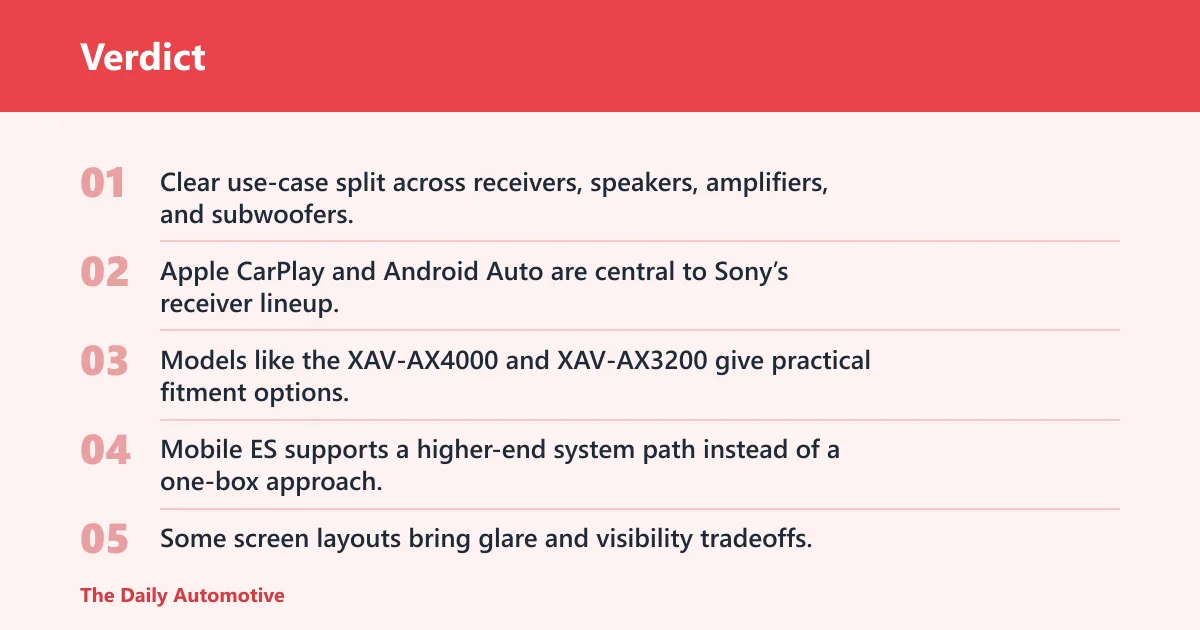
- Clear use-case split across receivers, speakers, amplifiers, and subwoofers.
- Apple CarPlay and Android Auto are central to Sony’s receiver lineup.
- Models like the XAV-AX4000 and XAV-AX3200 give practical fitment options.
- Mobile ES supports a higher-end system path instead of a one-box approach.
Cons
- Some screen layouts bring glare and visibility tradeoffs.
- Wireless convenience can add latency or connection stability concerns.
- Floating displays and large touchscreens can complicate dash clearance.
- Sony is not always the best value if you want maximum tuning depth per dollar.
📊 The Sony XAV-AX4000 uses 5V preouts. Source: Caraudiohunt.
Specs at a glance
| Category | What Sony offers | Fitment or buying note |
|---|---|---|
| Company background | Founded on 7 May 1946 in Nihonbashi, Chūō, Tokyo, Japan; headquartered in Minato, Tokyo (en.wikipedia.org) | Global electronics company with automotive products and Automotive Entertainment in its home-page business areas |
| Receiver families | Mobile ES, digital multimedia receivers, digital media receivers, CD receivers, XAV series | Pick by dash type, screen size, and source priority |
| Smartphone support | Apple CarPlay and Android Auto | Major comparison point for most buyers |
| XAV-AX4000 | Wireless CarPlay and Android Auto; 5V preouts; 6.95-inch display; 14-band EQ | Good for wireless-first users who may add an amp later |
| XAV-AX3200 | CarPlay and Android Auto; rear-view camera compatible; 2 DIN car stereo | Practical for common double-DIN installs |
| XAV-AX8100 | Floating display unit | Best only if dash clearance and viewing angle are acceptable |
| Sound upgrade pieces | Amplifiers, speakers, subwoofers | Useful for system expansion, especially in amp-and-sub builds |

Who it is for
Sony car audio is best for drivers who want a fitment-first path: older cars, simple dashboards, stock-speaker upgrades, and builds that may grow into an amp and sub later. It also suits buyers who want Apple CarPlay or Android Auto without a steep learning curve. It is less suited to people who need the most aggressive tuning control right away.
Picture a 2008 sedan with a standard double-DIN opening and factory speakers that still sound thin. A Sony XAV receiver can clean up daily use fast. Suppose a compact hatchback has shallow dash depth and a tight HVAC bezel; then a compact rear chassis matters more than a giant screen spec.
Pros and cons for the right buyer
Pros
- Good match for factory-system replacement without overcomplicating the install.
- Works well for smartphone-first driving.
- Scales from stock speakers to external amplification.
Cons
- Not every Sony head unit is ideal for shallow, crowded dashes.
- Some buyers will prefer a rival brand for deeper DSP-style tuning.
What works
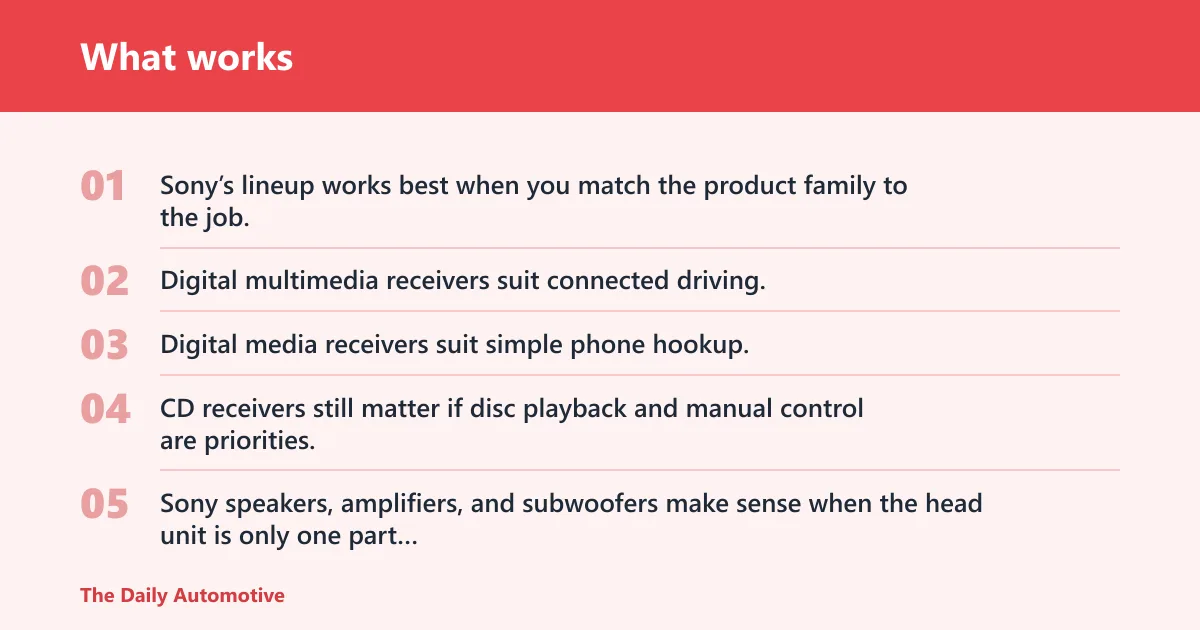
Sony’s lineup works best when you match the product family to the job. Mobile ES targets premium in-car systems. Digital multimedia receivers suit connected driving. Digital media receivers suit simple phone hookup. CD receivers still matter if disc playback and manual control are priorities. Sony speakers, amplifiers, and subwoofers make sense when the head unit is only one part of the build.
Mobile ES series for premium systems
Sony Mobile ES is the top-tier path in the in-car lineup. It is the pick for drivers who care about higher-grade listening and want a matched path across receivers, amplifiers, speakers, and subwoofers. That matters more than a feature list. A premium system still needs the right enclosure, power, and installer planning.
Digital multimedia receivers for connected driving
Sony digital multimedia receivers are the broad answer for modern smartphone use. They are built around large touchscreens and the latest connected features, so they suit buyers who expect CarPlay or Android Auto to be part of every drive. If your phone is the main source, this family is the cleanest fit.
Digital media receivers for simple phone-first setups
Sony digital media receivers are the simpler choice when you want phone hookup and a straightforward interface without paying for extra source hardware. They fit daily use well in older vehicles and cars with limited dash space. For many stock-speaker upgrades, this is enough.
CD receivers for disc playback and manual control
Sony CD receivers still have a place for buyers who use discs or want a more traditional source stack. They are built around clear, natural sound and customizable audio settings, which appeals to drivers who are less interested in touchscreen-first control. They are not the default recommendation for app-heavy users.
Amplifiers, speakers, and subwoofers as upgrade pieces
Sony amplifiers matter when the system needs more power output and room to expand. Sony speakers bring clearer audio quality, better response, and crisper bass than tired factory drivers. Sony subwoofers are the bass-focused step when the goal is low-end weight, not just louder mids and highs.
What does not
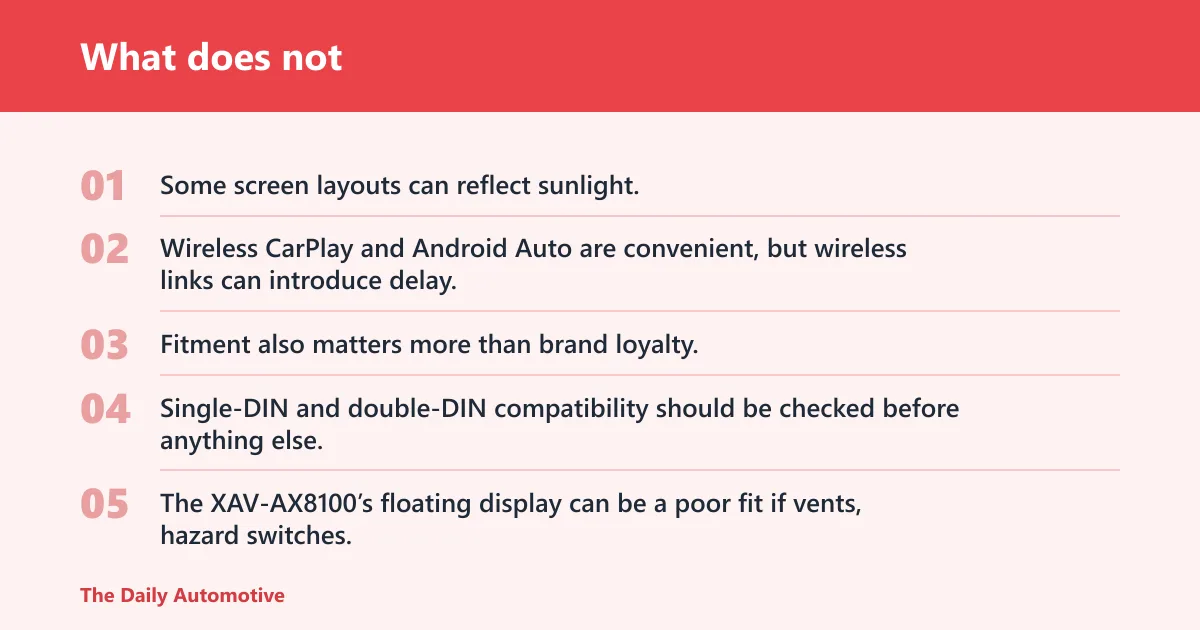
Sony is not always the easiest answer. Some screen layouts can reflect sunlight, and touchscreen responsiveness matters more than the spec sheet admits. Wireless CarPlay and Android Auto are convenient, but wireless links can introduce delay, pairing hiccups, or signal drops in busy RF environments. Fitment also matters more than brand loyalty.
Single-DIN and double-DIN compatibility should be checked before anything else. The XAV-AX8100’s floating display can be a poor fit if vents, hazard switches, or shifter clearance sit too close to the dash. Sony also is not always the strongest value if a competing model gives more processing control for the same money.
Where Sony is not the best value
If your build is mainly about deep tuning, an external DSP, or the most flexible adjustment set, Sony may not be the first stop. If your dash is unusually shallow, boxed in, or shaped around a factory screen, a different chassis style may install with less trouble. Value changes once fitment errors become labor costs.
Buyer-fit matrix: which Sony setup should you buy?
This matrix is the part most buyers need. It maps Sony’s main product families to the installation reality in front of you. The right answer depends on dash type, smartphone priority, amplifier needs, camera support, and glare risk, not just on whether the unit has CarPlay or a touchscreen.
| Scenario | Dash type | Smartphone priority | Amplifier need | Camera support | Glare risk | Verdict |
|---|---|---|---|---|---|---|
| XAV-AX4000 | Double-DIN | Wireless-first | Good fit for future amps; 5V preouts | Typical modern backup-camera setup | Medium on bright dashboards | Pass |
| XAV-AX3200 | Double-DIN, 2 DIN | Wired phone use | Fine for stock speakers or light upgrades | Rear-view camera compatible | Medium | Pass |
| XAV-AX8100 | Dash with clearance for floating screen | Mixed | Depends on build goals | Usable if the vehicle supports it | Medium to high if the screen sits proud | Pass, with caution |
| Digital media receiver | Older car, simple dash | Phone hookup first | Low to moderate | Only if the model supports it | Low | Pass |
| CD receiver | Older car, single-DIN-friendly dash | Low smartphone priority | Low to moderate | Depends on model | Low | Pass |
| Floating-screen Sony in a shallow dash | Shallow or blocked dash | Any | Any | Any | High | Fail |
| Speaker and subwoofer bundle without head-unit planning | Any | Any | High amp need | Any | Any | Fail |
What to read from the matrix
Wireless convenience is not free. If your commute is full of short trips, wired CarPlay or Android Auto can be more stable and less fussy. If you want to add an amp later, look hard at preout voltage and audio settings. If you want a rear camera, confirm support before buying the dash kit.
Is Sony better than Alpine or Pioneer?
Sony is better than Alpine or Pioneer when the build goal is clean smartphone use, sensible fitment, and a straightforward upgrade path. It is not automatically better for every sound-quality goal. Alpine and Pioneer can be the safer choice when you want very specific tuning control, a different screen layout, or a model family that matches unusual installs more closely.
Sony vs Alpine for sound quality
For pure sound quality, Sony should be judged by model and install path, not brand name alone. Sony can sound very good when preouts, speaker matching, and sub integration are right. Alpine may be the safer buy if your priority is tuning depth and a more specialized system plan.
Sony vs Pioneer for a car stereo upgrade
Sony often wins on ease of use and fitment clarity. Pioneer can be attractive if you want a broader set of tuning and source combinations. For a first upgrade in an older car, Sony is usually the more straightforward answer. For a more complex build, Pioneer may give you more control.
When Sony wins
Sony is a strong value choice for buyers who want a dash-friendly receiver, reliable phone integration, and a path to better sound without overbuilding the system. It also fits well when installation time matters. That makes Sony particularly sensible for stock-speaker refreshes and moderate amp upgrades.
When Alpine or Pioneer is the safer buy
Choose Alpine or Pioneer if your install is unusually tight, your tuning needs are specific, or you want to compare multiple chassis styles before buying. If your dash has little depth or your audio plan is more advanced than “head unit plus speakers,” a rival may fit the exact requirement better.
What Sony Mobile ES include?
Sony Mobile ES includes Sony’s premium in-car lineup: receivers, amplifiers, speakers, and subwoofers aimed at a higher-tier listening experience. It is the part of Sony’s catalog built for buyers who care about system matching rather than a single feature headline. The idea is a coordinated upgrade path, not a one-piece fix.
What the lineup means in practice
Mobile ES makes the most sense when you want to build around better source quality, stronger amplification, and speakers that keep pace. It is not the cheapest route. But for a system that starts at the head unit and expands into the rest of the car, it is the most complete Sony path.
Which Sony receiver is best for bass and amp upgrades?
The Sony XAV-AX4000 is the clearest receiver pick for bass and amp upgrades because it offers 5V preouts and a 14-band EQ, along with wireless CarPlay and Android Auto. That combination makes it easier to integrate external amplification while still keeping daily use simple for a smartphone-first driver.
Why preouts matter
Preout voltage helps the amplifier receive a cleaner signal path, which is why it matters more than a lot of shoppers realize. If a build is headed toward a subwoofer and external amp, the receiver should support that plan from the start. The XAV-AX4000 is built with that role in mind.
What Sony car audio system is best for my car?
The best Sony system depends on your dash and your daily habits. Older cars with simple openings usually do best with digital media or CD receivers. Double-DIN dashboards usually fit XAV models well. Amp-and-sub builds should start with the receiver’s preouts, then move to speakers and amplification.
How to match the system to the car
Single-DIN or shallow-dash cars need a compact chassis and careful depth checks. Double-DIN cars can take larger screens and more connected features. If your vehicle already has a backup camera or you plan to add one, confirm the head unit supports that before you buy the trim kit.
- Measure dash opening height and depth.
- Check whether the car is single-DIN, double-DIN, or floating-screen compatible.
- Decide whether you want wired or wireless smartphone integration.
- Confirm preout needs if an external amplifier is part of the plan.
- Verify rear-camera support and steering-wheel control needs.
- Match the receiver to the speakers or subwoofer you actually plan to use.
Should you buy a Sony car stereo?
Yes, if your priority is fitment-aware smartphone integration and a clear path from stock sound to a more capable system. Sony makes the most sense when the install is realistic, the dash is measured carefully, and the buyer chooses the receiver family by use case instead of by screen size alone.
Start with the dash. Then check phone priority, camera support, and expansion plans. If you need wireless CarPlay, the XAV-AX4000 is a strong candidate. If you want a more basic phone-first setup, a digital media receiver may be enough. If your build is more advanced than the average daily driver, compare Sony against Alpine and Pioneer before you buy.
Pre-buy checklist
- Confirm single-DIN, double-DIN, or floating-screen fitment.
- Check dash depth, vent clearance, and screen clearance.
- Decide wired versus wireless CarPlay or Android Auto.
- Verify rear-view camera support.
- Review preout voltage if you plan an external amplifier.
- Match speaker impedance and power goals before buying amps or subwoofers.
- Look for glare risk in the car’s usual daylight conditions.
Alternatives

- Wired and wireless CarPlay and Android Auto
- Built-in Bluetooth 5.0 for wireless calls
- High-Resolution Audio playback support
The Kenwood DMX9707S is the most direct alternative here because it also targets wireless and wired smartphone users, but it is a better fit for buyers who want Kenwood’s approach to a capacitive screen and High-Resolution Audio playback support. Based on the spec sheet and review patterns, it is a stronger cross-shop if wireless convenience matters more than brand loyalty, though its price is higher and it still needs the same fitment checks.
Frequently asked questions
Is Sony better than Alpine for car stereo sound quality?
Sony can sound excellent, but Alpine is often the safer choice if your main goal is tuning depth and a more specialized sound path. Sony is better when you want solid sound plus easier smartphone integration and a cleaner install decision. For pure sound tuning, the better answer depends on the exact model and system plan.
Is Sony better than Pioneer for a car stereo upgrade?
Sony is often better for a straightforward upgrade because the lineup is easier to map to fitment and smartphone use. Pioneer can be better if you want a broader set of configuration options or a more complex audio setup. For many daily drivers, Sony is the simpler and less risky buy.
What Sony car audio system is best for my car?
If you have an older car or a simple dash, start with a Sony digital media or CD receiver. If you have a double-DIN opening and want CarPlay or Android Auto, look at the XAV series. If you are adding an amp or subwoofer, prioritize preout voltage and tuning controls before screen size.
Does Sony make wireless CarPlay car stereos?
Yes. The Sony XAV-AX4000 offers wireless CarPlay and Android Auto, which makes it one of the most relevant Sony receivers for buyers who want cable-free phone connection. Wireless convenience is useful, but it should still be weighed against glare, pairing stability, and the car’s dash layout.
Which Sony receiver is best for bass and amp upgrades?
The XAV-AX4000 is the best fit in Sony’s current lineup for bass and amp upgrades because it combines wireless smartphone support with 5V preouts and a 14-band EQ. That makes it a practical source unit for an amplified system. It is still wise to match speakers and subs carefully.
Are Sony car speakers and subwoofers worth buying together?
They are worth buying together when the head unit, amplifier, and enclosure plan all support the same goal. Sony speakers and subwoofers can work as part of a coherent upgrade path, but they are not automatic add-ons. If the budget is tight, start with the head unit and front speakers first.
Products related to this article
Sponsored / affiliate links. As an Amazon Associate I earn from qualifying purchases. I may earn additional commission from eligible campaigns.