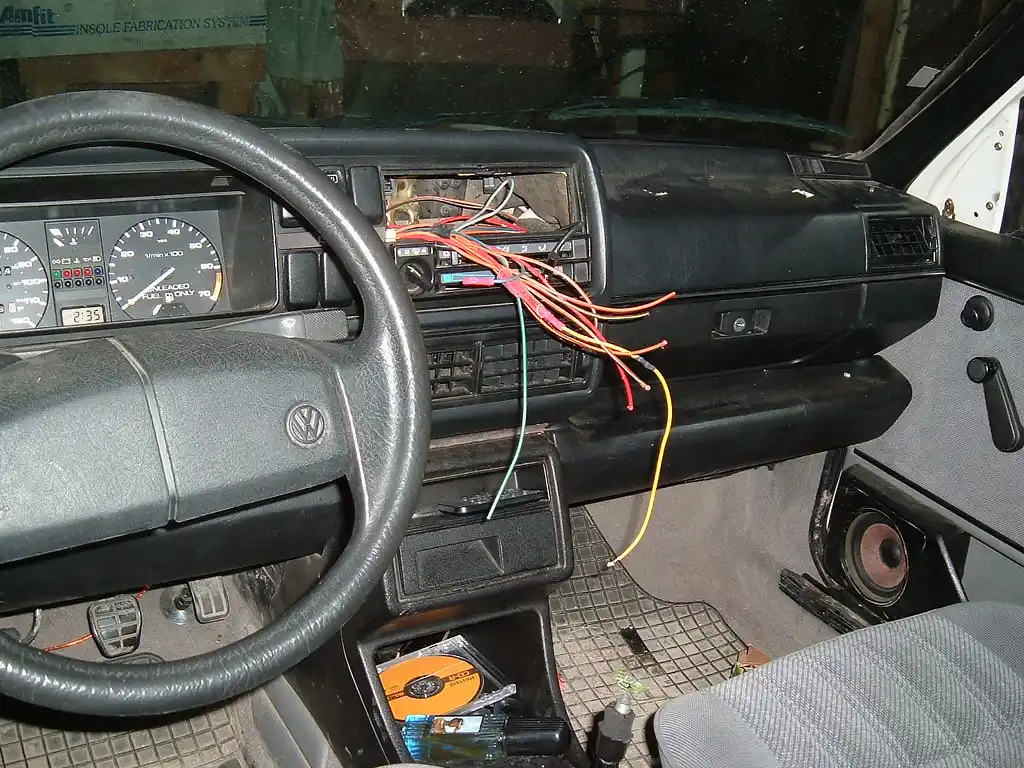
Pioneer Car Stereo Review: Which Models Are Worth It
Pioneer’s current head-unit family is one I can recommend for buyers who want plenty of fitment choices and solid phone integration without paying luxury money. Based on specs and reviews, the DMH-130BT is the cleanest safe buy here: it brings a 6.8-inch capacitive touchscreen, Bluetooth hands-free calling and audio streaming, and Alexa support through Pioneer’s Voizs app.
This guide is part of our Car audio systems guide series.
Verdict


The catch is familiar to anyone who installs these units for a living. Pioneer can pack in useful features and still be irritating day to day. Bluetooth pairing can be fussy, steering-wheel-control adapters can need extra setup, and USB behavior is not always as tidy as buyers expect. If your dash is tight, or if you still want discs, the right Pioneer is often the one that fits the car first and the phone second.
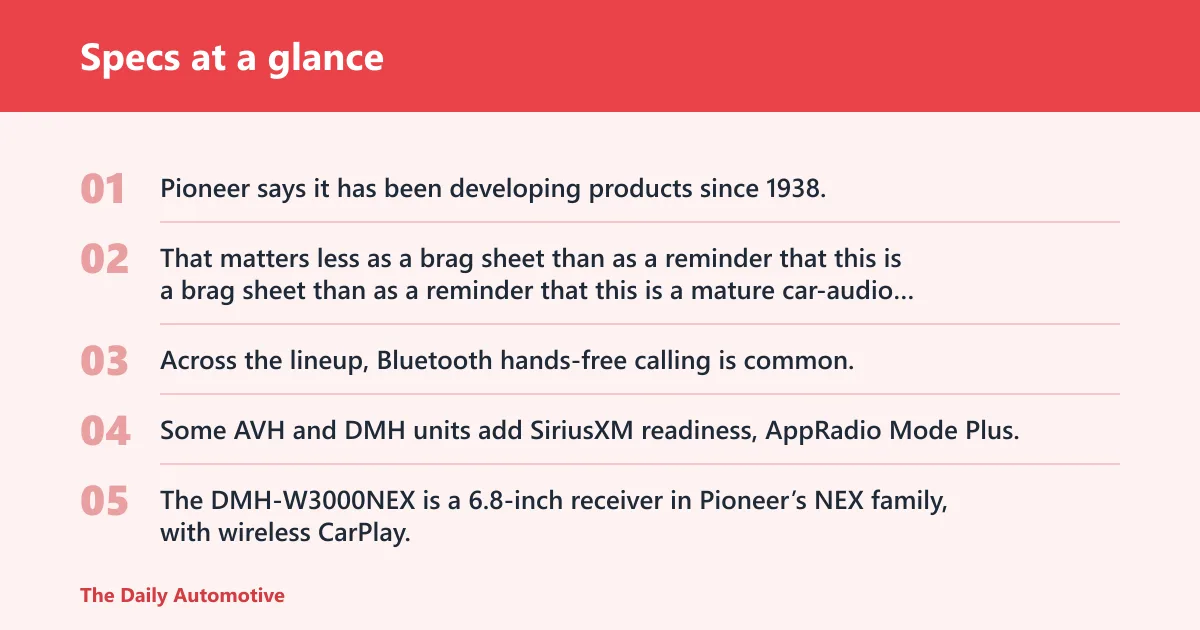
📊 Pioneer says it has been developing products since 1938. Source: Pioneer Corporation.
Specs at a glance
| Receiver family | Fitment | Screen / display | Phone integration | Typical use case |
|---|---|---|---|---|
| Single-DIN | Older cars, shallow dashes | Usually smaller or no full touchscreen | Bluetooth on many models | Basic replacement, compact dash openings |
| Double-DIN | Newer dashboards, larger openings | Often 6.8-inch to 7-inch class | Bluetooth, CarPlay, Android Auto on higher trims | Mainstream upgrade with easier use |
| Media receiver | Best for drivers who do not need discs | Varies by model | Often Bluetooth-first | Phone-heavy users, fewer moving parts |
| CD receiver | Older cars or buyers who still want discs | Often simpler displays | Bluetooth, USB, AUX on many units | Mixed-media setups |
| DVD receiver | Dashes that can take larger in-dash units | Usually larger screens | CarPlay and Android Auto on many models | Screen-first drivers and rear-seat media |
Core features to expect
Pioneer says it has been developing products since 1938, reports 51 million in-car devices manufactured annually, and lists 6,116 consolidated employees. That matters less as a brag sheet than as a reminder that this is a mature car-audio catalog, not a one-off product line.
Across the lineup, Bluetooth hands-free calling is common, USB and AUX appear on many budget and midrange units, and higher-end models add Apple CarPlay and Android Auto. Some AVH and DMH units add SiriusXM readiness, AppRadio Mode Plus, or wireless smartphone support.
Main family notes
The DMH-W3000NEX is a 6.8-inch receiver in Pioneer’s NEX family, with wireless CarPlay, Android Auto, and a floating or smart receiver layout. The DMH-1800NEX is a 6.8-inch double-DIN digital receiver for buyers who want a mainstream touchscreen without paying for the top shelf.
The DEH-S4220BT is a single-DIN CD receiver with Bluetooth, AUX, USB, and Smart Sync features. The MVH-S322BT is a single-DIN digital media receiver with Bluetooth and Alexa support, along with an equalizer and no disc transport. The AVH-2300NEX is a screen unit with CarPlay, Android Auto, AppRadio Mode Plus, and SiriusXM-ready support.
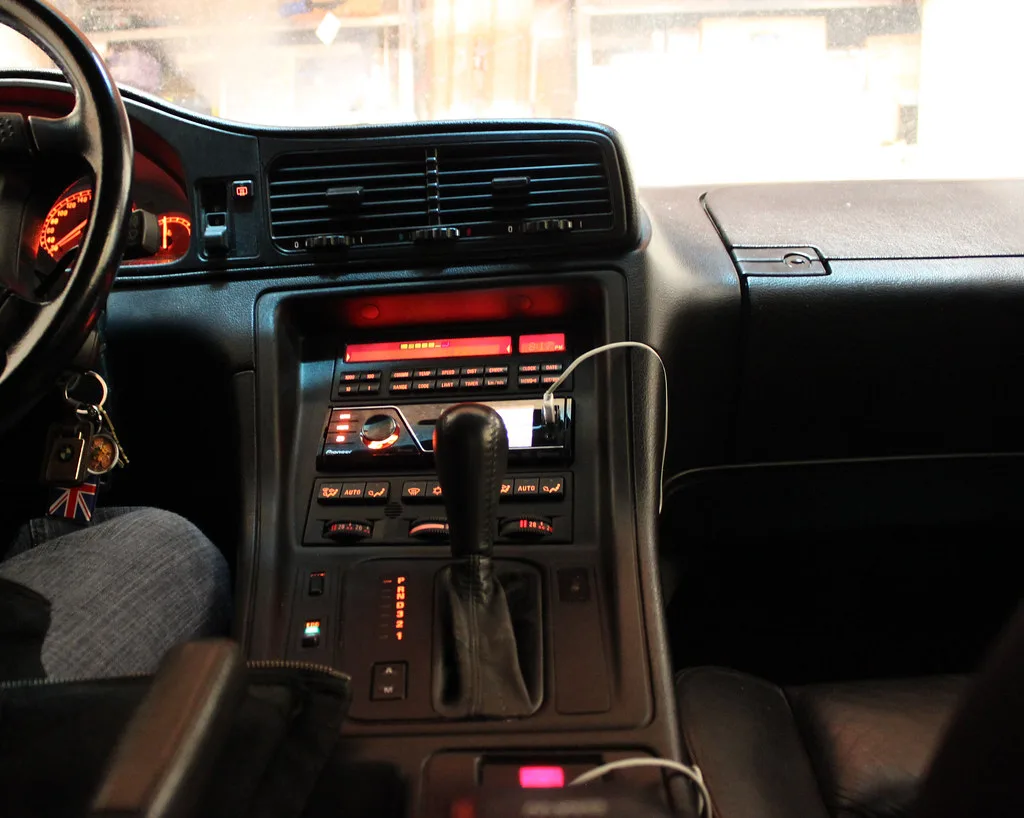
Who it is for
Pioneer is best for buyers who want a broad spread of head units and do not want to be boxed into one screen format. It fits older cars with single-DIN openings, newer dashboards that can take double-DIN or floating screens, and drivers who want a clear path from basic Bluetooth to full smartphone mirroring.
It is a weaker fit for buyers who expect every feature to feel polished out of the box. If the car has a finicky steering-wheel-control setup, if the dash is shallow, or if USB charging and reconnection behavior need to be flawless, some Pioneer models will take more tuning than the spec sheet suggests.
Who should pick which format
Single-DIN makes sense for older cars and smaller dash apertures. Double-DIN is the better choice when the dash can physically take a larger chassis and you want a better screen layout. Media receivers suit phone-first drivers. CD and DVD receivers still matter for buyers who want local playback or rear-seat media use.
What works
Pioneer’s biggest strength is lineup breadth. There are enough families here to match a lot of vehicles and habits, from simple Bluetooth commuting to CarPlay-heavy daily driving. That is exactly why shoppers keep putting Pioneer on their shortlists.
The DMH-W3000NEX is the clear step-up model for wireless CarPlay buyers. The DMH-1800NEX covers the middle ground well. The AVH-2300NEX still matters if you want a 7-inch WVGA screen and DVD support. The DEH-S4220BT and MVH-S322BT keep Pioneer relevant in older cars where a full touchscreen is not the point.
Pros and cons
- Pros: wide choice of single-DIN and double-DIN units, strong Bluetooth coverage, CarPlay and Android Auto on many higher models, good separation between disc and no-disc buyers.
- Cons: pairing can take extra steps, steering-wheel-control adapters can be temperamental, USB charging can be inconsistent, and some models demand more setup than buyers expect.
What stands out by model family
The DMH-W3000NEX is the best fit for drivers who want wireless phone integration and are willing to pay for a cleaner interface. The DMH-1800NEX fits mainstream shoppers who want CarPlay and Android Auto in a standard double-DIN shell. The DEH-S4220BT remains the honest budget answer for a dash that still needs a CD slot. The MVH-S322BT is for people who have fully moved past discs.
What does not
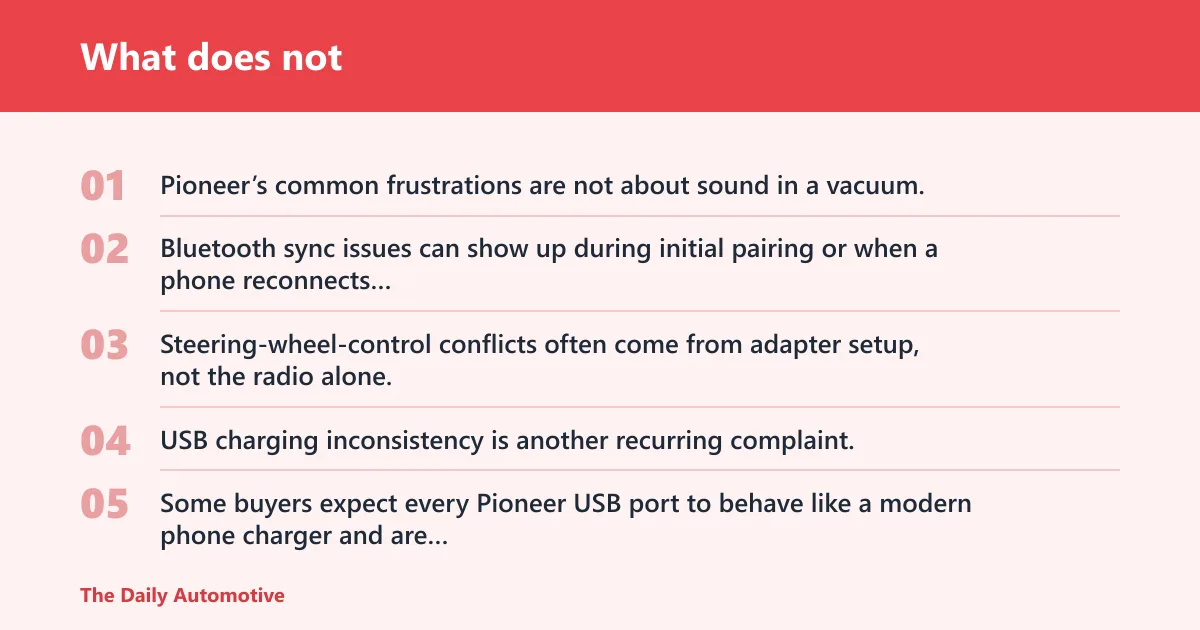
Pioneer’s common frustrations are not about sound in a vacuum. They are about daily use. Bluetooth sync issues can show up during initial pairing or when a phone reconnects after the vehicle has sat for a while. Steering-wheel-control conflicts often come from adapter setup, not the radio alone, but the owner still feels the pain at the wheel.
USB charging inconsistency is another recurring complaint. Some buyers expect every Pioneer USB port to behave like a modern phone charger and are disappointed when the connection is better for data than for power. Disc buyers also need to be realistic: the more a unit leans into smartphone features, the less relevant CD playback becomes.
Where Pioneer is weaker than the spec sheet suggests
Bluetooth menus are not always intuitive. Mic placement matters more than buyers think. And if the car uses odd factory amplifier or control logic, a Pioneer install can turn into an accessory hunt for adapters and interface boxes. None of that makes the brand bad. It just makes it less plug-and-play than casual shoppers hope.
Which Pioneer models are worth buying?
The best Pioneer model depends on dash layout and phone habits, not badge prestige. For wireless CarPlay and a bigger-screen feel, the DMH-W3000NEX is the clearest premium pick. For a mainstream double-DIN upgrade, the DMH-1800NEX is the safer bet. For older cars, the DEH-S4220BT and MVH-S322BT are the practical buys.
Best by use case
- DMH-W3000NEX: best for wireless CarPlay, Android Auto, and a cleaner floating-screen style upgrade.
- DMH-1800NEX: best for buyers who want a 6.8-inch double-DIN digital receiver without overthinking it.
- AVH-2300NEX: best for screen-first buyers who still want DVD capability and AppRadio Mode Plus.
- DEH-S4220BT: best for a single-DIN CD receiver with Bluetooth, AUX, USB, and Smart Sync features.
- MVH-S322BT: best for disc-free installs and basic phone integration, especially where Alexa support matters.
Model-selection matrix
| Pioneer family | Best fit | Fitment | Phone integration | Likely pain points |
|---|---|---|---|---|
| DMH-W3000NEX | Wireless CarPlay buyers | Newer dashes, larger openings | Wireless CarPlay, Android Auto | More setup, dash depth, adapter planning |
| DMH-1800NEX | Mainstream touchscreen shoppers | Double-DIN vehicles | CarPlay, Android Auto | SWC adapter compatibility, USB expectations |
| AVH-2300NEX | Screen-first DVD users | Double-DIN with room | CarPlay, Android Auto | More menu layers, older interface feel |
| DEH-S4220BT | Older cars, CD users | Single-DIN | Bluetooth, USB, AUX | No full touchscreen, limited modern mirroring |
| MVH-S322BT | Disc-free budget installs | Single-DIN | Bluetooth, Alexa | No disc transport, feature set is narrower |
When older cars and newer dashes need different answers
Older cars usually benefit from a single-DIN Pioneer or a simple double-DIN if the dash kit allows it. Newer dashboards, especially those with space for a 6.8-inch or 7-inch face, are where the DMH and AVH families make more sense. The wrong physical fit is still the fastest way to ruin a good buy.
What problems do Pioneer car stereos commonly have?
The most common Pioneer problems are Bluetooth pairing friction, steering-wheel-control conflicts, and USB inconsistency. Those issues show up more often than outright hardware failure. For most shoppers, the headaches come from integration with the car and phone, not from the brand forgetting how to make a head unit.
Short troubleshooting box
- Check the phone menu and Pioneer BT setting first.
- Use the add device flow on the phone and radio.
- Set the unit to visible or discoverable mode if the menu allows it.
- Confirm the 6-digit pairing code on both screens.
- Select Pioneer BT Unit if the phone lists multiple Bluetooth devices.
- If steering-wheel buttons fail, verify the adapter model and its learning steps.
What usually fixes it
Most Bluetooth issues clear up after deleting old pairings, rebooting the phone, and starting over with visibility enabled. USB problems often trace back to cable quality or a port that was assumed to be a charger when it is really a data port. Steering-wheel-control problems usually need the right interface module, not more radio settings.
Who is Pioneer best for?
Pioneer is best for drivers who want options. That includes commuters who only need Bluetooth calling, upgrade shoppers who want Apple CarPlay or Android Auto, and owners of older cars that need a single-DIN solution. It is also strong for buyers who still want CD or DVD capability alongside modern phone features.
It is less ideal for shoppers who want the least complicated install possible. In those cases, a simpler system with fewer menus and fewer adapters can be easier to live with, even if the feature list looks thinner on paper.
What works, and what does not
What works is the spread. Pioneer has budget Bluetooth units, disc-based options, screen-heavy double-DIN models, and wireless smartphone mirroring in the same family tree. That makes it much easier to match the stereo to the car instead of forcing the car to fit the stereo.
What does not work as cleanly is the setup experience. A buyer can get the right model and still fight initial pairing, steering-wheel integration, or USB behavior. That is why the best Pioneer choice is usually the one that fits the dash and phone needs with the fewest adapters.
What I would buy, and what I would skip
For most buyers, the DMH-1800NEX is the balanced pick. If wireless CarPlay matters, move up to the DMH-W3000NEX. If you still want discs, the DEH-S4220BT makes sense. If you want the simplest modern phone-friendly setup with no disc transport, the MVH-S322BT is the easier budget path.
Alternatives
The Pioneer DMH-130BT is a sensible alternative if you want a value-oriented double-DIN screen with Bluetooth hands-free calling, audio streaming, and Alexa support through Pioneer’s Voizs app. Based on the spec sheet and owner feedback, the main drawback is that it is a basic 6.8-inch touchscreen, so buyers expecting premium wireless phone mirroring will want to look higher up Pioneer’s range.

The Sony DSX-A410BT is a reasonable alternative if you want a single-DIN Bluetooth media receiver from a different brand and do not need a disc drive. Its likely weakness, compared with Pioneer’s broader family, is simpler feature depth and less choice around screen-based upgrades, which matters if you plan to move into CarPlay or Android Auto later.
Is Pioneer car stereo good?
Yes, Pioneer car stereos are good for buyers who want broad model coverage, strong Bluetooth availability, and clear upgrade paths into CarPlay or Android Auto. They are not flawless, but the lineup gives shoppers more ways to match a stereo to an older car, a newer dash, or a phone-heavy daily commute.
Is Pioneer a good brand for car audio?
Pioneer is a good car-audio brand if you value choice and long-term category depth. It has been around since 1938 and still covers basic Bluetooth radios, CD receivers, media receivers, and larger touchscreen units. The tradeoff is that setup quality depends heavily on the vehicle and the install parts.
Are Pioneer car speakers any good?
Pioneer car speakers are generally a reasonable buy at the value end of the market, but this review is mostly about head units, not speaker performance. Buyers should judge Pioneer speakers by fit, power handling, and system goals rather than assuming the stereo brand name guarantees the best sound match.
Is Kenwood better than Pioneer?
Neither brand is universally better. Pioneer often makes more sense when you want a wider spread of budget-to-premium head units and a straightforward path to disc, media, or floating-screen options. Kenwood can be the better buy if a specific model better matches your dash, controls, or interface preferences.
Do Pioneer stereos support Apple CarPlay and Android Auto?
Many do, especially in the double-DIN and NEX families. The DMH-W3000NEX supports wireless CarPlay and Android Auto, the DMH-1800NEX supports both in a 6.8-inch double-DIN format, and the AVH-2300NEX also supports both. Lower-cost Pioneer units may stop at Bluetooth, USB, and AUX.
How do you connect Bluetooth to a Pioneer car stereo?
Start in the phone menu and the Pioneer BT setting, then choose add device and make sure visibility is enabled. When the pairing prompt appears, confirm the 6-digit code on both devices and select Pioneer BT Unit if it shows up separately. If pairing fails, clear old pairings and try again.
is pioneer car stereo good
Yes, if you choose the right family for the car. Pioneer is strong for buyers who need single-DIN, double-DIN, media, CD, or DVD options under one brand. The biggest mistakes come from choosing by badge alone and ignoring dash depth, phone habits, and steering-wheel-control compatibility.
is pioneer a good brand for car audio
Yes. It is one of the better-known aftermarket names because it covers a lot of install scenarios and still supports modern smartphone features in many models. The brand is good, but the buy still needs to be matched to the vehicle, especially when the install depends on adapters.
are pioneer car speakers any good
They can be, depending on the system. Pioneer speakers are usually judged on value and fit more than pure audiophile performance. For shoppers building a complete system, the head unit choice and amplifier pairing often matter more than the logo on the speaker grille.
is kenwood better than pioneer
For some drivers, yes. For others, no. Kenwood may be the better fit when a particular interface or model layout matches the dash better, while Pioneer often wins on variety and familiar feature grouping. The right answer comes from use case, not brand loyalty.
Products related to this article
Sponsored / affiliate links. As an Amazon Associate I earn from qualifying purchases. I may earn additional commission from eligible campaigns.