Latch vs Seat Belt for Car Seat Installation Guide
Use LATCH only if both the vehicle and car seat allow it, and the child stays under the lower-anchor weight limit; otherwise, install with the vehicle seat belt. If you use the wrong method or ignore the limit, the seat may be outside its tested setup and could loosen in a crash. This guide gives a decision tree by seat type, child weight, and vehicle limits, plus the checks that matter after installation.
Latch vs seat belt: which installation method should you use?
Use the method that fits the seat stage, child weight, and anchor layout in the car. LATCH can be simpler in some vehicles, but seat-belt installation usually wins once lower-anchor limits are reached or the middle seat has no lower anchors. Match both manuals and the child’s current setup.
Latch vs seat belt at a glance
| Decision factor | Latch | Seat Belt for Car Seat Installation | Winner |
|---|---|---|---|
| How it attaches | Uses lower anchors in the vehicle seat bight; forward-facing seats also use the top tether. | Uses the vehicle seat belt; some seats add a lock-off or require belt locking. | Tie |
| Child weight limit | Limited by the lower-anchor rules in the vehicle and car-seat manual | No lower-anchor child-weight cap, but the seat and vehicle must still allow belt installation | Seat Belt for Car Seat Installation |
| Best for repeated swaps | Often quicker if anchors are easy to reach and the seat stays in one model of car | Often more repeatable across different cars and seating positions | Seat Belt for Car Seat Installation |
| Middle rear seat use | It may be impossible if that seat has no lower anchors. | Usually possible if the belt route and lock method are compatible | Seat Belt for Car Seat Installation |
| Tight-install consistency | Can be very good, but anchor shape and spacing vary by vehicle | Often more consistent when the belt locks cleanly and the seat has a clear belt path | Seat Belt for Car Seat Installation |
How the attachment system changes the result
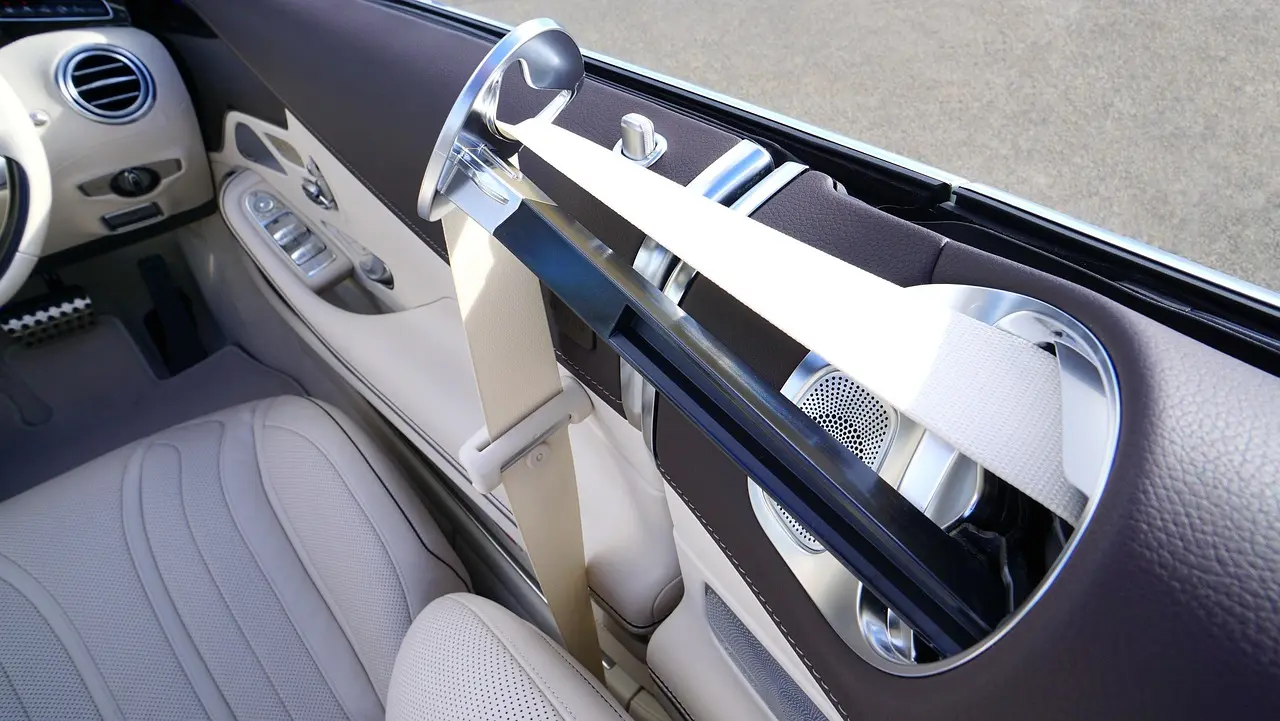
LATCH uses the lower anchors, which sit where the seat cushion meets the seat back. Seat-belt installation uses the vehicle belt instead, so it can work in spots without anchors. That difference matters most in the middle rear seat and in cars with awkward anchor access.
Why the weight limit matters so much
Lower anchors are not a lifetime attachment method. The vehicle owner’s manual and the car-seat manual or label set the limit, and that limit may be lower than a parent expects once the child and seat are counted together. Once the limit is reached, the seat belt is the correct path.
Why repeatability matters
A method that is easy once is not always easy every time. A seat belt with a clear lock or lock-off often gives more repeatable results across different vehicles than anchors that sit deep in the bight or are hard to reach by hand.

When LATCH is the better choice
LATCH is often the better pick for smaller rear-facing seats, for families who want a straightforward install in one vehicle, and for cars with easy-to-find lower anchors plus a reachable tether point for forward-facing use. It can be fast, clean, and consistent when the child is still under the lower-anchor limit.
Infant seats and smaller rear-facing setups
Infant carriers often fit well on the base with LATCH because the seat is light and the install path is simple. Smaller rear-facing convertibles can also be a good match when the child is still far below the lower-anchor limit. The key is that the manuals allow it.
Vehicles with clear anchors and easy tether access
Some vehicles place the lower anchors clearly at the seat bight, and the top tether anchor is easy to clip from behind the seat. In those cars, LATCH often saves time and reduces belt-routing mistakes. That matters most for caregivers who remove and reinstall the seat often.
When you move the seat often
If one seat moves between cars each week, a simple anchor setup can help. The better choice is still the one that installs correctly every time, but LATCH can be quicker when the same seat goes back to the same pair of lower anchors.
When should you use the seat belt instead of LATCH?
Use the seat belt instead of LATCH when the child has outgrown the lower-anchor limit, when the middle seat has no lower anchors, or when the belt locks more cleanly than the anchor setup. A correct belt install is the better answer anytime LATCH would put the seat outside its labeled limits.
You have passed the lower-anchor weight limit
This is the point many guides skip. Lower anchors are often limited by the combined child-plus-seat weight, and the exact limit comes from the vehicle owner’s manual and the car-seat manual or label. Once that limit is reached, switch to the seat belt even if the anchors still feel secure.
The middle seat has no lower anchors
Many rear middle seats do not have lower anchors at all. If the middle position is the one that installs most securely, the seat belt is often the only practical path there. A good belt install in the center can beat a poor anchor install on the side.
The belt locks more securely
Some vehicles have belts that lock with a firm switchable retractor, and some child seats have built-in lock-offs that clamp the belt in place. If those parts work well together, the belt can be easier to keep tight than fighting a stubborn anchor setup. The owner’s manual decides the method.
How to choose by car seat stage
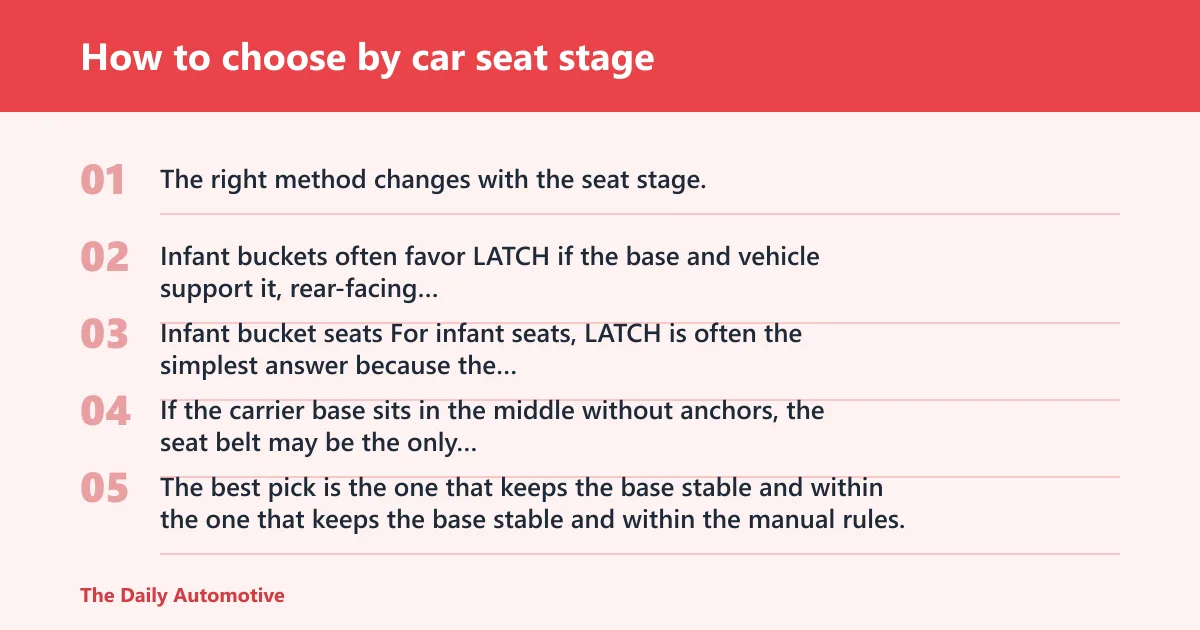
The right method changes with the seat stage. Infant buckets often favor LATCH if the base and vehicle support it, rear-facing convertibles can go either way depending on limits, forward-facing restraint seats need the top tether regardless of attachment method, and boosters usually ride with the seat belt because they are using the vehicle belt for the child.
Infant bucket seats
For infant seats, LATCH is often the simplest answer because the base is light and installed once, then the carrier clicks in and out. If the carrier base sits in the middle without anchors, the seat belt may be the only workable choice. The best pick is the one that keeps the base stable and within the manual rules.
Rear-facing convertibles
Rear-facing convertibles are where the lower-anchor limit starts to matter. A child who is still small may fit within LATCH limits, but a larger toddler can push the setup past its allowed range even while rear-facing. At that point, the seat belt is the correct switch.
Forward-facing harness seats
Forward-facing restraint seats need the top tether. That tether reduces head movement and is used with either LATCH or seat belt installation. If the child is near or above the lower-anchor limit, use the belt and keep the tether attached.
Booster seats
Boosters are a different category because the child is restrained by the vehicle belt, not by lower anchors or a restraint system. Many boosters are not installed with LATCH at all, except sometimes to hold the empty seat in place. The manual for that booster decides.
One-page decision table for LATCH vs seat belt
Read this table from left to right. Start with seat type, then child weight, then where the seat will sit, then whether lower anchors are available. If the answer lands in a gray area, the next move is to check both manuals and, if needed, ask a CPST.
| Seat type | Child weight | Seating position | Anchor availability | Best method | Common failure scenario | What to do next |
|---|---|---|---|---|---|---|
| Infant bucket | Under the base’s lower-anchor limit | Side or center | Anchors present and easy to reach | LATCH | Base shifts because the belt path was used incorrectly | Reinstall using the manual’s approved path |
| Infant bucket | Any weight within seat limit | Center | No lower anchors | Seat belt | Parent keeps searching for anchors that are not there | Use the belt and confirm lock method in the manual |
| Rear-facing convertible | Below lower-anchor limit | Side | Anchors present | LATCH | Seat is tight at the belt path but twisted at the base | Level and tighten again, then test movement at the belt path |
| Rear-facing convertible | At or above lower-anchor limit | Side or center | Anchors present or absent | Seat belt | Lower anchors are used past the labeled limit | Switch to belt installation immediately |
| Forward-facing restraint seat | Below lower-anchor limit | Side | Anchors present | LATCH plus top tether | Tether is left loose or unhooked | Attach and tighten the tether |
| Forward-facing restraint seat | At or above lower-anchor limit | Side or center | Anchors absent or hard to access | Seat belt plus top tether | Seat belt is not locked, so the seat shifts | Lock the belt as the manual instructs and retest |
What to do if the install fails in the real world
Real cars create real problems. A middle seat may lack lower anchors, a belt may lock only after a hard pull, or a cushion may tilt enough to make the seat look tight while the base still moves too much. In those cases, the answer is not to force the method; it is to change the position or the method.
Middle seat without anchors
If the middle position is best but has no lower anchors, use the seat belt there if the belt path is approved. If the belt install is awkward or impossible, move to a side seat where the method can be done correctly. Secure beats theoretical.
Stiff belt locks
Some belts do not feed smoothly through the child seat and lock in a predictable way. Built-in lock-offs on the child seat can help, but only if that feature is approved in the manual. If the belt still will not hold the seat tightly, a CPST should look at it.
Uneven cushions or deep bolsters
Some rear seats slope, buckle, or have bolsters that make the seat rock. A seat can feel tight in one spot and still move more than expected at the belt path. If the vehicle shape works against the install, another seating position may fix the problem faster than another round of tightening.
Choose Latch if… / Choose Seat Belt for Car Seat Installation if…
Choose LATCH if the car seat manual and vehicle manual allow it, the child is below the lower-anchor limit, and the seat will stay in a vehicle with easy anchor access. Choose the seat belt if the child has outgrown the lower-anchor limit, the middle seat has no anchors, or the belt locks more cleanly than the anchor setup. If the seat is hard to install either way, a CPST should make the final call.
Families who keep one seat installed in one vehicle
LATCH can be a clean choice when the seat lives in one car and the anchors are easy to reach. The install is often faster to repeat after the first setup. Once the weight limit is reached, though, the family should plan to switch to the seat belt.
Families who swap seats between cars
Seat belt installation often works better when the seat moves between different vehicles. Belt routing is more universal than anchor layout, and the install can be repeated in a wider range of positions. That matters when grandparents, carpools, or rentals are part of the routine.
When a CPST should make the call
A certified child passenger safety technician is the right next step when the install is unclear, the vehicle has unusual seating geometry, or both methods seem to work but neither feels solid. A CPST can help choose the best seating position, confirm the lock method, and spot mistakes that are easy to miss.
Frequently asked questions
latch vs seat belt car seat installation
The decision comes down to fit, limits, and vehicle layout. LATCH is useful when the child is under the lower-anchor limit and the anchors are easy to reach. The seat belt becomes the better choice when the anchors are absent, awkward, or outgrown by weight.
is latch better than seatbelt
Neither method is always better. LATCH can be easier in some cars, while the seat belt is often more flexible across vehicles and seating positions. The better method is the one approved by both manuals and used within all stated limits.
can you use both latch and seat belt for car seat
Usually not, unless the manual specifically allows a combined setup. Most car seats are installed with either LATCH or the seat belt, not both, unless the car-seat manual specifically allows a combined setup. Using both by default can create an install that is outside the seat’s tested instructions.
does my child outgrow lower anchors by weight?
Yes, in many cases. Lower anchors have a weight limit set by the vehicle and car-seat manuals, and that limit can be reached before the child outgrows the seat by height. Once that limit is reached, switch to the seat belt for installation.
is the top tether required for a forward-facing car seat?
Yes, the top tether should be used for forward-facing restraint seats whenever the vehicle and seat allow it. The tether attaches to the anchor point behind the seat and helps control movement in a crash. It is used with either LATCH or seat belt installation.
how tight should a car seat be when installed with LATCH or seat belt?
The seat should have only a small amount of movement side-to-side or front-to-back at the belt path when checked with firm hand pressure. That standard applies whether the seat is installed with LATCH or the seat belt. If it moves more than that, reinstall and check the lock method.
Products related to this article
Sponsored / affiliate links. As an Amazon Associate I earn from qualifying purchases. I may earn additional commission from eligible campaigns.
 Seat Belt Covers for Kids, 2 in 1 Car Seat Strap Covers & Auto Seatbelt Pillow for Kids nap, Car Travel Pillow & Strap Pads Cushion for headrest, Neck/Shoulder Support, fit Child, Adult, Grey;
 Universal Child Car Seat Chest Harness Clip – Kids Seat Belt Adjuster & Anti Escape Buckle Guard, Child Safety Car Seat Belt Lock Clip, Toddler Seatbelt Locking Clip for Stroller & Booster (Gray)