Car Door Handle Repair vs Full Handle Replacement
If the handle is cracked or loose but the cable and latch still move, replace the handle only. If the handle moves but the door will not open, inspect the cable and latch before buying a full assembly. Picking the wrong fix can leave you locked out, trap a broken part inside the door, or waste money on parts you do not need. This guide shows which symptoms point to handle, cable, latch, or full assembly replacement.
| Decision factor | Car Door Handle Repair | Full Handle Replacement | Winner |
|---|---|---|---|
| Up-front cost | Best when the failure is a cracked lever, loose trim, or a disconnected cable that can be reset or swapped separately. | Better when the handle shell, return spring, sensor, or integrated hardware is damaged enough that piecemeal repair is wasteful. | Car Door Handle Repair |
| Time and labor | Often faster if the broken part is simple and the door panel comes off cleanly. | Best when a single complete unit is easier to swap than chasing a hidden broken clip, frayed cable, or cracked housing. | Car Door Handle Repair |
| Reliability after the fix | Works well if the rest of the assembly is sound and the problem is limited to one worn part. | Better if the handle body is brittle, the mount points are worn, or the design has multiple weak points in one piece. | Full Handle Replacement |
| Best symptom match | Loose handle, cracked interior lever, or a handle that feels normal but no longer releases because of a cable or linkage issue. | Broken handle shell, damaged exterior grip, or an electronic handle with a failed sensor or micro-motor. | Depends on symptom |
| DIY difficulty | Lower on simple manual handles with easy panel access. | Higher on integrated electronic handles, tight packaging, or designs that require careful calibration and battery disconnect steps. | Car Door Handle Repair |
Handle failure decision guide
Repair, replace, or inspect first
Start with the symptom, not the handle itself. A crack, flop, or dead pull can point to three different parts: the handle, the cable or linkage, or the latch assembly.
If the handle is visibly damaged, a handle-only fix often makes sense. If the handle moves normally but the door stays shut, the cable or latch is the better suspect.
What the symptom usually means
Exterior handles connect to the latch by a cable or rod, so a loose or floppy feel often means the connection has failed. Interior handles can fail separately, usually from a cracked plastic lever or a stretched cable.
Handle problems also change with cold weather and corrosion. Ice, rust, and dirt can stiffen moving parts, and salt-prone regions can speed wear on plastic and metal pieces.
When the whole assembly is the better call
Full replacement makes more sense when the handle body, cable mount, return spring, or electronic parts are all worn together. That is more common on integrated handles, where the outer shell and release hardware are tightly packaged.
Tesla Model 3 exterior handles, for example, contain proximity sensors and micro-motors. That kind of design pushes the decision toward complete assembly replacement more often than a basic manual handle does.
Handle symptom-to-part table
| Symptom | Likely failed part | Recommended fix | DIY difficulty | Typical cost band |
|---|---|---|---|---|
| Interior handle feels cracked or pulls with no resistance | Interior handle lever | Replace the interior handle, then verify the cable seats correctly | Low to moderate | $100 to $250 with labor |
| Exterior handle is loose, floppy, or hard to pull | Exterior handle or cable/linkage | Remove the door panel, inspect the linkage, and replace the failed part only | Moderate | $40 to $400+ depending on parts and labor |
| Handle moves but the door will not open | Cable, linkage, or latch assembly | Check the cable first; replace the latch if the release mechanism does not move correctly | Moderate to high | $150 to $300 per handle for cable work; $300 to $600 for a failed latch |
| Both interior and exterior handles fail or act weak | Latch assembly or shared release hardware | Inspect the latch and striker alignment before buying another handle | High | $300 to $600 for latch replacement |
| Electronic handle does not present or unlatch normally | Sensor, micro-motor, or integrated handle assembly | Replace the electronic handle assembly and verify battery and connector status | High | Varies by vehicle; often higher than a basic manual handle |
Say your driver’s door interior handle snaps off at the pivot, but the cable still releases the latch when you pull it by hand. That is a clear handle-only repair, not a latch replacement. The same symptom on the outside could still be a cable or linkage issue, so the diagnosis changes with the side that failed.
Should I repair or replace a broken car door handle?
If the damage is limited to one part and the rest of the mechanism still moves correctly, repair is the better first choice. If the handle housing is cracked, the release hardware is bent, or the model uses integrated electronic pieces, full replacement is usually the cleaner fix.
When a repair is enough
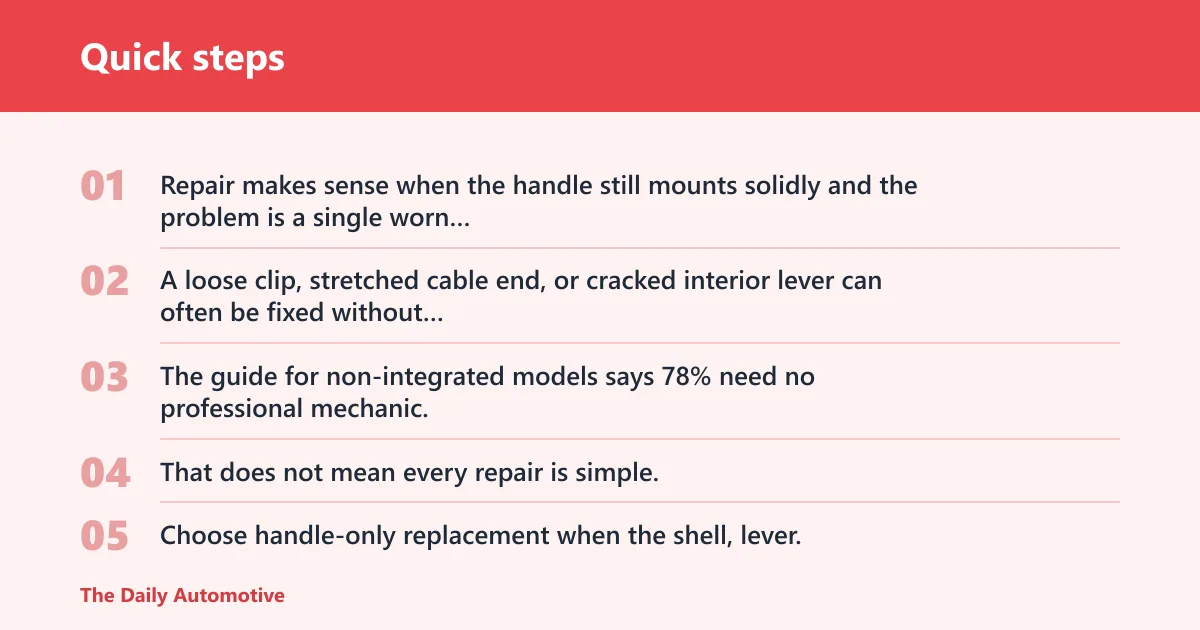
Repair makes sense when the handle still mounts solidly and the problem is a single worn piece. A loose clip, stretched cable end, or cracked interior lever can often be fixed without changing every part attached to the door.
The guide for non-integrated models says 78% need no professional mechanic. That does not mean every repair is simple, but it does mean many manual handles are still within reach for a careful DIY job.
When handle-only replacement makes sense
Choose handle-only replacement when the shell, lever, or pull surface is broken but the cable and latch still function. Most replacements take 30–90 minutes with basic tools, and a simple interior handle can be quicker on a straightforward vehicle.
Budget aftermarket parts may be enough for a basic repair. When fit and reliability matter more, OEM-equivalent parts are the safer default.
When the latch is the real problem
If the handle moves but the door will not open, the latch may be seized or broken. The latch is the shared mechanism both handles act on, so a latch fault can make both handles seem dead.
A broken latch can also affect emergency exit. That is more than an annoyance; it can delay egress and affect FMVSS 206 compliance.
What the repair costs usually include
Cost depends on which part failed and whether the door panel must come off. A handle repair is usually cheaper than a latch replacement because the latch is more buried and often takes more labor to align correctly afterward.
Parts cost versus labor
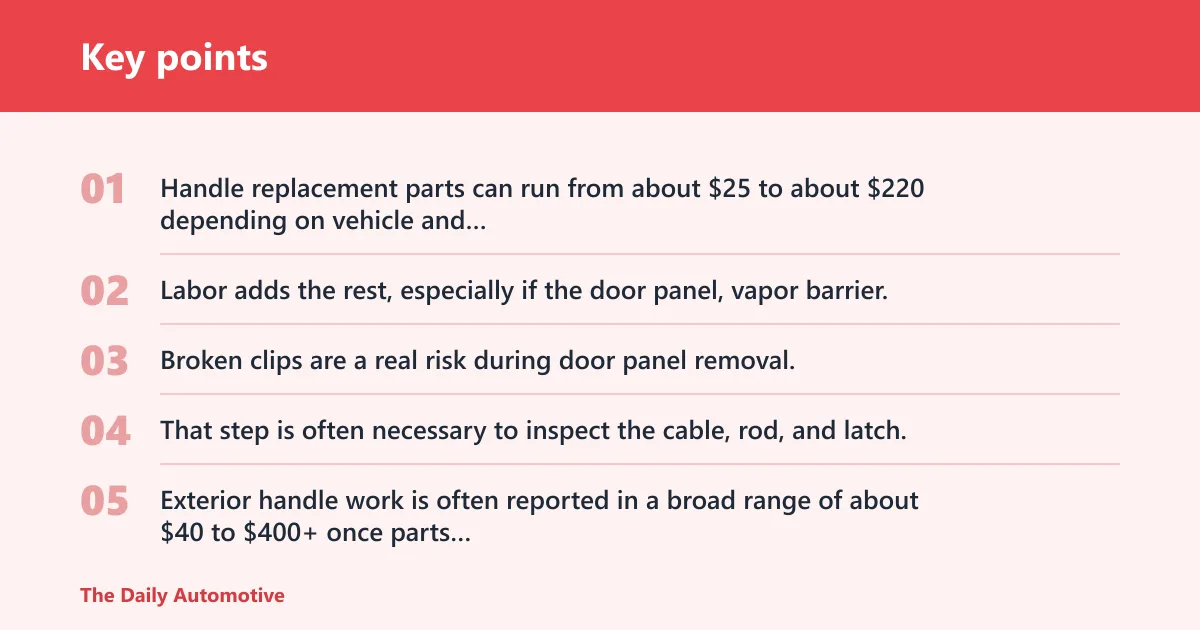
Handle replacement parts can run from about $25 to about $220 depending on vehicle and handle type. Labor adds the rest, especially if the door panel, vapor barrier, and trim clips need careful removal and reassembly.
Broken clips are a real risk during door panel removal. That step is often necessary to inspect the cable, rod, and latch, so careful trim work matters.
Handle-only replacement bands
Exterior handle work is often reported in a broad range of about $40 to $400+ once parts and labor are combined. Interior handles are usually cheaper and faster, especially when the issue is a cracked plastic lever or a stretched cable.
If you are comparing options on a simple manual door, handle-only replacement usually wins on cost. It loses its advantage when the failure lives deeper in the latch or wiring.
Latch assembly replacement bands
A failed latch mechanism can cost $300 to $600. That higher band reflects both the part itself and the extra labor required to remove, fit, and align it with the striker plate.
Misalignment matters. If the latch sits off relative to the striker, the door may close badly or refuse to open cleanly, even after the new part goes in.
When OEM-equivalent parts make sense
OEM-equivalent parts are the safest middle ground when fit and reliability matter. A reputable aftermarket part can be fine for a simple manual handle, but a poor fit can turn a small repair into a repeat job.
Budget aftermarket parts are more defensible when the design is plain and the failure is obvious. On integrated or electronic handles, a closer match to factory geometry is usually worth the extra cost.
How do I know if the handle or the latch is broken?
Watch what happens when you pull the handle. If the handle feels normal but nothing releases inside the door, the cable, linkage, or latch is more likely than the handle body itself.
Handle moves but the door stays shut
That symptom usually points to the cable, rod, or latch. The handle can still move because the outer shell is fine, but the release motion is not reaching the latch.
In that case, replacing the handle first is a guess. Inspect the cable and latch before spending on a full assembly.
Handle feels loose or floppy
A loose or floppy handle often means the cable has slipped, stretched, or detached. It can also mean the handle pivot or mounting point has cracked.
A common first-timer mistake is swapping the whole handle before checking the cable end. That can waste money if the cable is the only failed part.
Interior and exterior handles fail together
When both handles stop working, the latch becomes a stronger suspect. Shared hardware can fail once and make both handles look bad, even though only the latch or release mechanism is broken.
Child locks and central locking hardware can complicate the diagnosis. If the rear door will not open from inside but works from outside, the child lock may be the issue rather than the handle.
What a shop checks during door panel removal
Door panel removal is usually the access step for cable, rod, and latch inspection. It is where the real diagnosis happens, because the broken part is often hidden behind trim and vapor barriers.
Trim clips and fasteners
Panel removal starts with clips, screws, and hidden fasteners. Those pieces can break if the panel is pried off carelessly, which is why trim tools matter.
Once the panel is off, the tech can check whether the handle cable is still attached and whether the return spring or bracket has failed.
Cable, rod, and linkage inspection
The next step is checking whether the handle motion reaches the latch. A snapped cable, bent rod, or disconnected linkage will often show up here fast.
A cable replacement usually takes one to two hours. If the cable is damaged but the handle body is fine, replacing the cable alone is often the right call.
Latch alignment with the striker plate
The latch has to line up with the striker plate to work correctly. Even a new latch can feel wrong if the mounting position is off or the door was previously hit.
That is why reassembly checks matter. After the panel goes back on, the door should open and close without binding, scraping, or needing extra force.
Can cold weather cause this problem?
Yes. Cold weather can freeze moisture in the latch, stiffen grease, and make a weak cable feel worse than it is. Rust and ice can also raise the load on plastic parts until they crack.
Ice, rust, and stiff latches
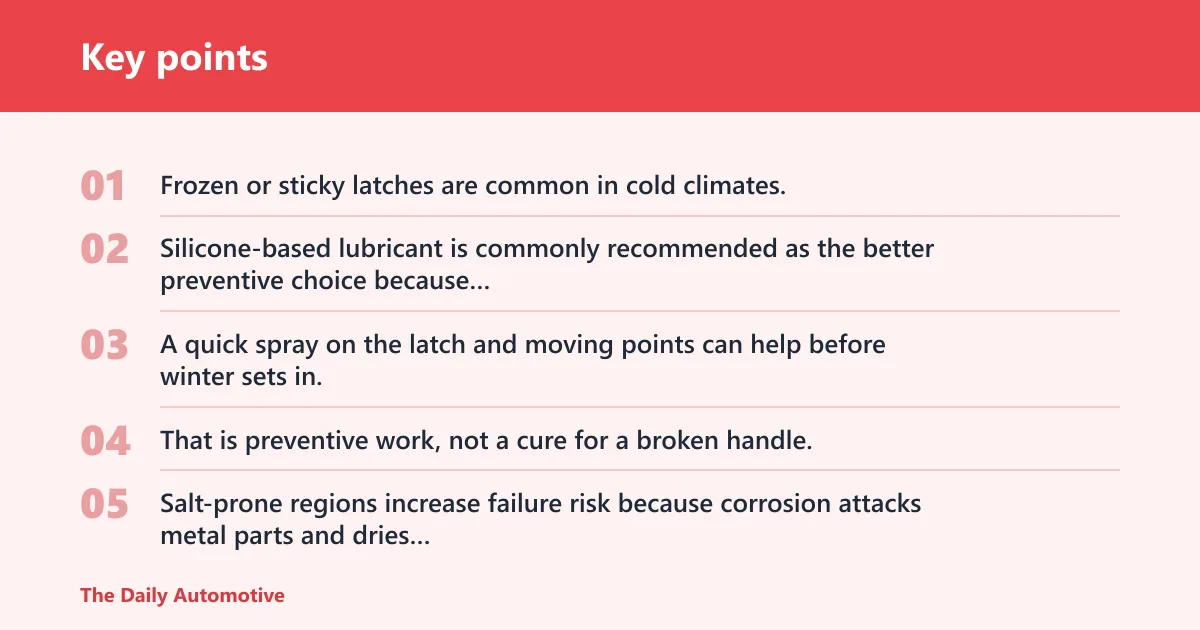
Frozen or sticky latches are common in cold climates. Silicone-based lubricant is commonly recommended as the better preventive choice because it can reduce sticking without collecting as much dirt as heavy grease can.
A quick spray on the latch and moving points can help before winter sets in. That is preventive work, not a cure for a broken handle, but it can keep a marginal mechanism from getting worse.
Corrosion risk in salt-prone regions
Salt-prone regions increase failure risk because corrosion attacks metal parts and dries out movement points. Over time, that can make a handle stiff, then loose, then broken.
Plastic fatigue also shows up faster when the mechanism is forced against ice or corrosion. The outside may look fine while the hidden clip or lever is already near failure.
Preventive lubrication that helps
Use silicone-based lubricant on sticky latches, not heavy grease in cold climates. Heavy grease can trap dirt and turn into a thicker paste that slows movement later.
For vehicles that live outdoors, a seasonal check is smart. If the handle starts to drag or the latch clicks weakly, inspect it before the part snaps.
Choose Car door handle repair if…
Choose Car Door Handle Repair if the handle is cracked, loose, or missing a lever, but the cable and latch still move. It also fits simple interior-handle failures, cable swaps, and cases where the rest of the assembly is sound.
Choose Full Handle Replacement if the handle body is broken, the design is integrated, or an electronic handle has sensor or motor trouble. If the handle moves but the door will not open, inspect the cable and latch first, then replace the full assembly only when the diagnosis points there.
- Check whether the handle is loose, cracked, or dead.
- Pull the handle and note whether the latch releases.
- Remove the door panel if the cable, rod, or latch needs inspection.
- Replace only the failed part when the rest of the mechanism is sound.
- Choose full assembly replacement when the handle design or damage makes piecemeal repair a weak bet.


Frequently asked questions
What does it cost to repair a car door handle?
Handle-related repairs can start with parts at about $25 and may run up to about $220 depending on vehicle and handle type. Cable replacement usually takes one to two hours and typically costs between $150 and $300 per handle, while labor pushes the final bill higher.
What does it cost to replace a car door handle?
Handle replacement commonly lands in the $40 to $400+ range once parts and labor are combined. A simple interior handle can cost $100 to $250 with labor, while a failed latch mechanism can reach $300 to $600 and needs more careful alignment.
Can a door handle be fixed without replacing the whole assembly?
Yes. A cable, linkage, spring, or interior lever can often be replaced without changing the entire handle assembly. That is most practical on manual doors with clean access, solid mounting points, and no electronic sensors built into the handle.
Is a broken interior door handle a safety issue?
Yes. A broken interior handle can block emergency exit, which matters more than convenience. It can also affect FMVSS 206 compliance if the door cannot be opened as intended, so it should be repaired quickly rather than ignored.
Products related to this article
Sponsored / affiliate links. As an Amazon Associate I earn from qualifying purchases. I may earn additional commission from eligible campaigns.
 Universal Mini Bear Jaw Car Door Latch Kit for Hot & Street Rods, Rod & Cable Release Compatible, Ideal for Ford Model A & T, Supports Shaved & Suicide Doors, Ensures Safety & Reliability
 Slim-Line Bear Jaw Car Door Latch Kit, Suitable for Standard/Suicide Doors, Works with Rod/Cable Mechanisms, for Steel and Fiberglass Doors, Includes Latches, Striker Pins, Cage Nuts