Seat Belt Pad Review: Fit, Comfort, and Value for Commuters
The best seat belt pads are slim, grippy, and tapered near the buckle. Thick foam shifts more, and it can slow belt retraction. Poor fit causes twisted straps, slower self-return, and a pad you stop using. This review compares seat belt pads for comfort, fit, retraction behavior, and value. The top pick for most commuters is the cotton-blend velvet pad because it balances a 10.2-inch length, 2 to 2.5 inch strap compatibility, and a low $7.99 two-pack price.
This guide is part of our Car accessories for comfort and convenience series.
Seat belt pad review: top pick and who it suits
Why fit matters more than softness
Fit matters more than softness. A seat belt pad should cut neck and shoulder friction without sliding into the latch plate area or adding enough bulk to slow the belt’s return. Many budget pads miss that target.
A pad that slides or bunches can create the exact problem it was meant to solve. It can also press into the shoulder on shorter torsos or broad shoulders, especially if the pad is too short to cover the contact area.
The top pick at a glance
The cotton-blend velvet pad is the strongest all-around choice here. It fits 2 to 2.5 inch straps, measures 10.2 inches long, and comes in a two-pack for $7.99. That gives it a better starting point for daily commuting than bulkier foam styles.
Quick picks by need
Here is the short version. Choose the cotton-blend velvet pad for the best balance of comfort and fit, the polyester-and-sponge pad for the cheapest route into the category, the wool option for a premium feel, and the pad that works on backpacks, strollers, and bag straps if you want multi-use value.
| Best for | Material / style | Notable fact | Price detail |
|---|---|---|---|
| Long commutes | Cotton-blend velvet | 10.2 inches long; fits 2 to 2.5 inch straps | $7.99 for two |
| Lowest upfront cost | Polyester and sponge liner | Outer polyester layer with sponge inner lining | $3.47 for two |
| Premium feel | Genuine Australian wool | Natural fiber option | Higher-priced category |
| Multi-use straps | Pad rated for backpacks, strollers, and bag straps | Works beyond car belts | Value depends on reuse |
Best budget pick
The polyester-and-sponge two-pack is the clear budget choice at $3.47. Pick it when you want a low-risk add-on for a daily driver, a spare car, or a quick fix for a shoulder strap that rubs too hard.
Best premium feel
The genuine Australian wool option is the premium pick. Real wool usually brings a softer, more natural feel than basic foam, but judge that against price, cleaning needs, and whether the added plushness creates too much bulk for your belt geometry.
Best for backpacks and bag straps
Choose the pad that is described as working on backpacks, strollers, and bag straps if you want the broadest use case. Another listed review notes that some pads work on backpack straps and luggage, which matters if you want one purchase to cover more than one strap type.
Which seat belt pad stays comfortable without slipping?
The most comfortable pad is usually the one that stays in place and does not add much thickness near the buckle. Hook-and-loop closures help with repositioning and grip, while wrap-around designs can feel simpler and flatter if they are cut narrowly enough. The wrong shape can slide, bunch, or interfere with retraction.
Hook-and-loop closure versus wrap-around attachment
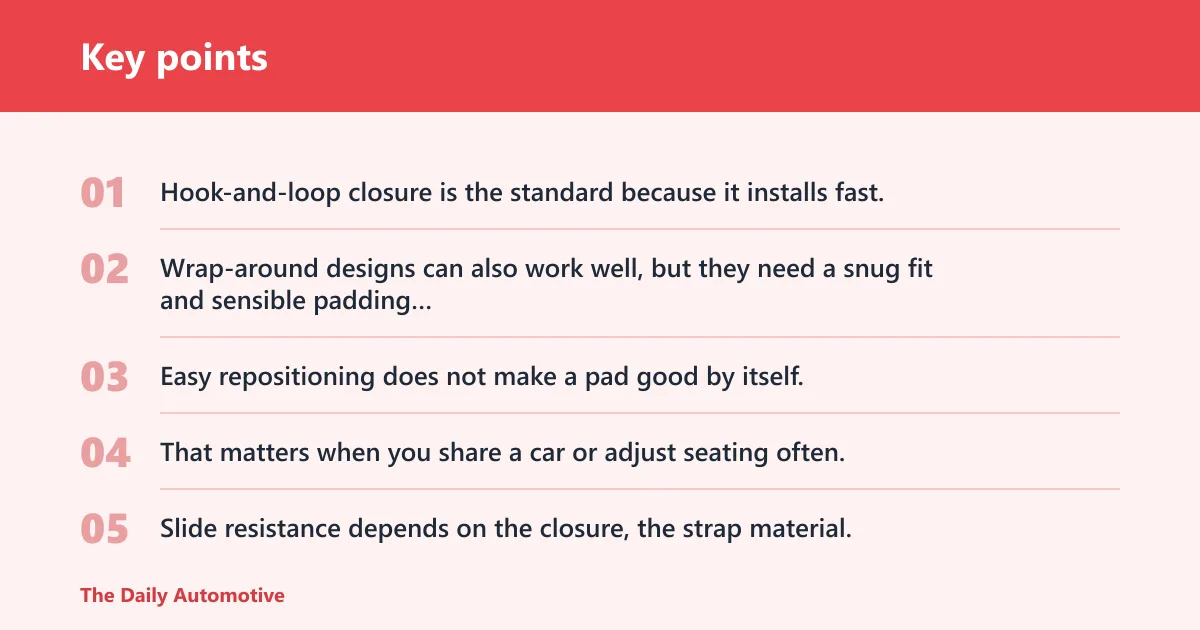
Hook-and-loop closure is the standard because it installs fast, lets you reposition the pad, and grips the strap well enough to limit sliding. Wrap-around designs can also work well, but they need a snug fit and sensible padding thickness or they may rotate during daily use.
Easy repositioning does not make a pad good by itself. That matters when you share a car or adjust seating often, but if the pad shifts every time the belt moves, comfort drops fast.
Slide resistance and retraction clearance
Slide resistance depends on the closure, the strap material, and how much the pad bulges past the edges of the belt. Retraction clearance matters just as much. If a pad catches near the shoulder guide or sticks at the latch plate, the belt may return more slowly.
Suppose a commuter has a short torso and sits upright close to the wheel. A thick pad that rides high can brush the neck at first, then move toward the buckle after a few stops. That is a comfort loss, not a gain.
When extra bulk becomes a problem
Extra bulk becomes a problem when the seat belt no longer lies flat. That can create a twisted look, reduce natural self-return, and make the strap feel heavier on the shoulder. A slimmer pad often works better than a plush one for drivers who buckle and unbuckle often.
Which material feels best over time?
The softest-feeling material is usually wool or velvet, but “best” over time depends on breathability, odor, and how the padding holds shape. Cotton-blend velvet feels comfortable against skin, polyester with sponge liner is easy on the wallet, and wool brings premium softness with a higher price expectation.
Cotton-blend velvet
Cotton-blend velvet is the best all-around material for most commuters. It feels soft, breathes better than many dense foams, and is less likely to trap heat during daily driving. The tradeoff is wear: velvet can flatten over time and may hold odor if it is not cleaned regularly.
Polyester with sponge liner
Polyester with sponge liner is the practical budget choice. The outer polyester layer is easy to maintain, and the sponge inner lining gives basic cushioning without much cost. The downside is durability; inexpensive foam can compress, lose shape, and feel less supportive after repeated use.
Sheepskin or real wool
A genuine Australian wool pad is the premium-feel option. Wool can be very comfortable against the neck and shoulder, and it usually feels less synthetic than foam-backed fabric. The cost premium only makes sense if you value that feel enough to pay more and care for it properly.
How do you know if a seat belt pad will fit your belt?
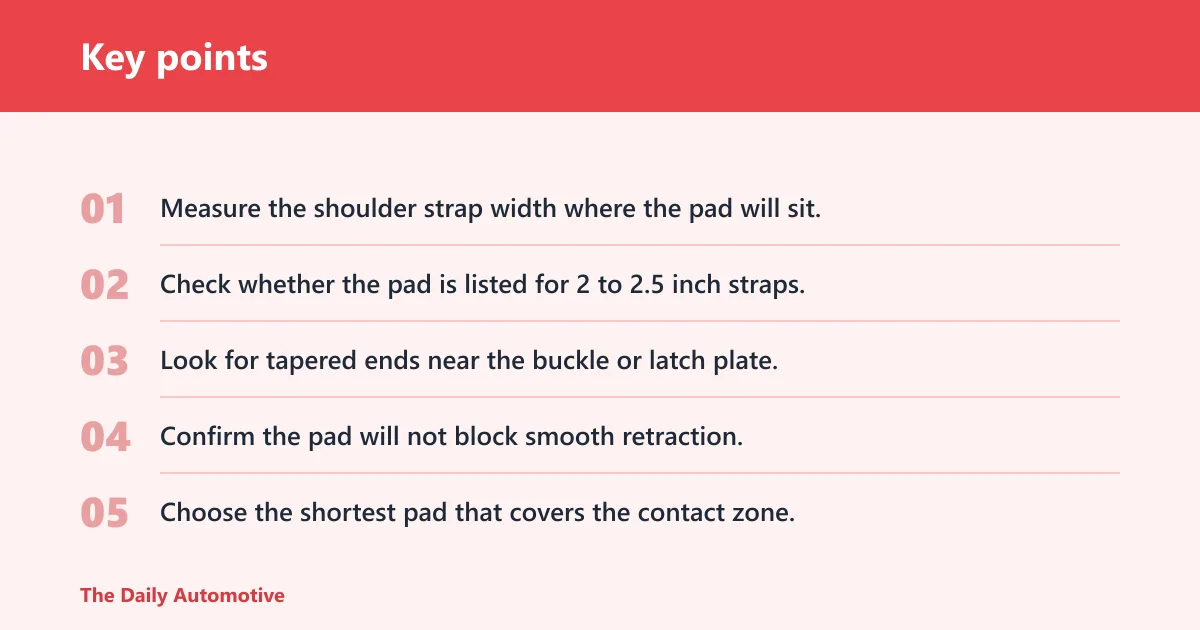
Start with belt width. Many seat belt pads claim universal fit, but in practice this category is usually aimed at shoulder straps around 2 to 2.5 inches wide. Then check thickness and buckle-side clearance, because the wrong pad can interfere with retraction or sit awkwardly where the belt meets the latch plate.
Seat belt width compatibility from 2 to 2.5 inches
The cotton-blend velvet pad explicitly fits straps 2 to 2.5 inches wide, which is a strong reference point for the category. If your belt sits within that range, you are in the typical fit zone. If the strap is thicker, heavily contoured, or unusually stiff, treat universal-fit claims with caution.
Belt thickness and buckle-side clearance
Width is only part of the story. A thick pad can push the belt outward, especially near the shoulder anchor and buckle area. That extra material may make the belt sit differently on the torso, which can hurt comfort even if the pad technically fits the strap.
Pad length and shoulder contact coverage
Pad length matters because the shoulder contact area is not the same for every driver. The 10.2-inch cotton-blend pad gives more coverage than very short pads, which helps spread pressure across the shoulder instead of concentrating it near the neck. Short-torso drivers may need less length; broad-shouldered drivers often need more.
- Measure the shoulder strap width where the pad will sit.
- Check whether the pad is listed for 2 to 2.5 inch straps.
- Look for tapered ends near the buckle or latch plate.
- Confirm the pad will not block smooth retraction.
- Choose the shortest pad that covers the contact zone.
Fit-and-failure checklist
Use this checklist to judge real-world fit, not just softness. A pad can feel nice in hand and still fail in daily use if it slips, traps odor, or loses shape after a few weeks of commuting. The scores below are practical buying judgments, not lab results.
| Pad type | Belt width compatibility | Retraction clearance | Neck contact coverage | Slide resistance | Washability | Likely lifespan for commuters |
|---|---|---|---|---|---|---|
| Cotton-blend velvet, 10.2 inches, 2-pack $7.99 | 5/5 | 4/5 | 4/5 | 4/5 | 4/5 | 4/5 |
| Polyester with sponge liner, $3.47 two-pack | 4/5 | 4/5 | 3/5 | 3/5 | 4/5 | 3/5 |
| Genuine Australian wool | 4/5 | 4/5 | 5/5 | 4/5 | 3/5 | 4/5 |
| Backpack, stroller, and bag strap pad | 4/5 | 4/5 | 3/5 | 3/5 | 4/5 | 3/5 |
What failures to watch for
The most common failures are sliding, bunching, odor retention, and foam that compresses too quickly. A pad can also make comfort worse by adding bulk where the belt should lie flat. That is why replacement frequency matters as much as the sticker price.
What should you pay for a seat belt pad?
Sticker price is only part of the answer. The better metric is cost over time, which depends on how many pads you get, whether they hold shape, and how long they stay usable before the lining compresses or starts to smell. A cheaper two-pack can be smarter than a pricier single pad.
Sticker price versus cost per pad
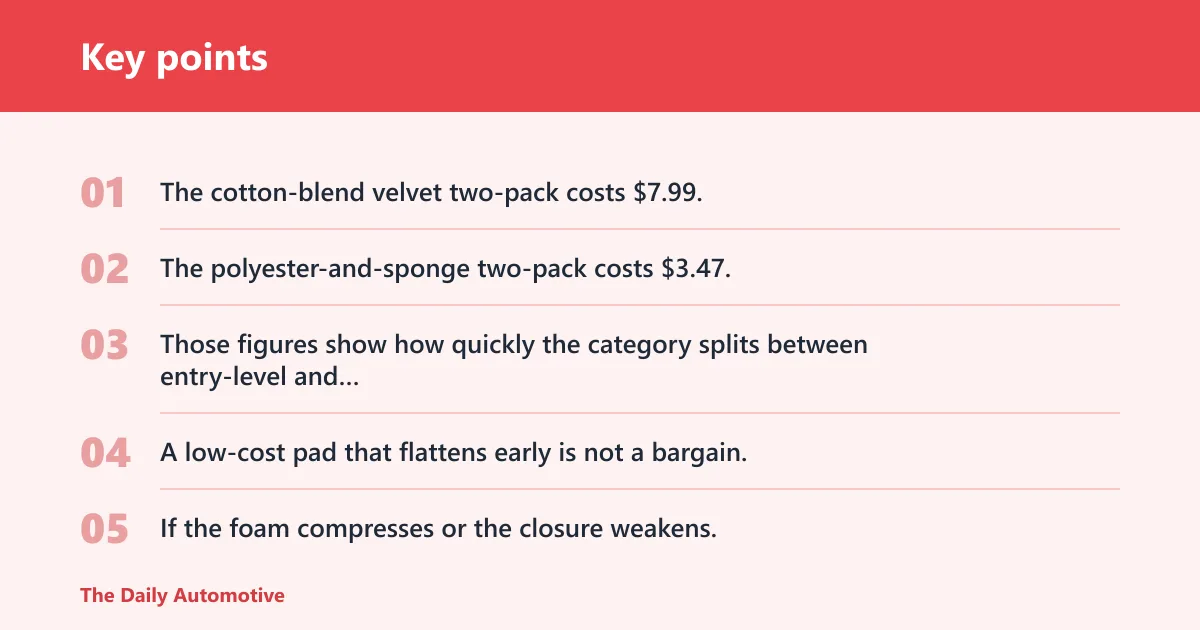
The cotton-blend velvet two-pack costs $7.99, which puts it in the middle of the pack for this group. The polyester-and-sponge two-pack costs $3.47, and one listed pad is sold under under six dollars for two pieces. Those figures show how quickly the category splits between entry-level and better-finished options.
How replacement frequency changes value
A low-cost pad that flattens early is not a bargain. If the foam compresses or the closure weakens, you replace it sooner and erase the savings. For daily commuters, the best value often comes from the pad that stays comfortable long enough to avoid constant replacement.
When a premium pad is worth it
Pay more when you care about feel, plan to use the pad every day, or need the best neck coverage. Premium wool can justify its cost if you drive long distances and want a softer surface that feels less synthetic. For occasional use, the cheaper polyester or cotton-blend options make more sense.
How to choose
Start with belt width, then decide how much thickness you can tolerate without hurting retraction. If your neck gets rubbed on a 30-minute commute, choose the longest pad that still lies flat. If you share a vehicle, pick hook-and-loop for easier repositioning. If you want a pad for bags and luggage too, buy the model with multi-use strap compatibility.
A common first-timer mistake is buying the thickest pad in the aisle and assuming more padding equals more comfort. On a belt that already sits close to the neck, extra bulk can do the opposite. The better choice is the pad that covers the contact point while staying slim enough to move with the belt.
Frequently asked questions
What is the best seat belt pad for long commutes?
The best seat belt pad for long commutes is usually the cotton-blend velvet option because it balances softness, strap fit, and a low profile. Long drives punish bulky pads that slide or trap heat. A 10.2-inch pad that fits 2 to 2.5 inch straps is a safer starting point than thicker foam.
Do seat belt pads actually make the belt more comfortable?
Yes, seat belt pads can make the belt more comfortable when they cut direct friction on the neck and shoulder. That benefit depends on fit, though. A pad that slides, bunches, or adds too much bulk may feel worse than the bare strap after a few drives.
Will a seat belt pad stop the shoulder strap from digging into my neck?
It can, if the pad is long enough to cover the contact area and narrow enough not to drift upward. Short torsos, broad shoulders, and upright seating positions are the hardest cases. If the belt sits high already, a tapered or slimmer pad usually works better than a thick foam block.
Which seat belt pads stay in place without sliding around?
Hook-and-loop seat belt pads usually stay in place better than loose wrap-only designs because the closure grips the strap and allows repositioning. That said, the strap width, pad thickness, and belt geometry still matter. A good pad should resist rotation without pinching or slowing belt return.
Are seat belt pads washable and easy to clean?
Many seat belt pads are washable or wipe-clean, but the cleaning method depends on the material. Cotton-blend velvet usually needs more care than basic polyester, while sponge-backed pads can hold odor if they are not dried well. Real wool feels premium, but it is not the easiest option to maintain.
How much do seat belt pads cost?
Prices range from very cheap two-packs to premium wool options. In this review, the polyester-and-sponge two-pack costs $3.47, the cotton-blend velvet two-pack costs $7.99, and some pads are sold under under six dollars for two pieces. Value depends on durability, not just the first checkout total.
Products related to this article
Sponsored / affiliate links. As an Amazon Associate I earn from qualifying purchases. I may earn additional commission from eligible campaigns.