Moto Rack for Car: 3 Best Motorcycle Hitch Carriers Compared
The best moto rack for car use is the one that leaves the most usable payload after rack weight, gives you a ramp you can manage alone, and keeps the bike steady at highway speed with the right tie-down points. Pick the wrong setup, and you can bend a hitch, tip the bike, or drop it during loading. This guide compares three hitch carriers by payload, ramp setup, solo-loading risk, and transport stability.
What matters more than advertised capacity?
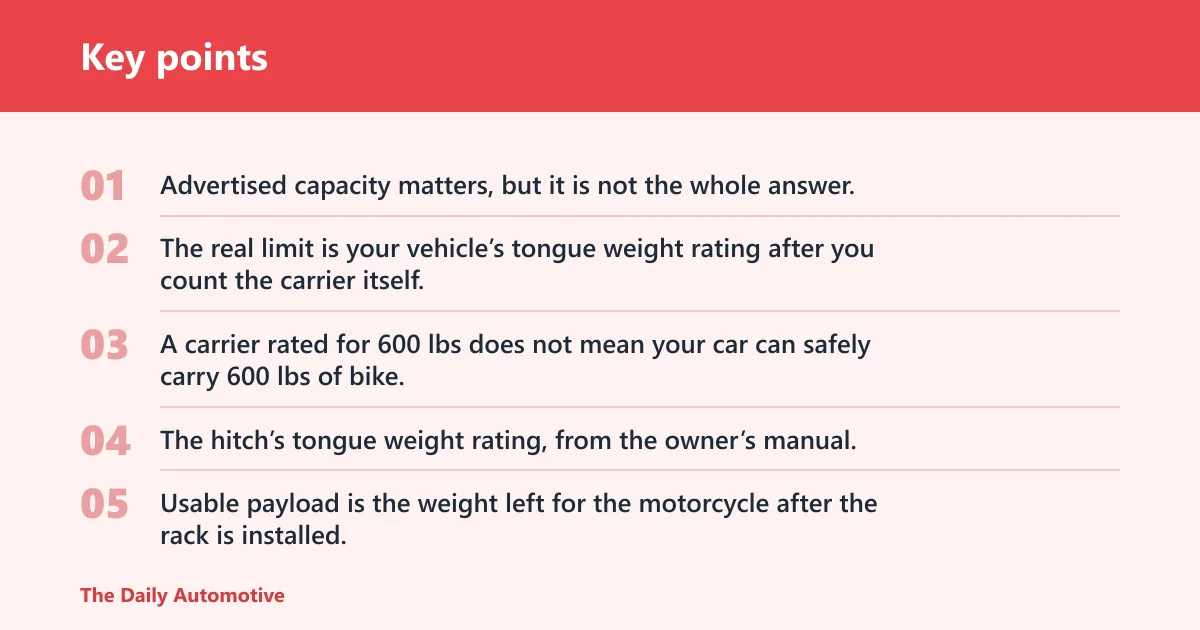


Advertised capacity matters, but it is not the whole answer. The real limit is your vehicle’s tongue weight rating after you count the carrier itself, and the bike’s type matters too: a dirt bike, a dual-sport, and a heavier street bike do not ask the same thing from the rack or the hitch.
Tongue weight versus carrier rating
A carrier rated for 600 lbs does not mean your car can safely carry 600 lbs of bike. The hitch’s tongue weight rating, from the owner’s manual, is the governing number because it includes the carrier’s own weight, the bike, and any accessories attached to the rack.
Why rack weight reduces usable payload
Usable payload is the weight left for the motorcycle after the rack is installed. A heavier steel carrier can be stiffer, but it also eats into the hitch limit faster than a lighter aluminum carrier. That is why the advertised max alone can mislead buyers.
Bike type changes the load plan
Dirt bikes usually fit carrier-mounted loading better because they are lighter and narrower. Street bikes can exceed practical limits faster, especially once you add a heavy rack and the rear overhang that works against the hitch. Dual-sports sit between those two and need the numbers checked, not guessed.
Moto rack table
Use this table as the fast filter. The advertised rating is only the starting point; the carrier weight, ramp length, and loading method decide whether the rack works for your bike and your hitch.
| Carrier | Advertised capacity | Estimated usable bike weight | Ramp length | Best for | Solo-loading risk |
|---|---|---|---|---|---|
| Mockins 83-inch tilting carrier | 500 lbs | Check the manufacturer’s listing for carrier weight before calculating usable load | 47 inches | Owners who want a tilting layout and a known loading ramp size | Moderate; shorter ramp means steeper loading unless the hitch height is low |
| VEVOR motorcycle carrier | 600 lbs total load | Check the manufacturer’s listing for carrier weight before calculating usable load | Check the manufacturer’s listing for ramp length | Heavier bikes where the hitch rating and rack weight still leave enough margin | Moderate to high until ramp length and anti-wobble hardware are confirmed |
| Black Widow MCC-600 | 600 lbs | About 500 lbs, using the listed carrier weight close to 100 pounds | About 71 inches | Bike owners who want a longer ramp and a higher-capacity steel carrier | Lower than short-ramp racks; longer ramp reduces lift angle for solo loading |
How to read the table
Based on the supplied data, the Black Widow usable payload estimate is about 500 pounds, since a 600-pound rating minus about 100 pounds of carrier weight leaves about 500 pounds for the bike and tie-down setup. For the other two, the safe move is to verify the rack’s own weight before you compare them to your hitch rating.
Best for heavy street bikes
The Black Widow MCC-600 is the strongest fit in this group for heavier street bikes because its 600 lbs rating pairs with a listed carrier weight close to 100 pounds and an about 71-inch ramp. That longer ramp lowers the loading angle, which matters more when the bike is tall or top-heavy.
Steel carrier strengths and tradeoffs
Steel carriers are common in the 500-600 lb class because they bring stiffness and load resistance. The tradeoff is weight. A steel carrier takes more of your tongue weight budget, and that can shrink the usable bike weight faster than buyers expect.
When capacity still is not enough
A 600 lb rating is not a green light for every large bike. If your vehicle’s tongue limit is modest, the rack itself may consume too much of the allowance. That leaves too little room for the motorcycle, the chock, and the straps needed to hold it steady.
Best for lighter bikes and rust resistance
An aluminum carrier is the better match when you want lower rack weight, easier handling during installation, and better corrosion resistance. That makes sense for lighter dirt bikes and smaller dual-sports, especially if the vehicle’s hitch limit is not generous.
Steel versus aluminum carrier tradeoffs
Steel usually gives you more rigidity and often lands in the 500-600 lb class. Aluminum usually saves weight, which helps preserve tongue-weight margin, but many aluminum designs top out lower. For a car, that weight savings can matter as much as the advertised capacity.
Where lower weight helps
If your vehicle sits low at the hitch or you need to remove the rack often, aluminum is easier to manage. It can also help with rear access on hatchbacks and SUVs because the rack is less punishing when you install or remove it by yourself.
Best for easier solo loading
The easiest rack to load alone is the one with the longest ramp you can physically handle, a stable anti-tilt or anti-rattle setup, and a front wheel chock that holds the bike straight while you strap it down. In this group, the Black Widow’s about 71-inch ramp is the most loading-friendly spec on paper.
Long ramp and tilt design benefits
A longer ramp lowers the approach angle. That reduces the chance of a stalled push, a dropped foot, or the front wheel running off line before it reaches the chock. A tilting carrier can also help, but tilt alone does not replace a long ramp.
Wheel chock and anti-rattle hardware
A wheel chock matters because it gives the front tire a fixed stop before you attach the straps. Anti-rattle or anti-tilt hardware matters because it cuts wobble at the receiver, which is where many highway problems begin. Without it, the bike and carrier can move more than they should.
How to choose the right carrier
Start with the vehicle manual and the hitch label, then work backward from the bike you want to carry. The right rack is the one that fits the hitch class, leaves enough tongue weight margin after rack weight is counted, and has a ramp and tie-down layout you can use without drama.
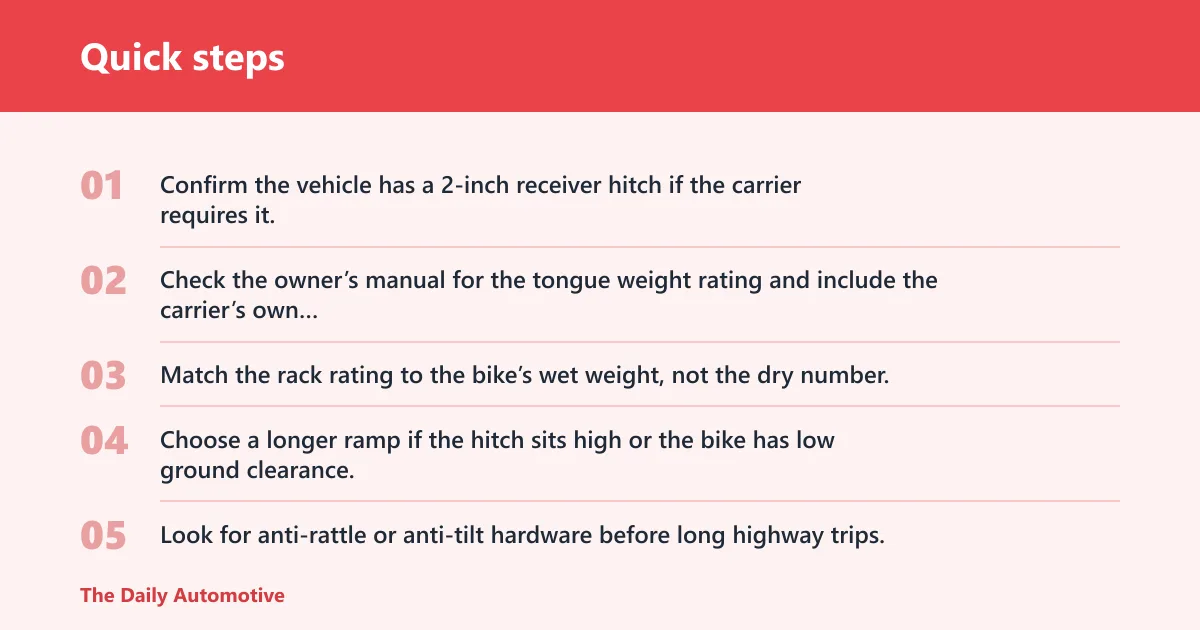
- Confirm the vehicle has a 2-inch receiver hitch if the carrier requires it.
- Check the owner’s manual for the tongue weight rating and include the carrier’s own weight in that limit.
- Match the rack rating to the bike’s wet weight, not the dry number.
- Choose a longer ramp if the hitch sits high or the bike has low ground clearance.
- Look for anti-rattle or anti-tilt hardware before long highway trips.
- Make sure the wheel chock fits your tire width and the tie-down points allow straps at multiple anchor points.
- Confirm whether a license plate holder is included, since rear visibility can be affected once the bike is loaded.
If a vehicle has a tongue weight rating of about 500 pounds and a rack weighs close to 100 pounds, there is far less room left for the bike than the advertisement suggests. That leaves far less room for the bike than the advertisement suggests, and a heavier steel model may be a poor fit even before you account for straps, chock hardware, or the bike’s fuel load.
Suppose you are carrying a dual-sport with a tall front end and a low rear hatch. A short ramp makes the loading angle steeper, which raises the chance that you need a second person to steady the bike. A longer ramp and a firm chock reduce that risk.
Will a 2-inch hitch hold a motorcycle carrier safely?
A 2-inch receiver is the common fitment standard for motorcycle carriers, but the receiver size alone does not make the setup safe. You still need the hitch class, the vehicle’s tongue weight rating, and the carrier’s own weight to line up. If any of those numbers miss, stop there.
What a 2-inch receiver means
Most guide examples use a 2-inch receiver hitch because many carriers are built around that standard. That helps with fitment, but fitment is not the same as load capacity. A 2-inch opening can still be attached to a vehicle with a tongue limit that is too low for the bike.
Why tongue weight is still the limiter
Tongue weight is the governing number because it is the load the rear of the vehicle can safely carry at the hitch. Since the carrier counts as part of that load, the advertised capacity has to be reduced by the rack’s own weight before you decide whether the setup is safe.
When to stop and check the owner’s manual
If the manual does not clearly support the loaded rack weight, do not assume the hitch will manage it. That rule matters even more on compact cars, crossovers, and older vehicles with aftermarket hitches that may not match the numbers you expect.
How much loading risk is acceptable?
For solo loading, the acceptable risk is the setup that gives you the most control on level ground, with enough ramp length to keep the angle manageable and enough hitch margin to avoid flex. If you need to fight wobble, shorten the load path, or guess at the tie-down points, the risk is too high.
Rear access for SUVs and hatchbacks
Vehicles with rear hatches need a rack that leaves enough room to open the back after loading, or at least enough clearance to access cargo before the bike goes on. A shorter rack can be easier to live with day to day, but it can also make loading steeper and less forgiving.
Failure modes that matter
Wobble is more than an annoyance. Loose hardware can let the carrier shift at the receiver. A short ramp can make the bike unstable before it reaches the chock. Paint wear and rust are slower problems, but they still point to a rack that needs better maintenance or better materials.
What is the best motorcycle hitch carrier for a car?
The best motorcycle hitch carrier for a car is the one that leaves the most real payload after rack weight, matches your hitch rating, and gives you enough ramp length to load without help.
Frequently asked questions
How much tongue weight do I need for a motorcycle hitch carrier?
You need enough tongue weight to cover the carrier plus the motorcycle with margin left over. The right number depends on the rack’s own weight, which is why a 600-lb carrier does not automatically mean 600 lbs of bike capacity. Check the manual and compare the loaded total, not the brochure number.
What is the difference between steel and aluminum motorcycle carriers?
Steel carriers are usually heavier and often land in the 500-600 lb class, which can help with rigidity. Aluminum carriers reduce rack weight and resist corrosion better, but they often leave less advertised capacity. The right material depends on your hitch limit and how often you install the rack.
Which motorcycle hitch carrier is easiest to load by yourself?
A carrier with a longer ramp, stable anti-wobble hardware, and a secure wheel chock is easiest to load alone. From the three compared here, the Black Widow MCC-600 stands out because its about 71-inch ramp lowers the loading angle more than a short-ramp setup.
Can a motorcycle hitch carrier carry a dirt bike and a street bike?
Yes, but not every carrier works for both. Dirt bikes are usually easier because they are lighter and narrower. Street bikes can push the limits quickly, especially once the rack weight is added. Dual-sports sit in between and still need the same hitch and payload check.
Do I need a longer ramp on a motorcycle hitch carrier?
Usually yes if the hitch sits high, the bike has low clearance, or you plan to load by yourself. A longer ramp lowers the angle and reduces the chance of stalling midway up. The Mockins 47-inch ramp is shorter, while the Black Widow’s about 71-inch ramp gives more loading margin.
What safety features should I look for in a motorcycle hitch carrier?
Look for anti-rattle or anti-tilt hardware, a wheel chock that fits your tire, multiple tie-down points, and a ramp long enough for the vehicle’s hitch height. A license plate holder is useful when the bike blocks rear visibility. Use the vehicle and product manual for the final setup.
Products related to this article
Sponsored / affiliate links. As an Amazon Associate I earn from qualifying purchases. I may earn additional commission from eligible campaigns.