Can You Negotiate the Price of a Dealer Extended Warranty?
Yes, dealer extended warranties are negotiable. Haggle the total contract price first, then work through the coverage, deductible, and term one by one. Skip that step, and you can pay too much for exclusions you do not need, or buy a contract that pays less than you expected. This guide shows which parts move the price, which questions to ask in the finance office, and when to walk away.
Can you negotiate the price of a dealer extended warranty?
Yes. The Consumer Financial Protection Bureau says extended warranties are optional add-on products, and it says the cost should be negotiated. Dealers can sell them, but the first menu price is rarely the final number. Treat the quote as an opening offer, not a fixed price. (Consumerfinance)
What the finance office is actually selling
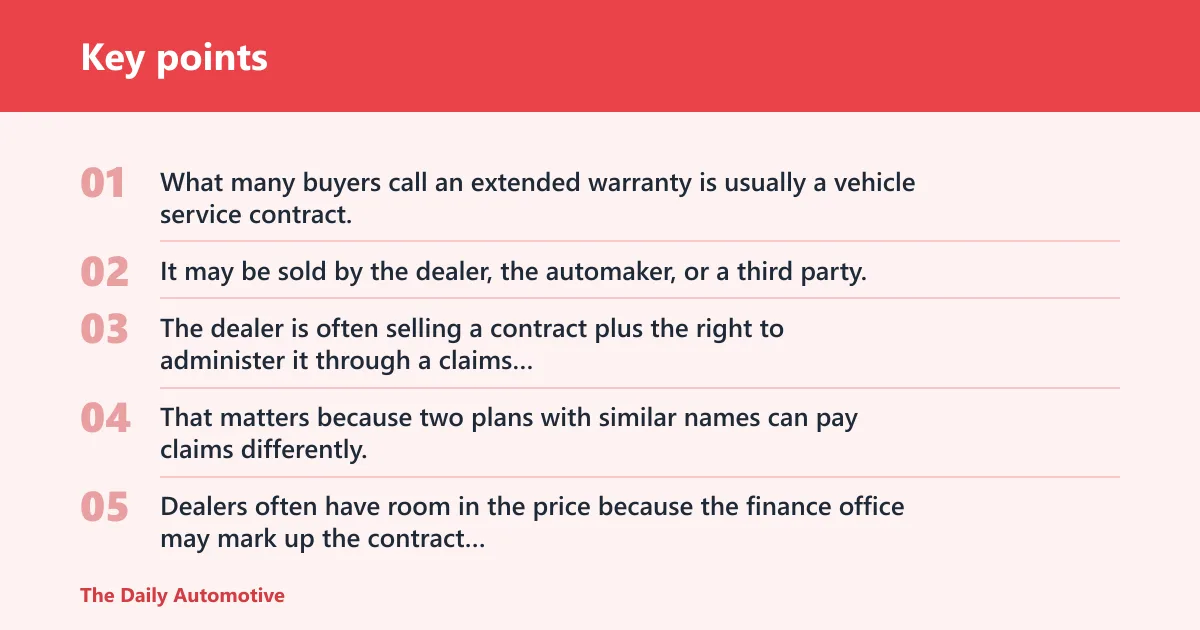
What many buyers call an extended warranty is usually a vehicle service contract, a separate product from the manufacturer’s warranty. It may be sold by the dealer, the automaker, or a third party, and the contract can cover certain mechanical and electrical parts while routine maintenance is usually excluded.
The dealer is often selling a contract plus the right to administer it through a claims company. That matters because two plans with similar names can pay claims differently, use different deductibles, and rely on different administrators.
Why the quoted price is rarely final
Dealers often have room in the price because the finance office may mark up the contract above its wholesale cost. That markup is where negotiation room comes from. The dealer may also present the plan as a small monthly addition instead of a clear total price, which can hide the real cost over the full term.
Ask for the total contract price before discussing payment amount. A low monthly figure can still mean a high total if the term is long or the contract is rolled into a financed amount with interest.
What to say before discussing monthly payment
Start with a direct question: “What is the cash price of the contract, and what is the administrator, deductible, term, and mileage limit?” That keeps the discussion on the product itself instead of the monthly payment. If the finance office shifts back to monthly cost, repeat the total and ask for the written contract details.
Dealer extended warranty pricing
Price depends on more than the badge on the hood. The same type of service contract can cost more or less based on the vehicle’s age, mileage, claim administrator, deductible, covered systems, and how long the contract lasts. U.S. News says extended coverage is generally written for years or miles, whichever comes first.
What drives the quote up or down
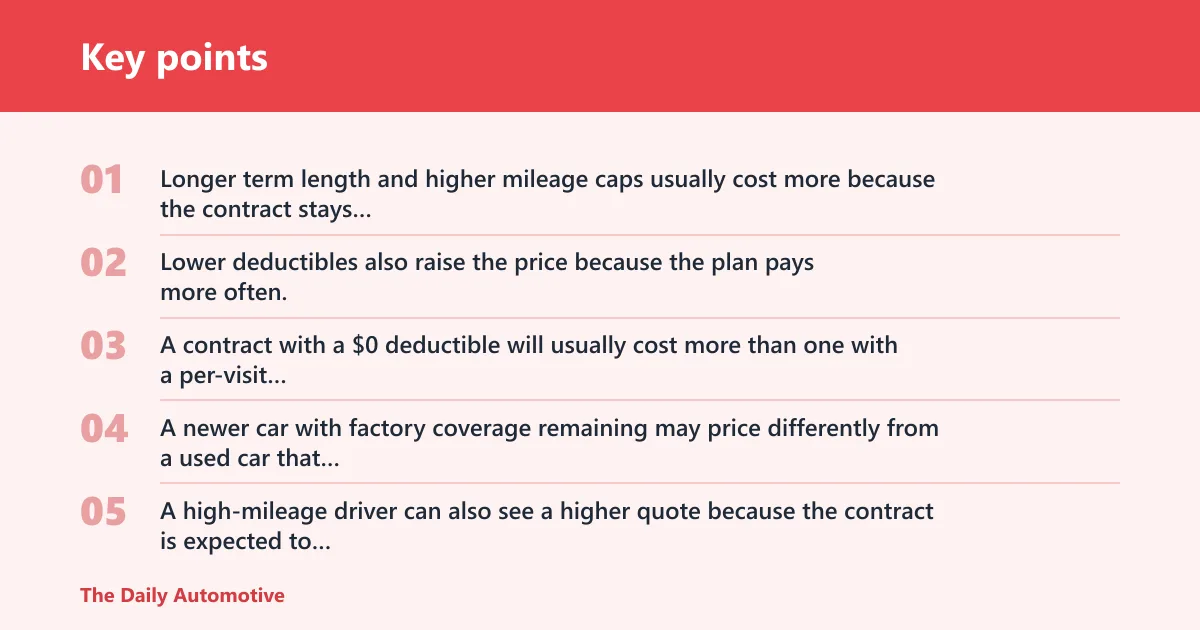
Longer term length and higher mileage caps usually cost more because the contract stays open longer and faces more repair exposure. Lower deductibles also raise the price because the plan pays more often. A contract with a $0 deductible will usually cost more than one with a per-visit deductible.
Vehicle age matters too. A newer car with factory coverage remaining may price differently from a used car that is already out of warranty. A high-mileage driver can also see a higher quote because the contract is expected to face more wear-related repairs, even when wear items themselves are excluded.
How deductible, term, and mileage change cost
Deductible is the amount you pay before coverage applies. It may be charged per visit or per claim, and that difference can change the economics of the plan. A per-visit deductible is often easier to compare because you know what each repair visit may cost.
Coverage term is the months or years of protection, plus the mileage cap, whichever comes first. If you drive 18,000 miles a year, a 5-year/60,000-mile plan may expire by mileage before the calendar ends. That should affect the value you assign to the quote.
Why the same plan can vary by dealer
Two dealers can quote different prices for what appears to be the same plan because they may use different markups, different administrators, or different contract menus. Factory-backed extended warranties can sometimes be price-shopped, and some dealers sell them over the phone. That is useful because a phone quote can give you a second number before you sign.
For example, one dealer may quote a 6-year/75,000-mile contract with a $100 deductible, while another may quote a similar term and deductible for less. The cheaper quote may be the better starting point, but only if the administrator, exclusions, and cancellation rules are similar.
Negotiate the contract, then the coverage
Do not negotiate only the monthly payment. Start with the total contract price, then adjust deductible, term length, mileage limit, and covered systems separately. That keeps the discussion concrete and makes it easier to compare one offer against another.
Start with the total contract price
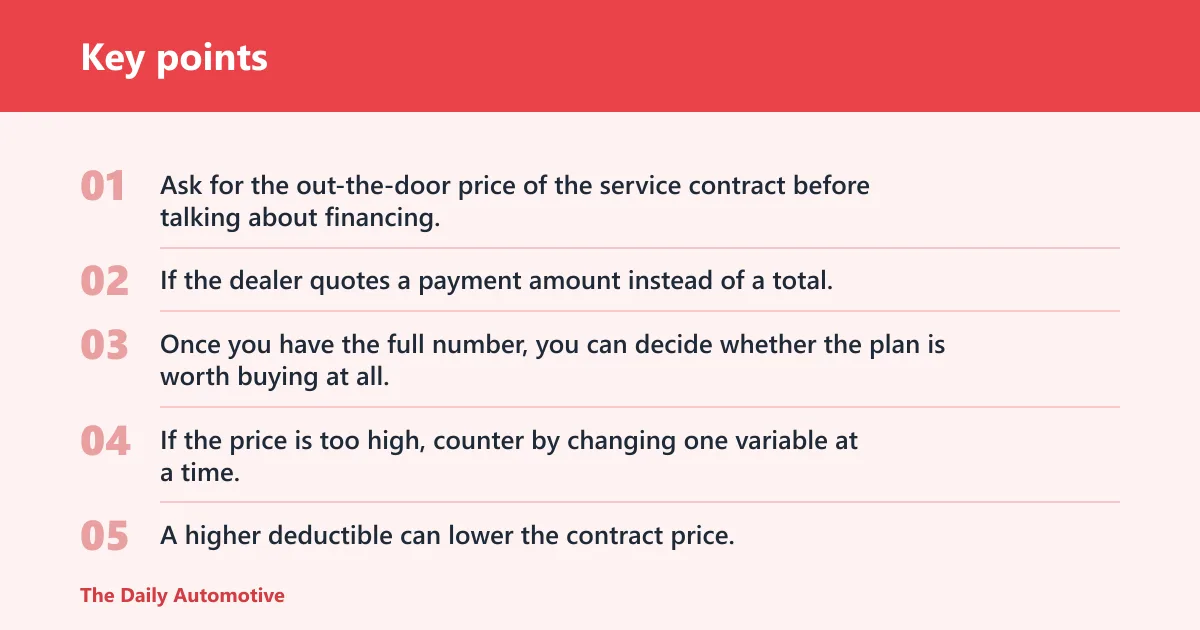
Ask for the out-the-door price of the service contract before talking about financing. If the dealer quotes a payment amount instead of a total, ask for the cash price in writing. Once you have the full number, you can decide whether the plan is worth buying at all.
Counter deductible and term separately
If the price is too high, counter by changing one variable at a time. A higher deductible can lower the contract price. A shorter term can do the same. A lower mileage cap can also reduce cost, but only if that limit still fits your driving pattern.
A common first-timer mistake is asking for “a cheaper warranty” without naming what should change. That invites the dealer to trim coverage in places you may not notice, while leaving the total price close to the original quote.
Check covered systems before agreeing
Coverage can be named-component or exclusionary. Named-component plans list the parts covered; exclusionary plans cover most mechanical systems unless specifically excluded. Either way, routine maintenance is usually excluded, and wear items often are too.
Before you agree, check whether the plan covers the systems most likely to cost real money on your vehicle, such as major electrical modules, infotainment hardware, air-conditioning components, or drivetrain parts. Also ask what counts as a covered failure and what counts as wear or pre-existing damage.
Warranty negotiation worksheet
Use this worksheet to compare a dealer quote with a target number and an outside quote. The goal is not to buy the cheapest piece of paper. The goal is to buy the contract that fits the vehicle, the mileage, and the administrator risk you are willing to accept.
| Quoted price | Target price | Deductible | Term/mileage | Covered systems | Cancellation window | Competing outside quote |
|---|---|---|---|---|---|---|
| $2,100 | $1,600 | $100 per visit | 72 months / 75,000 miles | Engine, transmission, steering, electrical, A/C | 30 days with full refund | $1,450 for similar term and deductible |
| $1,250 | $1,000 | $0 per claim | 48 months / 48,000 miles | Named-component plan: powertrain only | 60 days pro-rated after first 30 days | $1,050 with a $100 deductible |
- Write down the total price, not the monthly payment.
- Record the deductible and whether it applies per visit or per claim.
- Check the months, years, and mileage cap together.
- List the covered systems and any exclusions you can identify.
- Ask for the cancellation rule and refund timing in writing.
- Compare the same details against at least one outside quote.
- Walk away if the dealer will not separate price from coverage terms.
Simple walk-away rule: if the dealer will not give you the total contract price, the deductible rule, the exact term and mileage limit, and the administrator name in writing, do not sign.
Can you buy later instead?
Yes. The CFPB says service contracts can be purchased after the car is bought, so leaving the dealership does not always end your chance to buy coverage. That gives you time to compare dealer pricing with outside quotes and read the exclusions without pressure.
Buying after you leave the dealership
Waiting can help when you want to compare the dealer’s quote against a third-party service contract. It can also help if you need time to check the administrator’s financial reliability. Bankruptcy risk matters because the claims payer is the company you are really trusting, not just the sales desk.
Waiting can hurt if the car is already near the end of factory coverage, because some plans price higher as the vehicle ages or mileage climbs. If you expect to buy later, do not assume the price will stay flat.
Factory-backed plans versus third-party quotes
Factory-backed extended warranties can feel safer to some buyers because they are tied more closely to the automaker and are often easier to price-shop than people expect. Third-party plans can be cheaper or more flexible, but the administrator and exclusions deserve close review.
For lease buyers, the math is different. A lease may already end before major repair exposure rises, so a long service contract can be harder to justify unless the lease mileage is high or the vehicle’s technology package is expensive to repair.
What should you ask before signing?
Ask about the administrator, exclusions, deductible, cancellation rules, and claim process before paying. Those details decide what the contract actually does after the sale. The question is not whether the plan has a glossy name. The question is whether it pays when a covered part fails.
Is the administrator financially stable?
Find out who the claim administrator is and whether that company stands behind the contract. If the administrator is weak or hard to verify, the plan carries more risk. That is especially important on long terms, where the chance of a claim rises with age and mileage.
Which parts are excluded?
Check whether the plan is named-component or exclusionary. Then look for routine maintenance exclusions, wear-item exclusions, and any language that narrows electrical or infotainment coverage. A contract can sound broad and still leave out the exact repair that worries you most.
How are claims and cancellations handled?
Ask how a claim is filed, who approves it, and whether repair work must be done at a specific shop or dealer. Also ask about cancellation terms. Many contracts allow cancellation, but the refund may be prorated, and there may be a limited full-refund window.
Frequently asked questions
How much should an extended warranty cost at the dealer?
There is no single fair price, because the quote changes with the vehicle, term, mileage, and deductible. ConsumerAffairs lists average prices around $1,071 to $2,500 across sample plans, which is a useful comparison point, not a guaranteed dealer quote for your car.
Is a dealer extended warranty cheaper than buying later?
Sometimes, but not always. Buying later can help you compare dealer and third-party quotes without pressure, and the CFPB says service contracts can be purchased after the car is bought. Waiting can also backfire if the vehicle gets older or racks up more miles.
What should I ask before buying an extended warranty at the dealership?
Ask for the administrator name, the total contract price, the deductible rule, the exact months and miles, the covered systems, and the cancellation policy. Also ask whether the plan is factory-backed or third-party, since the administrator’s reliability matters if you ever file a claim.
Can I cancel a dealer extended warranty if I change my mind?
Often yes, but the refund terms vary. Some contracts allow a full refund only within a short cancellation window, then switch to a prorated refund. Get the cancellation language in writing before you sign, including whether any fees or time limits apply.
What’s the difference between a manufacturer warranty and a service contract?
A manufacturer warranty is included when you buy a vehicle and covers defects or failures for a fixed time or mileage. A service contract is an optional add-on, often sold as an extended warranty, and its coverage, exclusions, and administrator can vary widely by plan.
Are dealer extended warranties worth it on a new car?
Sometimes, but not automatically. New cars already include manufacturer warranty coverage, so the question is whether the added protection is priced well enough and covers enough beyond the factory plan. If the vehicle is reliable and you plan to sell it early, many buyers skip the add-on.
Do dealers mark up extended warranties?
Yes, they can. That markup is one reason the quote is negotiable in the finance office. If the dealer will not lower the total price, ask for the same contract details from another dealer or a third-party provider and compare the administrator, deductible, and coverage scope.
What coverage should I check before paying for an extended warranty?
Check the deductible, term length, mileage cap, covered systems, and exclusions. Routine maintenance is usually not covered, and wear items are often excluded. Pay special attention to whether the plan is named-component or exclusionary, because that changes what the contract will actually pay for.
Products related to this article
Sponsored / affiliate links. As an Amazon Associate I earn from qualifying purchases. I may earn additional commission from eligible campaigns.