NOCO Boost Plus Jump Starter Review: Is GB40 Worth It?
The NOCO Boost Plus GB40 is a compact jump starter intended for many gas cars and some small diesels, but it is not a full-size battery replacement or a fix for long-neglected batteries. Buy the wrong one and you can still be stranded, wait on a dead battery, or find the pack empty when you need it. This review focuses on charging speed, standby loss, ownership limits, and where the GB40 stops being the right choice.
This guide is part of our Car maintenance and repair guide series.
Bottom line on the NOCO Boost Plus GB40
Buy it if your vehicle fits its 12-volt, gasoline-to-6.0-liter or diesel-to-3.0-liter claim and you want a jump pack you can keep charged and ready. The GB40’s strength is readiness, not miracle recovery. It is a solid fit for a healthy battery that needs an emergency boost, and a weaker fit for batteries that sit discharged for weeks.
Verdict for most DIY drivers
For most DIY drivers, the GB40 makes sense as a first-response tool in the trunk or garage. It is light at 2.4 pounds, rated IP65, and built with a rubberized over-molded casing and high-discharge lithium technology, so it is easier to store than a lead-acid booster. Its value depends on whether you charge it before you need it.
Where its readiness claims are strongest
Its strongest case is a daily driver with a dead battery caused by a dome light, short-trip use, or a cold morning. NOCO says the pack can deliver up to 20 jump starts on a single charge, which is useful only if the pack itself stays charged and the vehicle battery is not too far gone to accept a normal start attempt.
Where owners should look elsewhere
Look elsewhere if you need repeated rescue for an aging battery, a large diesel, or a vehicle that sits outside through deep cold for long stretches. The GB40 can help with small diesels and many gas engines, but it is still a compact 12-volt jump starter. That matters when a battery has dropped too far or the engine demands more headroom.
Is the NOCO Boost Plus GB40 good for your car?
It is a good fit for many compact gas cars and some midsize SUVs, especially if the battery failure is occasional and the owner keeps the pack charged. It is a less comfortable match for larger gas engines, repeated winter starts, and diesel use near the top of its rating. Check the manufacturer’s listing for your exact engine and battery setup.
Compact gas cars and daily drivers
For compact gas cars, the GB40 is usually the most comfortable fit in this group. A smaller starter load gives the 1000A pack more margin, which matters when a battery is weak and the temperature is low. If the car is a daily driver with normal electrical load, this is the kind of vehicle the GB40 was built around.
Midsize SUVs and larger gas engines
Midsize SUVs can still be a fit, but the margin shrinks as engine size, battery age, and weather stress rise. The same source rates the GB40 for gasoline engines up to 6.0L, yet that is a ceiling, not a promise that every 6.0-liter engine will behave the same in every condition. A healthy battery helps the most.
Diesel use and cold-weather caution
Diesel owners should be stricter. The same source rates the GB40 for diesel engines up to 3.0L, and that is where cold cranking demand can make a compact pack feel thin. A common first-timer mistake is assuming “diesel up to 3.0L” means any 3.0L diesel in any weather. Deep cold and a tired battery can change the result fast.
What the specs mean in practice
The GB40’s headline numbers matter only if you translate them into use cases. The 1000A rating points to starting capacity, the 12-volt claim sets vehicle compatibility, and the weight, enclosure, and recharge details shape whether it stays ready between emergencies. Those are the numbers that affect ownership, not just the box copy.
1000A rating and 12-volt compatibility
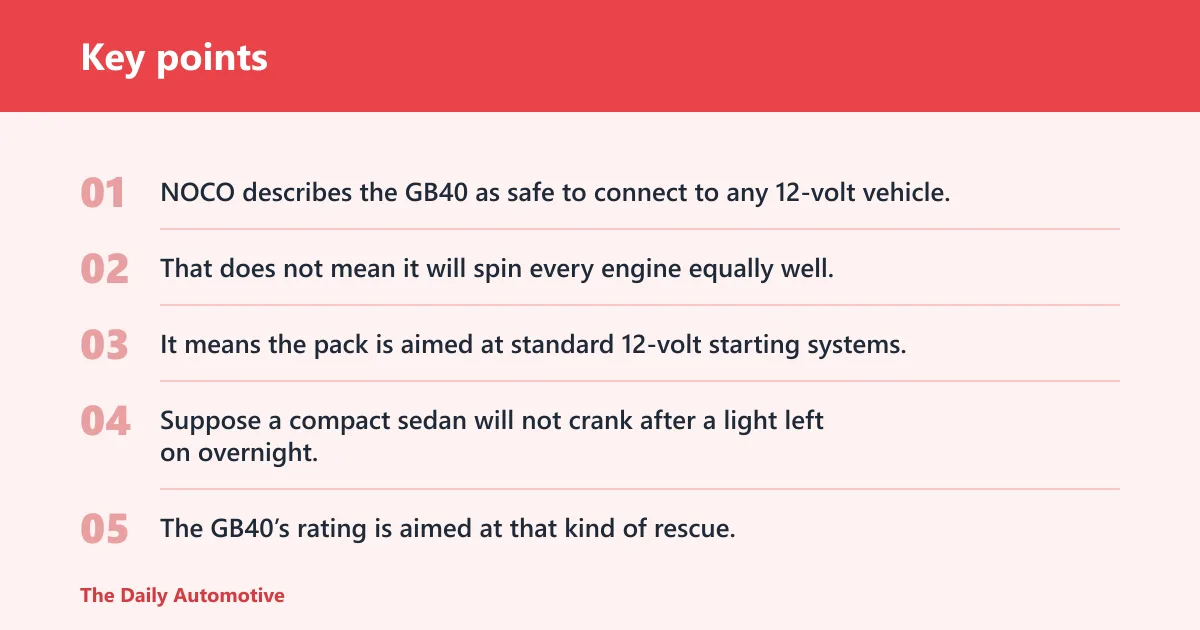
The same source describes the GB40 as safe to connect to any 12-volt vehicle, and it lists the unit as a 1000-amp lithium battery jump starter. That does not mean it will spin every engine equally well. It means the pack is aimed at standard 12-volt starting systems, with enough output for many gas engines and some smaller diesels.
Suppose a compact sedan will not crank after a light left on overnight. The GB40’s rating is aimed at that kind of rescue. Suppose a full-size gas truck with a deeply discharged battery has sat for two weeks in freezing weather. That is where the same rating can run out of headroom.
Up to 20 jump starts per charge
The same source says the GB40 can provide up to 20 jump starts on a single charge. That is a useful reserve for a family garage or roadside emergency kit, but it should be read as an upper claim, not a guarantee. Repeated cranking, cold weather, and a hard-to-start vehicle all eat into that reserve.
What the IP65 and 2.4-pound build mean
IP65 matters because roadside gear lives near dust, damp, and dirty trunk floors. The enclosure is also compact enough to carry at 2.4 pounds, which makes it much easier to keep in the vehicle than a heavier booster. The rubberized over-molded casing adds practical grip and protection from light knocks.
That build does not make it weatherproof in the way a sealed case would. It means the pack is more tolerant of everyday storage hazards, while still needing sensible care. Keep it dry, keep the ports clean, and do not leave it sitting loose where cargo can crush the clamps or cable ends.
How do you use the GB40 safely?
Use the GB40 by following the vehicle and product manual, checking clamp polarity before connection, and stopping if the battery appears damaged, swollen, leaking, or badly overheated. The pack’s safety system helps prevent common mistakes, but it does not turn battery work into a no-risk task. A dead battery can still be a bad battery.
Clamp order and polarity checks
- Make sure the vehicle is off and the transmission is in park or neutral, as applicable.
- Inspect the battery area for damage, leaks, or corrosion before attaching anything.
- Connect the clamps as directed by the GB40 and the vehicle manual.
- Check the connection status before attempting a start.
- Start the vehicle briefly, then remove the pack once the engine is running and the manual says to do so.
The UltraSafe system matters because it combines spark-proof technology, reverse polarity protection, and mistake-proof clamp connections. That helps reduce the chance of an obvious hookup error. It does not replace the manual’s connection order, and it does not solve a battery that cannot accept a jump in the first place.
When a battery is too far gone
Some batteries are not merely dead; they are too degraded to accept a normal jump-start attempt. In that case, the correct move is to stop and diagnose the battery, charging system, or cable condition rather than keep forcing jump attempts. If the battery case is hot, swollen, cracked, or leaking, do not keep trying.
Manual-first safety reminders
Jump-starting and battery work follow the manual’s connection order. Keep sparks away from fuel vapors, work in ventilation, and disconnect the battery when the repair procedure calls for it. If you are working around the battery tray or hold-down hardware, use the vehicle manual and avoid shortcuts that damage terminals or electronics.
How long does it take to charge and stay ready?
The GB40 charges quickly compared with older booster styles, but storage habits matter just as much as the recharge time. The same source says it recharges from a powered USB port in 3 hours at 2.1 amps. That is only useful if you actually return it to charge before the next emergency.
3-hour recharge at 2.1 amps
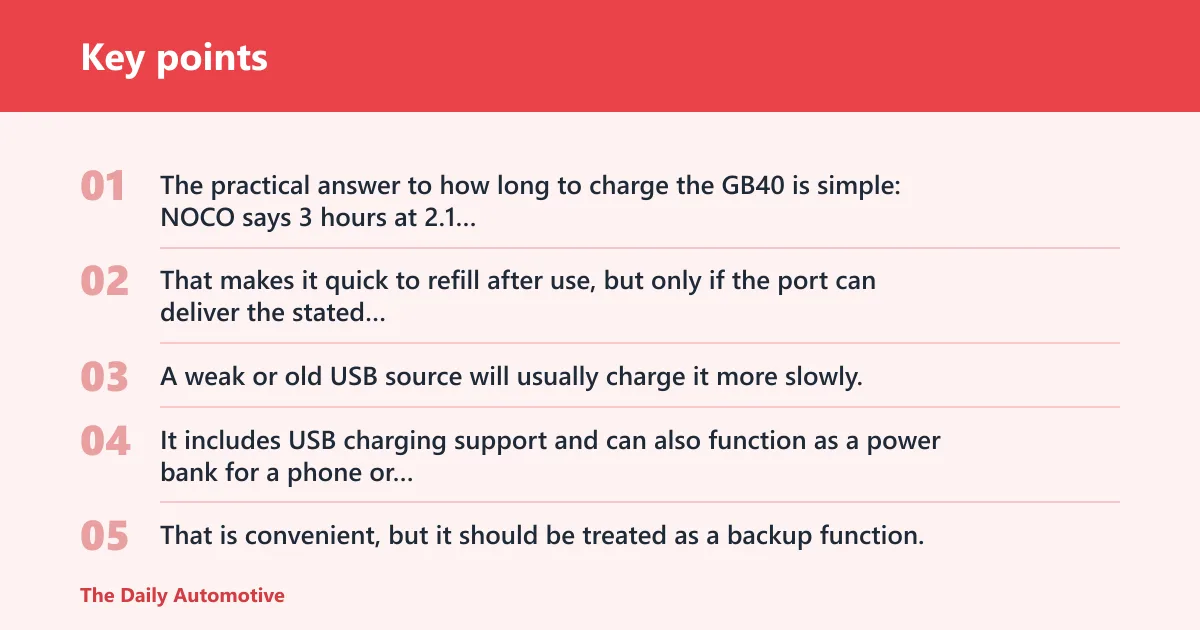
The practical answer to how long to charge the GB40 is simple: NOCO says 3 hours at 2.1 amps from a powered USB port. That makes it quick to refill after use, but only if the port can deliver the stated current. A weak or old USB source will usually charge it more slowly.
Can the NOCO Boost Plus charge a phone? Yes. It includes USB charging support and can also function as a power bank for a phone or tablet. That is convenient, but it should be treated as a backup function. The jump-start job is the main reason to keep it charged.
Recharge cadence for storage
If the pack lives in storage instead of daily use, plan on checking and topping it up on a routine cadence rather than waiting for it to die. The exact interval depends on storage temperature and how often it is moved or used. A sensible habit is to recharge after use and inspect it before long trips or winter weather.
Cold-weather and in-vehicle storage
Cold weather reduces battery performance across most lithium packs, so storage conditions matter. Autotrip lists the GB40 as operating from minus 20 to 50 degrees Celsius, but readiness still depends on how fully charged it is and how cold-soaked it becomes. In-vehicle storage is fine if the car stays reasonably protected, but a frozen trunk is harder on readiness than an indoor shelf.
Keep it where you can reach it fast. A glovebox is usually too small, and a buried trunk corner can waste time when you need a quick start. If you store it in the vehicle, make sure it is secured, not exposed to sharp cargo, and checked often enough that the battery is not forgotten.
NOCO Boost Plus readiness checklist
Use this section to decide whether the GB40 fits the vehicle and where to keep it ready. The point is not only whether it can jump-start an engine, but whether it will still be charged, reachable, and appropriate when the battery fails. If the pack sits empty, the rating stops mattering.
| Vehicle type | Likely fit for GB40 | Owner action if the battery is too far gone |
|---|---|---|
| Compact gas cars | Good fit for most 12-volt compact gas cars, especially with a healthy starter battery | Stop cranking, charge or replace the battery, and inspect terminals for corrosion or looseness |
| Midsize SUVs | Usually a fit if the vehicle is within the 6.0L gas claim and the battery is not deeply depleted | Use a battery charger or service test if repeated jump attempts are needed |
| 3.0L diesel | Possible fit, but cold weather and battery age matter more than the rating alone | Check battery health first; if it will not accept charge, replace it rather than keep jump-starting |
| 6.0L gas | At the upper edge of the stated gas limit, so fit depends on conditions and battery condition | Use only if the battery is sound; otherwise move to diagnosis instead of repeated jump attempts |
| Cold-weather storage | Fit depends on whether the pack is kept charged and protected from deep cold | Store indoors when possible, recharge after use, and verify charge before the first hard freeze |
Decision table: what to do if the battery is too flat
| Battery condition | GB40 response | Owner action |
|---|---|---|
| Normal dead battery after short parking | Likely a good match | Attempt a normal jump-start, then recharge the vehicle battery |
| Repeated no-starts over several days | May start once, but the vehicle battery likely needs attention | Test the charging system and battery health before relying on the pack again |
| Battery swollen, leaking, or hot | Do not attempt a jump-start | Stop and have the battery handled according to the vehicle manual and local safety rules |
| Battery too flat to respond | May not trigger a normal start attempt | Use the manual’s recovery or charging procedure, or replace the battery |
Mini charging FAQ for owners
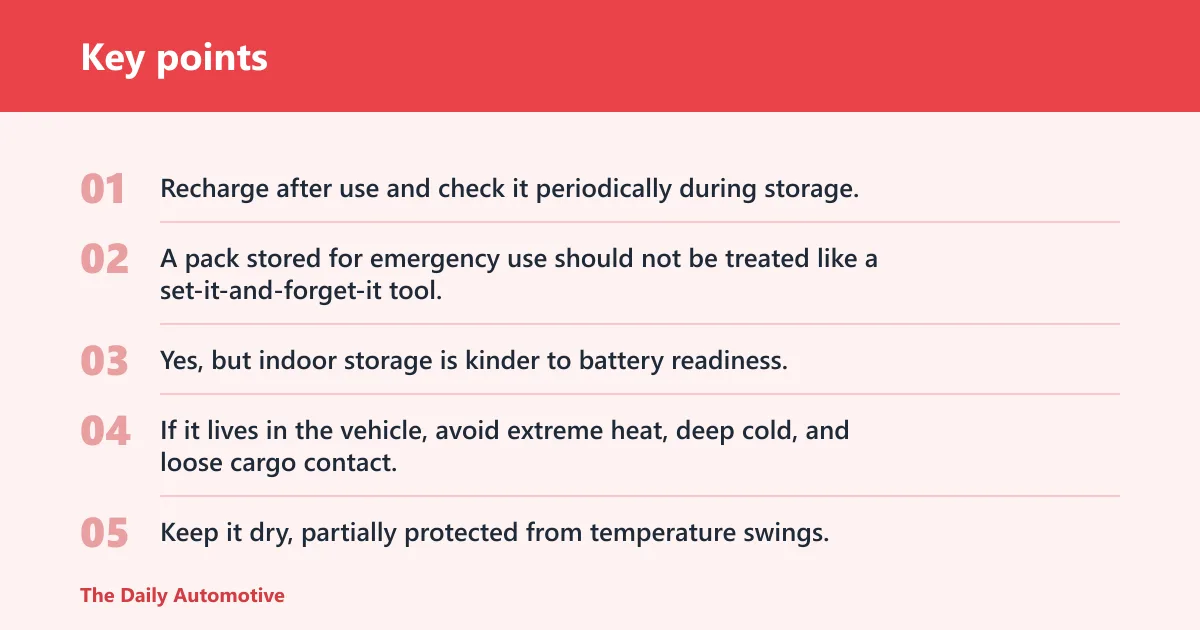
How often should it be recharged? Recharge after use and check it periodically during storage, especially before cold weather. A pack stored for emergency use should not be treated like a set-it-and-forget-it tool.
Can it stay in the car? Yes, but indoor storage is kinder to battery readiness. If it lives in the vehicle, avoid extreme heat, deep cold, and loose cargo contact.
What is the best storage habit? Keep it dry, partially protected from temperature swings, and ready to charge before long trips. If the vehicle sits unused for weeks, check the pack before you need it.
Pros and cons
The GB40 has a clear lane. It is a compact jump starter with real emergency usefulness, but it is still bounded by engine size, battery condition, and storage discipline. That trade-off is what most buyers need to understand before they pay for convenience.
Pros
- 1000A lithium jump starter with broad 12-volt compatibility
- Rated for gasoline engines up to 6.0L and diesel engines up to 3.0L
- Up to 20 jump starts per charge
- 3-hour recharge time at 2.1 amps
- 100-lumen LED flashlight with seven light modes
- 2.4-pound body with IP65 rating and rubberized casing
Cons
- At the upper edge of its claim on larger gas engines
- Diesel use leaves less margin in cold weather
- It depends on being kept charged and stored properly
- It cannot rescue every battery that is deeply worn out
Say your compact hatchback will not start after a weekend of short trips and a cold snap. The GB40 is the kind of pack that can make that problem manageable, because the failure is a typical dead-battery event rather than a high-demand rescue.
Frequently asked questions
How does noco boost plus work?
The GB40 delivers portable 12-volt jump-start power from its lithium battery through insulated clamps. The UltraSafe system adds spark-proof technology, reverse polarity protection, and mistake-proof clamp connections to reduce connection errors. It is meant for emergency starts, not as a battery replacement or a permanent fix for a failing charging system.
How to use noco boost plus battery charger
Connect it only as directed by the vehicle and product manuals, with the vehicle off and the clamps attached in the correct order. Check the indicator status before starting, then remove the pack after the engine is running and the manual says it is safe to do so. Do not use it on damaged batteries.
How long to charge noco boost plus
The same source says the GB40 recharges from a powered USB port in 3 hours at 2.1 amps. That figure assumes a suitable power source. Slower USB ports, low-output chargers, or degraded cables can lengthen the refill time, so the pack should be topped up before long storage periods.
How long does it take to charge a noco boost plus gb40?
The listed recharge time is 3 hours at 2.1 amps. Treat that as the planning number for routine ownership, then add a little margin if the source is weak or you are using a shared USB outlet. Recharge it after use so it is ready the next time the battery is flat.
Is the noco boost plus gb40 good for my car?
It is a strong match for many compact gas cars, some midsize SUVs, gasoline engines up to 6.0L, and diesel engines up to 3.0L. It is less suitable if your vehicle is outside those ranges, if the battery is badly degraded, or if you need a pack to sit unused for long stretches without checking it.
How many jump starts can the noco boost plus do on one charge?
The same source says up to 20 jump starts on a single charge. Real use can be lower if the starts are long, repeated, or done in cold weather. The safest reading is that the GB40 has enough reserve for multiple emergencies, but only if you keep it charged and the vehicle battery is still serviceable.
Can the noco boost plus charge a phone?
Yes. The GB40 includes USB charging support and can function as a power bank for phones and tablets. That feature is helpful on a roadside or during a power outage, but it should be viewed as secondary. Keeping enough reserve for a jump-start is still the main job.
What engine size can the noco boost plus start
The same source rates the GB40 for gasoline engines up to 6.0L and diesel engines up to 3.0L. Those figures describe the claimed fit range, not a guarantee in every climate or for every battery condition. Engine health, battery health, and temperature all affect whether the jump works on the first try.
Products related to this article
Sponsored / affiliate links. As an Amazon Associate I earn from qualifying purchases. I may earn additional commission from eligible campaigns.