Prepaid Car Maintenance Plan Review: Is It Worth It?
A prepaid car maintenance plan makes sense only if its price is lower than the scheduled services you will actually need before you sell, trade, or end the warranty period. Buy it without checking the math and you can pay for unused visits, duplicate coverage, or services you never keep the car long enough to use. This guide shows how to compare maintenance intervals, ownership horizon, resale timing, and dealer pricing before you sign.
What prepaid maintenance covers
Prepaid maintenance means paying in advance for scheduled service, not repair coverage. A dealer plan usually pays for routine items such as oil changes, filters, spark plugs, brake fluid, and tire rotations when the owner’s manual says they are due. If the contract matches your actual service needs, it can work. If it does not, you are prepaying for visits you may never use.
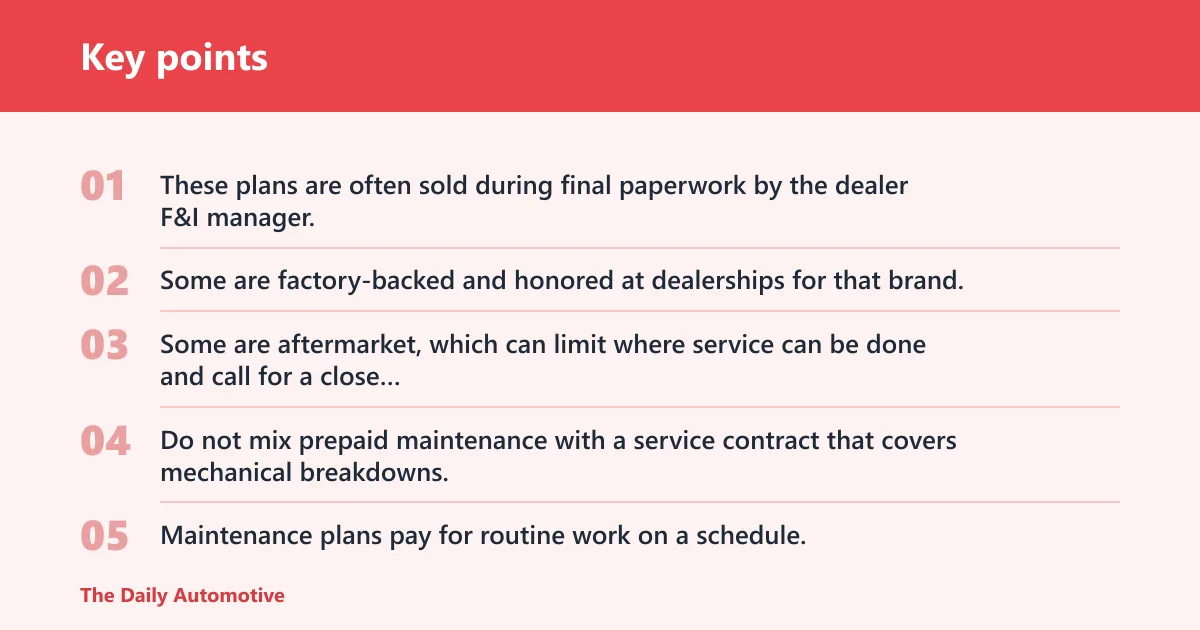
Some are factory-backed and honored at dealerships for that brand, with genuine OEM parts and factory-specified engine oil. Some are aftermarket, which can limit where service can be done and call for a close read of the fine print.
Scheduled service vs. repair coverage
Do not mix prepaid maintenance with a service contract that covers mechanical breakdowns. Maintenance plans pay for routine work on a schedule. They do not pay to replace a failed alternator, repair a transmission, or fix a broken compressor unless the contract says otherwise. That difference matters because buyers often compare the wrong products.
Typical included items and common exclusions
Plans often track the owner’s manual schedule for oil changes, filters, tire rotations, and sometimes brake fluid or spark plugs. Exclusions matter just as much. Prepaid plans usually do not cover brakes, tires, or wiper blades, and wear items often cost extra unless the contract says they are included.
Audi’s included coverage, for example, adds one brake fluid service along with up to three scheduled maintenance services for the first three years or 30,000 miles. Nissan maintenance care includes up to three oil changes within the first two years or 24,000 miles. Toyota models come standard with a two-year, 25,000-mile maintenance plan, and buyers can extend coverage up to five years. BMW’s scheduled maintenance plan covers three years or 36,000 miles, whichever comes first, and can be extended for two years or up to 39,000 miles. (Consumerreports)
Where dealer plans and aftermarket plans differ
Factory-backed plans are usually easier to use if you stay inside the brand’s dealer network. Aftermarket plans may not match dealer service coverage, and some restrict where the work can be done. Consumer Reports warns that some plans have restrictions on where work can be done, so the service location rule can matter as much as the price.
📊 BMW’s scheduled maintenance plan covers three years or 36,000 miles, whichever comes first. Source: Consumerreports.
How to compare it to your service schedule
The owner’s manual service schedule decides whether a plan matches the maintenance your vehicle actually needs. If the contract covers more intervals than you will reach, the value drops fast. If you drive enough miles to hit the included visits before you sell, the math can tilt the other way. Start with the manual, then check dealer pricing for each service interval.
Use the owner’s manual interval list
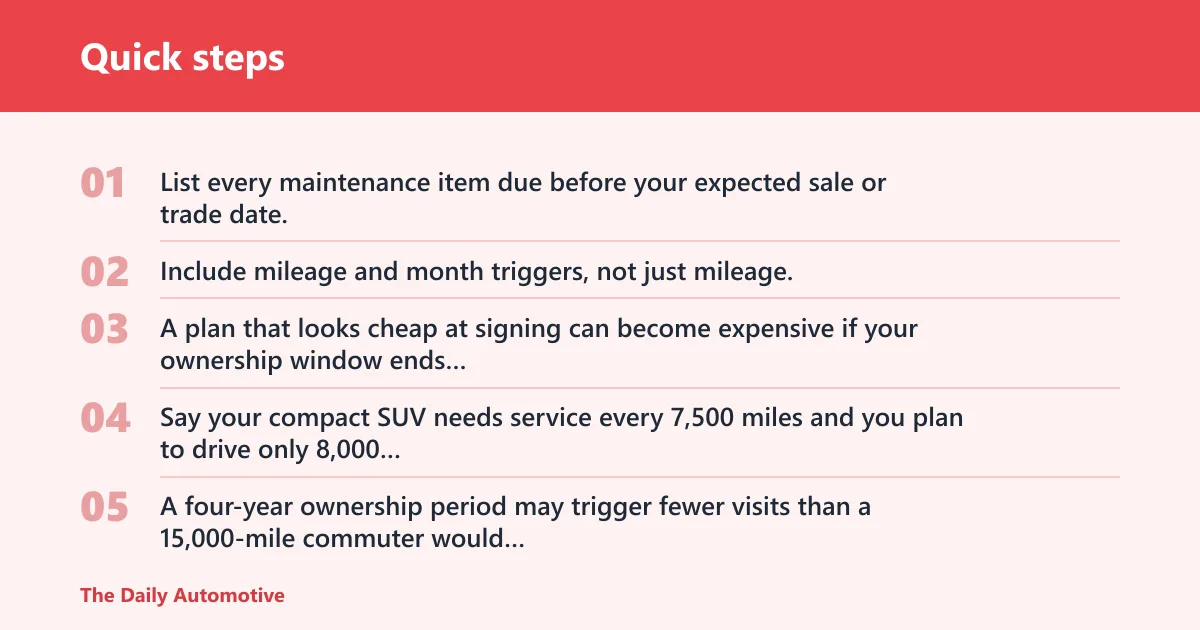
List every maintenance item due before your expected sale or trade date. Include mileage and month triggers, not just mileage. A plan that looks cheap at signing can become expensive if your ownership window ends before the second or third covered visit arrives.
Say your compact SUV needs service every 7,500 miles and you plan to drive only 8,000 miles a year. A four-year ownership period may trigger fewer visits than a 15,000-mile commuter would see in the same time. The plan’s real value depends on those intervals, not on the sticker price alone.
Check dealer pricing for each service visit
Ask the dealer for menu pricing on each covered visit before you buy the plan. Compare that total to the prepaid price. If the dealer says a visit costs about $89 and the plan covers four visits, the service-only total is about $356 before tax. If the plan costs more than that, you need a separate reason to choose it.
Suppose a midsize sedan needs a few routine services before a planned sale at around 30 months. If the dealer prices those visits at about $109, $109, $35, and $139, the pay-as-you-go total comes to about $392. The plan only helps if its prepaid price, plus any finance charge, stays below that number.

Is prepaid maintenance worth it?
It is worth it only when the contract fits your annual mileage, ownership horizon, and dealer pricing. Low-mileage owners often lose because they never use all the included visits. Average-mileage owners can break even if the schedule lines up neatly. High-mileage owners are the group most likely to find value, especially when dealer service prices are high.
Low-mileage owner verdict
For low-mileage drivers, the answer is usually no. If you drive far fewer miles than the plan assumes, you may not reach enough included services before resale. That is especially true if complimentary maintenance is already covering the first 2 to 3 years or 25,000 to 36,000 miles on a new vehicle.
Average-mileage owner verdict
For average-mileage owners, the answer is conditional. Compare the plan against the exact service intervals in the manual and count only the visits you will likely use before selling or trading. If the plan simply duplicates complimentary maintenance, or if resale comes before the covered schedule is exhausted, skip it.
High-mileage owner verdict
For high-mileage owners, the answer is more often yes, but only after checking the contract terms. More miles mean more scheduled visits, which can make prepaid pricing look better than paying per visit. Even then, the contract must still line up with the owner’s manual and must not exclude the services you actually need.
Should you finance the plan?
Rolling a maintenance plan into the auto loan can spread the cost out, but it also adds interest. That means the real price is not the menu price alone. Some buyers should pay cash if the plan is optional and the savings are small. A bundled plan can still work if the service savings are large enough to beat the extra interest.
How loan interest changes the total cost
Some plans can be bundled into an auto loan and paid monthly. That sounds convenient, but bundling means paying interest on the maintenance plan too. A $900 plan financed for five years at about 8% can cost more than $900 over time, and the gap can widen as the rate rises or the term lengthens.
A simple way to think about it: if the plan is financed, compare the prepaid sticker price to the loan amount plus the interest that extra amount will generate. The higher the APR and the longer the term, the less likely the plan is to win on cost alone.
When cash payment makes more sense
Cash makes more sense when the plan is modestly priced, the savings are small, or you expect to sell before using all the coverage. Paying cash also keeps the maintenance cost separate from the vehicle loan, which makes it easier to judge whether the plan truly pays off.
When a bundled plan can still work
A bundled plan can still work if you expect to keep the vehicle long enough to use every included service and the dealer’s menu pricing is clearly higher than the plan price. That is most common for drivers who rack up miles quickly and stay within the brand’s dealer network.
Maintenance breakeven worksheet
Use this worksheet to compare total prepaid cost against pay-as-you-go cost. Enter your own numbers, then use the verdict column to judge whether the plan fits your ownership pattern. The worksheet assumes the plan covers the listed services and that you can compare them to the dealer’s posted service prices.
| Input | Low-mileage owner | Average-mileage owner | High-mileage owner |
|---|---|---|---|
| Ownership months | 24 | 36 | 48 |
| Annual miles | 8,000 | 12,000 | 18,000 |
| Expected miles during ownership | 16,000 | 36,000 | 72,000 |
| Included services in plan | 2 oil changes, 2 tire rotations | 3 oil changes, 3 tire rotations, 1 brake-fluid service | 6 oil changes, 6 tire rotations, 2 brake-fluid services |
| Dealer per-service prices | $109 oil / $35 rotation | $119 oil / $39 rotation / $149 brake fluid | $129 oil / $45 rotation / $159 brake fluid |
| Dealer pay-as-you-go total | $288 | $563 | $1,104 |
| Prepaid plan price | $329 | $499 | $899 |
| APR if rolled into loan | 7.5% | 7.5% | 7.5% |
| Estimated interest on plan | $26 | $40 | $72 |
| Total prepaid cost with interest | $355 | $539 | $971 |
| Breakeven result | No | Yes, narrowly | Yes |
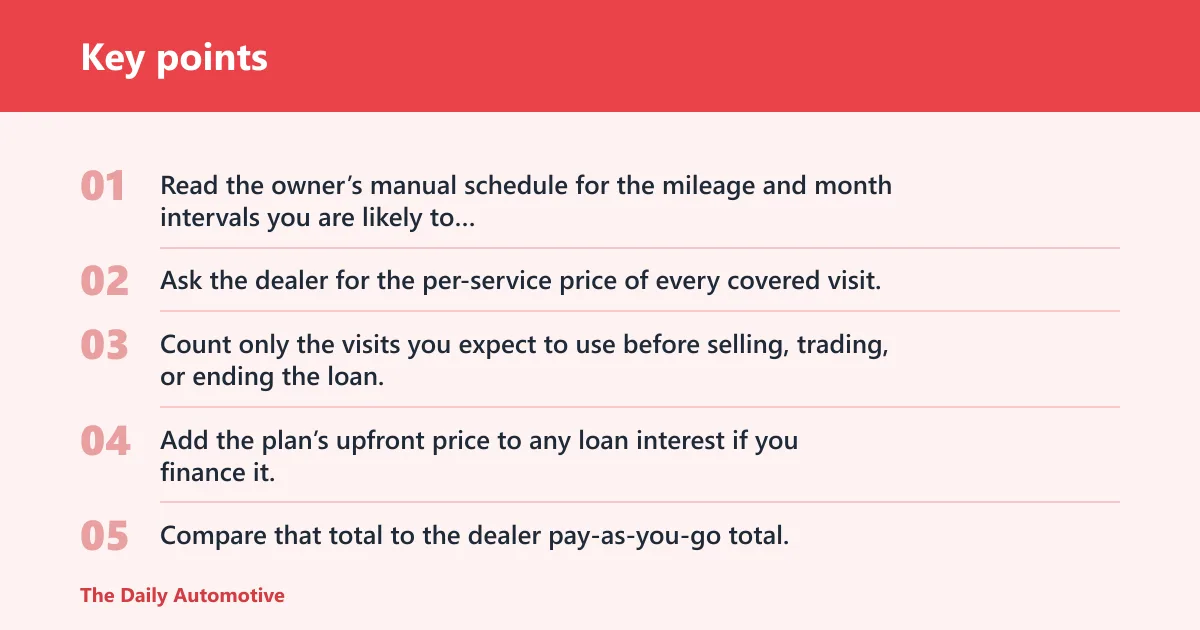
- Read the owner’s manual schedule for the mileage and month intervals you are likely to hit.
- Ask the dealer for the per-service price of every covered visit.
- Count only the visits you expect to use before selling, trading, or ending the loan.
- Add the plan’s upfront price to any loan interest if you finance it.
- Compare that total to the dealer pay-as-you-go total.
- If the plan does not beat the service total, pass on it.
A common first-timer mistake is buying the plan for a 36-month loan but keeping the car only 20 months. In that case, the buyer may never reach the third scheduled service, which turns the prepaid plan into an expensive unused benefit. Ownership timing matters as much as mileage.
Can you buy it later?
Yes, some prepaid maintenance plans can be bought after the car purchase, not only during signing. That can help if you want time to compare dealer pricing, read the contract, or confirm how much complimentary maintenance is already included. It also gives you a chance to see whether your driving pattern actually fits the plan.
Adding coverage after purchase
Buying later can reduce pressure during the finance office visit. It also helps if you need to compare several brands or dealer menus. Still, confirm that the post-sale price is the same, because some dealers price add-ons differently after delivery.
Transferability at resale
Some plans are transferable if you sell the car before the coverage expires. That can improve resale appeal, but it does not guarantee a higher sale price. Transfer rules should be written in the contract, along with any fee needed to move the coverage to a new owner.
When complimentary maintenance already covers you
New-car complimentary maintenance can already cover the early years of ownership. Toyota, BMW, Audi, and Nissan all publish brand-specific examples of included service, and those programs can reduce or eliminate the need for an add-on plan. If the complimentary plan covers the visits you would otherwise prepay, buying extra coverage is hard to justify.
Frequently asked questions
Are prepaid maintenance plans worth it?
Sometimes, but only when the contract matches your real service schedule and the dealer’s per-visit prices are higher than the prepaid total. Low-mileage drivers often lose money, while high-mileage drivers are more likely to come out ahead. Financing the plan can erase part of the savings.
What is prepaid maintenance on a car?
It is a plan you pay for before service is needed, usually covering scheduled maintenance such as oil changes, filters, tire rotations, spark plugs, and brake fluid. It is not the same as repair coverage for broken parts, and it usually does not cover wear items.
Car maintenance plan vs service plan: what’s the difference?
Dealers often use those terms loosely, so read the contract instead of relying on the label. In practice, both usually mean prepaid routine maintenance, while a separate service contract may cover repairs. The key question is whether the plan pays for scheduled service or mechanical breakdowns.
Is prepaid maintenance worth it if I use an independent mechanic?
Usually no, unless the contract explicitly allows outside service or your independent shop’s pricing is unusually close to the dealer’s. Most prepaid plans are built around dealer service rules, and some restrict where work can be done. If you prefer an independent shop, compare its prices directly to the plan.
What does a prepaid car maintenance plan usually cover?
Most plans cover routine maintenance on the owner’s manual schedule, such as oil changes, filters, tire rotations, and sometimes brake fluid or spark plugs. Coverage varies by brand and contract. Check whether factory-backed plans use OEM parts and factory-specified fluids, and whether your vehicle already has complimentary maintenance.
Do prepaid maintenance plans cover brakes, tires, or wiper blades?
Usually not. Prepaid plans typically exclude brakes, tires, and wiper blades, along with other wear items. Some brands may include a brake-fluid service, but that is different from replacing brake pads or rotors. Read the exclusion list before you assume any of those items are covered.
Products related to this article
Sponsored / affiliate links. As an Amazon Associate I earn from qualifying purchases. I may earn additional commission from eligible campaigns.