Tow Mirror Cost: What Drivers Actually Pay for Trucks
Tow mirror parts often run in the low hundreds per mirror, or roughly a few hundred to around a thousand-plus installed for a pair, depending on features like heat, power folding, turn signals, camera gear, and door wiring. I’ve seen jobs get paid twice when the wrong mirror went on first, then the shop had to fix dead functions, warning lights, or a leak around the door. This guide breaks down replacement and upgrade pricing by mirror features, truck and SUV complexity, labor, and the hidden charges that change the total.
How much do tow mirrors cost?
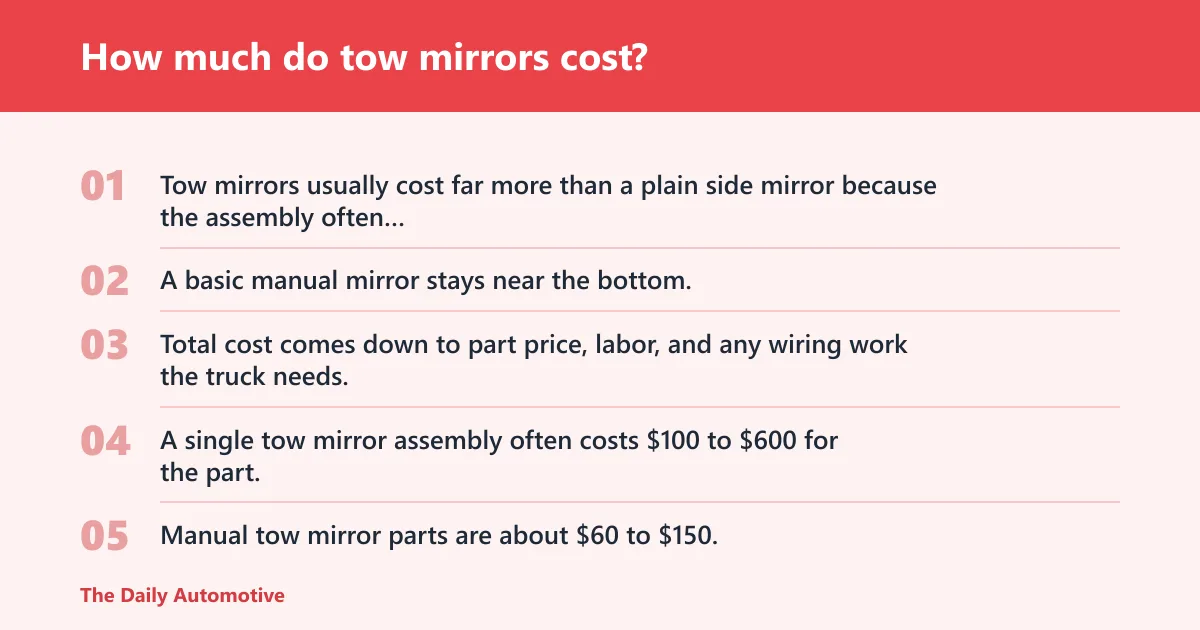


Tow mirrors usually cost far more than a plain side mirror because the assembly often includes motors, heaters, signals, fold motors, and heavier housings. A basic manual mirror stays near the bottom, then the price jumps fast once power or heated functions show up. Total cost comes down to part price, labor, and any wiring work the truck needs.
Part-only price ranges for single mirrors and pairs
A single tow mirror assembly often costs $100 to $600 for the part. Manual tow mirror parts are about $60 to $150, power-adjust tow mirror parts are about $100 to $250, heated tow mirror parts are about $150 to $300, and turn-signal and puddle-light mirror parts are about $175 to $350. Both sides together often cost $300 to $1,500 depending on brand and features.
Installed price versus DIY price
Labor commonly adds $50 to $200 per side, so a job can move from a parts-only purchase into a much larger invoice fast. Basic manual tow mirror installation is about $100 to $200 installed, power tow mirror installation is about $175 to $350 installed, heated and signal-equipped tow mirror installation is about $250 to $500 installed, and power telescoping or premium OEM tow mirror installation is about $400 to $800 or more installed.
Where manual and power mirrors usually land
Manual mirrors sit at the bottom of the price chart because they need less wiring and fewer compatible switches. Power mirrors cost more because the assembly and labor both rise. Once heating, turn signals, folding, telescoping, blind spot monitoring, or a camera are added, the job stops being a simple swap and turns into trim and electronics work.
📊 Manual tow mirror parts are about $60 to $150. Source: Tow Mirror Replacement Cost: Parts, Labor, and Savings.
What changes the price most?
Mirror features, truck complexity, and whether one side or both sides need work move the total more than the mirror shell alone. A basic truck with direct-fit manual mirrors is one thing. A late-model HD pickup with power-folding, heated, signal-equipped mirrors and a camera is another. That difference shows up in labor, adapters, and fitment time.
Mirror features that raise the bill
Power adjustment, defrost, integrated turn signal, puddle light, blind spot monitoring, camera, power-folding, and telescoping each add cost in parts or labor. The more the mirror talks to the truck, the more likely the shop must match connectors, switches, and modules. Even when the housing bolts on, the electrical side may not be plug-and-play.
Truck age, trim, and HD pickup pricing
Do tow mirrors cost more on newer trucks? Usually yes, because newer trucks often use more integrated electronics, tighter connector standards, and more trim pieces that slow the install. HD pickups also carry a premium. Their mirrors are larger, often feature-heavy, and more likely to need exact connector matching or programming after installation.
One-side replacement versus both sides
Replacing one side costs less on paper, but the shop still has to access the door, remove trim, and verify matching functions. If both sides are damaged or the owner wants symmetry, the total often climbs quickly. Both sides together often cost $300 to $1,500 depending on brand and features.
OEM or aftermarket: which costs less?
Aftermarket tow mirrors usually cost less than OEM tow mirrors, and OEM usually costs more because the part is built for exact fit and connector match. That extra cost can buy fewer surprises on newer trucks. Aftermarket can still be a smart buy if the truck uses a direct-fit design and the buyer knows which features are missing.
Why OEM tow mirrors usually cost more
OEM tow mirror assembly pricing sits in the higher tier because the part is built for exact vehicle fit and connector compatibility. That matters on newer trucks with heated glass, blind spot modules, cameras, or fold motors. Higher durability expectations also push OEM prices up, especially when the mirror must integrate with factory controls cleanly.
Direct-fit aftermarket versus upgrade-fit aftermarket
Direct-fit aftermarket mirrors are made to replace the factory unit with little drama. Upgrade-fit aftermarket mirrors can add more function than the original truck had, which sounds attractive until switches, harnesses, or modules are needed. The cheaper mirror can become the more expensive installation if the kit needs extra hardware.
Fitment and connector match issues
Connector mismatch is where buyers get burned. A mirror can bolt on and still fail to heat, fold, signal, or dim correctly. If the truck needs a different wire set or a missing switch panel, the part price no longer tells the real story. Fitment must be checked against year, trim, and factory options.
Labor cost and installation time

Labor commonly adds $50 to $200 per side, but access and electronics can push that higher. A simple mirror swap is a trim removal job. A loaded mirror can become a wiring and testing job. The more equipment inside the door, the more time a careful shop will spend opening, matching, and checking the system.
Trim removal and door-panel access
Most tow mirror jobs start with door trim or a door panel removal. That step adds time because clips, fasteners, and vapor barriers must come off and go back correctly. Loose trim can create wind noise or leaks later. On some trucks, access is straightforward. On others, the panel work is the real labor cost.
Wiring time, adapters, switches, and modules
Power tow mirror installs take longer because the mirror may need a new harness, a different switch, or a control module that the truck did not have before. Wiring adapters are common on upgrade jobs. If the mirror includes blind spot, camera, or folding functions, the shop may need more time to verify all circuits and warning lamps.
When calibration risk enters the quote
Calibration is not always needed, but it becomes a concern when a mirror includes camera gear or blind spot monitoring tied into vehicle electronics. Some trucks also require programming after module changes. That is why two quotes for the same mirror can look very different. One quote covers the bolt-on work; the other includes electronic setup and verification.
Decision table: what total cost should you expect?
The best way to price tow mirror cost is by mirror type, truck complexity, and install method. The assembly price alone misses wiring, trim access, adapters, and electronic setup. The table below gives realistic total ranges, including the hidden add-ons that usually move the final bill.
| Mirror type | Truck complexity | Install method | Likely hidden add-ons | Realistic total cost range |
|---|---|---|---|---|
| Manual tow mirror | Older truck, simple connector | Independent shop | Basic trim removal, clips, minor hardware | $100 to $250 per side |
| Powered tow mirror | Mainstream pickup, factory power option | Independent shop | Wiring adapter, switch check, door-panel access | $175 to $400 per side |
| Heated, signal-equipped tow mirror | Newer truck with more electronics | Shop install | Wire match, trim work, fault-code check | $250 to $550 per side |
| Power-folding or telescoping mirror | HD pickup or premium trim | Dealer or specialist | Module work, calibration risk, connector mismatch | $400 to $800 or more per side |
| Upgrade mirror with blind spot or camera | Late-model truck | Specialist shop | Programming, camera setup, extra harnesses | $500 to $1,000 or more per side |
Can you replace a tow mirror yourself?
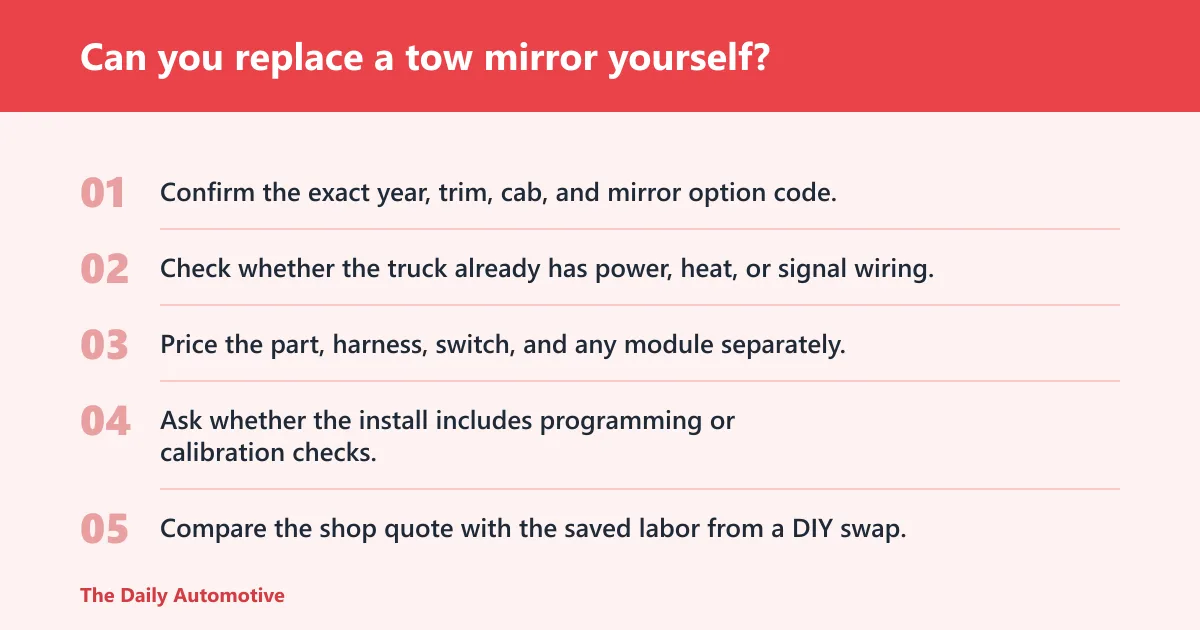
A DIY swap can save the full labor charge when the mirror is a simple direct replacement. That works best on manual mirrors or on trucks with easy door access and no extra electronics. Once the mirror includes heating, folding, signals, blind spot, or cameras, the savings shrink because mistakes become more likely.
What a DIY swap can realistically save
If labor commonly adds $50 to $200 per side, doing the job at home can save that amount on a basic setup. The catch is that the owner must still buy the correct part, the right hardware, and any missing clips or adapters. A cheap part plus a wrong connector is not a win.
Jobs that are simple enough for home tools
Manual mirror replacements on older trucks are the easiest. If the mirror bolts in, the connector is simple, and the door panel comes off without drama, a careful owner can do the work with basic hand tools. The job still needs patience, because damaged clips and torn vapor barriers create their own repair bill.
When to stop and let a shop handle it
Stop and book a shop when the mirror has power-folding, telescoping, blind spot, or camera features, or when the truck needs coding after installation. Also stop if the door wire loom is buried behind heavy trim and the owner does not want to risk a broken panel clip or an electrical fault. That is where DIY often turns expensive.
- Confirm the exact year, trim, cab, and mirror option code.
- Check whether the truck already has power, heat, or signal wiring.
- Price the part, harness, switch, and any module separately.
- Ask whether the install includes programming or calibration checks.
- Compare the shop quote with the saved labor from a DIY swap.
When does tow mirror replacement get expensive?
Tow mirror replacement gets expensive when the truck uses newer electronics, the mirror has multiple powered functions, or the shop must code a module after installation. Dealers usually charge more than independents, but both can become pricey once the job includes harnesses, trim work, and verification of warning systems.
Newer trucks and connector-heavy designs
Do tow mirrors cost more on newer trucks? Usually yes, because newer designs often use more specific connectors and more factory integration. That raises labor time and the chance of needing an adapter or module. Older trucks usually keep the job simpler, especially when the replacement is a basic manual unit.
Blind spot, camera, and power-folding systems
Blind spot mirrors, camera-equipped mirrors, and power-folding mirrors cost more because failure is not limited to a dead motor. They can trigger fault lights or leave features inoperative if the replacement is not matched properly. Those systems also raise the risk of calibration or programming charges after installation.
Dealer pricing versus independent shop pricing
Dealers often price higher because they use OEM parts and follow factory procedures more closely. Independent shops may price lower, especially on direct-fit aftermarket mirrors, but buyers should ask what is included. A lower quote that excludes harnesses, trim clips, or programming can end up higher than the dealer ticket.
How much are tow mirrors for my truck model?
Truck model matters as much as mirror type. A Ford F-150, Silverado 1500, and HD pickup do not price the same way, even if the mirror looks similar from the outside. Parts availability, connector style, and feature packaging all shape the quote, and a trim-level mismatch can change the total fast.
Model-specific pricing signals to watch
Boost Auto lists 2019-2026 Chevy Silverado 1500 Tow Mirrors at from $634.43, and Boost Auto lists Ford F150 (2021-2026) New Style Tow Mirrors from $504.13. Those examples show how modern truck fitment and feature content can lift part prices before labor even starts.
Replacement versus upgrade pricing
Owners replacing a damaged mirror usually pay less than owners upgrading from a basic mirror to a tow mirror setup. The upgrade path can need new switches, harnesses, or module support. A direct replacement is usually simpler because the truck already has the right wiring and control logic in place.
Frequently asked questions
How much do tow mirrors cost?
Tow mirror replacement typically runs about $150 to $800 per side. A single tow mirror assembly often costs $100 to $600 for the part, and labor commonly adds $50 to $200 per side. The total climbs quickly when the mirror has heat, power-fold, signal, or camera functions.
What affects tow mirror replacement cost?
The biggest factors are mirror features, truck model, year, and whether the job is one side or both sides. Wiring adapters, trim removal, door-panel access, and calibration risk also change the total. A simple manual mirror on an older truck is far cheaper than a loaded mirror on a newer HD pickup.
Are tow mirrors cheaper aftermarket or OEM?
Aftermarket tow mirrors are usually cheaper than OEM tow mirrors. OEM parts typically cost more because fit and connector match are tighter, and durability expectations are higher. Aftermarket direct-fit mirrors can save money, but upgrade-fit versions may need extra wiring, switches, or modules that narrow the savings.
How much does labor add to tow mirror replacement?
Labor commonly adds $50 to $200 per side. Simple jobs stay near the low end, while mirrors with heating, turn signals, power folding, or cameras take longer. Door-panel access, connector work, and testing the finished functions all add to the billed time.
Can I replace a tow mirror myself?
Yes, if the mirror is a direct-fit manual or simple power unit and the truck is easy to access. DIY can save labor, but it does not save money if the wrong part is ordered or a clip breaks. Feature-heavy mirrors are better left to a shop that can verify wiring and functions.
Do tow mirrors cost more on newer trucks?
Usually yes. Newer trucks often use more electronics, more specific connectors, and more factory integration, which raises labor and parts complexity. That is especially true for heated, signal-equipped, blind spot, camera, and power-folding mirrors. Older trucks tend to be simpler and cheaper to service.
Products related to this article
Sponsored / affiliate links. As an Amazon Associate I earn from qualifying purchases. I may earn additional commission from eligible campaigns.