
Are Extended Car Warranties Worth It?
Extended car warranties are worth it only when the contract price is lower than the repair risk you are likely to face, the car has a solid repair record, and you plan to keep it after factory coverage ends. Buy the wrong plan and you can still pay thousands through exclusions, deductibles, and claims that never cover the full bill. This guide shows when to buy, when to skip, and how to compare the quote against paying for repairs yourself.
Extended warranty decision table
Use mileage, how long you plan to keep the car, and how much repair risk you can absorb yourself. Start with the table below, then compare the quote against your deductible, the waiting period, and the repairs most likely for your vehicle.
| Buyer profile | Estimated value signals | Likely exclusions or friction points | Buy or skip |
|---|---|---|---|
| New low-mileage car | Strong factory warranty still in place; lower near-term repair exposure; owner can usually build a repair fund instead | Waiting period on the plan; exclusions for wear items and preexisting conditions; deductible can erase small-claim value | Skip unless you plan to keep it well past factory coverage or want a specific add-on you cannot get elsewhere |
| Used car over 60,000 miles | Higher chance of costly repairs; more value if the car has known expensive weak points and limited remaining factory coverage | Maintenance gaps can trigger denials; older parts may already show wear; some plans narrow coverage on high-mileage vehicles | Consider buying, but only after checking the contract price against likely repair exposure |
| High-repair-risk luxury or complex vehicle | Higher repair labor and parts costs; more systems that can fail, including electronics and air conditioning | Luxury-specific exclusions, shop authorization rules, and parts-use limits; some third-party plans cap labor rates or reimbursement | Often worth quoting if the plan covers your risk areas and the deductible is reasonable |
| Reliable mainstream car | Lower repair probability; easier to self-insure with a dedicated repair fund | Plan cost may exceed likely claims; routine maintenance and cosmetic issues are excluded anyway | Usually skip and self-insure unless mileage is high or the vehicle has a known costly defect pattern |
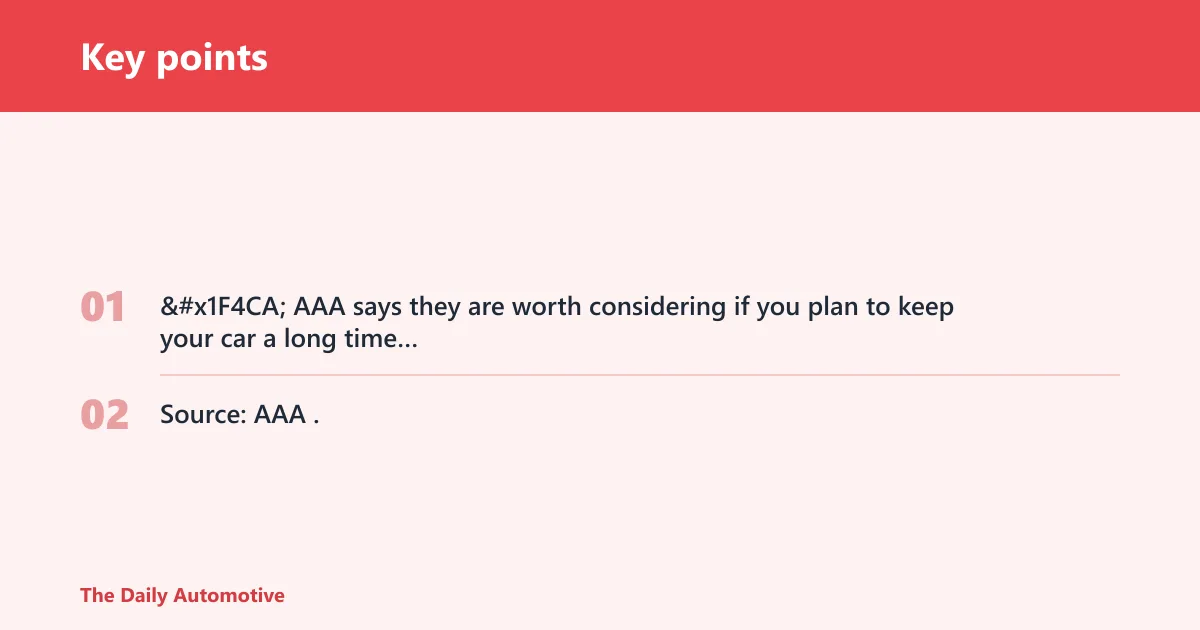
📊 AAA says they are worth considering if you plan to keep your car a long time or drive beyond higher-mileage points. Source: AAA.
What an extended car warranty actually
An extended car warranty, also called a vehicle service contract, is optional coverage that begins after factory warranty protection ends. Most plans are term-based or mileage-based, and the value depends on how long you will keep the car, how many miles you will drive, and what repairs the contract actually includes.
Factory warranty vs. extended coverage
A new car comes with a bumper-to-bumper warranty and a drive train warranty, so extended coverage usually starts only after those factory protections expire. That matters because you should not pay twice for the same coverage window. The question is where the factory coverage ends and your repair risk begins.
Powertrain vs. bumper-to-bumper coverage
Powertrain coverage focuses on major mechanical parts such as the engine and transmission, while bumper-to-bumper coverage is broader and can include electrical systems and air conditioning. If you are shopping an older vehicle, powertrain coverage is often the minimum worthwhile level. Bumper-to-bumper plans usually cost more.
Term-based and mileage-based contracts
Many contracts expire by time, mileage, or both. That means the plan can run out before you expect it to if you drive a lot. AAA says extended warranties are worth considering if you plan to keep your car a long time or drive beyond higher-mileage points.
Are extended car warranties worth it?
Sometimes. Compare the contract price, the deductible, and the repair risk across the years you plan to keep the car. If the plan costs more than the repairs you would likely pay yourself, it is a poor value. If one covered failure would be expensive enough to change the math, the plan can make sense.
The break-even test: price, deductible, and repair risk
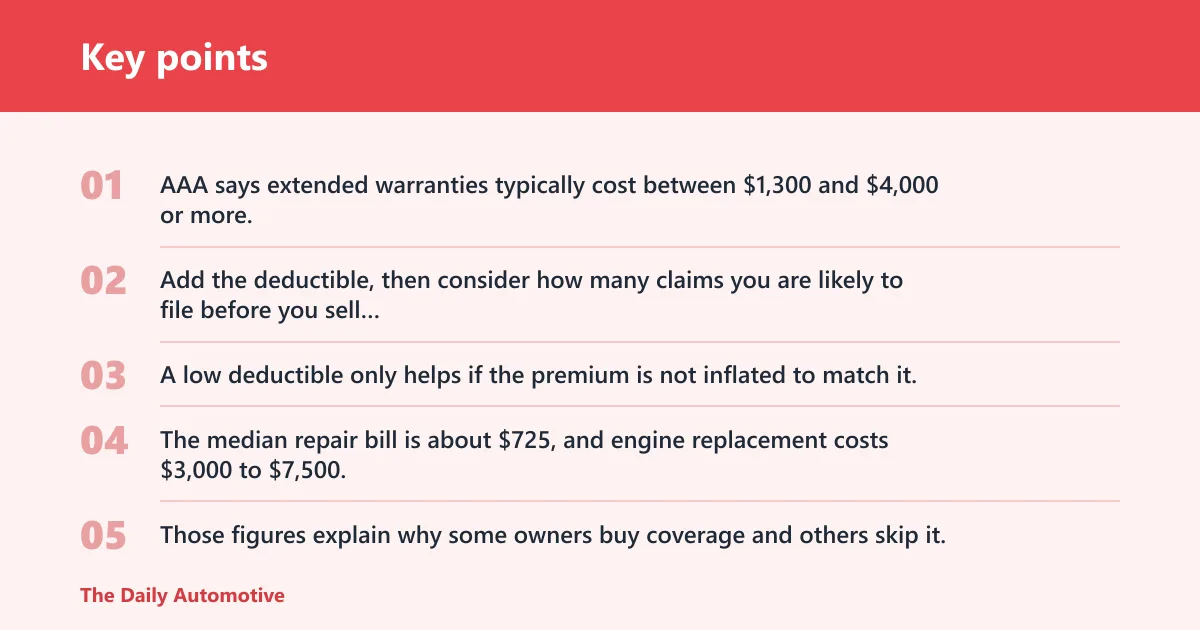
AAA says extended warranties typically cost between $1,300 and $4,000 or more. That cost does not stand alone. Add the deductible, then consider how many claims you are likely to file before you sell the car. A low deductible only helps if the premium is not inflated to match it. (AAA)
Repair exposure is real. The median repair bill is about $725, and engine replacement costs $3,000 to $7,500. Transmission repair costs $1,800 to $6,500. Those figures explain why some owners buy coverage and others skip it.
When self-insuring makes more sense
Self-insuring means setting aside money for repairs instead of paying a contract premium. That usually makes more sense for a reliable mainstream car, a low-mileage car still under factory warranty, or any owner with enough emergency savings to absorb a surprise bill. If the expected claims are small, the contract can drag down value.
When coverage can pay off
Coverage can pay off when the car is out of factory warranty, the mileage is climbing, and the vehicle has repair patterns that tend to be expensive. Say your six-year-old luxury sedan has 82,000 miles, a history of electrical glitches, and you plan to keep it three more years. A service contract may be worth pricing carefully.
What do these plans cover and exclude?
Extended warranties can cover the engine, transmission, drivetrain, electrical system and air conditioning, but every contract narrows that coverage in some way. The parts list matters more than the marketing language. Read the exclusions before you compare prices, or you may pay for a plan that misses the repair you actually fear.
Common covered parts and systems
Car and Driver notes that repairs can include the engine, transmission, gaskets, and axles. Some plans also add roadside assistance, which can include towing, gas delivery, flat tires, and dead batteries. Others include rental car reimbursement or even hotel cancellation help during trip interruption, but those extras should not drive the decision by themselves. (Caranddriver)
Typical exclusions and denial triggers
Extended warranties do not cover pre-existing conditions, routine maintenance or cosmetic defects. Wear-and-tear items are commonly excluded too. Claims can also be denied if the car did not meet the contract’s service rules, if the problem began before the waiting period ended, or if maintenance records are missing.
A common first-timer mistake is assuming “electrical coverage” means every dash warning is paid. It does not. If a fault traces back to a preexisting issue, bad maintenance, or a part that is excluded by name, the claim can still be denied.
Waiting periods and maintenance records
Extended warranties often have a 30-day and 1,000-mile waiting period before claims. That blocks immediate repairs on a recently purchased plan. If you buy coverage after the sale, you still need to hold off before filing many claims, and you need proof that scheduled maintenance was kept up.
Are dealer extended car warranties worth it?
Dealer plans can be worth it, but the sticker price is often marked up, so the quote should be treated as negotiable. Compare the dealer offer against a direct provider, then check what you lose or gain in shop choice, parts rules, transferability, and fees. The best plan is the one that fits your car and your repair network.
Dealer markup and room to negotiate
At the dealership, the first price is often not the last price. Ask for the contract name, the deductible, the exclusion list, and the cancellation terms before you discuss payment. If the dealer cannot explain how the plan differs from a direct-provider quote, that is a warning sign.
Manufacturer plans vs. third-party providers
Manufacturer-backed plans can feel simpler because they usually mirror the brand’s service structure. Third-party warranty provider plans may allow more repair-shop flexibility, but they can also require authorized shops or aftermarket parts in some cases. Transferability and fees can differ, so both the contract and the claims process matter.
Shop choice, parts, and transferability
Some third-party plans are easier to transfer when you sell the car, which can help with resale value. Others charge transfer fees or restrict where repairs can be done. Before you sign, ask whether the provider pays the shop directly, whether it limits parts sources, and whether you must seek approval before work starts.
When should you buy coverage?
Buy coverage when the remaining factory warranty is short, the car has crossed a mileage point where repairs are commonly more likely, and the contract still leaves room for value after the deductible and exclusions. For many owners, a higher-mileage point is a practical checkpoint, but the car’s history matters more than any single number.
New cars versus used cars
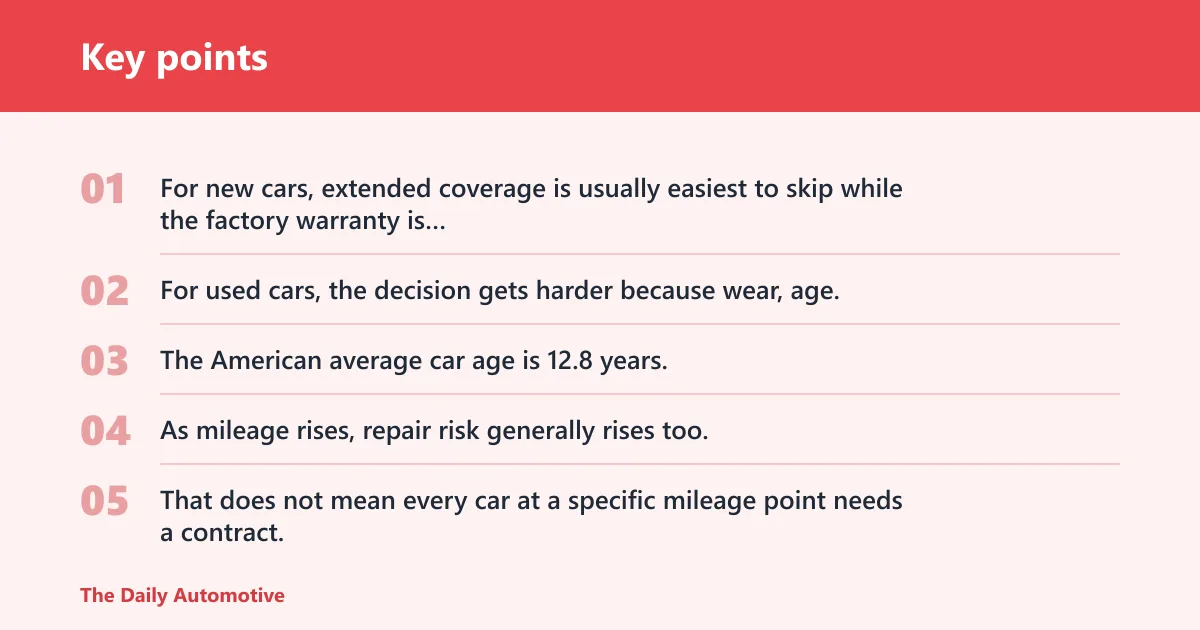
For new cars, extended coverage is usually easiest to skip while the factory warranty is strong. For used cars, the decision gets harder because wear, age, and prior ownership history can push risk higher. The American average car age is 12.8 years, which is one reason used-car buyers keep seeing these offers.
Mileage thresholds to watch
As mileage rises, repair risk generally rises too. That does not mean every car at a specific mileage point needs a contract. It means you should compare the quote against the specific repairs your model is known for, the deductible, and the number of years you intend to keep it.
Suppose a compact sedan has 63,000 miles, a clean service history, and no expensive model-specific defects. In that case, a modest repair fund may be a better move than a broad contract, especially if the plan excludes the wear items most likely to fail first.
Buying after the sale
Can you buy coverage after purchasing the car? Usually yes. Many owners add a plan after the car is already theirs, but the waiting period still applies and the price may rise with age and mileage. The sooner you shop after factory coverage shrinks, the more options you tend to have.
What repairs are usually not covered by an extended car warranty?
Routine maintenance, preexisting conditions, and cosmetic defects are usually not covered. Many contracts also exclude wear items and damage caused by neglect, misuse, or poor maintenance history. If the claim depends on your oil changes, inspection records, or service timing, ask for that language in writing before you buy.
How much do extended car warranties cost?
AAA says extended warranties typically cost between $1,300 and $4,000 or more. That range can be hard to judge without a deductible and term length, so the better question is whether the price is lower than your likely repair exposure over the years you plan to keep the car. If the answer is no, self-insuring wins.
Is a powertrain warranty enough instead of bumper-to-bumper coverage?
For many older or higher-mileage cars, yes. Powertrain coverage is the lower-cost alternative and often the minimum worthwhile option when the main concern is an expensive engine or transmission failure. Bumper-to-bumper coverage is broader, but you should only pay for it if the extra systems are worth the added premium.
Frequently asked questions
Are extended warranties worth it for new cars?
Usually not right away. A new car already comes with a bumper-to-bumper warranty and a drive train warranty, so you are paying to extend protection you already have. The exception is an owner who plans to keep the vehicle a long time and wants coverage to begin after factory protection ends.
Are extended warranties worth it for used cars?
They can be, especially if the car has limited remaining factory coverage or has a known history of expensive repairs. The contract still has to beat the expected cost of repairs after you account for the deductible, waiting period, and exclusions.
What does an extended car warranty cover?
Coverage varies, but extended warranties can cover the engine, transmission, drivetrain, electrical system and air conditioning. Some plans also include roadside assistance or rental car reimbursement. Read the contract closely, because the value depends on the exact components and the claim rules, not the sales pitch.
Can you buy an extended car warranty after purchasing the car?
Yes. Many buyers add coverage after the sale, as long as the car is still eligible under the provider’s age and mileage limits. Just remember that many plans have a 30-day and 1,000-mile waiting period, so coverage does not begin instantly.
Are extended car warranties worth it reddit?
Online forum advice is often blunt, but it is usually too broad to settle the question. A better filter is your own car’s repair risk, the quoted deductible, and whether the plan starts after factory coverage ends. Ignore the noise and compare the contract against actual ownership costs.
Are extended car warranties worth it uk?
The same decision logic applies: compare the contract price, deductible, exclusions, and ownership horizon against expected repair costs. Warranty terms can differ by market, so the exact rules, claim limits, and provider structure matter more than the label on the brochure. Read the contract before you buy.
Products related to this article
Sponsored / affiliate links. As an Amazon Associate I earn from qualifying purchases. I may earn additional commission from eligible campaigns.