What Is Speed Control in a Car? Explained
Many drivers find the concept of speed control in a car a bit tricky at first. Terms like cruise control or adaptive cruise control can sound complicated. But don’t worry, it’s simpler than you think.
We’ll break down What Is Speed Control in a Car? Explained in an easy, step-by-step way. You’ll understand how it works and why it’s helpful.
Let’s get started by looking at the basics of how cars manage their speed without constant driver input.
Understanding Car Speed Control Systems
Car speed control systems are technologies designed to help drivers manage their vehicle’s speed. They automate certain aspects of driving, making it more comfortable and sometimes safer. These systems range from simple cruise control, which maintains a set speed, to more advanced adaptive cruise control, which adjusts speed based on traffic ahead.
Understanding these systems can greatly improve your driving experience and efficiency. We will explore the different types, how they function, and their benefits.
What is Basic Cruise Control
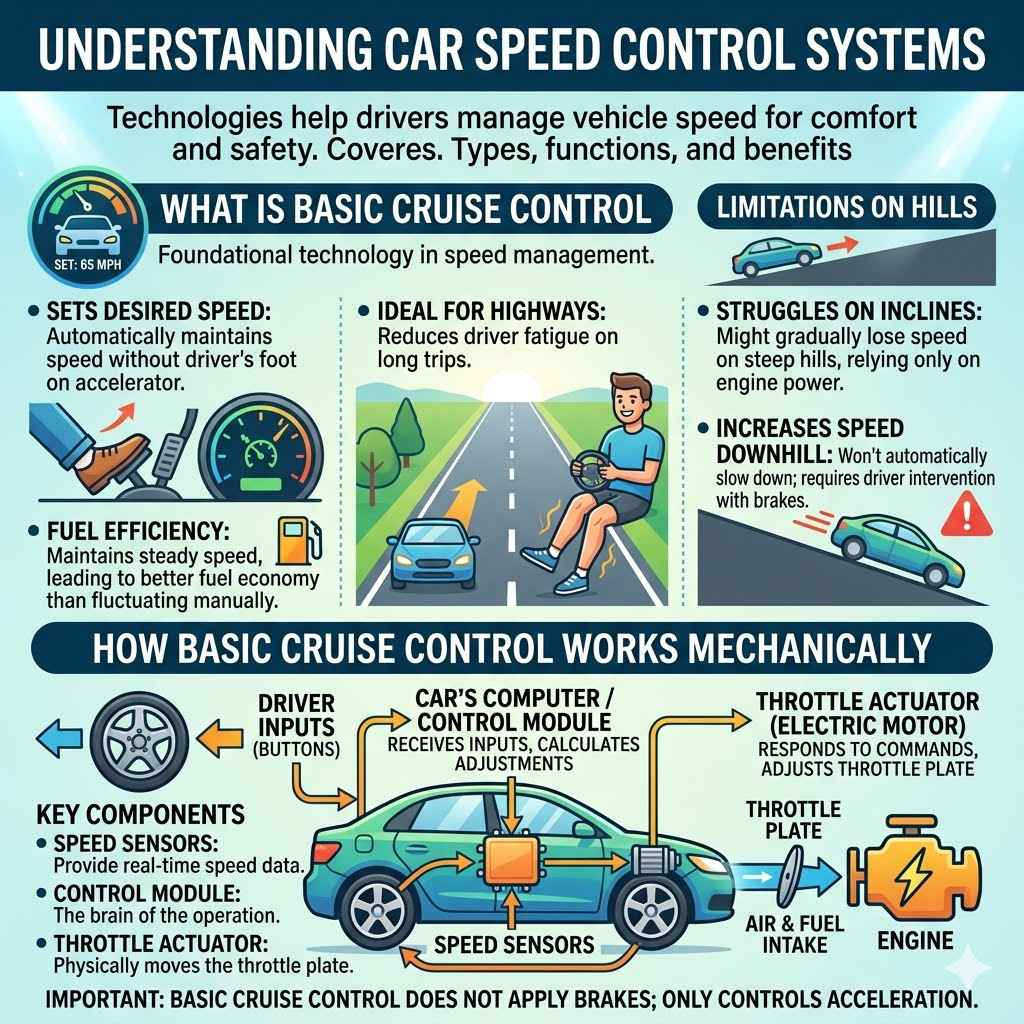
Basic cruise control is the foundational technology in car speed management. It allows a driver to set a desired speed, and the car will automatically maintain that speed without the driver needing to keep their foot on the accelerator pedal. This is particularly useful for long highway drives, reducing driver fatigue.
The system works by electronically controlling the throttle. When you set a speed, the car’s computer signals the throttle to open or close as needed to keep the vehicle at that precise velocity, even when going uphill or downhill.
When you activate cruise control, you typically press a button to engage it and then set your desired speed. The car’s computer then monitors the vehicle’s speed using sensors. If the speed drops, say on an incline, the computer tells the throttle to open wider to increase power and maintain the set speed.
If the speed increases, perhaps going downhill, the computer will reduce throttle input. It’s important to remember that basic cruise control does not apply the brakes; it only controls acceleration.
Here are some key points about basic cruise control:
- Ease of Use: Once set, it significantly reduces the need for constant pedal adjustments, making driving less tiring on long trips. It allows the driver to relax their leg and foot muscles, which can become strained during extended periods of manual speed management. This comfort benefit is a primary reason for its popularity.
- Fuel Efficiency: By maintaining a steady speed, basic cruise control can often lead to better fuel economy compared to fluctuating speeds caused by inconsistent acceleration and deceleration.The system aims for optimal engine performance at a constant RPM, avoiding unnecessary fuel consumption that occurs during rapid speed changes.
- Limitations on Hills: On steep inclines, basic cruise control might struggle to maintain the set speed. It relies solely on engine power and may not be able to overcome gravity sufficiently, leading to a gradual decrease in speed. Similarly, going downhill, it won’t automatically slow the car; it will maintain or even increase speed unless the driver intervenes.
How Basic Cruise Control Works Mechanically
The operation of basic cruise control involves several components working together. The driver initiates the system and sets a speed. This signal goes to a control module, which is essentially a small computer.
This module then communicates with the throttle actuator. In older systems, this might have been a vacuum-operated or cable-driven actuator. In modern cars, it’s almost always an electronic throttle control (ETC) system.
The ETC system uses an electric motor to directly control the position of the throttle plate in the engine’s intake manifold. The control module constantly receives data from the vehicle’s speed sensors. Based on this data and the driver’s set speed, the module sends precise commands to the throttle actuator.
If the car is going too slow, the actuator opens the throttle plate more, allowing more air and fuel into the engine for increased power. If the car is going too fast, the actuator closes the throttle plate, reducing engine power.
Here’s a breakdown of the key components and their roles:
- Speed Sensors: These are crucial for providing real-time information about the car’s velocity. They are typically located at the wheels or on the transmission. The data from these sensors is fed directly to the car’s main computer and the cruise control module.
- Control Module: This is the brain of the operation.It receives inputs from the driver (set speed, resume, cancel) and the speed sensors. It then calculates the necessary throttle adjustments.
- Throttle Actuator: This component is responsible for physically moving the throttle plate. In modern vehicles, this is an electronic motor that responds to the control module’s commands, adjusting the engine’s air intake and thus its power output.
Example Scenario: Imagine you are driving on a highway at 65 mph. You activate cruise control and set the speed. The control module registers 65 mph.
As you approach a gentle uphill slope, the car’s speed might start to drop to 63 mph. The speed sensors detect this change. The control module, recognizing the speed has fallen below the set point, signals the throttle actuator to open the throttle plate by a small amount.
This increases engine power, and the car accelerates back up to 65 mph. Once you crest the hill, the speed might increase to 67 mph. The control module detects this, and the throttle actuator closes the plate slightly, reducing power and allowing the car to slow back down to the desired 65 mph.
Advanced Speed Control Systems
Beyond basic cruise control, modern vehicles offer more sophisticated speed management features. These advanced systems use radar, cameras, and other sensors to not only maintain speed but also to react to the surrounding traffic environment. This evolution makes driving more convenient and adds layers of safety.
These systems understand their surroundings, allowing them to make decisions about speed that a basic system cannot.
What is Adaptive Cruise Control ACC
Adaptive Cruise Control, or ACC, is a significant upgrade from traditional cruise control. It goes beyond just maintaining a set speed. ACC systems use sensors, typically radar or cameras, to detect vehicles ahead.
If the system detects a slower vehicle in front, it will automatically reduce the car’s speed to maintain a safe following distance. When the road ahead clears or the slower vehicle moves out of the lane, ACC will accelerate the car back up to the originally set speed.
This “adaptive” nature makes it far more practical for real-world driving, especially in situations with fluctuating traffic. It takes some of the burden of constant speed adjustment off the driver. ACC systems are designed to provide a more seamless and less stressful driving experience in varied traffic conditions.
They can also help prevent rear-end collisions by reacting more quickly and consistently than a human driver might.
Key aspects of Adaptive Cruise Control include:
- Following Distance Control: Drivers can typically select a preferred following distance, often represented by bars or car lengths. The system uses this setting to determine how closely it should trail a vehicle ahead. This allows for personalized comfort levels regarding proximity to other cars.
- Automatic Braking and Acceleration: ACC can automatically apply the brakes to slow down and even bring the vehicle to a complete stop if necessary.Once the obstruction is removed or the traffic clears, it will resume the set speed. This feature is a major advancement in driver assistance.
- Traffic Jam Assist: Some advanced ACC systems include a traffic jam assist feature. This allows the system to manage speed and even stop-and-go traffic, bringing the vehicle to a halt and then resuming motion when traffic moves.This significantly reduces driver effort in congested conditions.
Real-life Example: Sarah is driving on a busy freeway with ACC activated. She has set her speed to 70 mph and a medium following distance. A car in front of her is traveling at 60 mph.
Her ACC system detects this car and smoothly applies the brakes, reducing Sarah’s speed to 60 mph to maintain the set following distance. After a few minutes, the car ahead speeds up to 75 mph. Sarah’s ACC system detects the open road and accelerates her car back to 70 mph.
Later, traffic slows to a crawl. Her ACC system brings her car to a complete stop behind the car in front. When the car ahead starts moving again, Sarah’s system automatically resumes speed to 70 mph.
How Adaptive Cruise Control Works
ACC systems rely on a combination of sensors to perceive their surroundings. The most common sensors are radar units, typically mounted in the front grille or bumper, and cameras, often placed behind the windshield near the rearview mirror. These sensors continuously scan the road ahead.
Radar sensors emit radio waves and measure the time it takes for them to bounce off objects and return. This allows them to determine the distance and relative speed of other vehicles. Cameras use image recognition to identify lane markings, vehicles, and other obstacles.
The data from these sensors is processed by a sophisticated control unit. This unit analyzes the information and makes real-time decisions about the vehicle’s acceleration and braking.
The control unit is integrated with the car’s throttle and braking systems. It can command the engine control module to adjust throttle position for acceleration and also communicate with the anti-lock braking system (ABS) or electronic stability control (ESC) module to apply braking force.
Here’s a look at the core components:
- Radar Sensors: These provide accurate distance and speed measurements of objects ahead, functioning effectively in various weather conditions like rain or fog. They are the primary tool for detecting other vehicles.
- Cameras: These assist in identifying lane boundaries and distinguishing between different types of objects on the road. They help the system understand the context of the driving environment.
- Control Unit: This is the central processing hub that integrates data from all sensors and makes decisions about vehicle speed and braking.It’s the intelligence that drives the ACC system.
- Electronic Throttle Control (ETC) and Braking System Integration: This ensures the control unit can seamlessly command the engine and brakes to achieve the desired speed and distance.
Sample Scenario: You are driving on a highway at 70 mph with ACC set. A truck enters your lane about 100 yards ahead, traveling at 60 mph. The radar and camera sensors detect the truck and its speed.
The ACC control unit calculates that maintaining 70 mph would result in a collision or too close a following distance. It signals the braking system to gently apply the brakes, slowing your car down to match the truck’s speed of 60 mph while maintaining your chosen following distance. Once the truck moves to another lane or speeds up, your sensors detect the clear path, and the ACC control unit commands the throttle to accelerate your car back to 70 mph.
Other Speed Control Features
Modern vehicles often integrate speed control with other driver assistance features. These can include speed limiters and intelligent speed adaptation. These systems work together to provide a comprehensive approach to managing vehicle speed.
They aim to enhance safety and compliance with traffic regulations.
Speed Limiters: These are systems that prevent the vehicle from exceeding a predetermined maximum speed, even if the driver presses the accelerator pedal harder. Unlike cruise control, which maintains a set speed, a limiter sets an absolute ceiling. This can be useful for fleet management or to prevent unintentional speeding.
Intelligent Speed Adaptation (ISA): ISA systems use cameras to read road signs indicating speed limits. The car’s computer then compares this detected speed limit with the vehicle’s current speed. The system can then provide warnings to the driver if they are exceeding the limit.
In some implementations, it can also subtly adjust the throttle to discourage speeding or even actively limit the vehicle’s speed to match the posted limit.
Here are some additional speed control related features:
- Speed Limiter Functionality: This is a straightforward feature that caps the vehicle’s maximum speed. It’s engaged by the driver and can be overridden if necessary, usually by pressing the accelerator firmly past a resistance point. This ensures that even an overzealous driver cannot exceed a defined safe maximum.
- Intelligent Speed Adaptation (ISA) Integration: This feature takes the speed limit information from road signs and uses it to inform the driver or limit the vehicle’s speed.It’s a proactive approach to obeying traffic laws and can significantly reduce the risk of speeding tickets and accidents.
- Driver-Set Speed Capping: Some vehicles allow drivers to set their own personal speed limit, separate from the cruise control or adaptive cruise control settings. This provides an additional layer of control for parents or guardians supervising new drivers, ensuring they do not exceed a speed chosen by the adult.
Benefits of Using Speed Control
Implementing speed control systems in vehicles offers a variety of advantages. These benefits touch upon comfort, safety, and efficiency. They are designed to make driving less taxing and more predictable.
Embracing these technologies can lead to a more enjoyable and responsible driving experience.
Comfort and Reduced Fatigue
One of the most immediate benefits of speed control, especially basic cruise control, is enhanced driver comfort. On long, monotonous stretches of highway, maintaining a constant speed requires continuous subtle adjustments to the accelerator pedal. This can lead to leg fatigue and discomfort.
By engaging cruise control, the driver can rest their foot and leg, significantly reducing strain.
Adaptive Cruise Control further amplifies this comfort by handling frequent speed adjustments in traffic. Instead of constantly braking and accelerating manually, the system does it for you, allowing for a smoother ride. This reduction in physical effort translates to less stress and fatigue, enabling drivers to arrive at their destination feeling more alert and refreshed.
This is especially valuable for professional drivers or those who undertake very long journeys regularly.
Key comfort benefits include:
- Reduced Physical Strain: Eliminates the need for constant accelerator pedal input, preventing leg and foot fatigue on long drives. This allows muscles to relax and reduces the likelihood of cramping or soreness.
- Improved Focus on Driving Environment: With less focus required on managing the accelerator, drivers can dedicate more attention to observing the road, traffic, and potential hazards. This mental shift can lead to more proactive driving.
- Smoother Ride Experience: Especially with ACC, the system’s precise control over acceleration and braking results in smoother transitions, making the ride more pleasant for all occupants.This avoids jerky movements that can be unsettling for passengers.
Safety Enhancements
Speed control systems, particularly adaptive cruise control, contribute significantly to vehicle safety. By maintaining a consistent speed and, in the case of ACC, a safe following distance, these systems can help prevent accidents. They react more consistently and sometimes faster than human drivers, reducing the risk of common collisions.
For example, ACC’s ability to automatically brake when a vehicle ahead slows down can prevent rear-end collisions, which are among the most frequent types of car accidents. Furthermore, by reducing driver fatigue, these systems indirectly enhance safety. A less tired driver is generally more attentive and better equipped to handle unexpected situations.
Intelligent Speed Adaptation also plays a role by helping drivers adhere to speed limits, thereby reducing the risk of speeding-related accidents.
Safety advantages of speed control:
- Prevention of Rear-End Collisions: ACC’s automatic braking to maintain a set distance significantly reduces the likelihood of running into the back of the car in front. This is a critical safety feature, especially in stop-and-go traffic.
- Reduced Speeding Violations and Accidents: Systems like Intelligent Speed Adaptation help drivers stay within legal speed limits, which is a fundamental aspect of road safety. This reduces the chance of accidents caused by excessive speed.
- Consistent Reaction Times: Electronic systems can react to changes in traffic flow with predictable timing, which can be more reliable than human reaction times, especially in unexpected situations.They are not subject to distractions or momentary lapses in attention.
Statistic on ACC Safety: According to a study by the Insurance Institute for Highway Safety (IIHS), vehicles equipped with automatic emergency braking (AEB), a component often integrated with ACC, had 56% fewer police-reported crashes than vehicles without it. This highlights the direct impact of these advanced systems on accident reduction.
Fuel Efficiency Improvements
Maintaining a steady speed is a cornerstone of fuel-efficient driving. Both basic and adaptive cruise control excel at this. By preventing unnecessary acceleration and deceleration, these systems help the engine operate within its most efficient range for longer periods.
This leads to a noticeable improvement in miles per gallon (MPG).
When a driver manually accelerates, they often provide more throttle than is strictly necessary, wasting fuel. Similarly, braking unnecessarily consumes energy that was previously used to accelerate the vehicle. Cruise control eliminates these inefficiencies.
Adaptive Cruise Control further optimizes this by reacting smoothly to traffic, avoiding abrupt throttle applications that would occur if a human driver were constantly adjusting.
Here’s how speed control boosts efficiency:
- Consistent Engine Operation: By holding a steady speed, the engine runs at a more consistent RPM, which is typically where it is most fuel-efficient. This avoids the fuel-guzzling effects of rapid acceleration.
- Reduced Braking and Acceleration Cycles: The systems minimize the need for the driver to brake and then re-accelerate, saving the energy that would be lost during these cycles. This is particularly beneficial in fluctuating traffic conditions with ACC.
- Optimized Throttle Control: The system precisely controls the throttle, providing just enough power to maintain the set speed.This prevents over-application of throttle and ensures fuel is used effectively.
Statistic on Fuel Savings: Reports suggest that using cruise control on highways can improve fuel economy by 7-10% compared to manually driving at the same average speed. This is due to the elimination of speed fluctuations that occur with manual pedal control.
Speed Control in Different Driving Conditions
The effectiveness and utility of speed control systems can vary depending on the driving environment. While ideal for highways, certain conditions require careful consideration or may render some systems less suitable. Understanding these nuances is key to using speed control safely and effectively.
We will explore how speed control performs in various scenarios.
Highway Driving
Highway driving is where speed control systems, especially basic cruise control, truly shine. The relatively consistent speeds and clear lanes make it an ideal environment for maintaining a set pace. Basic cruise control significantly reduces driver fatigue on long, straight roads.
Adaptive Cruise Control adds another layer of convenience and safety by managing speed in flowing traffic.
ACC systems can automatically adjust speed for slower vehicles, smoothly reintegrate after overtaking, and even manage stop-and-go traffic on congested highways. This capability makes long-distance travel far less demanding. The ability to set a speed and largely forget about the accelerator pedal allows drivers to focus more on steering and observing the broader traffic picture.
Considerations for highway driving:
- Ideal Use Case for Cruise Control: Highways are perfectly suited for maintaining a constant speed, which is the primary function of basic cruise control. This leads to comfort and potential fuel savings.
- ACC’s Advantage in Traffic Flow: Adaptive Cruise Control excels in highway traffic, automatically adjusting speed to match surrounding vehicles, making lane changes and merging smoother. It handles the stop-and-go nature of congested highways with ease.
- Potential for Complacency: Drivers must remain vigilant even when using cruise control, as it is an assistance system, not autonomous driving.Over-reliance can lead to a reduction in situational awareness.
City Driving and Stop-and-Go Traffic
City driving, with its frequent stops, starts, traffic lights, and unpredictable pedestrian and cyclist movements, presents a different challenge for speed control systems. Basic cruise control is generally not recommended for city driving due to the constant need for speed adjustments. Engaging it would be counterproductive and potentially dangerous.
However, Adaptive Cruise Control with a robust “stop-and-go” or “traffic jam assist” feature can be highly beneficial. These advanced ACC systems can bring the vehicle to a complete stop and then automatically resume the set speed when traffic begins to move again. This feature can significantly reduce driver workload in dense urban traffic.
It manages the tedious process of inching forward, allowing the driver to concentrate on navigating intersections and avoiding hazards.
Using speed control in urban settings:
- Basic Cruise Control’s Inappropriateness: The constant braking and accelerating required in cities makes basic cruise control unsuitable and unsafe. It’s designed for steady-state cruising, not dynamic urban environments.
- ACC with Stop-and-Go Functionality: Advanced ACC systems can be very effective in city traffic jams, automatically stopping and restarting the vehicle, thereby reducing driver fatigue and stress. This feature is a major convenience in congested areas.
- Importance of Driver Oversight: Even with advanced ACC, drivers must remain fully engaged and ready to take over control at any moment.Urban environments are highly dynamic and require constant human judgment.
Adverse Weather Conditions
Driving in adverse weather conditions like rain, snow, or fog introduces significant challenges for all vehicles, including those with speed control systems. The grip of the tires on the road is reduced, and visibility can be severely impaired. This is where driver caution is paramount.
For basic cruise control, its inability to brake means it can be dangerous in slippery conditions. If the system maintains speed on a patch of ice or during heavy rain, and the tires lose traction, the driver may not be able to regain control quickly. Adaptive Cruise Control is generally more suited to these conditions, as it can apply braking.
However, the sensors used by ACC (radar and cameras) can be affected by heavy precipitation, fog, or snow, potentially leading to reduced performance or temporary deactivation of the system.
Managing speed control in bad weather:
- Deactivating Basic Cruise Control: In slippery conditions, it is strongly advised to disengage basic cruise control. The driver needs full control over acceleration and braking to manage traction and avoid skids.
- ACC Sensor Limitations: Heavy rain, snow, or fog can interfere with radar and camera sensors, potentially reducing the effectiveness or disabling ACC. Drivers should be aware of these limitations.
- Reduced Following Distances Recommended: When adverse weather is present, even with ACC, drivers should increase their following distance manually.The system’s ability to brake may be compromised by reduced traction.
Sample Scenario: It’s raining heavily, and you are using ACC on the highway. The radar detects a car ahead, and the system applies the brakes. However, due to the wet road surface, your tires have less grip.
The car in front is also braking, but your ACC system’s braking might not be as effective as it would be on a dry road. If the system’s sensors also become partially obscured by spray, it might not react as quickly. In such a scenario, it’s wise to disengage ACC and manually control your speed and braking, increasing your following distance to compensate for reduced tire grip and potentially impaired sensor performance.
Speed Control System Maintenance and Care
To ensure your speed control systems function reliably and safely, proper maintenance and care are essential. Like any technology in your vehicle, these systems need attention to perform at their best. Regular checks and awareness of potential issues can prevent problems and ensure a smooth driving experience.
Sensor Cleaning and Inspection
The advanced sensors used in systems like Adaptive Cruise Control require regular attention. Radar units and cameras are typically located on the exterior of the vehicle, making them susceptible to dirt, mud, ice, and debris. These obstructions can impair the sensors’ ability to accurately detect the environment.
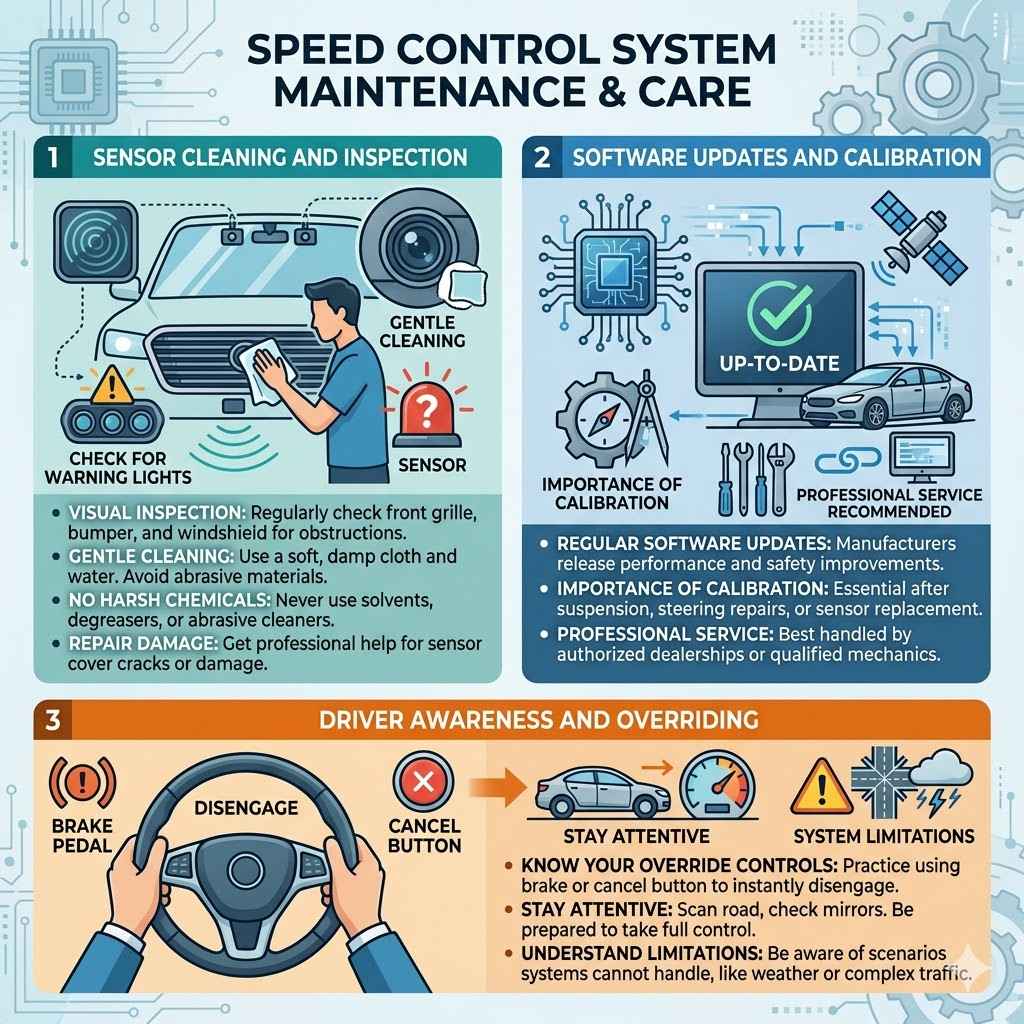
It is important to visually inspect these sensors periodically. Gently clean them with a soft cloth and water or a mild automotive cleaner. Avoid using abrasive materials or harsh chemicals, as these could damage the sensor housing or optics.
If you notice any cracks or damage to the sensor covers, they should be professionally inspected and repaired. Many vehicles will display a warning light if a sensor is malfunctioning or obstructed, prompting the driver to take action.
Maintenance steps for sensors:
- Visual Inspection: Regularly check the front grille, bumper, and windshield for any obstructions or damage to sensors. Look for anything that might be blocking the view or signal path.
- Gentle Cleaning: Use a soft, damp cloth to wipe away dirt, mud, or salt. For stubborn grime, a very mild car wash soap can be used, followed by rinsing with clean water.
- Avoid Harsh Chemicals: Never use solvents, degreasers, or abrasive cleaners on sensor surfaces.These can damage the protective coatings or the sensor components themselves.
- Check for Warning Lights: Pay attention to dashboard warning lights. If a speed control system warning appears, it often indicates a sensor issue that needs attention.
Software Updates and Calibration
Modern speed control systems are heavily reliant on software. Vehicle manufacturers frequently release software updates to improve performance, fix bugs, and enhance functionality. It is crucial to ensure that your vehicle’s software is up-to-date.
These updates are typically performed by authorized dealerships or qualified mechanics.
Calibration is another important aspect, especially after repairs involving the vehicle’s suspension, steering, or replacement of sensor components. If a sensor is out of calibration, it may not provide accurate readings, leading to incorrect system operation. The calibration process uses specialized equipment to ensure the sensors are precisely aligned and reporting data correctly relative to the vehicle’s orientation and motion.
Key aspects of software and calibration:
- Regular Software Updates: Manufacturers periodically release updates that can improve the performance and safety of speed control systems. Keeping your vehicle’s software current is vital.
- Importance of Calibration: After certain repairs or if a system is not functioning correctly, recalibration of sensors may be necessary to ensure accuracy. This is a technical process requiring specialized tools.
- Professional Service Recommended: Software updates and sensor calibration are best handled by trained technicians at dealerships or reputable auto repair shops.They have the necessary diagnostic tools and expertise.
Driver Awareness and Overriding
Even with the most advanced speed control systems, driver awareness and the ability to override the system are paramount. These systems are aids, not replacements for attentive driving. Drivers must always be prepared to take manual control of the vehicle.
Understanding how to quickly and safely disengage cruise control or ACC is a fundamental skill. This is typically done by pressing the brake pedal or a dedicated cancel button. Familiarizing yourself with your car’s specific override procedures is essential.
Over-reliance on these systems can lead to dangerous situations if the system encounters a scenario it cannot handle, or if its sensors are compromised. Active and aware driving remains the most critical component of road safety.
Essential driver practices:
- Know Your Override Controls: Be familiar with how to instantly disengage cruise control or ACC using the brake pedal or cancel button. Practice this so it becomes second nature.
- Stay Attentive: Never assume the system will handle every situation. Always scan the road ahead, check mirrors, and be prepared to intervene.
- Understand System Limitations: Recognize that speed control systems have limitations, especially in adverse weather or complex traffic.Do not use them in conditions where they might not perform reliably.
Frequently Asked Questions
Question: What is the main purpose of speed control in a car
Answer: The main purpose of speed control in a car is to help drivers maintain a desired speed automatically, reducing fatigue on long drives and potentially improving fuel efficiency.
Question: Is basic cruise control the same as adaptive cruise control
Answer: No, basic cruise control only maintains a set speed. Adaptive cruise control also adjusts speed based on traffic ahead and maintains a safe following distance.
Question: When should I not use cruise control
Answer: You should not use cruise control in heavy traffic, on winding roads, in bad weather (rain, snow, fog), or in construction zones where speeds frequently change.
Question: Can speed control systems prevent accidents
Answer: Adaptive Cruise Control and related safety features like automatic emergency braking can help prevent some types of accidents, particularly rear-end collisions, by reacting faster than human drivers.
Question: How do I know if my car has adaptive cruise control
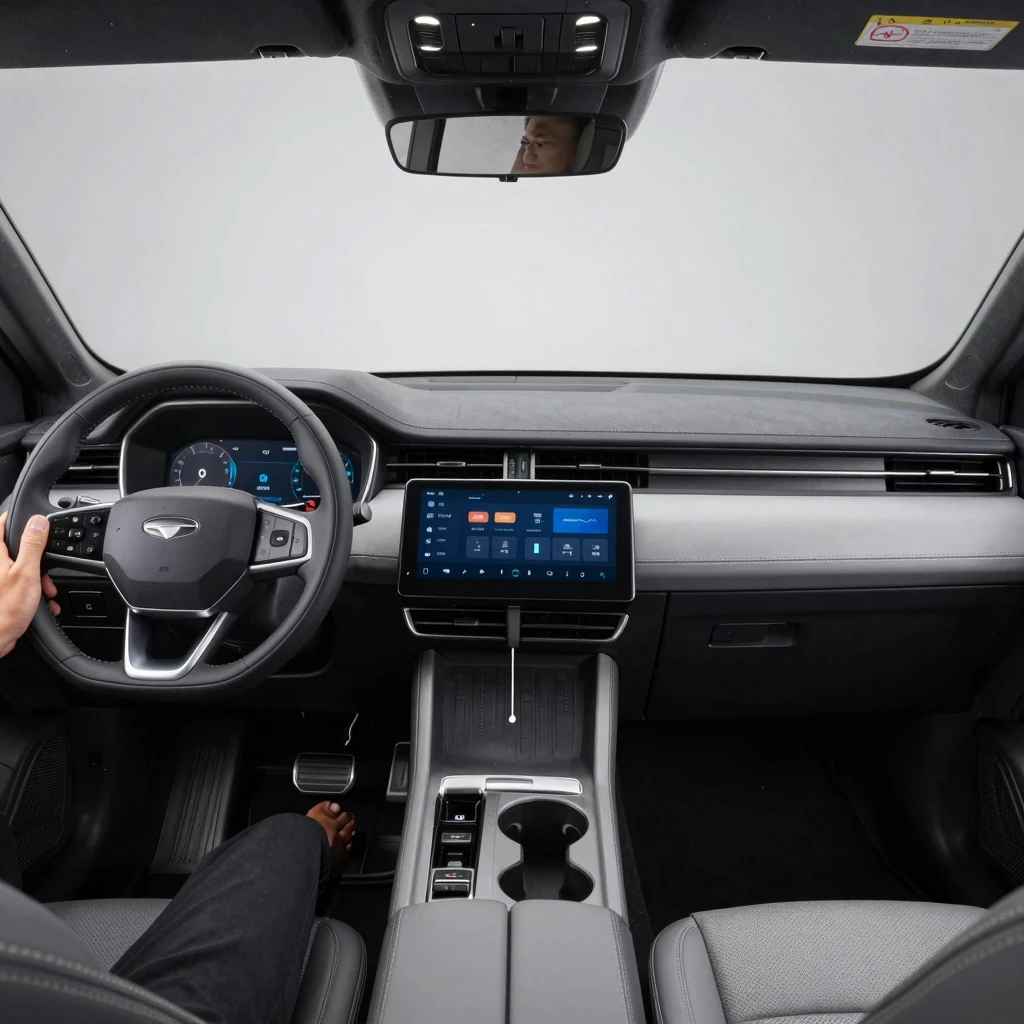
Answer: Your car likely has adaptive cruise control if it has sensors on the front (radar in the grille or bumper) and buttons on the steering wheel related to distance setting and adaptive cruise control engagement.
Summary
Understanding What Is Speed Control in a Car? Explained reveals systems that enhance driving comfort, safety, and efficiency. From basic cruise control maintaining a steady pace to advanced adaptive systems that react to traffic, these technologies offer significant benefits.
By knowing their functions, limitations, and proper use, drivers can leverage them effectively for a better driving experience.