What Was The Dukes Of Hazzard Car? The General Lee Story
The Dukes of Hazzard’s General Lee was a 1969 Dodge Charger, usually built from multiple Chargers for one TV car. Get the car wrong, and you mix up the hero prop, the stunt fleet, and the real hardware. This guide separates the screen car from the behind-the-scenes Chargers and the factory specs.
The General lee’s real-world specs
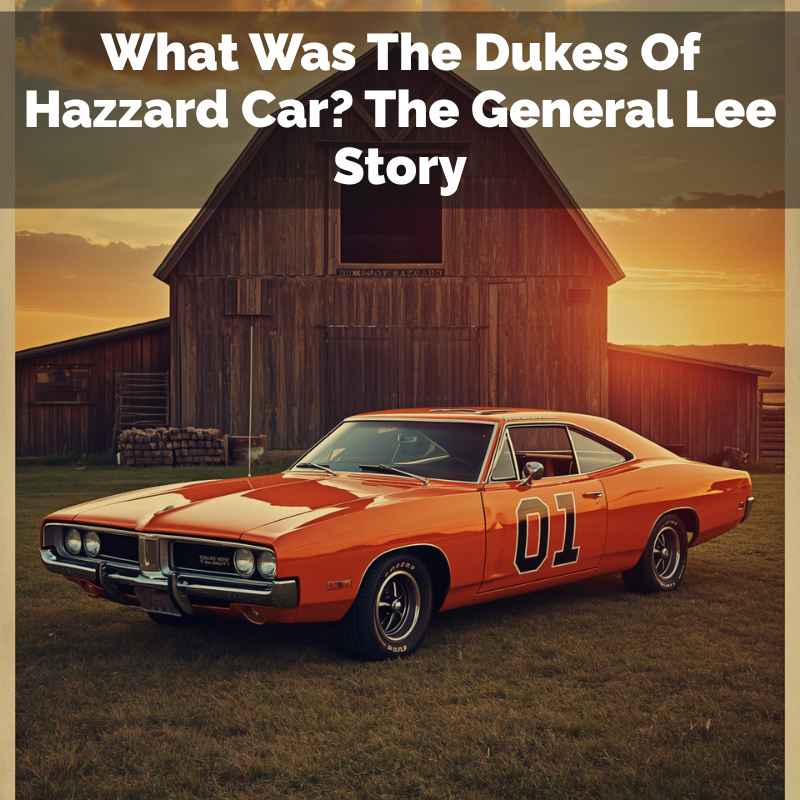
The General Lee was a 1969 Dodge Charger on screen. It wore orange paint, 01 on the doors, and a Confederate flag marking on the roof, with some production cars having welded-shut doors that forced the actors to climb in through the windows. The body shape mattered because the Charger’s long hood and fastback roofline read as muscle car drama on camera.
General Lee fact sheet
| Hero car vs. stunt fleet | What to keep straight |
|---|---|
| On-screen identity | The famous car was a 1969 Dodge Charger known as the General Lee. |
| Known body years used | 1969 was the core identity, but 1968 Dodge Chargers were occasionally used or reworked when production needed them. |
| Commonly cited engine choices | The most common engine mentioned is the 440-cubic-inch Magnum V8 with 375 horsepower. Some episodes are also associated with a 383-cubic-inch V8, while a lighter 318-cubic-inch V8 was used for specific stunts. |
| Transmission references | Most General Lees featured the Chrysler Torqueflite A-727 automatic transmission. |
| When Chargers ran short | Production used substitutions, including AMC Ambassadors, and camera tricks helped hide the swap. |
What to say: The show’s General Lee was a 1969 Dodge Charger, and the production used multiple cars over time.
What not to say: Don’t call every General Lee a single surviving 1969 Charger, and don’t treat every stunt car as the same hardware as the opening-credits hero car.
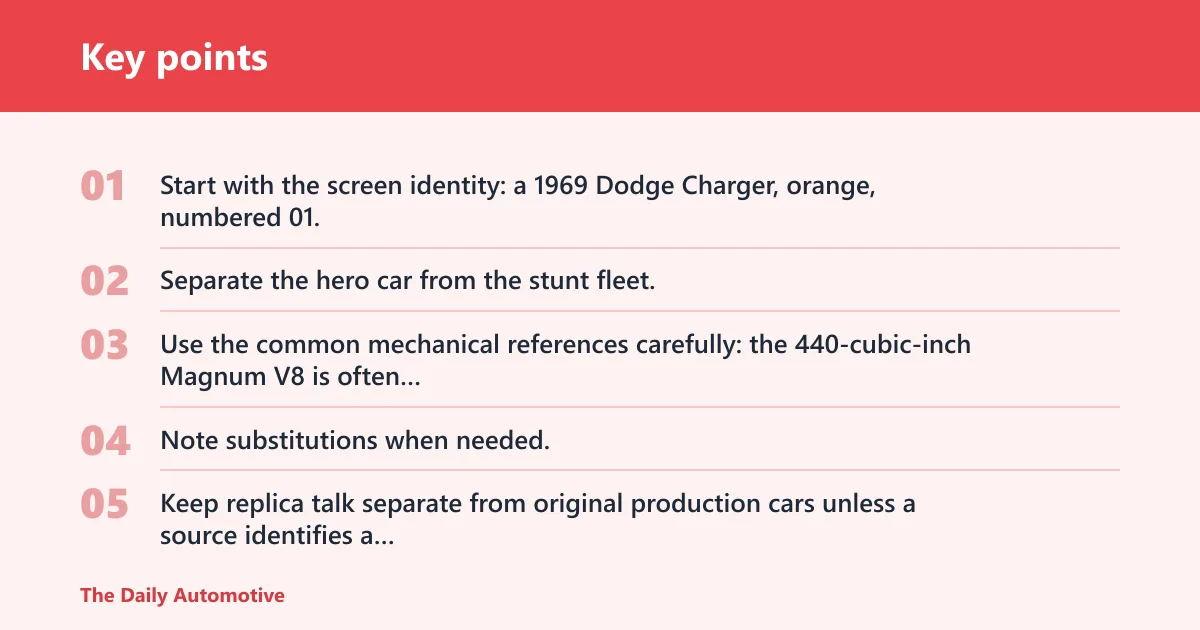
- Start with the screen identity: a 1969 Dodge Charger, orange, numbered 01, and fitted with the roof marking.
- Separate the hero car from the stunt fleet. The opening-credits Charger is not the same thing as every vehicle seen across the series.
- Use the common mechanical references carefully: the 440-cubic-inch Magnum V8 is often cited at 375 horsepower, with Chrysler Torqueflite A-727 automatic transmission usually cited.
- Note substitutions when needed. 1968 Chargers appear in the production story when real Chargers were in short supply.
- Keep replica talk separate from original production cars unless a source identifies a specific survivor.
That split matters because television production used several levels of “General Lee.” The car on camera for the opening credits is not the same thing as every vehicle used to land a jump, survive a skid, or get crushed during filming. The show’s car story is a fleet story.
Why was a 1969 Charger used?
A 1969 Dodge Charger fit the show’s look better than most full-size cars of the era. The car’s wide stance, long hood, and fastback roofline made it easy to read as fast, even before it moved. The Charger R/T image also helped: the performance variant carried a strong muscle-car reputation, and the 440-cubic-inch Magnum V8 option is commonly listed at 375 horsepower.
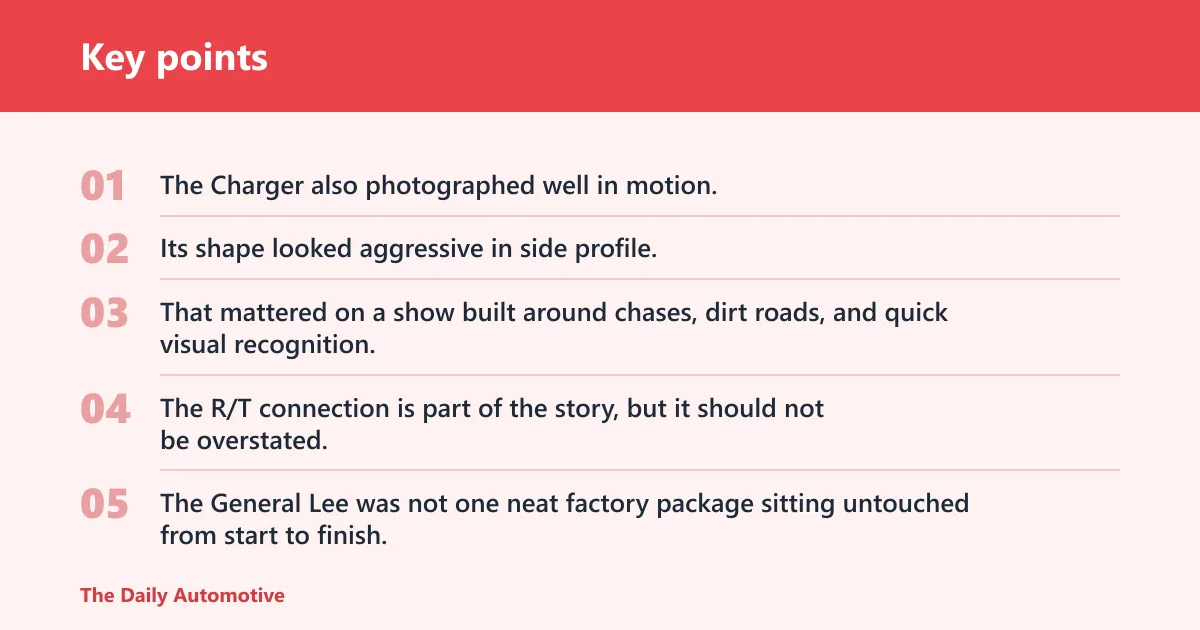
The Charger also photographed well in motion. Its shape looked aggressive in side profile, and its proportions made jumps and slides read clearly on television. That mattered on a show built around chases, dirt roads, and quick visual recognition.
The R/T connection is part of the story, but it should not be overstated. The General Lee was not one neat factory package sitting untouched from start to finish. Production-built cars changed over time, and some were reworked to fit the needs of a given episode or stunt.
How the Charger fit the show’s image
The car’s visual cues did a lot of work. Orange paint cut through dust and dusk. 01 made the doors legible on a small screen. The roof marking made the car easy to spot from above or in a moving shot.
The sound mattered too, especially in scenes where the body was only part of the cue. The General Lee horn played the first notes of “Dixie,” which became one of the show’s most recognizable audio signatures.
How many General Lees were used on The Dukes of Hazzard?
There is no single exact count that should be treated as fully settled, because different episodes used different cars, and many stunt bodies were destroyed during filming. A widely cited figure says at least 300 different cars were used as the General Lee, while the first five episodes in Georgia filming locations used six General Lees.
That range tells you more than a single hard number would. The production needed a steady supply of Chargers for jumps, repairs, and replacements, and the supply did not always keep up with demand. When Chargers ran short, substitutions entered the mix.
What surviving-car claims can and cannot prove
Claims about surviving originals often mix together film-used cars, later replicas, and tribute builds. A car that looks correct in orange paint does not prove it was on set. A documented survivor can help anchor the story, but it does not settle how many bodies were used across the series.
Say your friend shows you a bright orange Charger with 01 on the doors at a weekend meet. That car may be a replica, a tribute build, or a carefully restored production car. The paint and decals tell you the theme, not the entire provenance.
What made the General Lee look and sound like that?
The General Lee’s look came from a few fixed cues: orange paint, 01 on the doors, and the roof marking. Some production cars had welded-shut doors, which made the actors climb through the windows and helped the car feel more like a stunt machine than a daily driver. The horn cue finished the package.
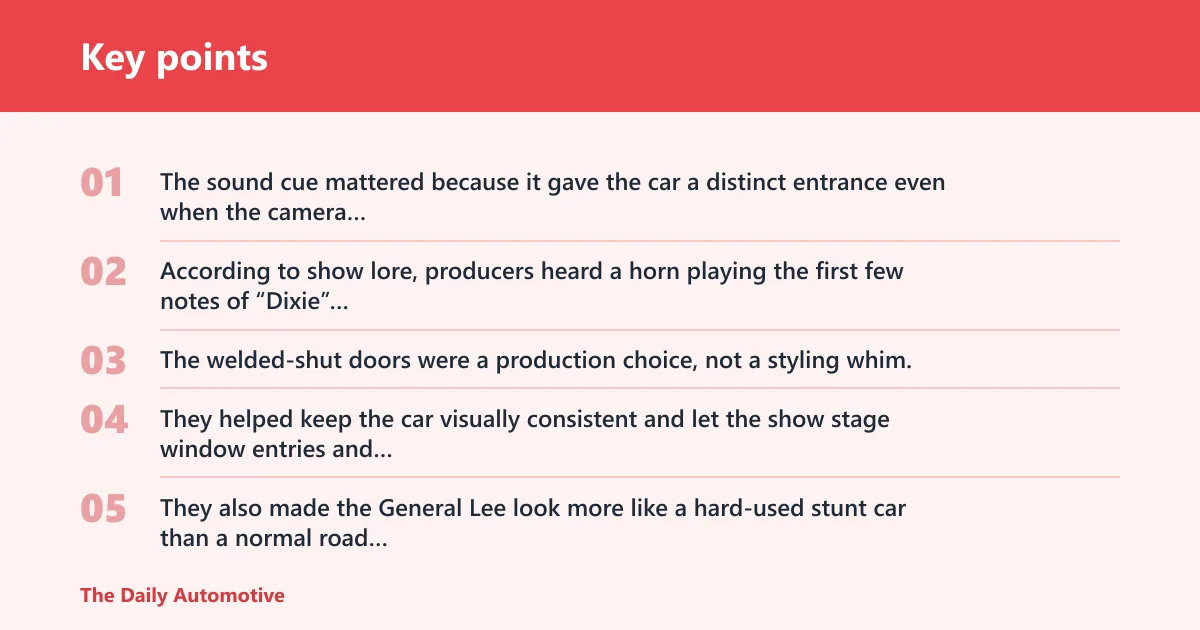
The sound cue mattered because it gave the car a distinct entrance even when the camera was far away. According to show lore, producers heard a horn playing the first few notes of “Dixie” and bought it, then used that sound as a signature cue throughout the series.
Why the doors were welded shut
The welded-shut doors were a production choice, not a styling whim. They helped keep the car visually consistent and let the show stage window entries and exits cleanly. They also made the General Lee look more like a hard-used stunt car than a normal road car.
The car’s heavy engine made it pitch forward, so the trunk was weighted. That detail sits behind many of the action shots: the car had to behave predictably when it launched, landed, or braked hard.
What the horn was playing
The horn played the first notes of “Dixie.” That cue is part of why the General Lee became so easy to identify in only a few seconds of screen time. It is also one of the details that remains tied to the show’s original broadcast era, because later reruns and modern reception often frame it differently than viewers did in the 1970s and 1980s.
A common first-timer mistake is to think the horn sound means the car on screen was always the same physical car. It did not. The sound cue was consistent; the body underneath it changed many times.
What about the flag controversy?
The General Lee story includes a controversy over its Confederate ties. During the show’s run, the car’s roof carried a Confederate flag marking, and that image later drew far more public criticism than it did when the series first aired. Audience reaction changed over time, especially as reruns, cultural memory, and public debate moved forward.
That history should be handled as part of the car’s reception, not as a side note. The flag on the show car was tied to the character of the vehicle, the series branding, and the name itself, which is commonly said to have come from Robert E. Lee, the Confederate States general. Over time, that association became harder for many viewers to separate from the car’s pop-culture status.
The shift matters because it changes how people describe the General Lee today. Some still remember it as a TV icon first. Others see the same image as inseparable from the flag and the historical association it carried.
Frequently asked questions
What car was the General Lee in the dukes of hazzard?
The General Lee was a 1969 Dodge Charger. On screen, it wore orange paint, 01 on the doors, and a Confederate flag marking on the roof. It was usually built from multiple cars rather than one surviving original, especially when production needed jumps, repairs, or replacements.
Why was a 1969 dodge charger used as the general lee?
The 1969 Charger fit the show’s muscle-car look better than many alternatives.
What engine did the General Lee have?
Some episodes are also linked to a 383-cubic-inch V8, and a lighter 318-cubic-inch V8 was used for specific stunts. That mix reflects production needs more than one exact factory build.
Why did the General Lee have welded-shut doors?
Some production cars had their doors welded shut so actors had to climb through the windows. That choice supported the show’s stunt staging and kept the car looking like a hard-used action machine. It also helped production maintain a consistent on-screen look across different cars and repairs.
What was the General Lee horn playing?
The horn played the first notes of “Dixie.” According to show lore, producers heard that horn and bought it, then used it as one of the General Lee’s signature sound cues. It became as recognizable as the orange paint and 01 on the doors.
Is the Confederate flag controversy part of the General Lee story?
Yes. The car carried a Confederate flag on top during the show’s run, and that image later drew sustained controversy. The reaction changed over time, especially as reruns kept the car visible long after the original broadcast, which made the symbol harder to separate from the car’s fame.
Products related to this article
Sponsored / affiliate links. As an Amazon Associate I earn from qualifying purchases. I may earn additional commission from eligible campaigns.
 iPhone Car Charger,USB C Fast Car Charger[Apple MFi Certified] Apple Car Charging 38W Dual Port CarCharger Cigarette Lighter Adapter 2x3ft PD&QC 3.0 Lightning Cable for iPhone 14/13/12 Pro/11/Airpods
 Car Polishing Wax Kit Sponge Body Compound Cream Wax Car Body Compound Scratch Remover Vehicle Paint Scratch Repair Auto Paint Scratch Remover Kit Car Scratch Repair (Universal)