Why Does a Car Battery Go Bad? Inside the 5 Ways Cells Fail
A car battery goes bad from the inside out — lead sulfate hardens onto the plates, the internal grids corrode, and the acid separates into layers long before the car ever fails to start. Factory defects cause under 7% of failures, so unless yours was a lemon, the damage came from how it was charged and stored. This guide covers the five internal failure modes, why heat above 77°F halves battery life, and whether batteries die gradually or suddenly.
Quick Answer
A car battery goes bad through five internal failure modes: sulfation, grid corrosion, positive plate shedding, acid stratification, and water loss. Nearly all of them are triggered by the same two conditions — chronic undercharging and heat. Keeping the battery above 12.4 volts prevents the most common one, sulfation.
The 5 Ways a Car Battery Actually Goes Bad
Sulfation is the buildup of hardened lead sulfate crystals on a battery’s plates that can no longer be converted back into active material. It is the single most common way a lead-acid car battery loses capacity, and it starts every time the battery sits at a partial state of charge rather than a full one.
Most articles on this topic stop at the external symptoms — heat, cold, corrosion, a light left on. Those are triggers, not causes. What follows is what those triggers actually do inside the case, because the failure mode determines whether the battery can be saved or has to be replaced.
1. Sulfation: Lead Sulfate Hardens on the Plates
Every time a battery discharges, lead on the negative plate converts to lead sulfate. Charging normally reverses that reaction. But when a battery is left partially charged, those sulfate crystals keep growing and harden into a layer the charger can no longer break down. Battery University distinguishes reversible (soft) sulfation, which can sometimes be cleared by holding 2.50–2.66 volts per cell for roughly 24 hours, from permanent (hard) sulfation, which sets in after weeks or months at low charge and cannot be undone.
2. Grid Corrosion: The Current Collectors Eat Themselves
Inside each cell, the active paste sits on a lead grid that carries current out to the terminals. That grid is permanently sitting in sulfuric acid, so it slowly corrodes no matter what you do — heat and overcharging just speed it up. As the grid corrodes it expands and its resistance climbs, so the battery can still show a healthy resting voltage while delivering far less cranking current. In the 2010 BCI Failure Modes Study cited by Battery University, plate and grid-related breakdown had risen to 39% of failures, up from 30% five years earlier.
3. Positive Plate Shedding: Active Material Falls Off
Plates physically expand on discharge and contract on charge. Cycle that enough times and the paste loses its grip on the grid wires, breaks into crystallites, and sheds to the bottom of the case. Every gram that falls off is capacity the battery will never get back. Enough sediment collecting under the plates can eventually bridge them and short the cell out — which is why a battery that was merely weak can go completely flat overnight with no warning.
4. Acid Stratification: The Electrolyte Separates into Layers
In a flooded battery, the heavy acid can settle to the bottom of the cell and leave weak, watery electrolyte at the top. This happens when a battery habitually dwells below about 80% state of charge and never gets a full saturated charge — exactly what short trips with the headlights, heater and infotainment running produce. The bottom of the plates then sulfates faster while the top does almost no work. Discover Battery reports that stratification can strip up to 40% of a battery’s usable active material within six months of normal use.
5. Water Loss and Dry-Out: Heat Boils the Electrolyte Away
Heat and overcharging split water in the electrolyte into hydrogen and oxygen, which vent out of the case. As the level drops, the tops of the plates are exposed to air, and exposed plate area stops storing energy permanently. In a sealed or maintenance-free battery you cannot top it back up, so water loss is a one-way trip. This is the mechanism behind the smell of rotten eggs some batteries give off — vented hydrogen sulfide from an overcharging cell.
Which Failure Mode Do You Have?
| Failure mode | What triggers it | Recoverable? | Telltale sign |
|---|---|---|---|
| Sulfation | Sitting at partial charge, long storage | Sometimes, if caught early | Charges quickly but dies fast |
| Grid corrosion | Heat, age, chronic overcharging | No | Normal voltage, weak cranking |
| Plate shedding | Deep cycling, vibration, age | No | Sudden dead cell after being merely weak |
| Acid stratification | Short trips, staying under 80% charge | Sometimes, with a full saturated charge | Tester reads fine, car still cranks slowly |
| Water loss / dry-out | Heat, overcharging alternator | Only on serviceable (capped) batteries | Swollen case, rotten-egg smell |
Do Car Batteries Go Bad Gradually or All at Once?
The degradation is gradual; the discovery is sudden. Sulfation, grid corrosion and shedding all build over months or years, quietly shaving off cranking amps while the battery still starts the car every morning. You only notice the day the remaining capacity finally drops below what the starter demands — usually on the first genuinely cold morning, because cold thickens the oil and cuts the battery’s available output at the same time.
That is why so many batteries “suddenly” die in the fall or early winter after a hot summer. The heat did the damage months earlier; the cold simply revealed it. The exception is plate shedding severe enough to short a cell internally — that genuinely can take a battery from cranking normally to completely dead in a single night.
“Low charge and acid stratification are the most common causes of the apparent failure.”
The practical takeaway is that a voltage reading alone will not warn you. A stratified or sulfated battery can rest at a convincing 12.6 volts and still fail a load test, because surface charge masks the real capacity underneath. If you want to know where yours actually stands, a proper capacity test is the only honest answer — our guide to checking car battery health walks through it, and when a car battery is considered dead covers the thresholds.
Best Sulfation-Prevention Pick

NOCO GENIUS1 1A Smart Battery Charger & Maintainer
A 1-amp trickle charger that holds a 12V battery at full charge indefinitely and includes a dedicated repair mode aimed at soft sulfation — the failure mode that starts the moment a battery stops getting a full charge.
- Best for: Cars that sit for weeks, or short-trip drivers whose alternator never finishes the job
- Why we picked it: It attacks the root condition behind sulfation and stratification — chronic partial charge — rather than treating symptoms
- Main drawback: At 1 amp it maintains well but is slow to recover a deeply discharged battery
Compare more battery-care options
 Option 1 ANCEL BA101 12V Battery & Alternator Tester
|
 Option 2 NOCO NCP2 M401 Terminal Cleaning Kit
|
 Option 3 TowerTop 2/10/25A 12V Smart Charger
|
As an Amazon Associate we earn from qualifying purchases.
What Triggers Each Failure Mode
Every external cause you have read about elsewhere maps onto one of the five internal mechanisms above. Knowing which one a habit feeds tells you whether changing that habit will actually help.
Heat Does More Damage Than Cold
Cold gets the blame because that is when batteries fail, but heat is what kills them. Higher temperatures accelerate the chemical reactions that drive grid corrosion and water loss, so a battery baked through a desert summer arrives at winter with a fraction of its original capacity. Parking in shade or a garage during summer is a more effective longevity measure than anything you do in December.
📊 For every 15°F of average operating temperature above 77°F, lead-acid battery life is cut roughly in half. — Source: Battery University, BU-806a
Short Trips and Chronic Undercharging
Starting the engine is the single biggest draw a battery ever sees, and a 10-minute commute rarely gives the alternator time to put that back — let alone reach the saturated charge that prevents stratification. Repeat that daily with the heater, headlights and heated seats loading the alternator, and the battery lives permanently below 80% charge, feeding both sulfation and stratification at once. An occasional 30-minute drive, or a maintainer overnight, resets the cycle. Note that idling in the driveway is a poor substitute — engine speed at idle produces far less charging output than driving does.
A Weak Alternator or a Parasitic Drain
A failing alternator undercharges the battery every mile you drive, producing the same chronic partial charge as short trips. A parasitic drain — a module that never goes to sleep, an aftermarket accessory wired to a constant-hot circuit, a radio that keeps pulling current — does it overnight instead. Either way the battery is the victim, not the culprit, which is why a replacement battery fitted without finding the drain fails again within months. If your battery keeps going flat rather than just getting old, start with why a car battery dies so fast, which walks through diagnosing the drain itself.
Terminal Corrosion Is a Different Problem Than Grid Corrosion
The blue-green crust on the posts and the grid corrosion inside the cells are two separate faults that happen to share a name. Terminal corrosion is a connection problem — it adds resistance, so the alternator sees an artificially high voltage and stops charging properly, which then feeds sulfation. It is also the only one of the two you can fix with a wire brush. If yours keeps coming back, recurring battery corrosion usually points at overcharging or a leaking seal rather than dirt.
Are Manufacturing Defects Really to Blame?
Usually not. It is a comforting explanation when a battery dies early, but the data does not support it: according to Battery University, factory defects account for less than 7% of car battery failures. The same source notes that of 400 batteries returned under warranty, roughly 200 were found to be working normally — the fault lay in the charging system, a parasitic drain, or a usage pattern that never let the battery reach full charge.
Genuine defects do exist — a bad weld between cells, contaminated electrolyte, a grid casting flaw — and they typically show up in the first few months, not in year three. If a battery fails inside its free-replacement window, claim it. If it fails at year four, the honest answer is almost always the chemistry doing what chemistry does.
How to Slow the Chemistry Down: 5 Steps That Extend Battery Life
None of these reverse damage already done, but each one removes a condition that drives one of the five failure modes.
- Keep it above 12.4 volts: Measure resting voltage with the engine off and the car untouched for a few hours; a fully charged 12V battery reads about 12.6 volts, and anything sitting below 12.4 is already sulfating.
- Put a maintainer on any car that sits: Connect a smart trickle charger to seasonal, weekend or stored vehicles instead of letting them self-discharge for weeks.
- Drive long enough to actually recharge: Take one 30-minute drive a week if your normal routine is short hops, so the alternator can deliver a saturated charge rather than a surface one.
- Clean and protect the terminals: Scrub the posts and clamps with a battery brush, then fit anti-corrosion washers or spray so the connection resistance stays low.
- Test capacity instead of waiting for a no-start: Run a load or conductance test every autumn from year three onward, because resting voltage will look fine long after cranking capacity has gone.
Frequently Asked Questions
What actually causes a cell to go bad in a car battery?
A cell goes bad when its plates can no longer store and release charge. In practice that means hardened lead sulfate coating the plates, the lead grid corroding until it cannot carry current, active paste shedding off the plates, or shed material piling up until it shorts the cell internally. A single failed cell drops the whole battery to roughly 10.5 volts, which is not enough to crank an engine.
Do car batteries fail gradually or suddenly?
They degrade gradually but usually fail suddenly from the driver’s point of view. Capacity erodes over months while the car keeps starting normally, then drops below what the starter needs on the first cold morning. The exception is an internal short from plate shedding, which can take a battery from working to completely dead overnight with no warning at all.
Can a sulfated car battery be fixed?
Sometimes, if the sulfation is still soft. Battery University describes reversing soft sulfation by holding a regulated charge at roughly 2.50 to 2.66 volts per cell for about 24 hours, which is what the repair or desulfation mode on a smart charger attempts. Once a battery has spent weeks or months in a low state of charge, the sulfation hardens and no reliable recovery method exists.
How does temperature affect car battery life?
Heat shortens life, cold exposes the damage. Battery University reports that every 15°F of average operating temperature above 77°F roughly halves a lead-acid battery’s service life by accelerating grid corrosion and water loss. Cold does not degrade the battery chemically; it temporarily reduces available output while thickening engine oil, which is why a heat-weakened battery fails on the first freezing morning.
Can frequent short trips drain a car battery?
Yes. Starting the engine is the largest single draw a battery experiences, and a short trip rarely gives the alternator time to replace it, especially with the heater and lights running. The battery then lives below roughly 80% state of charge, which drives both sulfation and acid stratification. One longer drive a week, or an overnight maintainer, prevents it.
What are the signs of a bad car battery?
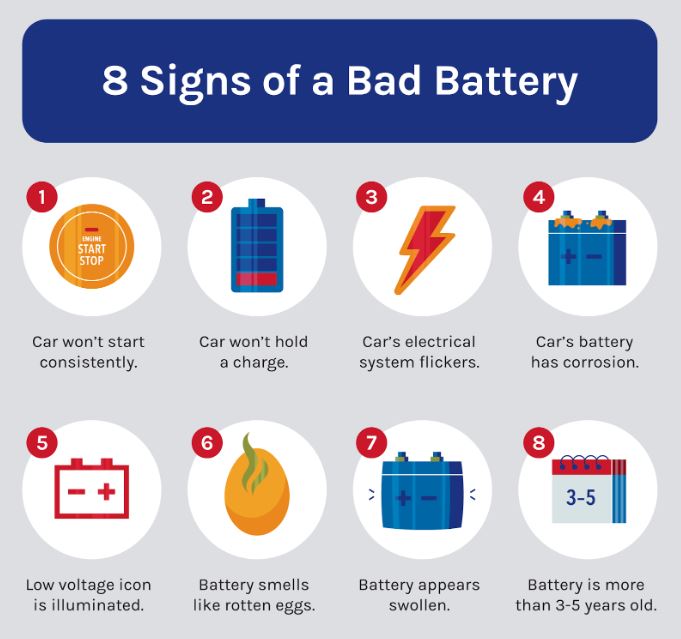
Slow or laboured cranking, headlights that dim while starting, a rapid clicking from the starter, needing a jump more than once, and dashboard electrical warnings that come and go. A swollen case or a rotten-egg smell means the battery is venting and should be replaced immediately. A weak battery can also cause stalling in cars with sensitive electronics.
Do car batteries go bad from sitting unused?
Yes, and faster than most people expect. A parked car still draws a small parasitic current for its alarm, clock and control modules, so the battery self-discharges into the low state of charge where sulfation hardens. Several weeks parked is enough to do measurable damage. A smart maintainer, or disconnecting the negative terminal on long-term storage, prevents it.
The Bottom Line
A car battery does not go bad because of one dramatic event. It goes bad because sulfate hardens, grids corrode, paste sheds, acid separates and water escapes — slowly, in that order, over three to five years. Heat sets the pace and chronic undercharging does the rest, which is why the two habits that matter most are parking out of the summer sun and making sure the battery reaches a genuinely full charge on a regular basis.
If yours is past year three, test its capacity before winter rather than trusting a voltage reading. That single check is the difference between choosing when to replace a battery and finding out in a parking lot.
Products related to this article
Sponsored / affiliate links. As an Amazon Associate I earn from qualifying purchases. I may earn additional commission from eligible campaigns.