Is Adam’s Wheel Cleaner Worth It? Verdict and Value
Adam’s Wheel and Tire Cleaner is worth it if you want a safer, spray-and-rinse wheel cleaner for painted, clear-coated, polished, or chrome wheels and you wash regularly; if price per wash matters most, a cheaper cleaner usually wins. Skipping the right product can mean stubborn brake dust, extra scrubbing, and more risk of dulling delicate finishes. This guide breaks down cleaning performance, finish safety, smell and spray quirks, bottle-size value, and when a premium bottle pays off.
Worth the premium vs when a cheaper cleaner wins


Adam’s is a strong buy for owners who care about wheel safety, regular upkeep, and convenience more than bare-minimum cost. It fits best when brake dust is a routine problem and you want a ready-to-use spray that can clean wheels and tires without mixing or measuring.
Short answer: when it is worth the premium
It is worth the premium when your wheels are painted, clear-coated, or otherwise finish-sensitive, and you clean often enough that bottle size matters. That is where a ready-to-use formula can save time and lower the chance of using a harsher cleaner than you need.
It also makes sense if you are cleaning multiple finishes on the same vehicle, such as wheels plus tires, and you want one bottle for both jobs. If your routine is frequent, the safer chemistry and convenience carry more weight than the sticker price.
Short answer: when a cheaper cleaner is smarter
If your wheels collect only light dust and you wash infrequently, a budget cleaner is often the better value. Lower-cost alkaline or concentrate products can cut the cost per wash, especially for large vehicles or multi-car homes that go through product quickly.
Budget options are also easier to justify on daily drivers with durable finishes and modest contamination. The tradeoff is usually more mixing, more caution, or more scrubbing.
Best fit by driving habits and wheel condition
For a commuter sedan that gets light to moderate dust every week or two, the 16 fl. oz bottle is a common entry point. For an SUV or truck, the gallon size usually makes more sense because wheel area is larger and the bottle goes faster.
For a garage that covers several vehicles, the 5-gallon option is the more economical choice. It only makes sense if you will actually use it before storage, because a bulk buy loses value fast when the cleaner sits unused.
How Adam’s wheel cleaner works
It is sold as a ready-to-use spray formula. That matters because you can move straight from bottle to wheel face, which is the main value proposition versus concentrate products that need dilution and careful measuring.
Brake dust, grime, and tire browning
Brake dust is the core target. Heavy buildup can leave visible residue on the face, behind spokes, and around lug recesses, and that is where a wheel cleaner earns its keep. The same formula can also help with tire browning, road film, and sidewall dirt as a secondary benefit.
A visible purple reaction is often associated with iron-rich contamination on wheel cleaners in this category, but reaction alone does not mean the wheel is clean. Stubborn contamination still needs agitation.
Why dwell time and agitation still matter
Even a good cleaner works best with a short dwell time, then a brush if contamination remains. One competitor review says this cleaner works in 2 to 3 minutes of dwell time, which is a practical window: long enough to loosen grime, short enough to avoid drying.
The label guidance to not let the product dry on the surface matters for coated and clear-coated wheels. If it dries, you lose cleaning efficiency and raise the chance of streaking or residue.
Say your front wheels are gray with brake dust after a week of city driving. A spray-only pass may loosen the film, but a second pass with a wheel brush around the barrel and lug area is what usually finishes the job.
Is Adam’s wheel cleaner safe on your wheels?
It is described as safe for painted, paint-coated, and clear wheels, and another review describes it as safe for painted, clear-coated, polished, and chrome wheels. That makes it a broad-use cleaner, but not a universal no-caution product.
Painted and clear-coated wheels
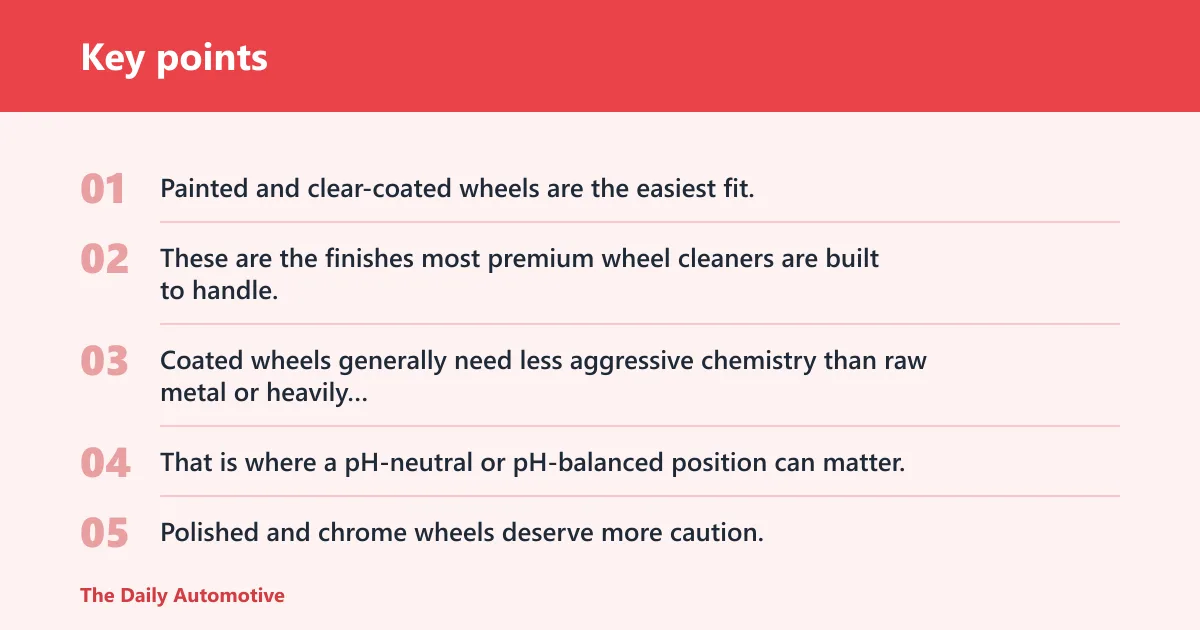
Painted and clear-coated wheels are the easiest fit. These are the finishes most premium wheel cleaners are built to handle, and Adam’s fits that lane if you follow the dwell-time and rinse instructions.
Coated wheels generally need less aggressive chemistry than raw metal or heavily corrected surfaces. That is where a pH-neutral or pH-balanced position can matter, especially for owners who want less risk of etching or dulling.
Polished and chrome wheels
Polished and chrome wheels deserve more caution. The cleaner is described as safe for polished and chrome wheels in one review, but that should not be read as a license to ignore finish condition. Existing pitting, scratching, or thin plating can still be sensitive to any cleaner left too long.
Rinse thoroughly and dry with a microfiber towel after cleaning. That reduces spotting and helps you see whether the finish needs a gentler follow-up on the next wash.
Powder-coated, matte, and damaged finishes
Powder-coated wheels are commonly treated as compatible if the coating is intact, but matte and damaged finishes call for caution. A matte surface can show residue or streaking more easily, and chipped or previously repaired wheels may react differently than a healthy coated wheel.
If a wheel is already dull, etched, or flaking, the cleaner will not fix the damage. In that case, use the mildest product that will do the job and keep dwell times short.
Picture a powder-coated SUV wheel with light dust and no chips. That is a good candidate for Adam’s. A matte wheel with scuffs near the spokes is not a reason to skip cleaning, but it is a reason to be conservative with dwell time and drying.
How much does it cost per wash?
Cost per wash depends on bottle size, vehicle size, and how heavily contaminated the wheels are. The 16 fl. oz bottle is the easiest way to get started, but the gallon and 5-gallon options usually win on cost per wash if you clean often.
16 fl. oz bottle: sedan use case
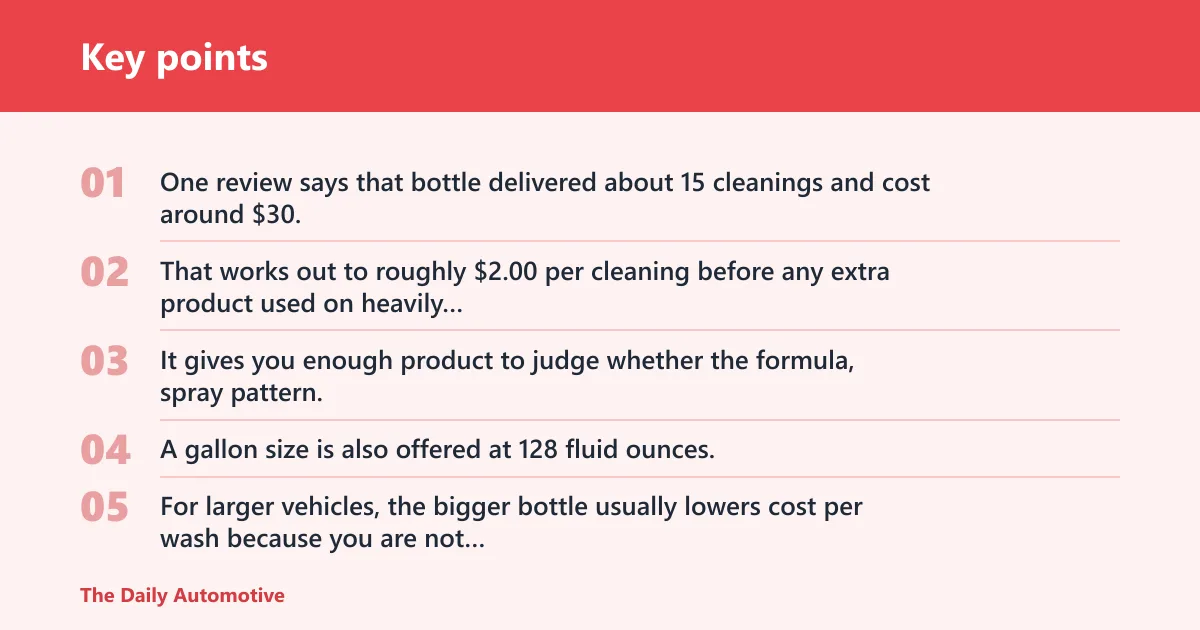
The product is sold as a 16-ounce bottle. One review says that bottle delivered about 15 cleanings and cost around $30. That works out to roughly $2.00 per cleaning before any extra product used on heavily dirty wheels or tires.
For a sedan with moderate dust, the 16 fl. oz size is the sensible trial buy. It gives you enough product to judge whether the formula, spray pattern, and finish safety justify the premium.
128 fl. oz gallon: SUV and truck use case
A gallon size is also offered at 128 fluid ounces. For larger vehicles, the bigger bottle usually lowers cost per wash because you are not paying small-bottle packaging costs over and over.
If an SUV or truck uses roughly two to four times as much cleaner per session as a sedan, the gallon starts making more sense quickly. That is especially true if wheels are wide, have deep barrels, or collect heavy dust from daily driving.
5-gallon option: multi-car or high-frequency use
A 5-gallon version is listed in the package options. That size is mainly for high-frequency users, detail-focused households, or multi-car situations where wheel cleaning is part of the weekly routine.
Bulk size only pays if the product will be used regularly. For one vehicle and occasional washes, the 5-gallon route can tie up cash and storage space without much payback.
Wheel cleaner decision table
This table ties vehicle type, finish, contamination, and wash frequency to the bottle size that usually makes the most sense. The “worth it” call is about whether Adam’s premium price is justified by safety, convenience, and bottle economics.
| Vehicle and finish | Contamination level | Wash frequency | Best bottle size | Estimated uses per bottle | Simple cost per wash | Worth it? |
|---|---|---|---|---|---|---|
| Sedan, painted or clear-coated wheels | Light to moderate dust | Every 1 to 2 weeks | 16 fl. oz | About 12 to 15 | About $2.00 to $2.50 | Yes, for safety and convenience |
| SUV, painted or powder-coated wheels | Moderate to heavy dust | Weekly or twice monthly | 128 fl. oz gallon | About 80 to 120 | About $0.75 to $1.25 | Yes, if you want lower cost per wash |
| Truck, clear-coated or chrome wheels | Heavy brake dust | Weekly | 128 fl. oz gallon | About 60 to 100 | About $1.00 to $1.75 | Yes, if brushing is already part of the routine |
| Multi-car household, mixed finishes | Light to heavy mix | Often | 5-gallon option | Several hundred | Lowest per wash of the group | Yes, if you will use it quickly |
| Any vehicle, matte or damaged wheel | Unknown or uneven contamination | Occasional | 16 fl. oz | About 12 to 15 | About $2.00 to $2.50 | Maybe, but test cautiously |
How to use it correctly
The correct workflow is simple, but the order matters. Spray, let it dwell briefly, agitate with a brush when needed, rinse thoroughly, and dry with a microfiber towel.
- Work on cool wheels in shade when possible.
- Spray the wheel face, barrel, and tire sidewall.
- Let the cleaner dwell briefly, but do not let it dry.
- Agitate stubborn areas with a wheel brush.
- Rinse thoroughly with clean water.
- Dry with a microfiber towel to reduce streaks and spots.
Spray and dwell
Start with an even spray, then give the formula a short dwell time. That lets the cleaner work on brake dust and grime before you touch the surface. Longer is not better if the product begins to dry.
Brush stubborn contamination
Do not expect spray-only use to handle heavy baked-on dust on its own. A wheel brush reaches corners, spoke backs, and tight lug areas where residue tends to stick. That is especially important on trucks and performance sedans that shed more brake dust.
Rinse and dry without streaks
Rinse thoroughly so residue does not sit in seams or around emblems. Dry with a microfiber towel if you want the cleanest finish and fewer water marks. That final step matters more on polished, chrome, and dark-painted wheels.
Pros and cons
Adam’s sits in the premium cleaner category for a reason. It gives you convenience and finish-sensitive cleaning, but the price only makes sense if you will use the product often enough.
Pros
- Ready-to-use spray formula with no mixing.
- Works on wheels and tires.
- Good fit for painted, clear-coated, polished, and chrome wheels when used correctly.
- Useful for brake dust, grime, and tire browning.
- Bulk sizes help lower cost per wash for frequent users.
Cons
- More expensive than budget cleaners.
- Heavy contamination still needs brushing.
- Cost per wash rises fast on large vehicles if you buy only the small bottle.
- Matte, damaged, or uneven finishes need extra caution.
- Smell and spray pattern may matter to sensitive buyers, even if they are not universal problems.
Who is Adam’s wheel cleaner for?
It is best for premium care buyers who want a safer cleaner for coated wheels and do not want to gamble with harsh chemistry. It is also a good fit for multi-car homes and detail-focused owners who will use the gallon or 5-gallon size enough to bring down cost per wash.
Skip it if budget matters most and your wheels are easy to clean with a cheaper product. A basic cleaner can be the smarter buy for light dust, low-frequency washes, or vehicles where you do not mind more scrubbing.
A common first-timer mistake is buying the smallest bottle for a truck with heavy brake dust and then judging the product by that setup. The cleaner may still work well, but the bottle economics will look worse than they should.
Frequently asked questions
Is Adam’s wheel cleaner worth it for brake dust?
Yes, if brake dust is a regular problem and you want a safer cleaner for coated or clear-coated wheels. It is worth it most when you value finish protection and ease of use. If you only need occasional cleaning, a cheaper product may be enough.
Who makes the best wheel cleaner?
There is no single best wheel cleaner for everyone. Adam’s is a strong premium choice for safety and convenience, while lower-cost alkaline or concentrate products can be better on cost per wash. The best pick depends on wheel finish, dust level, and how often you clean.
Can Adam’s wheel and tire cleaner be used on all wheel types?
It is described as safe for painted, paint-coated, clear, polished, chrome, and clear-coated wheels, but that still does not mean every wheel should be treated the same. Matte, damaged, or previously repaired finishes deserve extra caution and shorter dwell time.
How much does Adam’s wheel and tire cleaner cost to use per wash?
One review says the 16-ounce bottle delivered about 15 cleanings at around $30, which works out to roughly $2.00 per wash. Larger bottles usually lower that figure, especially on SUVs, trucks, or multi-car households that use more product per session.
Is Adam’s wheel cleaner better than cheaper alternatives?
It is better if you want convenience, safer chemistry, and finish-sensitive cleaning. Cheaper alternatives can still clean well, especially on durable wheels and light contamination. The premium only makes sense when the lower risk and easier workflow matter enough to justify the added cost.
Does Adam’s wheel cleaner need brushing or can it be spray and rinse?
Light dust may come off with spray and rinse, but heavy brake buildup usually needs brushing. The formula works best when you spray, let it dwell briefly, agitate stubborn areas, rinse thoroughly, and dry. That is the safer path for rough contamination.
What size Adam’s wheel cleaner bottle should I buy?
Choose the 16 fl. oz bottle for a sedan or as a trial buy. Choose the 128 fl. oz gallon for an SUV or truck. Choose the 5-gallon option only if you clean multiple vehicles often enough to use the product quickly.
Is the smell or spray nozzle a problem with Adam’s wheel cleaner?
Smell and nozzle feel are buyer considerations, not universal defects. If you are sensitive to odor or want a very fine spray pattern, check those details before buying a large bottle. Otherwise, the more important question is whether the cleaner fits your wheels and your cleaning routine.
How do you use Adam’s wheel and tire cleaner correctly?
Spray the wheel and tire, allow a short dwell time, agitate stubborn dirt with a brush, rinse thoroughly, and dry with a microfiber towel. Do not let the product dry on the surface. That keeps streaking down and helps protect delicate finishes.
Products related to this article
Sponsored / affiliate links. As an Amazon Associate I earn from qualifying purchases. I may earn additional commission from eligible campaigns.