
Best Auto Insurance for Students
Methodology: This guide compares carrier-published student discount rules, state DOI guidance, and national consumer resources from the NAIC and Insurance Information Institute (III), with figures dated as of October 28, 2026 unless otherwise noted. Because rates change by state, driver profile, and garaging address, all price references below should be treated as examples, not guarantees.
The cheapest valid auto insurance for students is usually a parent’s policy, if the student still qualifies as a dependent, drives the family car, and lives at home or close enough for a garaging-address match. Bad setup choices can add hundreds a year, or trigger claim problems if the policy and living situation do not match. This guide shows which discount stack fits your mileage, address, and vehicle value, and when to keep, split, or switch coverage.
Best setup for most students
For many students, the best starting point is the parent household policy, because it often prices better than a standalone policy when residency and garaging rules line up. Younger drivers usually cost more to insure because age and driving history still matter, so the biggest savings usually come from the policy structure, not from one single discount. NAIC and III consumer guidance both emphasize that rating varies widely by driver profile and state, so the cheapest setup is the one that matches the car’s real overnight location and use pattern.
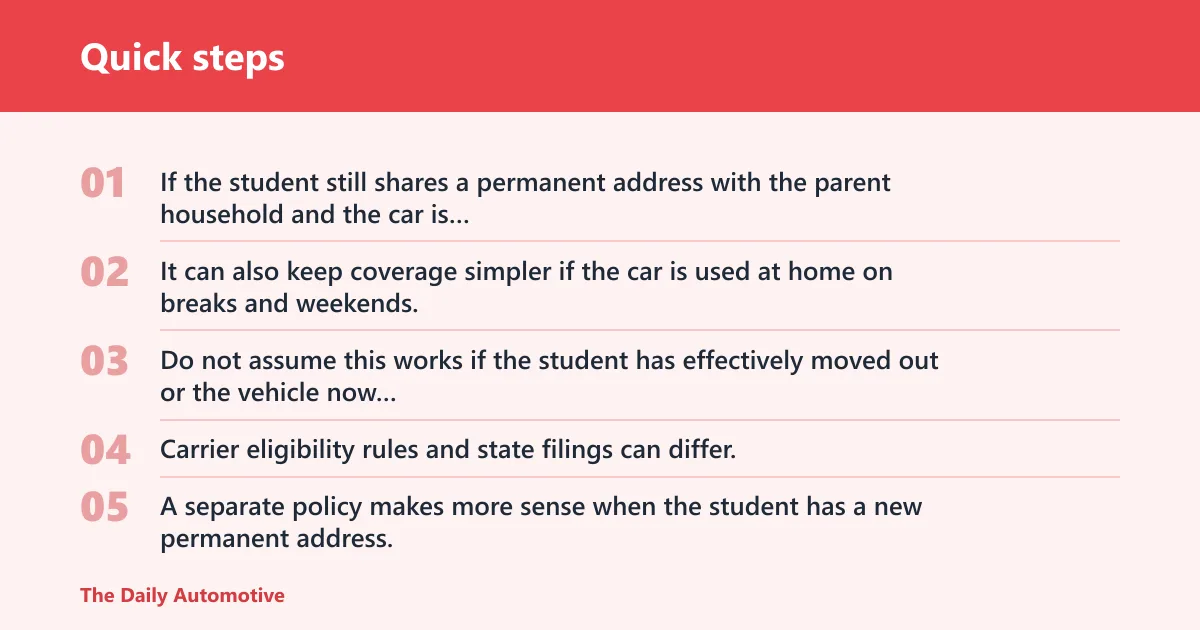
Top pick: stay on a parent policy when eligible
If the student still shares a permanent address with the parent household and the car is garaged there, this is often the cheapest valid setup. It can also keep coverage simpler if the car is used at home on breaks and weekends. Do not assume this works if the student has effectively moved out or the vehicle now lives near campus year-round. Carrier eligibility rules and state filings can differ, so the same student may qualify with one insurer and not another.
When a standalone policy makes more sense
A separate policy makes more sense when the student has a new permanent address, keeps the car near school full-time, or no longer qualifies for the parent household policy under the carrier’s residency rules. GEICO can be a good fit for some students on their own policy, while State Farm often works well for younger drivers who still qualify for household pricing, and Allstate can be a good fit for students bringing a car to school. Those are not universal winners: availability of student discounts, telematics, and away-at-school pricing varies by state and carrier, and the lowest quote depends on the student’s actual garaging address, annual mileage, and coverage limits.
What to compare before you quote
Ask about liability limits, deductible choices, student discounts, telematics, and whether the carrier accepts the student’s actual garaging address. Compare identical coverage limits and deductibles across multiple insurers, including GEICO, State Farm, Progressive, Allstate, USAA, and Liberty Mutual. USAA eligibility is limited to qualifying military members, veterans, and eligible family members; ROTC status alone does not automatically create USAA eligibility, although some military-affiliated students may qualify through family ties. For state-specific exceptions, ask whether your state or carrier has any alternatives to standard auto insurance requirements, such as financial responsibility bonds or self-insurance for rare qualifying situations.
| Quote comparison item | What to verify | Why it changes the price | Source to check |
|---|---|---|---|
| Garaging address | Where the car sleeps most nights | Urban campus, suburban home, and out-of-state garaging can all price differently | Carrier rating rules; state DOI consumer guidance |
| Annual mileage | Estimated school-year and summer driving | Low-mileage or telematics programs may apply only below certain thresholds | Carrier discount pages; telematics terms |
| Coverage limits | Liability, collision, comprehensive, UM/UIM where available | Higher limits cost more but can prevent underinsurance | NAIC/III coverage guides; state minimums |
| Deductibles | Collision and comprehensive deductible amounts | Higher deductibles usually lower the premium | Carrier quote screen; policy declarations |
| Student discounts | Good student, away-at-school, and telematics eligibility | Discounts can stack, but not always in every state | Carrier discount pages; state filings |
| Claims/complaints snapshot | State complaint patterns and consumer service issues | Low price is less useful if service or claims handling is weak | State DOI complaint data; NAIC resources |
Quick picks by student situation
The right setup changes with the student’s routine. A commuter with daily driving needs a different price stack than a dorm student who barely uses the car. Low mileage, address, and vehicle value matter more than the school name.
- Daily commuter: parent policy if eligible, plus good student discount and telematics if the driving record is clean.
- Dorm student leaving the car home: student away at school discount, possible parent policy, and sometimes a low-mileage or pay-per-mile setup.
- International student buying alone: standalone policy, liability first, then telematics and any academic discount the carrier allows.
- Older-car owner: liability plus a careful collision and comprehensive check, because full coverage may cost more than the car is worth.
A common first-timer mistake is paying for full coverage on a car worth less than the deductible plus a year of premiums. If the vehicle is old and cheap to replace, that money may be better spent on a larger emergency fund and a higher liability limit.
Student insurance matrix
This matrix turns student status, mileage, living arrangement, and car value into a workable setup. Use it to narrow quotes before you ask an insurer for price.
| Student scenario | Recommended policy setup | Likely discounts to ask about | Coverages to keep | Common mistakes to avoid |
|---|---|---|---|---|
| Commuter | Stay on the parent household policy if the car is garaged at home or the school commute keeps the address match valid. | Good student, telematics, multi-car if the household has more than one vehicle. | Liability first; collision if the car is newer or financed. | Leaving the old home address on file after the car moves to campus. |
| Dorm student | Ask whether the car qualifies for the student away at school discount while remaining on the family policy. | Student away at school, good student, pay-per-mile or telematics if mileage drops sharply. | Liability, then decide on collision and comprehensive based on car value. | Keeping the car on the policy as if it is still used daily. |
| International student | Usually a standalone policy, unless a parent household policy still applies through local residency and garaging rules. | Good student if eligible, telematics, and any newcomer-friendly pricing the carrier offers. | Liability at a legal minimum or higher, plus collision on a financed car. | Buying the cheapest policy without checking state minimums and proof-of-residency rules. |
| Older-car owner | Choose the leanest legal setup that still protects against a major lawsuit, then review full coverage against car value. | Good student, telematics, low-mileage, and sometimes pay-per-mile. | Liability; collision and comprehensive only if the payout would justify the premium. | Paying for collision and comprehensive when the deductible nearly matches the car’s value. |
What discounts should students ask for?
Students should ask for every discount tied to grades, school status, mileage, and driving behavior. Good student discounts and low-mileage pricing are common savings levers, but the best result usually comes from stacking the right discounts on the right policy structure.
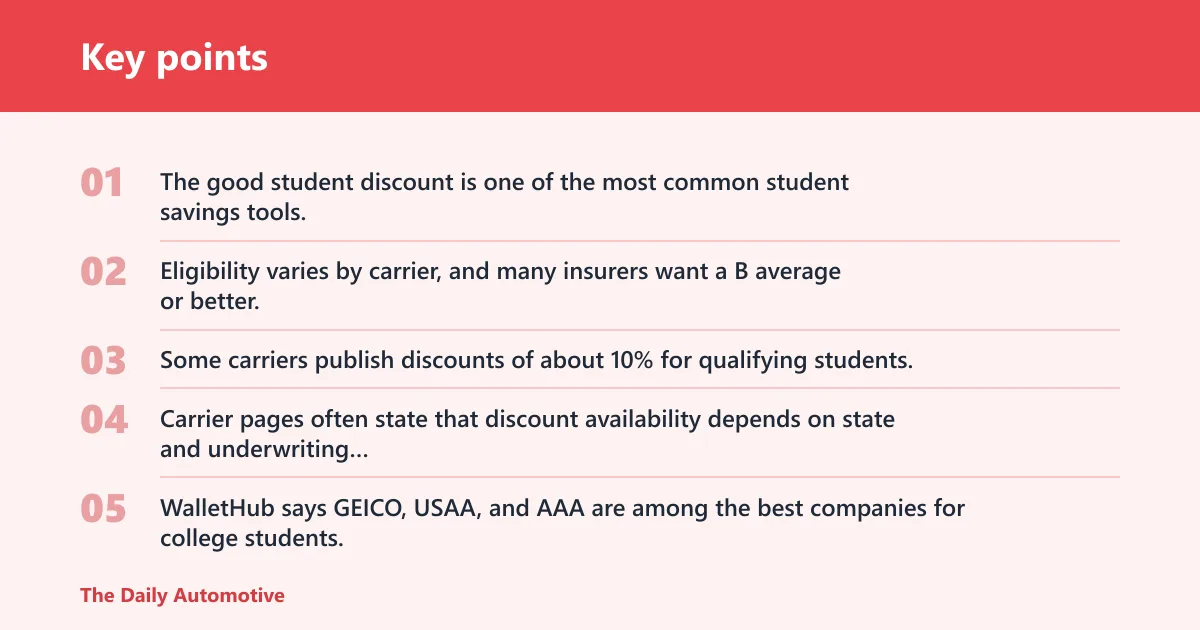
Good student discount
The good student discount is one of the most common student savings tools. Eligibility varies by carrier, and many insurers want a B average or better. Some carriers publish discounts of about 10% for qualifying students, and USAA says its good student discount can save up to 10% for qualifying students. Carrier pages often state that discount availability depends on state and underwriting rules, so exact savings should be confirmed in the quote.
WalletHub says GEICO, USAA, and AAA are among the best companies for college students, and it lists GEICO at $609 per year for students and USAA at $699 per year for students. WalletHub also says students can save up to $900 per year, but the actual number depends on the policy, the state, and the student’s record. Those figures should be treated as dated comparison data rather than universal pricing, because the underlying quote mix and state rules can change quickly.
Student away at school discount
This discount can apply when a full-time student is away from home and the car is not regularly available while the student is at school. It often stacks with other student discounts. AAA is one carrier cited for both good-student and distant-student discounts, which makes this especially worth asking about for dorm students. Availability is not uniform across all states or all policy forms.
Telematics and usage-based insurance
Telematics uses driving behavior data to price the policy. It can help careful students and low-mileage drivers, especially if the student mostly drives short campus trips, avoids late-night driving, and keeps annual mileage low. It is a practical option when the student does not need a large fixed-rate policy. Carrier programs often vary by state and may include enrollment, device, or app requirements.
Pay-per-mile and low-mileage options
Pay-per-mile or other low-mileage pricing can fit students on walkable campuses or students who rely on public transit most of the week. If the car stays parked for long stretches, ask whether the carrier offers pricing that tracks actual use instead of assuming everyday driving. Some insurers cap eligibility by annual mileage or zip code, so this is worth confirming before binding coverage.
ROTC or military eligibility
ROTC and military family status can matter because USAA is often a strong option for eligible military households. If the student qualifies through a parent or guardian, it is worth checking whether that access changes the price enough to beat other quotes. Eligibility is specific: ROTC participation by itself is not the same thing as USAA military-family eligibility, so verify the family connection before relying on this option.
Which coverages are worth keeping?
Liability coverage is the base layer every student should treat as non-negotiable. State minimums vary, and liability pays for injuries to other people and property damage you cause. After that, the right answer depends on car value, loan terms, and how much repair risk you can absorb.
Liability coverage first
Start with liability that meets your state rules, then consider higher limits if the budget allows. Minimum required coverage may be legal, but it can be thin after a serious crash. A student with assets, savings, or a parent co-signer may want stronger limits than the state floor. For a refresher on how limits work, see what does car insurance cover and what is liability auto insurance.
Collision coverage on newer or financed cars
Collision coverage pays for your car after a crash. It is usually worth keeping on newer vehicles, leased cars, or cars with a loan attached. On a low-value older car, collision often stops making sense when the annual premium plus deductible risk approaches the car’s replacement value.
Comprehensive coverage and vehicle value
Comprehensive covers non-collision damage such as theft, hail, fire, or vandalism. It is a major component of full coverage and can be worth keeping on cars that would be expensive to replace, but the price still has to fit the car’s actual value. If the payout would be small, dropping comprehensive may be reasonable.
Choosing a deductible you can actually pay
A higher deductible usually lowers the premium, but it raises your out-of-pocket claim cost. For a student on a tight budget, a deductible should be high enough to cut the price, but not so high that a small crash becomes a financial shock. Pick a number you could pay without borrowing. For more detail, see what is a deductible in car insurance.
Suppose a student drives a roughly 12-year-old sedan worth about $3,000 and raises the deductible to save a little on premium. If one moderate repair would cost close to the car’s market value, collision and comprehensive may not be worth paying for anymore.
How do you choose the cheapest valid setup?
Choose the cheapest valid setup by matching the policy to where the car lives, how often it moves, and what the car is worth. Do not start with insurer brand names. Start with residency, garaging, mileage, and whether you need the parent household policy or a standalone one.
- Confirm where the car is garaged. Use the real overnight address, not the most convenient one.
- Decide whether the student still belongs on a parent household policy or needs a separate policy.
- Match coverage to vehicle value and mileage. Keep liability, then decide on collision, comprehensive, telematics, or pay-per-mile.
- Ask for every discount you may qualify for, then compare multiple quotes with the same deductible and coverage limits.
- Save proof of grades, enrollment, away-at-school status, residency, and military eligibility before you bind the policy.
One failure case matters a lot: if the student moves from home to a dorm, but the insurer still thinks the car is garaged at the family house, the discount stack may change or the claim file may get attention later. Quote accuracy matters as much as price.
How much is a good student discount for car insurance?
A good student discount is often around 10% at some insurers, though the actual number can vary by carrier and state. Some companies ask for a B average or better, and some may also want current proof of grades or enrollment. The discount helps most when paired with the right policy structure.
In practice, the discount can be meaningful, but it rarely beats a bad garaging setup or the wrong coverage choice. A student on the wrong policy can lose far more than the discount saves.
Is insurance cheaper for students?
Usually, no. Younger drivers with less experience often pay more, but they can qualify for discounts that trim the bill. The way to lower the price is to qualify for the parent policy, keep mileage low, ask for student discounts, and avoid carrying more physical damage coverage than the car justifies. III and NAIC consumer materials both note that age, experience, and usage patterns are major price drivers.
That is why the cheapest valid setup is usually a combination of policy structure and discounts, not a single insurer name.
What insurance companies offer good student discounts
Several major insurers are commonly mentioned for student savings. The same source says GEICO, USAA, and AAA are among the best companies for college students, and Allstate is the top pick for students bringing a car to school. Those claims are useful as comparison signals, but they should not be treated as universal rankings because student discount eligibility, rates, and telematics rules vary by state and by quote profile.
Do not shop by brand alone. Ask each carrier whether it accepts good-student proof, away-at-school status, telematics, and the correct garaging address before you compare price.
What is the cheapest auto insurance for college students?
The cheapest valid option is usually the parent household policy when the student still qualifies, followed by a student-specific standalone policy only when the address or residency rules require it. AutoInsurance.com lists a $1,731 annual full-coverage average for students on their own policy and a $144 monthly full-coverage average for students on their own policy, both dated 2026 in that source’s student pricing round-up. Those figures highlight how quickly costs add up once the student moves off the household plan, but they are not a promise of what any one student will pay.
Those averages do not mean every student will pay that amount. They show why quote structure matters before the insurer name does.
Frequently asked questions
Should a student stay on a parent’s policy?
Usually yes, if the student still qualifies as part of the parent household, the car is garaged where the policy expects, and the insurer allows the arrangement. This is often cheaper than a standalone policy. If the student has moved out or the garaging address changed, the answer can flip fast.
Does student away-at-school status lower car insurance?
It can, especially when the car is left at home and not regularly available while the student is away. Some carriers treat this as a separate discount, and it can stack with good-student pricing. The key is proving that the car is not being used as a regular campus vehicle.
What is the alternative to car insurance?
There is no real alternative to carrying auto insurance when you own and drive a car on public roads. What you can change is the coverage mix: liability only, higher deductibles, telematics, pay-per-mile pricing, or a parent household policy if you still qualify. In a few states and special cases, financial responsibility bonds or self-insurance may exist, but those are not typical student solutions and usually require separate legal and financial qualification.
Do students get cheaper car insurance?
Not automatically. Students often pay more because of age and inexperience, but they can qualify for discounts that reduce the bill. The biggest savings usually come from staying on a parent policy, using low-mileage pricing, and asking for academic or away-at-school discounts.
What is the best coverage for an older student car?
For an older, low-value car, liability is the core coverage to keep. Collision and comprehensive should be judged against the car’s market value and the deductible. If the annual premium plus deductible risk is close to what the car is worth, full coverage may not be worth it.
How do students compare quotes the right way?
Use the same driver details, garaging address, school status, deductibles, and coverage limits at every carrier. Ask for discounts in writing, then compare the final price from at least a few insurers. If one quote is much lower, check whether it changed the residency or mileage assumptions.
Products related to this article
Sponsored / affiliate links. As an Amazon Associate I earn from qualifying purchases. I may earn additional commission from eligible campaigns.