How to Safely Accept Payment When Selling a Car
Accept payment only after you check the buyer’s identity, see cleared funds in your own account, sign the transfer paperwork, and keep the car and keys until all of that is finished. If you skip that order, bad checks, fake transfers, or chargebacks can cost you the car, the money, or both. This guide covers a seller-safe payment workflow for cash, cheque-style payments, bank transfers, and records you should keep.
Safest payment method
For a private car sale, bank transfer is the safest common choice because it leaves a traceable record and usually shows the money quickly. The key rule is plain: do not release the car until the money shows in your own bank account, not on a phone screen.
That matters because proof of transfer is not the same as cleared funds. A screenshot, email, or payment notice can be edited, delayed, or reversed depending on the channel. If the buyer objects to a bank transfer, treat that as a warning sign, not a reason to bend the process.
What counts as cleared funds
Cleared funds are money your bank has received and made available to you. The seller should see the payment posted in the account used for the sale, with no pending status and no need to trust the buyer’s app or a third-party message. Do not hand over the keys until the funds are in your account.
If you sell through a dealer or a reputable car buying service, payment may move through a different process, but the same rule still applies: the vehicle stays put until the funds are fully cleared and the paperwork matches the agreed sale.
When to release the keys
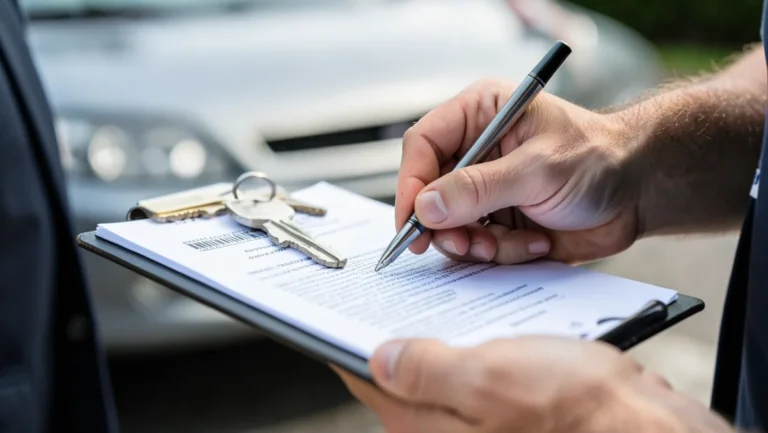
Release the keys only after payment has cleared, the bill of sale is signed, and the transfer paperwork is complete. That includes the transfer details where relevant, plus any separate receipt you keep for your records. Never swap the keys for a promise that money is “on the way.”
Picture a buyer who arrives with a banking app showing a transfer marked “sent.” If your account still shows nothing, the sale is not complete. The car stays with you until the money appears in your own account and the paperwork is signed.
Car sale payment safety checklist
| Payment method | Clearance risk | Verification step | When to release keys | Scam red flags |
|---|---|---|---|---|
| Bank transfer | Low, but only after it has cleared in your account | Check your own bank app or statement for posted funds | After funds are visible, paperwork is signed, and the sale details match | Buyer urges instant handover, shows only a screenshot, or claims the transfer is “pending” |
| Cash | Counterfeit notes, no paper trail, and personal safety risk with large amounts | Count at a bank, use counterfeit checks, and verify the total before deposit | After the cash is verified and safely deposited | Meeting in a car park, rushed counting, mixed denominations, or resistance to going to a bank |
| Cheque | Can bounce and needs clearing time | Wait for full clearing and, for a banker’s draft or cashier’s cheque, verify with the issuing bank | Only after clearing is confirmed by your bank | Urgency, refusal to wait, or claims that a cheque is “as good as cash” |
| Banker’s draft | Can still be forged | Call the issuing bank directly using a verified number, not one supplied by the buyer | After direct verification and cleared funds | Unverifiable paperwork, mismatched names, or pressure to complete outside banking hours |
| Payment apps | Limits, fees, reversals, and disputes | Check transfer limits and whether the service allows chargebacks or holds | Only after the money is fully available in your account and cannot be disputed | Buyer wants to split the price, pay through a personal account, or avoid bank transfer |
| Instalment offers | High risk because payment is incomplete at handover | Decline unless you have legal advice and full protection | Do not release the car on instalments in a normal private sale | Requests for “deposit now, balance later,” post-dated promises, or informal contracts |
Can you accept cash for a car?
Yes, but cash is a poor fit for most private car sales. Motorway warns about counterfeit notes and notes that cash leaves no paper trail. Large amounts also create personal safety risk, especially if the meeting place is a car park, a driveway, or anywhere you have to carry the money away alone.
If cash is the only option, handle it at a bank branch. Count it there, ask staff to help verify the notes if the branch allows it, and deposit the full amount immediately. Do not take the cash home first, and do not hand over the keys until the deposit is accepted and the sale is documented.
Why a bank branch is better than a car park
A bank branch gives you witnesses, deposit facilities, and a safer way to deal with a large bundle of notes. A car park gives you none of that. If a buyer insists on an isolated meeting place or wants to rush the exchange, the deal should stop there.
Suppose a buyer arrives with a thick envelope of notes for a £6,000 hatchback. The right move is to go inside the bank together and deposit the cash, not to count it beside the boot while traffic passes around you.
Are cheques and banker’s drafts safe?
Not as a default choice. Motorway says cheques are discouraged because they can bounce, and banker’s drafts can still be forged. A cheque or draft may look official, but that does not make it final. The seller still needs real clearing time and direct verification before the car leaves.
How to verify directly with the issuing bank
If a buyer offers a banker’s draft or cashier’s cheque, contact the issuing bank directly using a number you source yourself. Ask the bank to confirm that the draft is genuine, payable, and issued for the correct amount to the correct name. Some banks will not confirm draft validity to non-customers, so be prepared for them to decline verification. Do not rely on a phone number printed on the draft if you did not source it separately. (FDIC)
Do not release the keys while waiting for a cheque to “probably clear.” If the payment method needs clearing time, the car stays parked. If the buyer presses for immediate collection, the risk is theirs, not yours.
What if the buyer wants PayPal or instalments?
Payment apps and digital payment services are awkward for car sales because they may have limits, fees, reversals, and disputes. Instalment offers are worse for a private sale because you hand over the car before full payment. In a normal seller-side workflow, both options should be declined unless there is strong legal protection and clear written advice.
Why payment apps are a poor fit
Many apps are built for smaller everyday payments, not high-value vehicle transactions. A transfer may be delayed by limits, held for review, or disputed later. If a buyer proposes an app instead of a bank transfer, the seller should ask whether the full amount can be verified in the seller’s own account and whether any reversal rights remain.
How to reject pressure to split payment
A buyer may ask to pay part now and part later, or to use one method for a deposit and another for the balance after pickup. Decline that structure. If a deposit is taken at all, it should be small, written into the agreement, and understood as a deposit only, with the car retained until the full amount is cleared.
A common first-timer mistake is letting a buyer take the car after a partial payment because they “seem honest.” That leaves the seller with a debt claim instead of the vehicle. If the buyer cannot pay in full now, the sale is not ready.
What if the car still has finance?
If the car still has outstanding finance, check the lender’s requirements before you sell. Ask for a settlement letter so you know the exact balance due, then use the sale proceeds to clear the loan before you transfer ownership.
What a settlement letter shows
A settlement letter sets out the exact outstanding finance balance and the terms needed to clear it. That figure matters because the seller needs to know the amount that must be paid to the lender at sale. If the car is sold before that balance is settled, the buyer may face a title problem and the seller may still owe the lender.
How to clear the loan at sale
Use the sale money to pay the lender’s settlement amount first, then release the car only when the finance account is confirmed closed or the lender has confirmed the payoff. If the buyer is paying by bank transfer, it is often sensible to wait until the lender side is ready so the funds can be applied without delay.
Do not accept a promise that the finance will be “sorted later.” Later is too late. The lender’s claim comes before the handover, not after it.
How to document the handover
The handover should produce written proof that the car was paid for in full and who received it. Keep a receipt that confirms the car was paid in full, and that is the right standard for a private sale as well. Keep a copy of everything you sign.
What to put on the receipt or bill of sale
The receipt or bill of sale should record the vehicle details, the sale price, the date, and the names of both parties. It should also state that payment was made in full and identify the payment method. If there are any included items, such as spare keys or locking wheel nuts, list them too.
That wording makes later disputes harder. If the buyer claims the car was only partly paid for, the document should say otherwise. If the seller later forgets which date was agreed, the receipt should answer that too.
What proof to keep after payment
Keep the bank transfer confirmation, the signed receipt or bill of sale, a copy of the transfer handover details if applicable, and any message confirming the final agreed price. Keep the same set of records the buyer gets. That symmetry helps if a dispute follows.
When to notify ownership transfer or disposal
Notify the relevant authority straight away after the sale. That is the right move for avoiding later liability for tolls, fines, or offences tied to the car after it has left your control. If your jurisdiction uses a notice of sale or disposal, lodge it without delay.
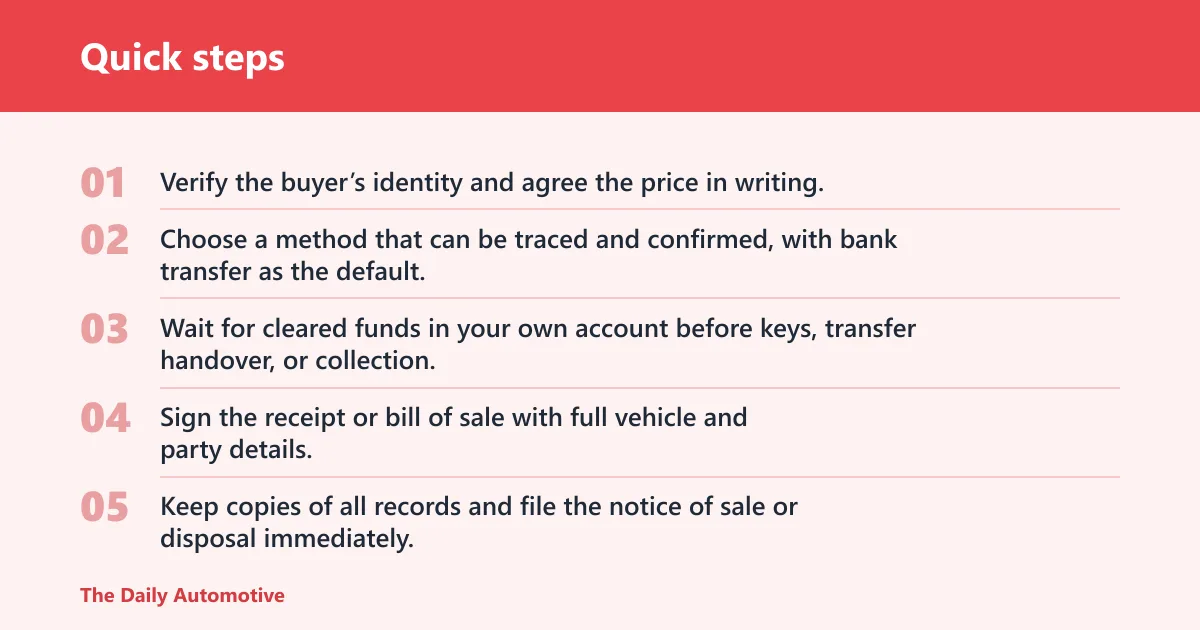
- Verify the buyer’s identity and agree the price in writing.
- Choose a method that can be traced and confirmed, with bank transfer as the default.
- Wait for cleared funds in your own account before keys, transfer handover, or collection.
- Sign the receipt or bill of sale with full vehicle and party details.
- Keep copies of all records and file the notice of sale or disposal immediately.
Frequently asked questions
What is the safest way to accept payment when selling a car?
Bank transfer is the safest common option because it is traceable and usually visible in your account before handover, but only if you wait for cleared funds. Do not release the car on a screenshot, a promise, or a pending notification. Keep the vehicle until the money is actually in your account.
How do I know a bank transfer has cleared before handing over the car?
Check your own bank account, not the buyer’s app. The money should appear as posted funds, not a pending item, and the amount should match the agreed sale price. If anything looks delayed or incomplete, hold the car, hold the keys, and ask the buyer to wait.
Can I accept cash for a private car sale?
You can, but cash carries counterfeit-note risk, leaves no paper trail, and can put you in an awkward personal-safety situation if you are carrying a large amount. If you accept it, count and deposit it at a bank branch before the car changes hands. Never meet in a place that makes you vulnerable.
Are cheques safe when selling a car?
They are not a good default choice. The same source says cheques can bounce, and banker’s drafts can still be forged. If a buyer offers either one, you need clearing time and direct verification with the issuing bank before you release the car. If the buyer wants instant handover, decline the cheque route.
What should I do if a buyer wants to pay in instalments?
Decline the offer in a normal private sale. Instalments leave you with the car gone and the money unfinished, which is the wrong risk balance for a seller. Only consider it if you have legal advice, a formal contract, and protection that leaves you no worse off than a full cash sale.
How do I avoid overpayment scams when selling my car?
Do not refund anything until the original payment has fully cleared and you have verified it with your bank. In an overpayment scam, the buyer sends too much, asks for a refund, and the first payment later fails or is reversed. If the buyer overpays, stop the sale and wait.
Can I sell my car if I still owe finance?
Yes, but only after you check the lender’s requirements and settle the balance. Get a settlement letter so you know the exact amount due, then use the sale proceeds to pay off the lender before completing the sale. If the lender has not been paid, the transfer is not clean and the sale should not finish.
What paperwork should I keep after accepting payment for a car?
Keep a receipt or bill of sale that shows the price, date, vehicle details, and both parties’ names, plus proof that the payment was made in full. Keep the bank record as well. After that, file the notice of sale or disposal so you are not left tied to later fines or offences.
Should I accept payment through PayPal or a payment app?
Usually no. Payment apps can have limits, fees, reversals, and disputes, which makes them a poor default for a private car sale. If a buyer insists on using one, confirm that the full amount can be verified in your own account before you move a single key.
How can I protect myself during a private car handover?
Meet in a bank branch or another controlled place, verify the buyer, confirm cleared funds, sign the receipt, and notify the transfer immediately after the sale. Do not hand over the car, the keys, or the transfer paperwork until each step is complete. If anything feels rushed, stop the deal.
Products related to this article
Sponsored / affiliate links. As an Amazon Associate I earn from qualifying purchases. I may earn additional commission from eligible campaigns.