
5 Best Car AC Gauge Sets for Home Mechanics (2026): We Compared
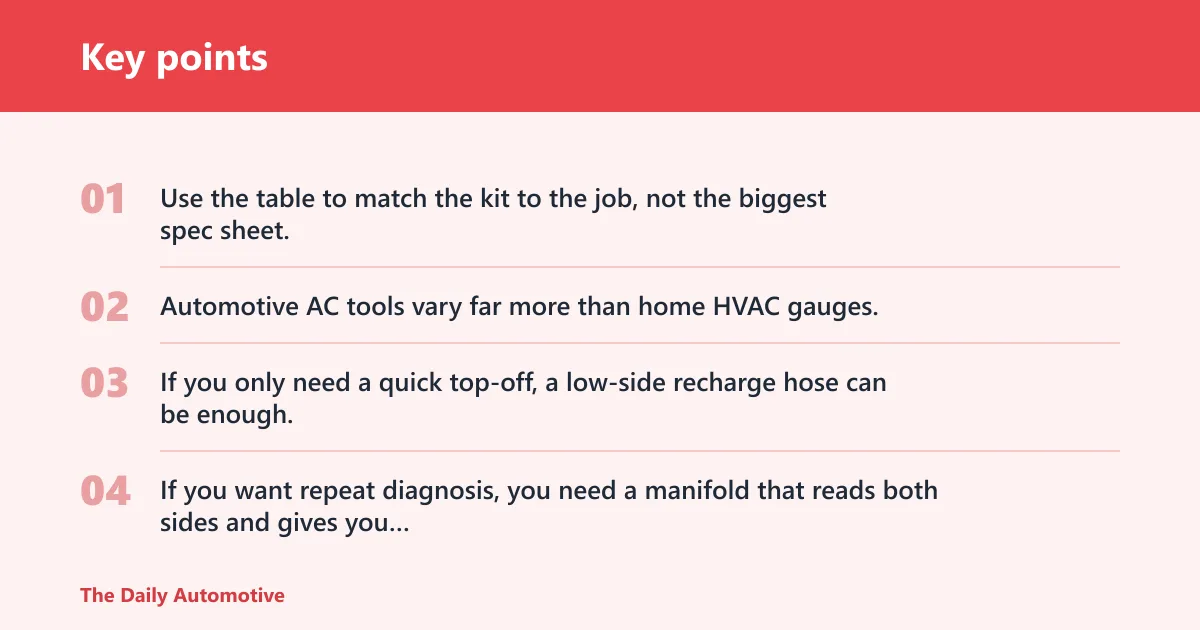
Use the table to match the kit to the job, not the biggest spec sheet. Automotive AC tools vary far more than home HVAC gauges, especially once you separate R134a from R1234yf.
For most home mechanics, the best car AC gauge set is a manifold kit matched to the task: a low-side recharge hose for quick R-134a top-offs, a two- or three-hose manifold for repeat diagnostics, or a legacy refrigerant setup with the right adapter set. Buy the wrong one and you can get bad readings, waste refrigerant, and still end up with warm air at the vents. This guide breaks down which gauge set fits each task and which features are worth paying for.
Quick comparison
| Product | Badge | Best for | Price | ||
|---|---|---|---|---|---|
 |
VIVOHOME HVAC Gauges with R134a R1234yf Quick CouplersVIVOHOME | Our pick | 3-hose manifold set · n/a · R134a/R1234yf | $66.49
Price as of 3 Nov 2026
|
View |
 |
LICHAMP AC R1234YF R134A Gauge SetLichamp | Also great | 4-valve gauge set · n/a · R1234YF/R134A | $89.99
Price as of 3 Nov 2026
|
View |
 |
WISSCOOL Digital Manifold Gauges HVACWisscool | Upgrade pick | Digital manifold set · n/a · R454B/R134A/R410A | $128.99
Price as of 3 Nov 2026
|
View |
 |
PB Motor Tech 3 Way Brass Manifold Gauge Set for R134A R12PB Motor Tech BMT | Budget pick | 3-way manifold set · n/a · R134A/R12/R22 | $26.99
Price as of 3 Nov 2026
|
View |
 |
R1234YF Refrigerant Charge Hose Kit with Puncture Can TapTigbear | Our pick | $19.99
Price as of 27 Nov 2026
|
View |
If you only need a quick top-off, a low-side recharge hose can be enough. If you want repeat diagnosis, you need a manifold that reads both sides and gives you more than one hose path to work with.
How we chose
Selection came from manufacturer specs, listing details, and published buyer feedback about clarity, completeness, and fit for car AC work.
- Job fit: recharge-only, diagnosis-first, or mixed refrigerant use.
- Compatibility: R134a versus R1234yf separation, plus legacy refrigerant support where listed.
- Usefulness: hose count, couplers, can taps, and vacuum-pump compatibility.
- Readability and repeatability: gauge range, calibration claims, and pressure-control clarity.
- Build details: hose ratings, manifold layout, and completeness of the kit.
VIVOHOME HVAC gauges: best for quick recharge work
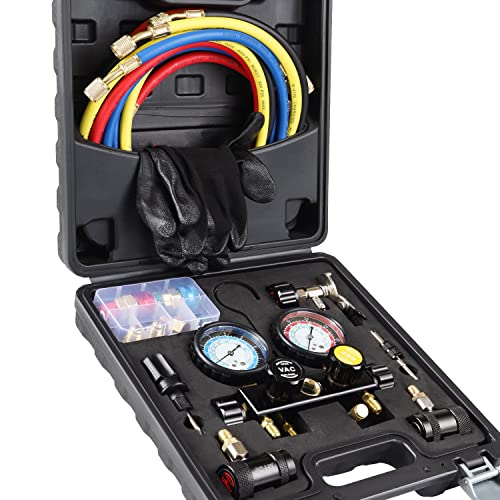
This 3-hose VIVOHOME manifold set fits the home mechanic who wants one kit for charging and evacuation on cars that use R134a or R1234yf service hardware. The listing says it includes quick couplers and can taps, so it covers the basic hookup steps without forcing you to buy the connectors separately.
What stands out is the mix of plain layout and flexibility. Three hoses are enough for common car AC service, and the kit is aimed at AC diagnostics and refrigerant work, which is the right scope for a first manifold purchase.
The drawback is that it is still a general-purpose kit, so a buyer focused on repeated diagnosis may want a manifold with more control points. Confirm refrigerant-specific fit before buying, because R1234yf and R134a tools should stay separate in the shop.
LICHAMP AC gauge set: best for repeat diagnostics
This Lichamp 4-valve manifold is the better fit when you want more control during repeat troubleshooting. The listing says it works with R1234YF and R134A refrigerants, includes four hoses and quick couplers, and uses brass and aluminum parts for durability.
That extra valve layout matters when you are checking pressures more than once, isolating a path, or comparing side-by-side system behavior. A manifold with more control points usually makes diagnosis easier than a simple recharge hose.
The drawback is that a diagnosis-focused set can be more tool than a beginner needs if all you want is a basic top-off. Also verify coupler match carefully, because mixing refrigerant families is a bad idea even when a listing mentions both.
PB Motor Tech 3-way manifold: best for mixed older fleets
This PB Motor Tech 3-way brass manifold is the pick for older vehicles and mixed refrigerant work where legacy support matters. The listing says it covers R134A, R12, R22, and R502, and includes quick couplers, a 410 adapter, a puncturing can tap, a valve core tool, and color-coded hoses.
That makes it the most flexible option here for a garage that sees older cars or multiple refrigerant standards. It is also the clearest example of a classic automotive manifold gauge set, with a brass body and enough accessory coverage to handle basic diagnostic and charging tasks.
The drawback is that broad compatibility can tempt users to treat all refrigerants the same. It should not be treated as a shortcut for R1234yf service, and the included puncturing can tap is not the right answer for every can or every refrigerant family.
Which one should you buy?
Pick the VIVOHOME set if your main goal is a straightforward recharge on a car AC system and you want a kit that already includes quick couplers and can taps. Pick the Lichamp set if you expect to diagnose the same vehicle more than once and want the control that comes with a 4-valve manifold.
Pick the PB Motor Tech set if your work spans older vehicles and legacy refrigerants. It is the broadest match for mixed fleets, but broad compatibility is not the same as universal compatibility, and it should not be treated as a default R1234yf tool.
If you only need to add refrigerant once, a low-side recharge hose may be enough. If you need to read both high-side and low-side pressure, check system behavior, or evacuate before recharge, a manifold gauge set is the better buy.
Say your sedan uses R134a and the AC blows warm after a slow leak. A low-side hose may help confirm charge state, but if the compressor cycles oddly or pressures do not make sense, a full manifold gives you the high-side reading that a simple hose cannot.
Suppose you service an older pickup one weekend and a newer compact car the next. In that case, you need to keep refrigerant families separate, confirm coupler fit, and avoid assuming that one adapter set makes R134a and R1234yf interchangeable.
How do you read AC gauges correctly?
Read the blue low-pressure side and red high-pressure side together, not in isolation. The low side helps you judge suction-side behavior, while the high side shows discharge-side load. Static pressure can tell you whether a system is roughly charged, but it cannot confirm compressor performance by itself.
What the blue low-pressure side tells you
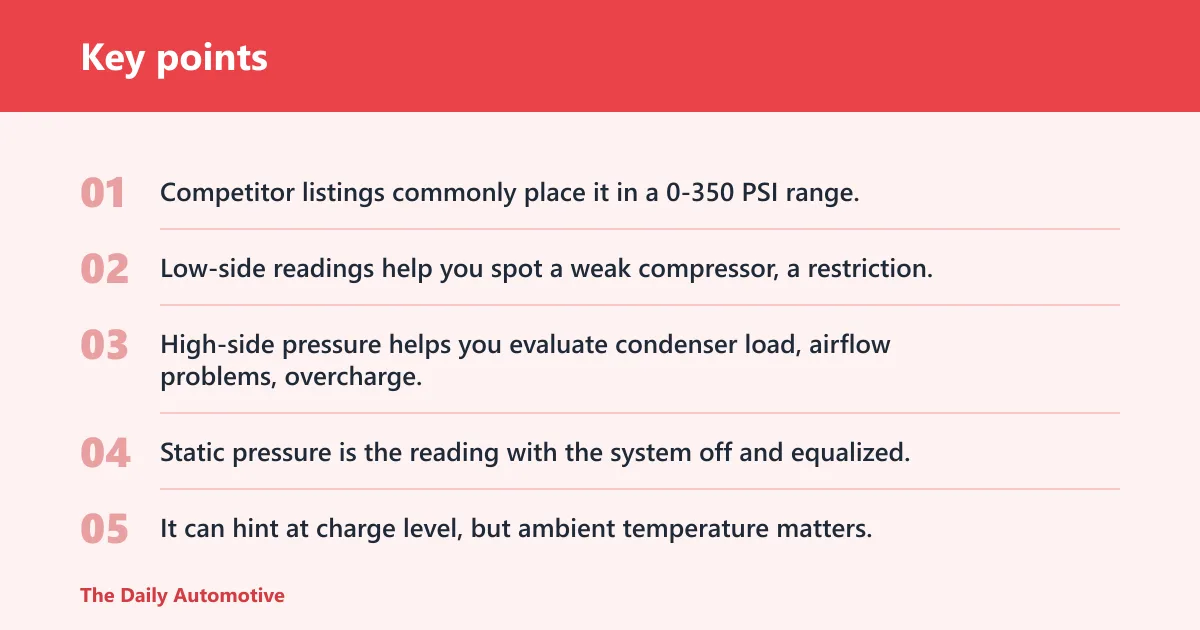
The blue gauge is the low-pressure gauge. Competitor listings commonly place it in a 0-350 PSI range, though the exact scale varies by kit. Low-side readings help you spot a weak compressor, a restriction, or a system that is undercharged enough to starve the evaporator.
What the red high-pressure side tells you
The red gauge is the high-pressure gauge. A common listing range is 0-500 PSI. High-side pressure helps you evaluate condenser load, airflow problems, overcharge, and restriction issues that a low-side reading can hide.
What static pressure can and cannot tell you
Static pressure is the reading with the system off and equalized. It can hint at charge level, but ambient temperature matters, and model-specific charts still matter more than a universal rule. A stationary compressor can also fool you into thinking the system is fine when it is not moving refrigerant.
Common mistakes that create false readings
Kinked hoses, leaking coupler seals, and a gauge set that is not fully seated can all distort the number. So can reading pressures on a hot engine with poor airflow and assuming the result is a universal truth. Check the vehicle manual and the gauge-set instructions before adding refrigerant.
| Scenario | Minimum hose length | Refrigerant compatibility | Preferred can tap type | Vacuum pump included? |
|---|---|---|---|---|
| Beginner recharge | 5 ft | R134a only | Self-sealing | No |
| Diagnosis-first | 5 ft | R134a with separate R1234yf tools if needed | Self-sealing | Yes |
| Mixed older/newer fleet use | 5 ft | R134a, plus legacy R12 where the kit is listed for it | Self-sealing and puncture-style | Yes |
Hookup order matters. Connect the manifold, verify the couplers fit the service ports, and keep the refrigerant family correct before you open anything. A 3-way or 4-way manifold gives you better control than a simple hose, especially when you are checking both sides of the system.
Hookup order and coupler fit
Start with the correct coupler on the correct port, then confirm the hoses are routed cleanly with no sharp bends. Color-coded hoses help prevent mistakes, but they do not replace a close look at the port size and thread type. If a coupler feels loose, stop and verify fit.
When to use a vacuum pump
Use a vacuum pump when you are evacuating the system before recharge or removing moisture after a component replacement. DIY kits commonly pair the manifold with a 1/3 HP or 4 CFM pump. That step matters because moisture in the system can affect performance and long-term reliability.
When to stop and check the manual
Stop if the readings do not match the vehicle’s expected pressure behavior, if the compressor is not engaging, or if you are unsure whether the car uses R134a or R1234yf. Do not rely on the gauge set alone when the system behavior does not match the manual.
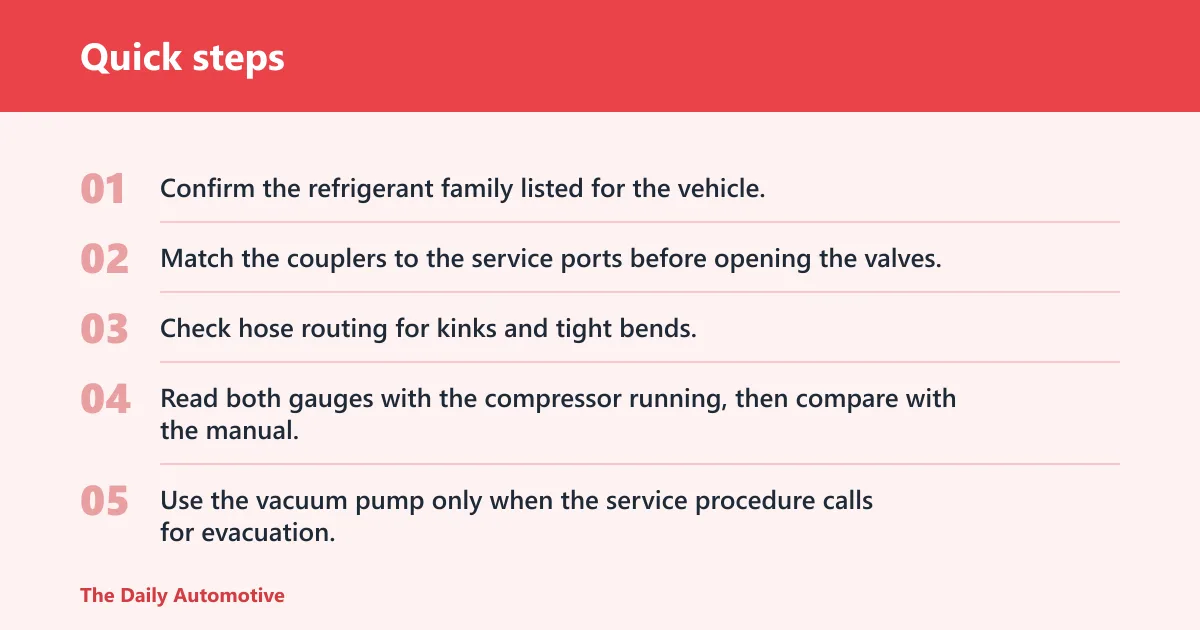
- Confirm the refrigerant family listed for the vehicle.
- Match the couplers to the service ports before opening the valves.
- Check hose routing for kinks and tight bends.
- Read both gauges with the compressor running, then compare with the manual.
- Use the vacuum pump only when the service procedure calls for evacuation.
- Stop if the reading does not make sense and verify the setup again.
A common first-timer mistake is to add refrigerant after a quick static check and call it done. If the compressor is cycling oddly or the high side climbs too fast, that same system may need leak diagnosis or airflow inspection, not more refrigerant.
Working and burst ratings matter because hose failure is not a small inconvenience. One competitor claims a 600 psi working rating and 3000 psi burst rating, and another buying guide points to 3000 PSI burst pressure for hose durability in tight engine bays. That is the kind of detail that helps separate a flimsy kit from one built for repeated use.
Calibration matters too. One competitor claims calibration screws maintain about 1.6% accuracy, and that is useful when you want repeatable diagnostics rather than a rough charge check. A gauge that reads cleanly today and drifts tomorrow is hard to trust.
Frequently asked questions
What AC gauge set do I need for R134a or R1234yf?
Choose a gauge set that matches the refrigerant family on the vehicle and avoid cross-contamination. R134a is common in older systems, while R1234yf requires compatible couplers and separate handling. Do not assume an adapter turns one tool into the other.
What pressure should car AC gauges read
There is no universal pressure number that fits every car. Ambient temperature, compressor speed, and vehicle design all change the expected reading. Use the manufacturer chart for that model, then compare the low and high sides together before adding refrigerant.
Difference in ac gauges home vs automotive
Home HVAC gauges and automotive gauges are not interchangeable in practice. Car systems use different service hardware, different refrigerants, and different pressure behavior. An automotive manifold set is built around vehicle service ports, quick couplers, and charging or evacuation work for cars.
Products related to this article
Sponsored / affiliate links. As an Amazon Associate I earn from qualifying purchases. I may earn additional commission from eligible campaigns.