Best Fuel Pressure Sensors for Commuters (2026): We Compared
For everyday commuters, the best fuel pressure sensor is an OEM-equivalent part matched to the exact part number and connector, with no pinout or pressure-range mismatch. A wrong sensor can cause hard cold starts, rough stop-and-go drivability, stalling, and repeat check-engine lights. This guide covers the best buyer picks, symptom-based selection, and the fitment mistakes to avoid.
Quick comparison
| Product | Badge | Best for | Price | ||
|---|---|---|---|---|---|
 |
BOSCH 0281006325 Original Equipment Fuel Rail PressureBosch | Our pick | OE fit · Fuel pressure sensor · Bosch | $83.78
Price as of 30 Oct 2026
|
View |
 |
499000-6160 Fuel Rail Pressure Sensor for DENSO/For IsuzuHM | Budget pick | Common rail · Fuel sensor · Denso cross-fit | $21.50
Price as of 30 Oct 2026
|
View |
For plug-and-play commuting repairs, the Bosch direct replacement is the safer pick when your vehicle listing matches exactly. For custom monitoring or a non-OE setup, the HM universal-style sensor is the lower-cost option, but only if the thread, signal, and wiring are verified first.
How we chose
Selection uses manufacturer specs, listing details, and published buyer feedback for fitment and reliability clues. The main filters were vehicle compatibility, connector count, pressure range, output signal type, and whether the part is a direct OE-style replacement or a universal transducer.
That matters because a fuel pressure sensor does more than report pressure. It feeds the engine management system, and the wrong part can upset cold starts, idle quality, and fuel delivery in gasoline, diesel, and mixed systems.
Fuel pressure sensor checklist
If your commute symptoms are getting worse in traffic or after a short stop, use this checklist before you buy a sensor. The goal is to match the fault pattern to the right sensor type before you replace a part that was never the problem.
| Symptom | Likely sensor type | Fitment check | Signal type | Connector count | Replacement risk |
|---|---|---|---|---|---|
| Extended crank after overnight parking | Fuel rail pressure sensor | Match year, make, model, engine, and OE part number | Often linear analog; verify 0.5V–4.5V compatibility if specified | Often 3-pin on common applications | High if the pinout or pressure range is wrong |
| Rough idle in stop-and-go traffic | Fuel rail pressure sensor | Confirm exact connector style and OE number | Check ECU signal compatibility and 5V supply if required | Usually matches the original connector count | High if the wrong rail sensor is ordered |
| Hot-soak hesitation after a brief stop | Fuel rail pressure sensor or fuel tank pressure sensor, depending on code | Use scan data to separate rail faults from evaporative-system faults | Verify the sensor’s output range and format | Vehicle-specific | High if rail and tank sensors are confused |
| MIL or repeated fuel-system code | OEM-style direct replacement if the code points to a known OE part | Confirm the fault with scan data and the manufacturer listing | Must match the ECU’s expected signal | Exact match required | Medium to high if diagnosis is skipped |
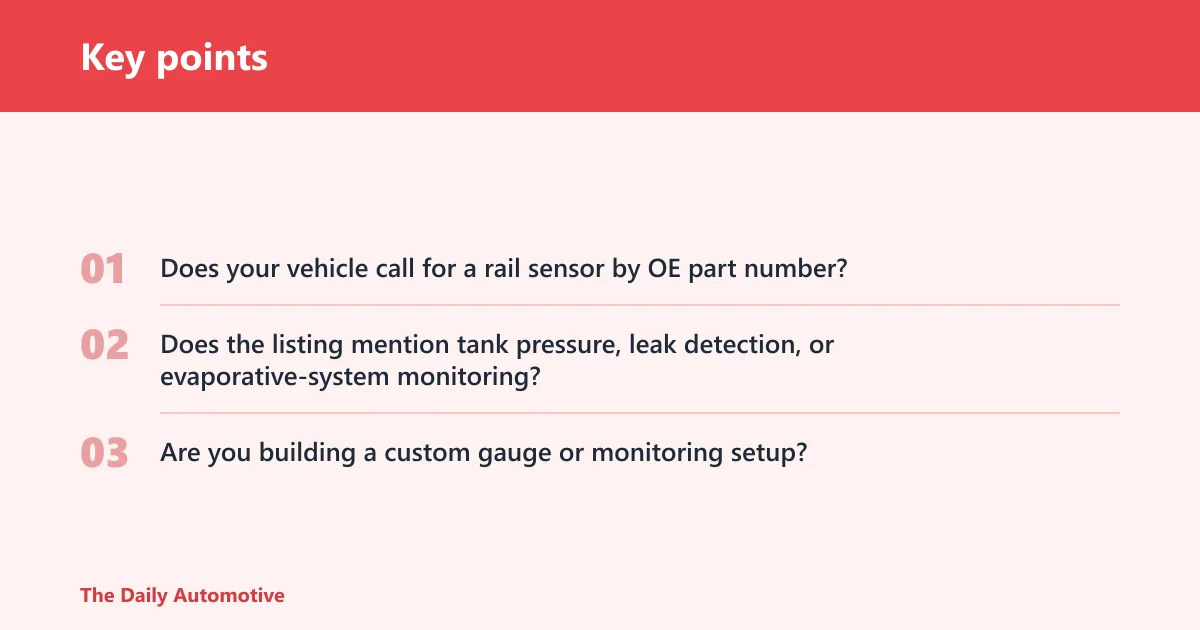
- Does your vehicle call for a rail sensor by OE part number? Choose an OEM-style direct replacement.
- Does the listing mention tank pressure, leak detection, or evaporative-system monitoring? Choose a fuel tank pressure sensor only if that is the failed part.
- Are you building a custom gauge or monitoring setup? Choose a universal transducer after checking thread, wiring, and signal compatibility.
A fuel rail pressure sensor usually supports stable starts, idle, and fuel delivery because it feeds real-time pressure data to the ECU. A fuel tank pressure sensor is different; it monitors tank pressure changes and is commonly tied to evaporative or fuel vapor systems, so buying the wrong one can leave the original problem untouched.
BOSCH 0281006325 Original Equipment Fuel Rail Pressure Sensor: best for select Ram trucks
This Bosch sensor is the safer pick when your Ram application calls for an OE-style direct replacement and the listing matches your exact engine and connector. Bosch says it is an original equipment fuel rail pressure sensor for select Ram 2500 and Ram 3500 models, and that it matches factory fit, form, and function.
That makes it a strong choice for commuters who want the shortest path back to predictable cold starts and steady idle quality. The big advantage is fitment confidence; the drawback is that it is not a universal part, so the vehicle listing has to match before you buy.
For Ram owners, this is the kind of part to choose when plug-and-play matters more than price. The listing’s direct replacement positioning also lowers the risk of wrong connector, wrong pinout, and wrong calibration mistakes that can keep a fuel code from clearing.
499000-6160 Fuel Rail Pressure Sensor: best for custom cross-fit needs
This HM sensor is aimed at buyers who are working from cross-reference numbers rather than a single OE service part. The listing ties it to DENSO and Isuzu 4HK1/6HK1 applications and says it cross-references multiple OEM numbers, which can help when you are matching an older or mixed parts setup.
Its lower price is the obvious attraction, especially for a commuter vehicle where you are trying to restore drivability without overpaying for a dealer part. The drawback is that cross-fit parts demand more verification, because the wrong signal, connector, or pressure match can create the same symptoms you are trying to fix.
Use this kind of sensor only after you confirm the OE number, connector layout, and application details. If the vehicle is a daily driver with older wiring or a history of previous repairs, that extra checking matters even more.
OEM-style direct replacement: best for plug-and-play
An OEM-style direct replacement is the safer choice for vehicle-specific fitment, especially when you need the original connector, pin count, and signal format to line up exactly. It is the right path when the problem is on a commuter vehicle and you want the lowest risk of repeat codes, hard starts, or idle complaints.
For fuel rail pressure sensors, exact OE part-number matching matters more than a generic description. Auto parts listings often cover multiple OE numbers, but the best result still comes from matching year, make, model, engine, and connector count before you order.
That approach also reduces comeback risk. If the old sensor was failing intermittently, a direct replacement is less likely to create a new wiring or calibration problem on top of the original fault.
What to verify before you click buy
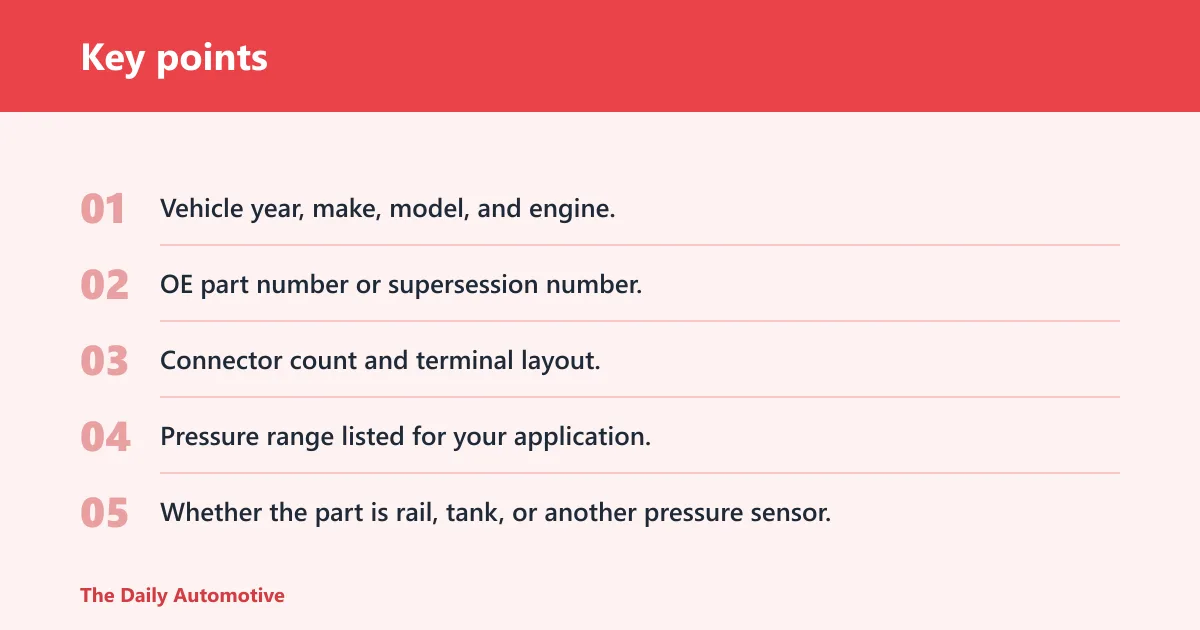
- Vehicle year, make, model, and engine.
- OE part number or supersession number.
- Connector count and terminal layout.
- Pressure range listed for your application.
- Whether the part is rail, tank, or another pressure sensor.
Say your car cranks for several extra seconds after an overnight park, then settles into a shaky idle at the first stoplight. That pattern points more toward a fuel rail pressure issue than a generic drivability complaint, which is why an exact OE-style replacement is the better first buy if the scan data agrees.
Durability matters too. For a daily driver, corrosion resistance and temperature tolerance are worth checking because high-mileage cars often live in wet engine bays, salted roads, and wide under-hood temperature swings.
Aftermarket universal transducer: best for custom setups
An aftermarket universal transducer can make sense for custom monitoring, fabrication, or non-OE setups where the goal is measuring pressure rather than restoring an exact factory part. These sensors often use a linear 0.5V–4.5V output and are commonly paired with a 5V supply, but signal verification is still needed before connecting one to an ECU or logger.
Universal parts are not universal fit parts. A common 1/8-inch NPT fitting is useful for inline fuel, oil, or air applications, but it only works when the adapter and line setup match the vehicle or project.
The HM listing illustrates the tradeoff well. It can help when you are cross-matching OEM numbers, but the burden shifts to you to confirm the wiring, connector, and pressure range. The risk is higher than with an OE-style sensor, especially on commuter vehicles that need predictable starts and idle quality every day.
Signal and thread checks that prevent mistakes
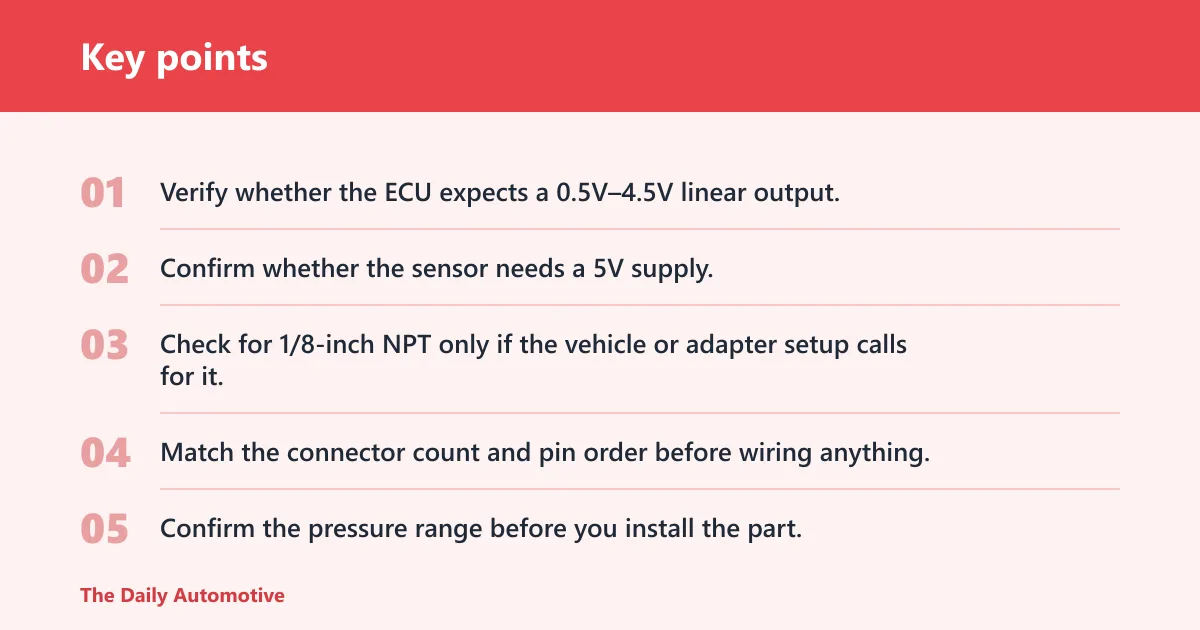
- Verify whether the ECU expects a 0.5V–4.5V linear output.
- Confirm whether the sensor needs a 5V supply.
- Check for 1/8-inch NPT only if the vehicle or adapter setup calls for it.
- Match the connector count and pin order before wiring anything.
- Confirm the pressure range before you install the part.
Suppose you are adding a gauge to a diesel truck for commuting and towing, and the sender location already uses an adapter block. In that case, a universal transducer can be the right tool, but only if the thread, range, and output format are matched before the installation starts.
The Ronybuy and AUTEX specs show why this matters. Ronybuy uses a 1/8-inch NPT thread, outputs a linear 0.5V to 4.5V signal, is rated from -40 to 105°C, and has an IP65 waterproof rating. AUTEX also uses a 0.5–4.5V linear output and a standard 1/8-inch NPT connection, which is useful information only if your setup is built for it.
Which fuel pressure sensor should you buy?
For most commuters, buy the exact OEM-style direct replacement if the fault code, connector, and OE number all line up. Choose a universal transducer only for custom monitoring, fabrication, or a non-OE installation where you can verify thread, signal, and wiring before purchase. Use a tank pressure sensor only when the vehicle’s evaporative system calls for that part.
Yes or no makes this easier. Does your vehicle already identify the failed part by OE number? If yes, buy the direct replacement. Does your setup need pressure monitoring for a custom rail, line, or gauge? If yes, a universal transducer may fit. If neither applies, keep diagnosing before replacing anything.
The budget tradeoff is simple. A cheaper universal sensor can save money up front, but a mismatched signal or wrong thread can turn that savings into more labor and a second purchase. For a daily driver, the safer choice is usually the part that reduces fitment risk the most.
Do not confuse fuel rail pressure sensors with fuel tank pressure sensors. The rail sensor feeds the ECU with delivery data for starts and idle, while the tank sensor is tied to pressure changes in the evaporative system. Buying the wrong one is one of the most common mistakes on older commuter cars with mixed repairs.
Frequently asked questions
What is a fuel pressure sensor used for?
A fuel pressure sensor measures fuel pressure for engine management. Depending on the system, it may be used in gasoline, diesel, or mixed applications, and the ECU relies on that signal to control delivery, starting, and idle stability. The right part must match the vehicle connector and pressure range.
Which fuel pressure sensor is best for my car?
The best fuel pressure sensor for your car is usually the OEM-style direct replacement listed for your exact year, make, model, and engine. That choice is safest for plug-and-play fitment because it reduces the risk of wrong connector count, wrong pinout, and signal mismatch that can keep drivability problems alive.
How do I know if a fuel pressure sensor is bad?
Common signs include extended crank, rough idle, hot-soak hesitation, and recurring fuel-system fault codes. Those symptoms can point to a bad sensor, but scan data and manufacturer specs should confirm the fault before replacement, because wiring issues, pump problems, and unrelated codes can look similar.
Are fuel pressure sensors universal or vehicle-specific?
They can be either, but not in the same way. OE-style fuel pressure sensors are vehicle-specific, while aftermarket universal transducers are built for custom fuel, oil, air, or water pressure setups. Universal parts still need verified thread, wiring, signal type, and pressure range.
What pressure range should I choose for a fuel pressure sensor?
Choose the pressure range that matches the system you are monitoring, not the cheapest option. A universal sender that is too narrow can saturate early, while one that is too wide may reduce useful resolution for the ECU or gauge. Check the listing and the vehicle specification before buying.
Will a bad fuel pressure sensor cause a check engine light?
Yes, it can. A faulty sensor may trigger the MIL and create drivability complaints at the same time, especially on cold starts or in stop-and-go traffic. The light alone does not prove the sensor is bad, so diagnosis should confirm the code, signal, and fitment before you replace the part.
Products related to this article
Sponsored / affiliate links. As an Amazon Associate I earn from qualifying purchases. I may earn additional commission from eligible campaigns.