Car Loan vs Personal Loan
A car loan is usually cheaper than a personal loan because the vehicle secures the debt. A personal loan can still make sense if you need title freedom, faster funding, or the car falls outside lender age or mileage rules. Choose the wrong one, and you can pay more interest, lose flexibility, or get turned down after finding the car. This guide compares total cost, title control, and approval rules, then shows when a personal loan makes better sense.
| Decision factor | Car Loan | Personal Loan | Winner |
|---|---|---|---|
| APR | Usually lower because the vehicle is collateral; NerdWallet lists 4%-30%. | Usually higher; NerdWallet lists 7%-36%. | Car Loan |
| Monthly payment | Often lower at the same amount and term, especially if the rate is lower. | Often higher unless you get a shorter term or a much better offer. | Car Loan |
| Title control | The lender has a lien until repayment, so title control is limited. | No vehicle lien in most cases, so ownership is cleaner from day one. | Personal Loan |
| Purchase flexibility | Usually best for dealer purchases and standard used-car deals. | Can fund private-party purchases and nonstandard cars more easily. | Personal Loan |
| Cash needed at closing | May require a down payment. | Usually no down payment, though the rate can be higher. | Personal Loan |
Car loan vs personal loan at a glance
Secured vs. unsecured borrowing
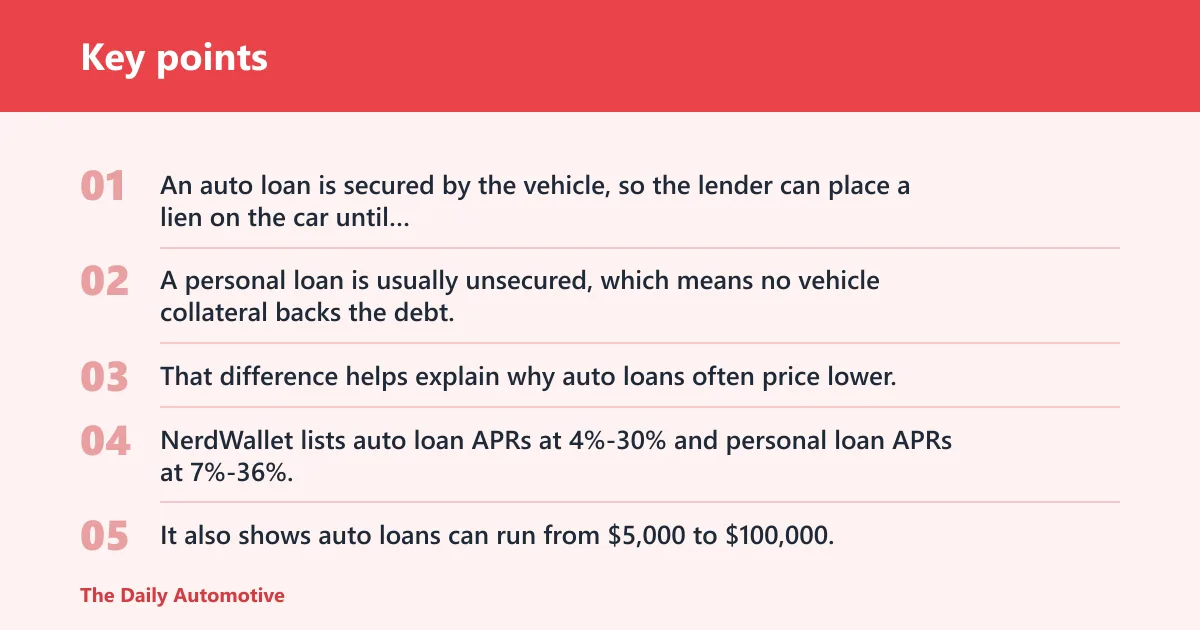
An auto loan is secured by the vehicle, so the lender can place a lien on the car until you repay it. A personal loan is usually unsecured, which means no vehicle collateral backs the debt. That difference helps explain why auto loans often price lower.
NerdWallet lists auto loan APRs at 4%-30% and personal loan APRs at 7%-36%. It also shows auto loans can run from $5,000 to $100,000, while personal loans can run from $1,000 to $100,000. Those ranges overlap, but the borrowing structure is different.
APR, term and monthly payment
APR is the best single number for comparing borrowing cost because it combines interest into one rate. Your credit profile, income, debt load and loan type all affect pricing.
Loan term matters too. Both products commonly run from about 2 to 7 years. A longer term lowers the monthly payment, but it also raises total interest paid over the life of the loan.
Down payment and collateral
Auto loans may require a down payment, and that cash can lower the amount financed. It can also reduce negative equity risk if the car loses value faster than you pay it down. Personal loans usually do not require a down payment.
That difference matters when cash is tight. A personal loan can leave more money for taxes, registration, insurance, or immediate repairs. A car loan can cost less in APR but still ask for more cash up front.
Title, lien and ownership control
With a car loan, the lender’s lien stays on the vehicle until repayment. That is normal, but it means less freedom if you want to sell quickly or make title changes during the loan term.
With a personal loan, the debt is usually separate from the car title. That gives you cleaner ownership control, which can matter for private-party deals or older cars with unusual paperwork.
Is a personal loan better than car finance?
A personal loan is better than car finance only in specific cases: when the auto loan APR is not much lower, when the car fails lender rules, or when you need purchase flexibility more than the lowest possible rate. If the car loan is clearly cheaper, the auto loan usually wins on total cost.
When a lower APR on an auto loan wins
If the car is new or late-model and the lender offers a solid auto rate, the secured loan usually comes out ahead. Citi says auto loans are typically the better choice for most car buyers, and that fits the basic pricing advantage of collateral.
Suppose you are choosing between a dealer-financed car loan and an unsecured personal loan for the same car. If the auto loan rate is several points lower, the payment and total interest usually favor the car loan even before you factor in fees.
When flexibility matters more than rate
A personal loan can make more sense when the seller is private, the car is very old, or the vehicle has a salvage title or project-car status that many auto lenders reject. It can also help if you need money for tax, registration, or immediate repairs and want one lump sum.
A common first-timer mistake is to find the car first and then discover the lender will not finance it. Pre-qualification or pre-approval helps you compare offers before you commit, so you can see which lenders will fund the deal and on what terms.
When fees change the result
The headline APR is only part of the bill. If an auto loan asks for a large down payment but the personal loan does not, the cheaper rate may still demand more cash at signing.
That cash has a cost. Money tied up in the car cannot be used for maintenance, emergency repairs, or other savings goals. The real comparison is total borrowing cost plus cash you must set aside to close the deal.
Can you buy a car with a personal loan?
Yes. A personal loan can fund a car purchase, including from a private seller, and it can also cover related costs that many auto loans do not. The tradeoff is that you usually give up the lower APR and lender-friendly structure that comes with secured auto finance.
Private seller purchases
Private-party purchases often fit personal loans well because the lender does not need the dealer process or the same title-handling workflow. Some auto lenders do finance private-party sales, but others restrict them or require extra paperwork.
Picture a buyer who finds a $7,500 used hatchback from a private seller and still needs $900 for registration and tires. A personal loan can fund the full amount in one step, while a car loan may cover only the vehicle price and leave the buyer to cover the rest another way.
Taxes, registration and repairs
Personal loans can be useful when the purchase price is only part of the bill. If you need cash for tax, title transfer, registration, or first-week repairs, an unsecured loan can be cleaner than stacking several payment sources.
That flexibility is one reason personal loans can beat car finance even when the rate is higher. The real question is whether the all-in cost is still acceptable after you add the extra cash needs.
When lenders may prefer an auto loan
Some lenders will still push you toward an auto loan because the collateral lowers their risk. If the car is standard, titled cleanly, and priced within common lending limits, the secured product is often easier to underwrite and may come with better pricing.
That is especially true for dealer inventory. A standard new or used dealer purchase usually gives you more lender choices than a private-party or unusual-vehicle deal.
Car loan payment table
| Purchase scenario | Estimated monthly payment direction | Collateral required? | Down payment likely? | Likely lender restrictions | First question before applying |
|---|---|---|---|---|---|
| New dealer car | Usually lower with Car Loan | Yes for Car Loan; no for Personal Loan | Often yes for Car Loan; usually no for Personal Loan | Dealer financing, clean title, standard mileage and model-year rules | Which offer has the lower APR after fees? |
| Used dealer car | Usually lower with Car Loan, but the gap can narrow | Yes for Car Loan; no for Personal Loan | Often possible for Car Loan; usually no for Personal Loan | Age limits, mileage caps, vehicle condition rules | How old and how many miles does the car have? |
| Private-party used car | Often competitive with Personal Loan if auto lenders restrict the sale | Usually no for Personal Loan; yes for Car Loan | Usually no for Personal Loan; sometimes yes for Car Loan | Private seller paperwork, title transfer, proof of sale | Will the lender finance a private seller purchase? |
| Old or high-mileage car | Often lower or only available with Personal Loan if Car Loan is unavailable | Usually no for Personal Loan; often yes for Car Loan if approved | Unclear for Car Loan; usually no for Personal Loan | Vehicle age, mileage, salvage history, minimum loan amount | Does the lender accept this vehicle at all? |
Which is better for a used car?
For most used cars, a car loan is still the better starting point because auto lenders often price used-car risk better than unsecured lenders. But the gap can shrink on older, high-mileage, or lower-value cars, where standard auto financing is harder to get or the rate is not very attractive.
Used dealer cars with standard financing
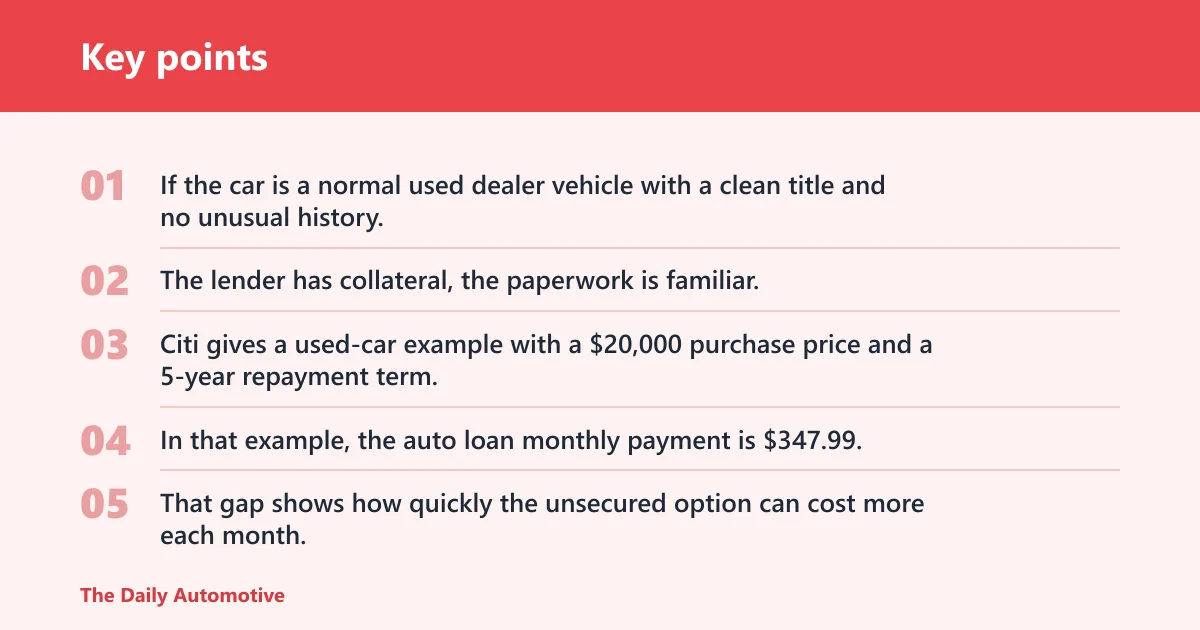
If the car is a normal used dealer vehicle with a clean title and no unusual history, the auto loan usually wins. The lender has collateral, the paperwork is familiar, and the APR is often lower than a personal loan.
The same source gives a used-car example with a $20,000 purchase price and a 5-year repayment term. In that example, the auto loan monthly payment is $347.99, while the personal loan monthly payment is $415.17. That gap shows how quickly the unsecured option can cost more each month.
Older or high-mileage cars
Older or high-mileage cars are where personal loans become more competitive. Some auto lenders will refuse them, shorten the term, or add pricing that erases the usual secured-loan advantage.
If the car is old enough that the lender’s model-year or mileage rules are tight, the personal loan may be the only realistic way to buy it. That is not because it is cheaper by default, but because it is available when standard auto finance is not.
When a personal loan can beat used-car APRs
Used-car financing often costs more than new-car financing, so the auto-loan advantage is smaller than many buyers expect. If your credit is strong and the unsecured offer is close on APR, the personal loan can become the simpler choice, especially for a private seller or a car needing immediate work.
The break-even point usually depends on vehicle age, mileage and the rate spread. If the personal-loan APR is only slightly higher, but the auto loan adds a down payment, stricter title rules or a dealer-only restriction, the total result can tilt toward the personal loan.
Do car loans usually need a down payment?
Often, yes. Auto loans may require a down payment, while personal loans usually do not. That cash difference changes monthly cost, approval odds, and the amount of equity you start with on day one.
How a down payment changes monthly cost
A larger down payment reduces the amount you borrow, which usually lowers the monthly payment. It can also reduce the chance that you owe more than the car is worth early in the loan.
That matters most on vehicles that depreciate quickly. If the car loses value faster than you pay it down, a small or zero down payment can leave you upside down for a longer stretch.
Negative equity risk
Negative equity risk is higher when the loan balance starts close to the car’s full price. A down payment helps absorb the early drop in value and can make it easier to sell or trade the car later without bringing cash to the table.
A personal loan avoids that specific risk because the debt is not tied to the vehicle title. But the tradeoff is usually a higher APR, so you are paying for that freedom in a different way.
When no-down-payment offers still cost more
No-down-payment financing can look easier, but the total cost still matters more than the first payment date. If the unsecured loan rate is several points higher, the monthly payment and total interest can outrun the cash you saved up front.
That is why APR and term should be compared together. A low monthly payment from a long term can hide a large interest bill, whether the loan is secured or unsecured.
Choose Car Loan if… / Choose Personal Loan if…
Choose Car Loan if the vehicle is eligible, the lender offers a lower APR, and you are comfortable with a lien on the title until payoff. Choose Personal Loan if the car is private-party, very old, high-mileage, salvage-title, or if you need title freedom and broader use of the borrowed cash.
Choose Car Loan if…
- You are buying a new or standard used dealer car.
- The auto loan APR is clearly lower after fees.
- You can handle a down payment and a lien on the title.
- You want the lower monthly payment that often comes with secured financing.
Choose personal loan if…
- You are buying from a private seller and want one loan for the car plus taxes or repairs.
- The car is old, high-mileage, salvage-title, or otherwise hard to finance with an auto lender.
- You want no vehicle collateral and cleaner title control.
- The car loan is unavailable, or the rate gap is small enough that flexibility matters more.
- Get pre-qualification or pre-approval from at least one auto lender and one personal loan lender.
- Compare APR, term, fees and any required down payment.
- Check whether the lender accepts the car’s age, mileage and seller type.
- Total the cash needed to close, including taxes, registration and immediate repairs.
- Pick the option with the lower all-in cost and the right approval rules.
Frequently asked questions
Is an auto loan a personal loan?
No. An auto loan is a secured loan tied to the vehicle, while a personal loan is usually unsecured and can be used for almost any purpose. That distinction affects pricing, title control, and what happens if you miss payments.
What is the difference between a car loan and a personal loan?
The main difference is collateral. A car loan uses the vehicle as security and may require a down payment, while a personal loan usually does not use the vehicle as collateral. APR, lender restrictions and title handling also tend to differ.
Do personal loans have higher interest rates than car loans?
Usually, yes. The same source lists personal loan APRs at 7%-36% and auto loan APRs at 4%-30%. The exact offer still depends on your credit profile, income, debt and the loan type, so compare the full quote rather than the headline rate alone.
Do car loans usually require a down payment?
Often they do. The same source notes that auto loans may require a down payment, while personal loans usually do not. A down payment can reduce the monthly payment and lower negative equity risk, but it also increases the cash you must bring to the deal.
How do personal loan and car loan monthly payments compare?
Car loan payments are usually lower when the amount borrowed and the term are the same, because the rate is often lower.
Can I buy from a private seller with a personal loan?
Yes, and that is one of the clearest use cases for a personal loan. It can be easier for private-party purchases because the lender does not need the same dealer process or vehicle lien setup. Some auto lenders restrict private-party deals or add paperwork hurdles.
Car loan vs personal loan interest rate
Auto loans usually have the lower interest rate because the car secures the debt. The same source lists 4%-30% for auto loans and 7%-36% for personal loans. Still, your final rate depends on credit, income, debt load and lender rules, so two quotes can differ sharply.
Car loan vs personal loan malaysia
The same comparison logic still applies in Malaysia: compare the total borrowing cost, the term, any upfront cash required, and whether the lender places a charge or lien on the vehicle. Local rates and lender rules vary, so use pre-approval and compare the full repayment schedule before you commit.
Products related to this article
Sponsored / affiliate links. As an Amazon Associate I earn from qualifying purchases. I may earn additional commission from eligible campaigns.
 Auto Car Dent Repair Puller Head Paintless-Dent Repair Removal Kit for Slide Hammer Pulling Tab Adapter Pulling Tabs Car Aluminum-alloy Puller Head Adapter Screw Glue-tabs for Slide Hammer and
 Biugaaufai 2 Pack Black Car Ramps, Low Profile Car Service Ramp for Vehicle Maintenance, Heavy Duty Car Ramps for Oil Changes, Trucks & Cars