Do You Need Keys To Tow A Car? What Tow Drivers Say
Yes. Many cars can be towed without keys if the wheels roll freely and the transmission can be put in neutral, but some cannot. AWD, locked steering, or electronic park systems often call for a flatbed. Tow it wrong and you can damage the transmission, tires, steering lock, or parking system. Here’s when keys matter, when they don’t, and which recovery method keeps the car safe.
Can a tow truck move a car without keys?


A tow truck can often move a car without keys, but only if the vehicle can roll safely and the recovery method matches the drivetrain and brake setup. If the steering is locked, the transmission is stuck in park, or the parking brake cannot be released, a wheel-lift alone may not be enough.
What the operator checks first
The first check is simple: does the car roll, steer, and come out of park or a parking brake without force? The answer changes with make, model, year, and transmission. Modern security systems also matter, because some cars will not let the shifter move without the correct key or a powered ignition state.
When rolling is possible and when it is not
If the wheels rotate freely, the steering can be controlled, and the parking brake releases, a tow operator may move the car with a flatbed, wheel-lift, or dollies. If any of those fail, dragging becomes risky. That is how transmissions, brakes, and steering locks turn a simple tow into a damage problem.
Tow decision checklist
Use this before the truck arrives. It separates a recoverable car from one that needs a different plan. The safest method is the one that avoids drivetrain bind, tire scrub, steering lock damage, and dragging a set parking brake.
| Vehicle type | Key status | Steering lock | Parking brake status | Transmission | Recommended recovery method | Red-flag warnings |
|---|---|---|---|---|---|---|
| Front-wheel-drive car | Keys present or missing | Unlocked | Released | Automatic or manual in neutral | Wheel-lift or flatbed | No rolling resistance, no drivetrain bind, no dragging |
| Front-wheel-drive car | Missing | Locked | Released | Automatic cannot reach neutral | Flatbed | Do not force steering; wheel-lift alone may bind the front wheels |
| Rear-wheel-drive car | Missing | Unlocked | Released | Manual in neutral | Wheel-lift with rear wheels up, or flatbed | No park pawl issue if it is truly in neutral |
| Rear-wheel-drive car | Missing | Locked | Released | Automatic | Flatbed, or dollies/skates if the operator can safely load | Locked steering can prevent a controlled tow path |
| AWD or 4WD vehicle | Missing or present | Any | Released | Any | Flatbed | Wheel-lift towing can create drivetrain damage on many models |
| Any vehicle | Missing | Locked | Engaged or unknown | Unknown | Locksmith-first or flatbed after safe release | If nothing can be released, do not drag the car |
Simple yes/no flow
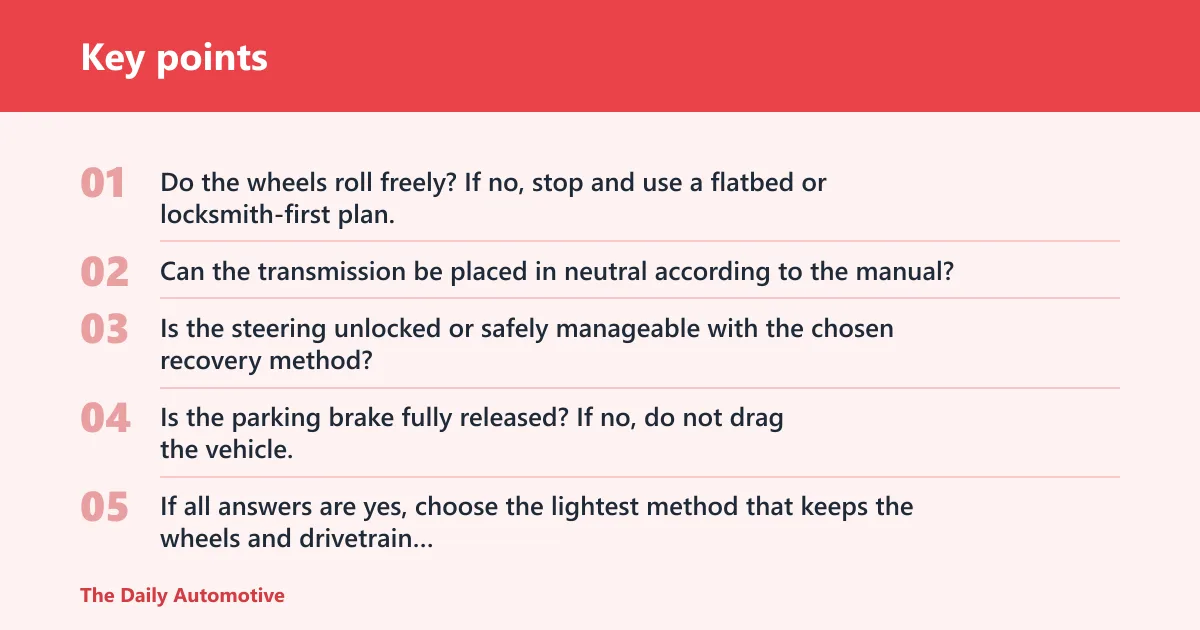
- Do the wheels roll freely? If no, stop and use a flatbed or locksmith-first plan.
- Can the transmission be placed in neutral according to the manual? If no, do not attempt a standard tow.
- Is the steering unlocked or safely manageable with the chosen recovery method? If no, use a flatbed or dollies/skates as needed.
- Is the parking brake fully released? If no, do not drag the vehicle.
- If all answers are yes, choose the lightest method that keeps the wheels and drivetrain safe: wheel-lift, dollies, or flatbed.
What blocks a keyless tow?
The main blockers are an automatic transmission that will not leave park, a steering lock that will not release, and a parking brake that stays applied. Any one of those can stop a safe tow. If more than one is present, a flatbed becomes the safer default.
Automatic transmission and parking pawl risk
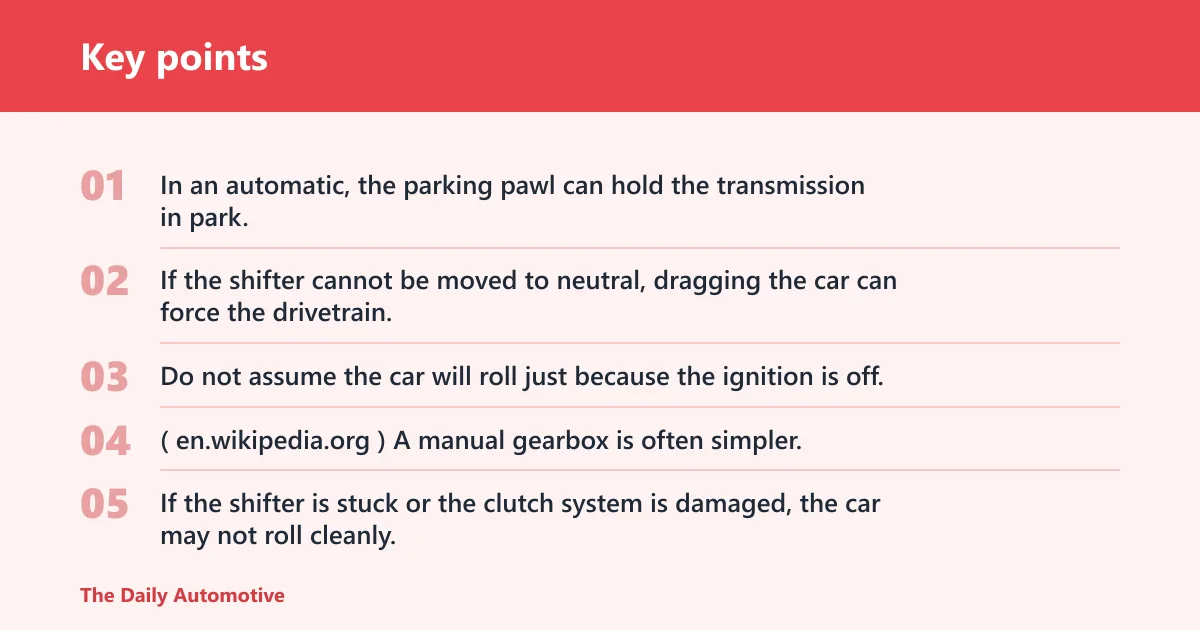
In an automatic, the parking pawl can hold the transmission in park. If the shifter cannot be moved to neutral, dragging the car can force the drivetrain. That is where damage starts. Do not assume the car will roll just because the ignition is off. (Wikipedia)
Manual transmission and neutral position
A manual gearbox is often simpler, but it still needs to be in neutral before towing on wheels. If the shifter is stuck or the clutch system is damaged, the car may not roll cleanly. A locked gear can resist movement and may require a flatbed instead.
Steering lock and wheel movement
When the key is absent, many cars may engage a column lock. That can stop the front wheels from turning enough for a controlled tow. If the front wheels cannot track the truck safely, skates or dollies may be needed. If those cannot be used, load the car on a flatbed.
Electronic parking brake and release limits
An electronic parking brake can be released through the vehicle’s service mode or manual override, but the correct method belongs to the owner’s manual. If the brake cannot be released safely, do not drag the vehicle. Dragging with an applied parking brake can overheat components and damage tires or brake parts.
Say your sedan has a dead battery, the shift lever will not leave park, and the steering stays locked. That is not a wheel-lift job. A flatbed avoids forcing the park pawl, the column lock, and the rear brake hardware at the same time.
Which recovery method fits the car?
The right method depends on what the car can do, not on what is fastest. Flatbed recovery is the safest option when the vehicle cannot roll cleanly, cannot steer, or has AWD hardware that should not be dragged. Wheel-lift use is narrower and depends on the drivetrain and wheel position.
Flatbed use cases
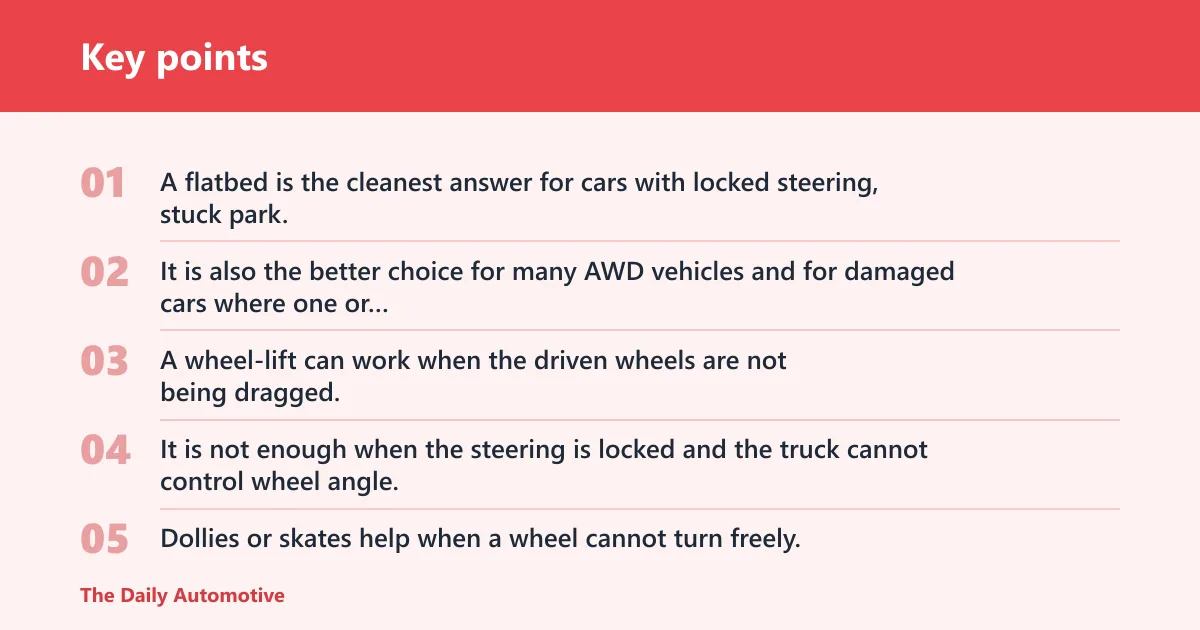
A flatbed is the cleanest answer for cars with locked steering, stuck park, unknown drivetrain status, or electronic parking brakes that will not release. It is also the better choice for many AWD vehicles and for damaged cars where one or more wheels do not turn correctly.
Wheel-lift use cases
A wheel-lift can work when the driven wheels are not being dragged, the parking brake is off, and the remaining wheels can track. It is not enough when the steering is locked and the truck cannot control wheel angle, or when drivetrain parts cannot tolerate being rolled on the ground.
When dollies or skates are needed
Dollies or skates help when a wheel cannot turn freely, when a steering lock prevents the wheels from following the truck, or when a wheel must be protected from drag. They are not a fix for every car. If the setup still risks drivetrain bind, flatbed loading is the better option.
When a locksmith should come first
If the only blocker is lost keys and the car otherwise cannot be moved, a locksmith-first response can be smarter than towing to a dealer. Auto locksmiths often handle all-keys-lost cases on site instead of towing to a dealer. If all keys are lost, the vehicle usually cannot be moved until access and programming are restored.
Picture a crossover with all keys missing, a locked steering column, and an electric park switch that will not wake up. A locksmith-first visit may restore access and let the car be shifted correctly. If that fails, the recovery still starts with a flatbed, not a hard pull.
What should the tow driver ask first?
Before arrival, the driver should ask for the VIN, year, make, model, transmission type, brake type, and whether the wheels roll. Those details tell the operator whether the car can be moved on wheels or needs a flatbed. The key question is not “Can it start?” It is “Can it move safely?”
VIN, year, make, and model
The vehicle’s identity can change the tow plan. The same badge can hide different drivetrains, brake systems, and electronic parking brake logic across model years. The VIN helps confirm the exact build before anyone touches the car.
Transmission and brake type
Ask whether it is automatic or manual, and whether it has an electronic parking brake or a cable-operated handbrake. That tells the operator whether neutral is likely available and whether the brake can be released safely. If the answers are unknown, a cautious plan is the better plan.
Whether the wheels roll and the steering turns
A quick field check matters: do the wheels roll, and does the steering move enough for the truck to load the car? If either answer is no, the operator needs that information before arriving. It avoids delays and reduces the chance of dragging the vehicle.
Where the keys are and whether a spare exists
Ask whether there is a spare key, a hidden key blade, or access to a mobile locksmith. Many modern vehicles use transponder, remote, immobilizer, or proximity systems, so a cut key alone may not be enough. Programming may still be needed after cutting.
Tow equipment and road rules
Towing gear has to be legal as well as capable. A car can be moved badly with the wrong attachment, the wrong visibility setup, or the wrong trailer equipment. That matters when the car is being recovered on a tow bar, trailer, or tow truck.
Tow bar fitment and type approval
A tow bar on a car must be type approved. Cars first used before 1 August 1998 are exempt from tow-bar type approval. If the tow bar is not approved where required, the setup can be illegal even before the car starts moving.
Towing mirrors and rearward visibility
If a trailer is wider than the car, suitable towing mirrors are required. They are there so the driver can see behind the trailer and keep the combination legal. Towing without proper mirrors can cost up to £1,000 and 3 points.
Trailer brakes and breakaway gear
A loaded trailer over 750kg must have a working brake system. A trailer must use a breakaway cable or secondary coupling if it detaches. If those parts are missing or wrong, do not move the vehicle on that trailer setup.
Trailer number plate placement
A trailer must display the same number plate as the towing car. The plate also needs to be placed correctly for the road setup being used. If towing more than one trailer, check the rules before moving off.
For road use, a bad tow setup can carry real penalties. You can be fined up to £2,500 for using a vehicle in a dangerous condition while towing. Improper towing can also bring a driving ban and 3 penalty points.
Frequently asked questions
Do you need keys to tow a car?
Not always. Many cars may be towable without keys if the wheels roll freely and the transmission can be set to neutral. But keys may still be needed to release a steering lock, free an electronic parking brake, or access a shift interlock on modern vehicles.
Can a tow truck tow a car without keys?
Yes, a tow truck often can. The operator still has to confirm that the car can roll, steer, and free itself from park or the parking brake without damage. If those checks fail, a flatbed or locksmith-first approach is safer than forcing a wheel-lift tow.
Can a car be towed if the steering is locked?
Sometimes, but not with every method. A locked steering column can prevent the wheels from tracking properly, which makes a wheel-lift tow risky. If the steering cannot be released, dollies, skates, or a flatbed may be needed to move the car without damage.
Can you put a car in neutral without a key?
Sometimes, but the answer depends on the car. Some vehicles allow a manual shift release or another approved method in the owner’s manual. Others do not. Do not guess, because forcing the shifter can damage the transmission or leave the parking pawl loaded.
Will towing damage a car with electronic parking brake?
It can, if the brake stays applied or is not placed into the correct service state. Dragging a car with an engaged electronic parking brake can damage brake parts and tires. Use the manual’s release procedure, or choose a flatbed if the brake will not release safely.
What should a tow driver do if the car has no keys?
The driver should ask for the car’s year, make, model, VIN, transmission type, brake type, and whether the wheels roll. If the car cannot be shifted, steered, or released safely, the right move is to stop and bring a flatbed or recommend a locksmith-first visit.
Can a dealership or locksmith make a key after towing?
Yes. A dealership or auto locksmith can often replace a lost key after the car is recovered, but the route differs by vehicle. Many modern cars use transponder, remote, immobilizer, or proximity systems, so cutting a key is only part of the job. Programming may still be required.
Products related to this article
Sponsored / affiliate links. As an Amazon Associate I earn from qualifying purchases. I may earn additional commission from eligible campaigns.