How Long Does It Take to Make a Car Key?
Many car keys can be made in about 15 minutes to 2 hours, but a basic metal key may take only minutes, while a smart key or lost-key job can take about 1 to 5 days. A bad match can leave you stranded, trigger towing fees, or cost more if the wrong key is cut or programmed. This guide breaks down turnaround by key type and service path so you can tell whether same-day replacement is realistic.
Car key replacement time by type
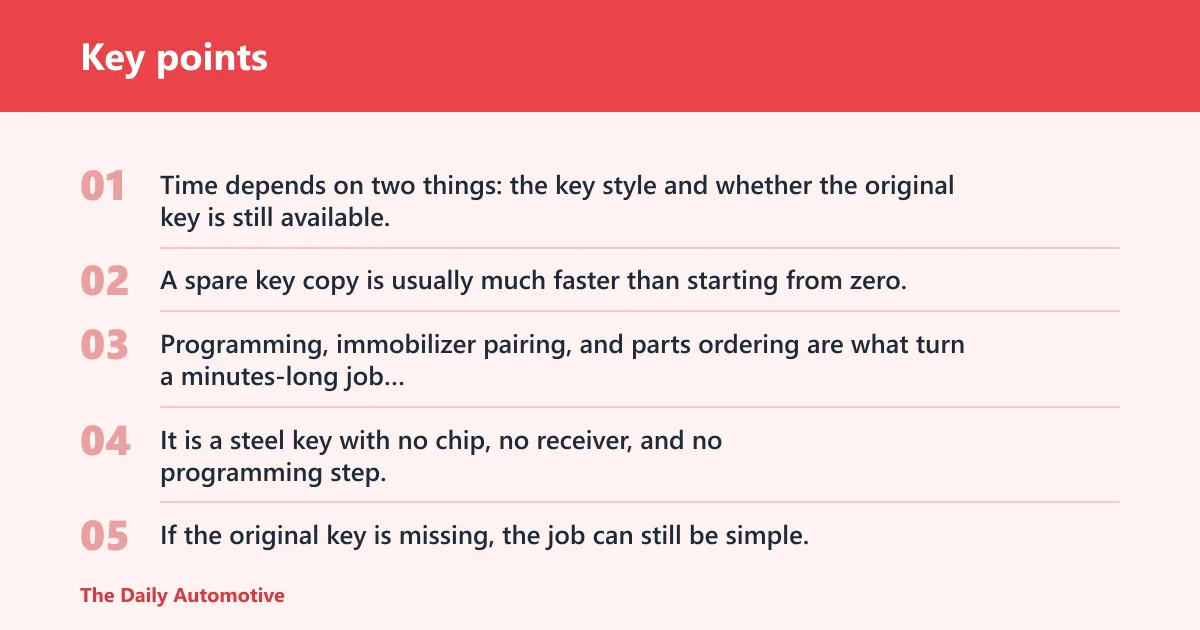


Time depends on two things: the key style and whether the original key is still available. A spare key copy is usually much faster than starting from zero. Programming, immobilizer pairing, and parts ordering are what turn a minutes-long job into an hours- or days-long one.
Traditional car key
A traditional car key is the simplest case. It is a steel key with no chip, no receiver, and no programming step, so duplication often takes minutes once the blank is on hand. If the original key is missing, the job can still be simple, but verification and cutting from code or lock code add time.
Transponder key
A transponder key has a chip in the plastic head, so the blade may be cut in minutes but the vehicle still has to accept the chip. That programming step is why a transponder copy usually takes longer than a plain metal key. If the original key is gone, expect extra time for VIN lookup, proof checks, and immobilizer pairing.
Remote key
A remote key usually handles locking and unlocking with a separate transmitter, then also needs the blade cut and the electronics set up. That means there are at least two jobs: cutting and programming. If the remote shell or battery is also being replaced, the time can stretch because the vehicle may need more than one setup pass.
Laser-cut key
A laser-cut key, sometimes called a sidewinder key, is cut on special equipment and can also be part of a transponder setup. The cut itself takes longer because the blade profile is more precise, and not every shop has the right machine. If the original is missing, the blank has to match the vehicle before cutting and coding can start.
Smart key and key fob
A smart key or key fob is the most complex replacement type. It lets the driver lock, open, and start the car without taking the fob out of a pocket, which means the vehicle and the fob have to communicate correctly. Replacement can be same-day if the right part is in stock, but it can also take days when a dealer has to order the unit or release access codes.
What the replacement-time matrix shows
This matrix separates copy jobs from lost-key jobs. It also shows the main reason one situation takes minutes while another takes days. The pattern is simple: the more the job depends on parts, programming, and proof checks, the longer it takes.
| Key type | Original key available? | Who can do it? | Typical time band | Main delay trigger |
|---|---|---|---|---|
| Traditional metal key | Yes | Locksmith or dealership | 5 to 20 minutes | Blank availability and cutting line |
| Traditional metal key | No | Locksmith or dealership | 30 minutes to 2 hours | Lock or code lookup, proof of ownership |
| Transponder key | Yes | Locksmith or dealership | 20 minutes to 1 hour | Programming and immobilizer pairing |
| Transponder key | No | Locksmith or dealership | 1 to 3 days | VIN checks, coding access, blank ordering |
| Remote key | Yes | Locksmith or dealership | 30 minutes to 2 hours | Cutting plus remote setup |
| Remote key | No | Locksmith or dealership | 1 to 4 days | Parts ordering and programming access |
| Laser-cut key | Yes | Specialist locksmith or dealership | 30 minutes to 2 hours | Specialty cutting machine availability |
| Laser-cut key | No | Specialist locksmith or dealership | 1 to 4 days | Blank sourcing and code verification |
| Smart key / key fob | Yes | Locksmith or dealership, if supported | 30 minutes to 3 hours | Software pairing and module authorization |
| Smart key / key fob | No | Often dealership; some locksmiths | 2 to 5 days | Part ordering, access codes, vehicle verification |
How long does a locksmith take?
A locksmith can often finish a car key job the same day, and many mobile calls end in under 2 hours when the key type is common and the parts are on the truck. If the locksmith needs the VIN, ID, or registration to verify ownership, that adds only a short delay if the documents are ready.
Mobile service timeline
Mobile service is usually the best path when speed matters. A technician can come to the car, cut the blade on-site, and program many transponder or remote keys without a tow. For a traditional key copy, the work may take only a few minutes after arrival. For a smart key, the visit can still be same-day if the vehicle is supported and the correct fob is stocked.
When VIN and ID are needed
Locksmiths often ask for the VIN, personal ID, and vehicle registration before they cut or program a key. That is normal ownership verification, not a delay tactic. If the paperwork is ready, the check is usually brief. If the VIN is hard to read, or the registration does not match the current owner, the job can stop until the records are fixed.
When a shop visit still makes sense
A shop visit can still be the better choice when the key is rare, the car needs more exact programming, or the locksmith does not stock the blank. Shop equipment may also handle higher-security cutting more easily than a mobile van. That said, a shop visit usually means you have to get the car there somehow, which can eat the time you hoped to save.
How long does a dealership take?
A dealership can be the right call when the key needs factory access codes, brand-specific software, or a part that local shops cannot source. The tradeoff is time. Dealership work often takes days rather than hours, and if the car cannot be started, towing may be part of the plan.
Why dealership work can take days
Dealerships often do not cut and program keys on the spot unless the part is already in stock and the service lane has time. If the key or fob must be ordered, shipping can push the job into a multi-day wait. Some makes also require special security steps before programming, which adds another queue.
Why some jobs need towing
If the vehicle cannot be started and the dealership is the only place that can program the replacement, towing may be required. That adds time before the key work even begins. It can also add cost, which is why a locksmith is often the first call when a same-day solution matters.
When dealer access beats local speed
Dealer access can be worth the wait when the vehicle uses an unusual smart key, the immobilizer data is locked down, or the local provider cannot get the correct blank. In those cases, the dealership may be slower, but it can still be the only path that ends with a working key. If you have a second working key, though, local duplication is usually simpler and cheaper.
What changes the timeline?
The time on the calendar is usually driven by four bottlenecks: programming, cutting equipment, VIN checks, and whether the original key is missing. A spare key shortens every one of those steps because the vehicle can be duplicated from a working example instead of being rebuilt from records alone.
Programming and immobilizer pairing
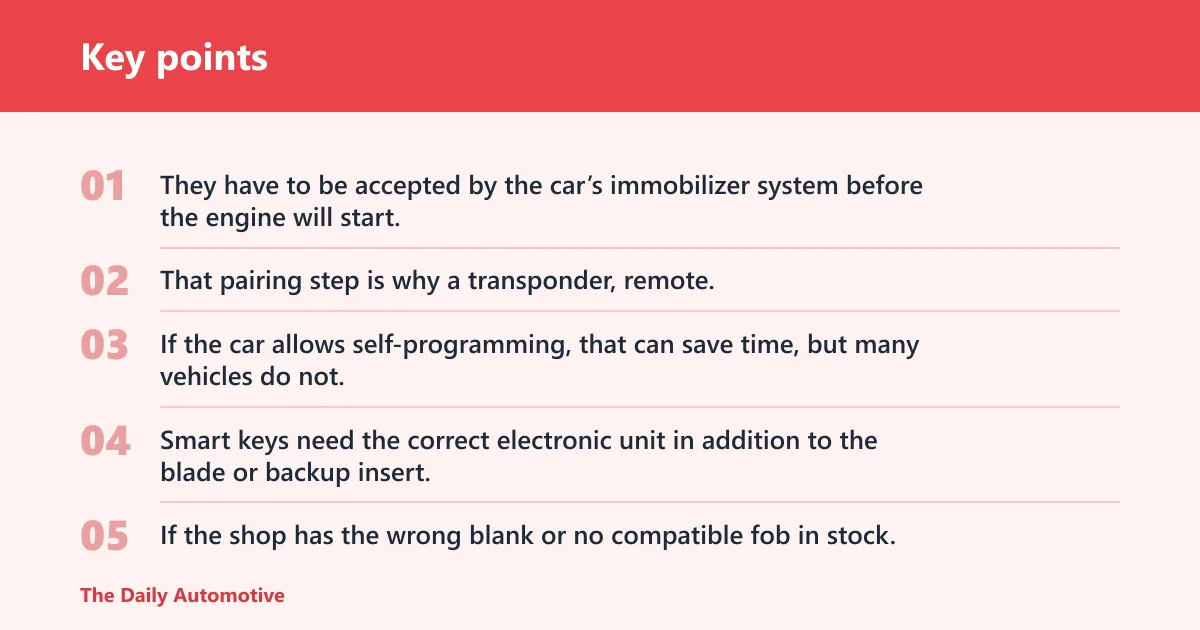
Many modern keys do more than open doors. They have to be accepted by the car’s immobilizer system before the engine will start. That pairing step is why a transponder, remote, or smart key takes longer than a plain metal copy. If the car allows self-programming, that can save time, but many vehicles do not.
Cutting equipment and blank availability
Traditional keys need a basic cutter. Laser-cut keys need specialist equipment. Smart keys need the correct electronic unit in addition to the blade or backup insert, if one exists. If the shop has the wrong blank or no compatible fob in stock, the job waits on parts instead of labor.
VIN lookup and ownership checks
VIN lookup helps match the correct blank and, in some cases, the right code path for cutting or programming. Proof of ownership is also part of the process. Expect a personal ID and vehicle registration to be requested. If the title is in another name, call ahead so you know what other paperwork the shop will accept.
Missing original key
Without the original key, a duplicate becomes a replacement from scratch. That usually means more verification, more programming, and a higher chance of a special-order part. Say your only smart key is lost in a parking lot at 8 p.m. A same-night locksmith visit may still happen, but only if the vehicle is supported and the fob is in stock. Otherwise, the wait can stretch into the next day or longer.
How long does it take to make a copy?
A copy of an existing key is the shortest path. A plain metal copy may take only a few minutes, while a chipped or remote key copy usually takes longer because the new key has to be cut and then accepted by the car. If the key type is unusual, the copy can still be same-day, but not always at every shop.
Copying a spare key
A spare key is the cheapest and fastest thing to duplicate because it gives the technician a working template. The blade can be matched directly, and the electronics can often be paired without pulling vehicle data from scratch. That is why a spare reduces downtime so much compared with a full replacement after loss.
Copying a chipped key
A chipped key copy usually means cutting the blade and programming the transponder. That can fit into a single visit, but the process is longer than a plain cut because the new chip has to be registered to the vehicle. If the car only recognizes a limited number of keys, that can add another step.
Copying a remote or smart key
Remote and smart keys can be copied when the correct blank or fob is available and the car supports the procedure. The key can be more expensive because the electronics are part of the job, not an add-on. A common first-timer mistake is assuming any replacement shell will work; if the electronics do not match the vehicle, the copy fails and the wait starts over.
How to speed up replacement
You can shorten the wait by removing avoidable delays before you call. The fastest jobs usually start with the right paperwork, the right key type, and the right provider. If you are unsure, a 2-minute call with the VIN in hand can save an extra day.
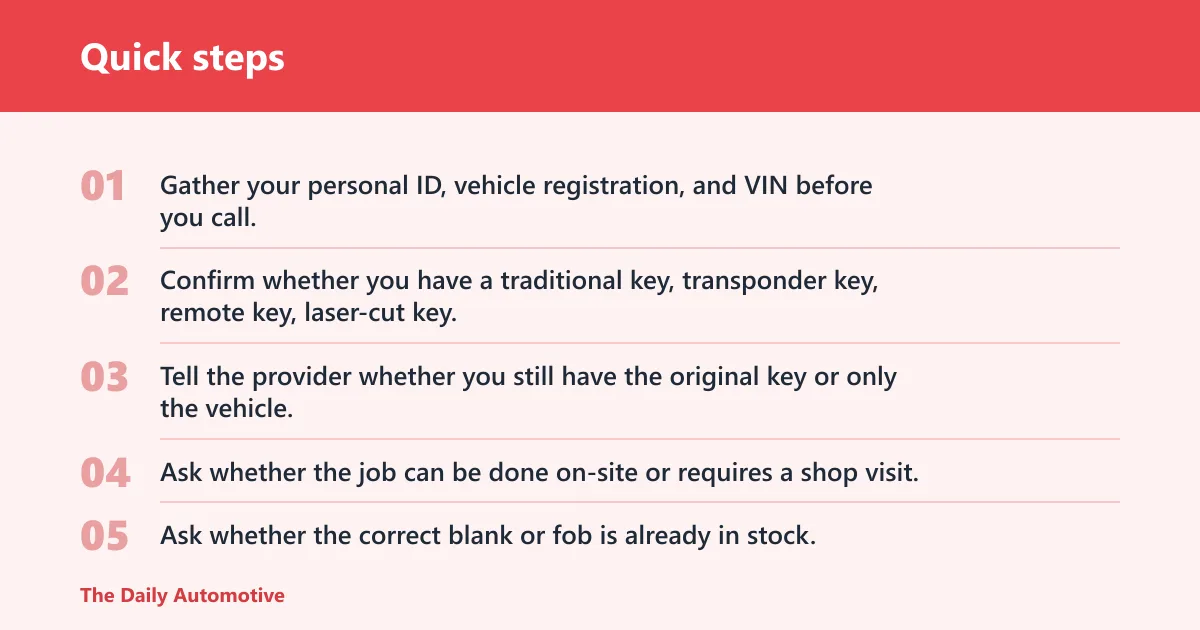
- Gather your personal ID, vehicle registration, and VIN before you call.
- Confirm whether you have a traditional key, transponder key, remote key, laser-cut key, or smart key.
- Tell the provider whether you still have the original key or only the vehicle.
- Ask whether the job can be done on-site or requires a shop visit.
- Ask whether the correct blank or fob is already in stock.
- Choose a locksmith first if same-day mobility matters and the vehicle is supported.
- Choose the dealership when access codes, factory software, or special parts are the limiting factor.
One useful comparison: a standard outlet adds only a few miles of range per hour for EV charging, while a level 2 charger typically adds 15-25 miles per hour. One EV owner needed 12 full hours to add 50 miles of range on a regular outlet, while another owner’s car charged for about three hours overnight on a level 2 charger. Car-key replacement has a similar spread; the service path matters as much as the equipment.
Another quick rule: if the key can be copied from a working original, replacement is often measured in minutes or hours. If the original is gone and the car needs programming, the wait is more likely to be measured in hours or days. If the provider also needs to order a blank, expect the timeline to move again.
Frequently asked questions
How long does it take to make a car key copy?
A basic car key copy can take 5 to 20 minutes when the original is present and the blank is in stock. Chipped, remote, or smart keys take longer because the vehicle has to accept the new key. That extra programming step is what pushes many copies into the 30-minute-to-2-hour range.
How long does it take to make a car key without the original?
Without the original, expect a wider range: often 1 to 3 days for transponder or remote keys, and sometimes 2 to 5 days for smart keys. The delay comes from VIN checks, ownership verification, blank ordering, and programming access. A locksmith may still finish sooner than a dealership if the right part is already available.
Should I call a locksmith or dealership for a new car key?
Call a locksmith first if you want the best shot at same-day service, especially for a standard, transponder, or remote key. Call the dealership when the vehicle needs factory access codes, a rare smart key, or a part the local market does not stock. The best choice depends on the key type, not just the car brand.
How long does it take a locksmith to make a car key?
A locksmith can often make a car key in 15 minutes to 2 hours when the job is supported and the paperwork is ready. Mobile service helps because the technician comes to the vehicle, cuts on-site, and programs many common keys there. Rare keys and missing originals can still push the job into the next day.
How long does it take a dealership to make a car key?
A dealership can take from a few hours to several days, and sometimes longer if the key or fob has to be ordered. The wait grows when towing is needed, the service lane is busy, or factory security steps are required. Dealerships are often less convenient, but they can be the only option for some smart keys.
How long does it take to make a new car key?
A new car key can take minutes, hours, or days depending on the type and the service path. A traditional metal key is the quickest. A transponder, remote, laser-cut, or smart key takes longer because cutting, programming, and verification all add time. If you have no spare, the timeline usually moves to the longer end.
Products related to this article
Sponsored / affiliate links. As an Amazon Associate I earn from qualifying purchases. I may earn additional commission from eligible campaigns.