How Much Does a Battery Tender Cost?
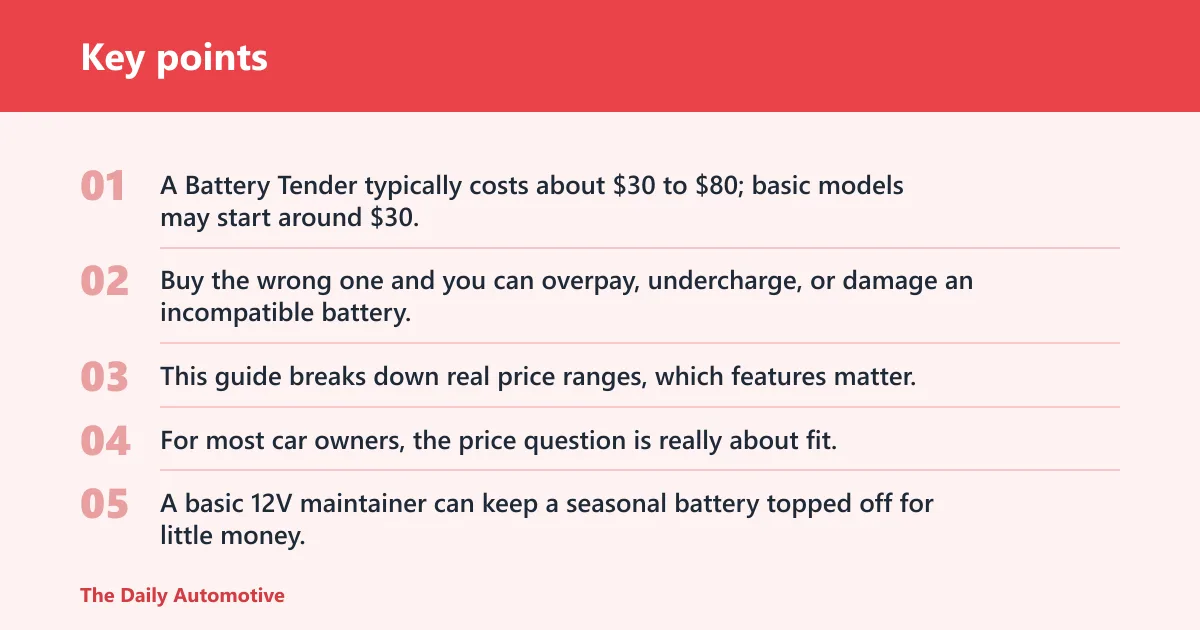
A Battery Tender typically costs about $30 to $80; basic models may start around $30, while lithium-capable, waterproof, or multi-bank units can run into roughly the $60 to $150 range. Buy the wrong one and you can overpay, undercharge, or damage an incompatible battery. This guide breaks down real price ranges, which features matter, and what to buy for your vehicle.
For most car owners, the price question is really about fit. A basic 12V maintainer can keep a seasonal battery topped off for little money. Higher prices usually mean more amperage, longer leads, weather resistance, or extra connection options. That is what you are paying for.
Quick answer


Forum pricing gives a useful snapshot. One poster said a branded Battery Tender could be bought for under $40, another said similar devices worked great for about $40, and a Costco mention put a sale price at $29 with $10 savings. Those numbers line up with the low end of the market, not the top.
Battery tender price table
| Common category | Typical retail price band | Connection method | Charging speed | Best-fit storage scenario |
|---|---|---|---|---|
| Entry-level 12V maintainer | $30 to $40 | Direct-to-battery leads | Low amperage, slow maintenance | Seasonal storage for one car, motorcycle, or lawn vehicle |
| Midrange branded unit | $40 to $80 | Direct leads, sometimes quick-connect harnesses | Moderate amperage | Daily drivers, weekend vehicles, longer storage stretches |
| Higher-end or multi-bank model | $60 to $150 | Direct leads, accessory cables, sometimes multiple attachment options | Higher output or multi-bank support | Multiple vehicles, tighter battery-access layouts, wetter storage areas |
| OEM-branded accessory pricing | Usually higher than aftermarket retail | Vehicle-specific accessory or dealer-installed setup | Depends on the underlying unit | Owners paying for convenience, branding, or dealer integration |
The table is the short version. A lower price usually means fewer extras, not less usefulness. If the battery lives in a dry garage and the vehicle sits for weeks at a time, a basic maintainer often covers the job without paying for features you will never use.
How much does a battery maintainer cost?
A battery maintainer usually costs less than a full-featured charger because it is built to hold a battery at a healthy charge, not recover a deeply discharged one. Basic consumer units often land around the $30 to $50 range, while smarter or higher-output models can rise into roughly the $60 to $150 range.
That price gap reflects features more than category labels. Automatic shutoff, float charging, reverse-polarity protection, extra cable length, and weather-resistant housings all raise cost. So does support for both 6V and 12V batteries, or a design meant to serve more than one vehicle type.
A common first-timer mistake is buying the cheapest charger on the shelf for long storage. If the vehicle sits for months, you want a maintainer that can stay connected safely, not a bulk charger that expects active supervision. For that use case, a basic maintainer is often enough.
Which Battery Tender do you need?
Most Battery Tender units are aimed at 12V batteries and regular maintenance use. That makes them a strong fit for cars, motorcycles, boats, and seasonal vehicles that need help avoiding parasitic drain during long storage. If the vehicle has a standard 12V lead-acid battery and sits unused, this is the right category to start with.
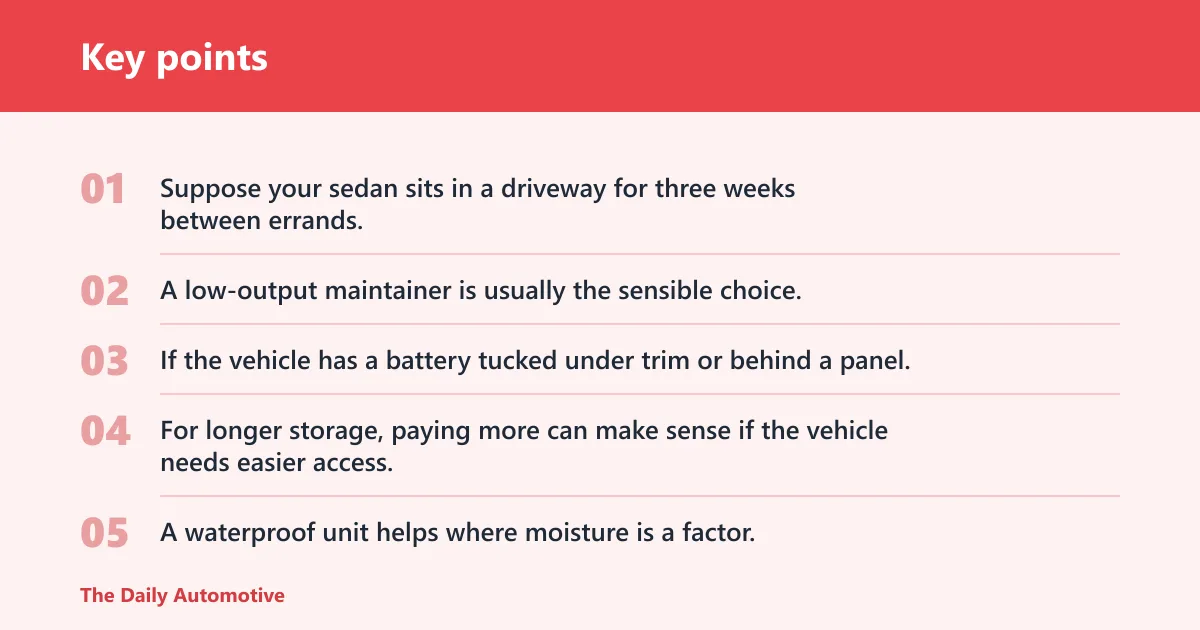
Suppose your sedan sits in a driveway for three weeks between errands. A low-output maintainer is usually the sensible choice. If the vehicle has a battery tucked under trim or behind a panel, a longer lead or a cleaner mounting option can matter more than a higher amperage rating.
For longer storage, paying more can make sense if the vehicle needs easier access, better weather protection, or a faster recovery from repeated short trips. A waterproof unit helps where moisture is a factor. A higher-output model can be more convenient when the battery is larger or the owner wants a quicker return to maintained charge after use.
What features justify a higher price?
Three features tend to separate a cheap maintainer from a pricier one: amperage, attachment options, and durability. More amperage can shorten recovery after the battery drops below full. More attachment choices can help if you want cigarette lighter hookup, direct battery leads, or a cleaner permanent lead route. Waterproofing matters for exposed storage spots.
Lead length also matters more than many shoppers expect. A longer cable can mean easier routing from the battery to a wall outlet without pinching the wire. That matters in garages where the outlet is nowhere near the parking spot.
Where can you buy one for less?
Retail pricing is usually lower than dealer or OEM-branded accessory pricing, and that difference can be large. One forum user said a dealer-installed NSX battery tender cost much more than retail options, while others pointed to Walmart, Amazon, and Costco as lower-cost sources. Those are the first places many shoppers check for price, because the same basic function often costs less once you leave the dealer parts counter.
Costco can be especially interesting if a sale is running. One member said a Costco sale price was $29, with $10 savings called out in the post. That is typical warehouse pricing behavior: a sharp sale, limited selection, and a price that can move quickly.
Walmart is usually the place to check for the lowest sticker price on a basic maintainer. Amazon often has more bundle variation, including different lead lengths, mounting kits, and brand combinations. Those bundle differences can make two listings look similar while pricing them very differently.
Battery Tender pricing at the dealer is different. OEM-priced accessories are often marked above aftermarket equivalents, even when the underlying job is the same. If you only need a maintainer to prevent drain during storage, aftermarket usually makes more sense.
How do you connect it?
The simplest method is direct-to-battery connection. That means attaching the maintainer’s leads to the battery terminals, then routing the cable to a reachable spot. One owner described connecting the Battery Tender directly to the battery and routing the cable through the hood area. That approach keeps the setup simple and repeatable.
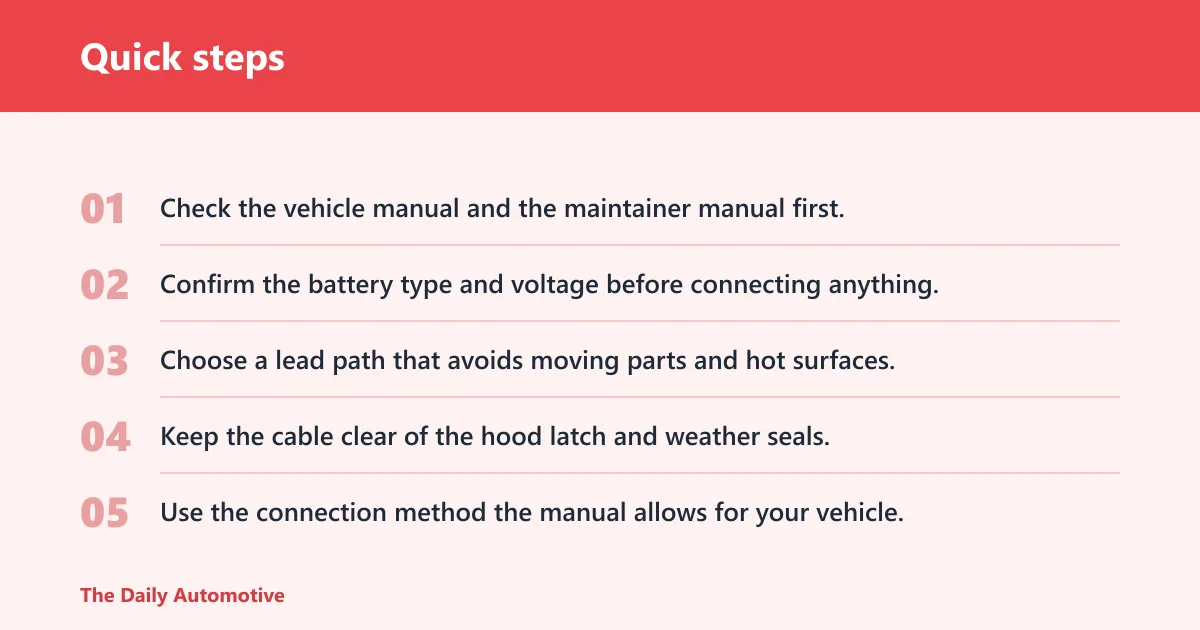
- Check the vehicle manual and the maintainer manual first.
- Confirm the battery type and voltage before connecting anything.
- Choose a lead path that avoids moving parts and hot surfaces.
- Keep the cable clear of the hood latch and weather seals.
- Use the connection method the manual allows for your vehicle.
Another option is snaked cable routing, which keeps the connection ready without leaving the clamp set exposed. That is useful when the charger will be used regularly and you want a cleaner setup. A third option is cigarette lighter socket hookup, but only if the vehicle and the charger both support it.
One user said the cigarette lighter socket was the easiest connection method. Another said battery terminal connection is the best way. Both can be true, depending on the vehicle. The manual decides what is allowed, and some vehicles keep the lighter socket alive only in certain key positions.
What should you check before installation?
Check whether the socket stays powered when the car is off, whether the battery is accessible, and whether the vehicle’s accessory circuit allows charging through that outlet. If the manual does not allow that method, use direct battery leads instead. Do not guess on electrical connections.
Follow the vehicle and product manual. Jump-starting and battery work follow the manual’s connection order. Fuel, coolant, and electrical work need ventilation, no sparks, and the battery disconnected.
Battery maintainer alternatives worth comparing
Battery Tender is one option in a crowded field, not the only acceptable one. The right comparison is feature-by-feature: price, battery compatibility, output, and attachment options. For some buyers, a different maintainer gives better value because it includes the exact connector or voltage support they need.
The CTEK 3300 came up in forum discussion because it has multiple attachment options. That matters if you want more than one connection style without buying separate accessories. It also fits shoppers who care more about setup flexibility than brand familiarity.
The Schumacher SP1297 is another relevant comparison. It was described as a 3A unit, supports both 6V and 12V batteries, and was called an automatic battery maintainer. Those specs make it a useful alternative when a buyer wants more output or broader battery compatibility than a very basic maintainer provides.
Brand choice should follow use case, not logo preference. If the vehicle sits for months and only needs maintenance, a lower-cost maintainer can do the job well. If the battery layout is awkward, a unit with multiple attachment options may justify a higher price even if the brand is less familiar.
Frequently asked questions
How much does a battery tender cost?
A Battery Tender typically runs from about $30 to $80 for most consumer buyers, with lower-cost basic units starting around $30 and more capable models reaching $60 to $150. The price moves with amperage, cable length, weather resistance, and whether the unit supports more than one battery type.
How much does a good car battery charger cost?
A good car battery charger can cost anywhere from about $30 for a basic consumer unit to well over $100 for a smarter model with more output or battery modes. If you only need long-term storage support, a maintainer is usually the better purchase than a higher-priced charger.
Is Battery Tender a good brand?
Battery Tender is a well-known maintainer brand, and forum buyers often point to it as a sensible baseline for 12V storage use. Its value is strongest when the goal is keeping a battery charged over time, not jump-starting a dead vehicle. For that job, the brand has a solid reputation.
Will a cheaper Battery Tender work as well as an OEM one?
In many cases, yes, if the cheaper unit matches the battery type and the storage job. Aftermarket units are usually cheaper than OEM-branded accessories, and forum pricing suggests the functional difference may be small. Pay extra only when the OEM version adds a feature you actually need.
How much does a Battery Tender cost at Costco?
One forum member said a Costco sale price was $29, with $10 savings mentioned in the same post. That makes Costco a useful place to watch for short-term deals, although warehouse pricing changes quickly and selection is usually narrower than at a general retailer.
What Battery Tender options work for long-term storage?
For long-term storage, a basic 12V maintainer is often enough if the battery is healthy and the vehicle is parked for weeks or months. Look for automatic maintenance mode, safe float charging, and a connection method that fits your parking spot. Waterproofing helps if the unit sits in a damp area.
Products related to this article
Sponsored / affiliate links. As an Amazon Associate I earn from qualifying purchases. I may earn additional commission from eligible campaigns.