What Happens at the End of a Car Lease?
At lease end, the lowest-cost move is the one with the smallest total after you add buyout price, disposition fee, wear-and-tear charges, taxes, and your next-car costs. Skip that math and you can pay hundreds more than expected. This guide shows how to compare return, buy, and extension step by step.
This guide is part of our Car Dealer Money Guide: Negotiating, Financing, Leasing, Trading In and Selling series.
Review your lease terms early
Most lease contracts give you three paths: return the car, buy it, or extend the lease if the lessor allows it. Most leasing companies contact you before the expiry date to arrange collection, but you should still read the contract early so you know the mileage allowance, residual value, and any fees.
Start with the contract
Pull the lease paperwork first. Check the residual value, mileage allowance, disposition fee, purchase option fee, and any extension terms. Reviewing lease paperwork 60–90 days before the lease ends, and that timing matters because fees and repair choices are easier to manage before turn-in.
If the car is worth less than the residual value, a buyout usually makes less sense unless you want the vehicle for other reasons. If the car is worth more than the residual value, the buyout gap may work in your favor, especially if you have extra miles or wear that would cost money on return.
Use a simple timeline
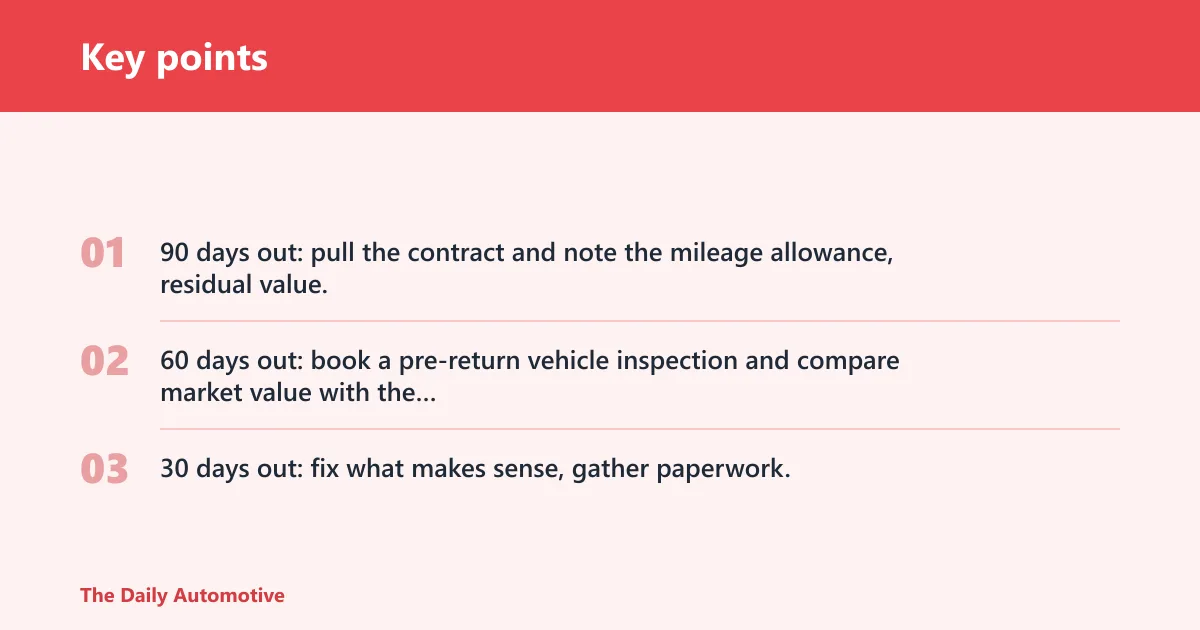
- 90 days out: pull the contract and note the mileage allowance, residual value, disposition fee, and purchase option fee.
- 60 days out: book a pre-return vehicle inspection and compare market value with the buyout price.
- 30 days out: fix what makes sense, gather paperwork, and confirm the return or buyout steps in writing.
Say your sedan has 8,000 miles left on the allowance and only light scuffs. Return may be cheapest. Suppose the same car is 12,000 miles over the limit and needs a windshield and tire replacement. The buyout or extension may cost less than a return with mileage and damage charges.
📊 Car and Driver says automaker leases commonly charge a disposition fee upon termination, usually around $400. Source: Caranddriver.
What fees can you pay at lease end?
Return-path costs can include a disposition fee, excess mileage charges, wear-and-tear charges, and missing-item charges. Some lease returns can trigger charges for late returns, unfinished repairs, unresolved tolls, or parking tickets. Treat those as part of the final bill, not afterthoughts.
Disposition fee
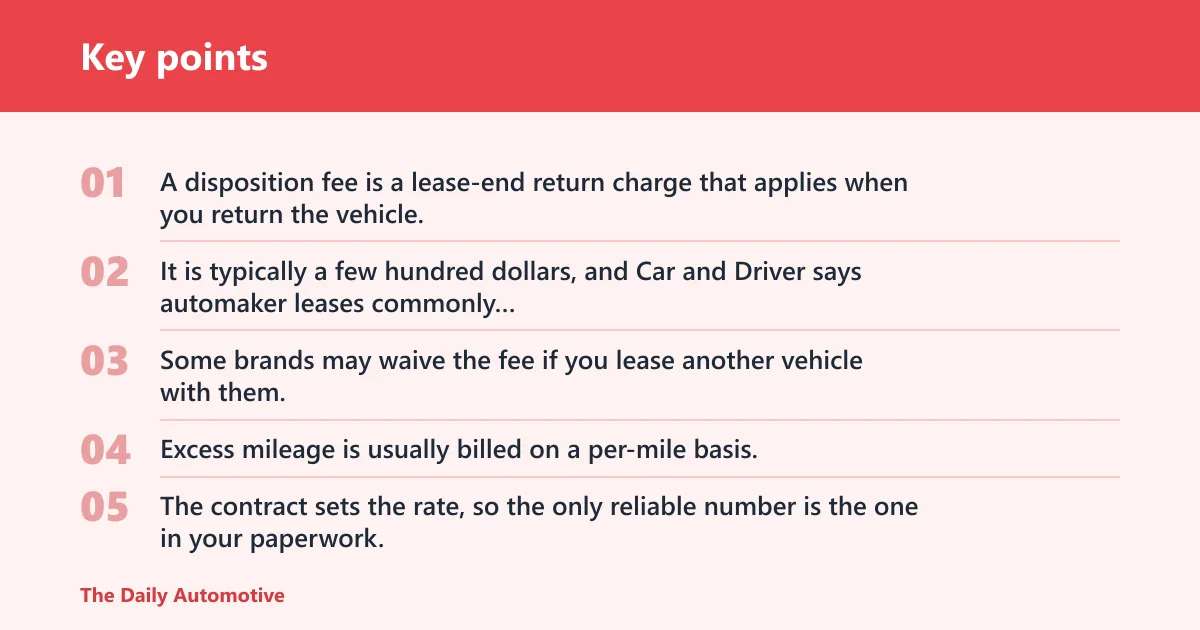
A disposition fee is a lease-end return charge that applies when you return the vehicle. It is typically a few hundred dollars, and Car and Driver says automaker leases commonly charge around $400. Some brands may waive the fee if you lease another vehicle with them.
Excess mileage charge
Excess mileage is usually billed on a per-mile basis, and it can become large if the odometer is over the allowance. The contract sets the rate, so the only reliable number is the one in your paperwork. A small overage can still add up fast across thousands of miles.
Wear, missing items, and late return costs
Normal wear and tear usually covers minor scuffs and light stains. It does not cover major damage, cracked glass, or torn seats. Missing keys, manuals, cargo covers, or accessories can also create charges if the contract requires them. Late returns may add another fee because the lease term has already ended.
| Option | Expected cash outlay | Avoided fees | Best for scenarios |
|---|---|---|---|
| Return | Disposition fee, excess mileage, wear charges, missing-item charges, plus next-car costs | Buyout price, sales tax on purchase, registration tied to ownership | Low mileage, light wear, and no strong case for keeping the car |
| Buyout | Residual value, possible purchase option fee, sales tax, DMV fees, possible financing cost | Return mileage charges, wear charges, disposition fee | Residual value is below market value, or you want to keep the car |
| Extension | Temporary monthly payment, possible updated mileage charge, possible admin fee | Immediate return charges and immediate buyout cash | You need time, but only if the lessor confirms the terms in writing |
What should you check before the inspection?
Check the car against the lease standards before the inspection, not after it. The inspection is the chance to find chargeable items early, compare repair quotes, and decide whether to fix the car, return it as-is, or buy it out. That choice can save real money.
Normal wear and tear versus damage
The inspection benchmark varies by lessor or brand, but the broad line is consistent: minor scuffs and light stains are usually normal wear, while major damage is not. Cracked glass, torn seats, broken trim, and dents beyond ordinary use are common chargeable items.
Bring back the right items
Drivers should gather paperwork, including the V5C registration document and servicing invoices. Also return keys, manuals, cargo covers, accessories, and any other original equipment required by the contract. Missing items often create avoidable charges because the lessor expects the car back in complete form.
Clear the loose ends
Check tolls, parking tickets, service records, and any unfinished repairs before turn-in. A common first-timer mistake is leaving a toll balance open and assuming it will sort itself out later. If the lessor finds it after return, the bill can grow with processing fees.
Picture a compact SUV with two missing keys, a cracked mirror housing, and a stack of unpaid parking tickets. The return path looks cheap until those items are added. If the repair and paperwork bill is close to the buyout gap, buying the vehicle may be the cleaner choice.
Should you return, buy, or extend?
Return the car when the total of return charges and your next-car costs is lower than the cost of keeping it. Buy the car when the residual value is below market value or when you want to avoid mileage and wear charges. Extend only if the lessor allows it and the terms still fit your budget.
Return when the math favors it
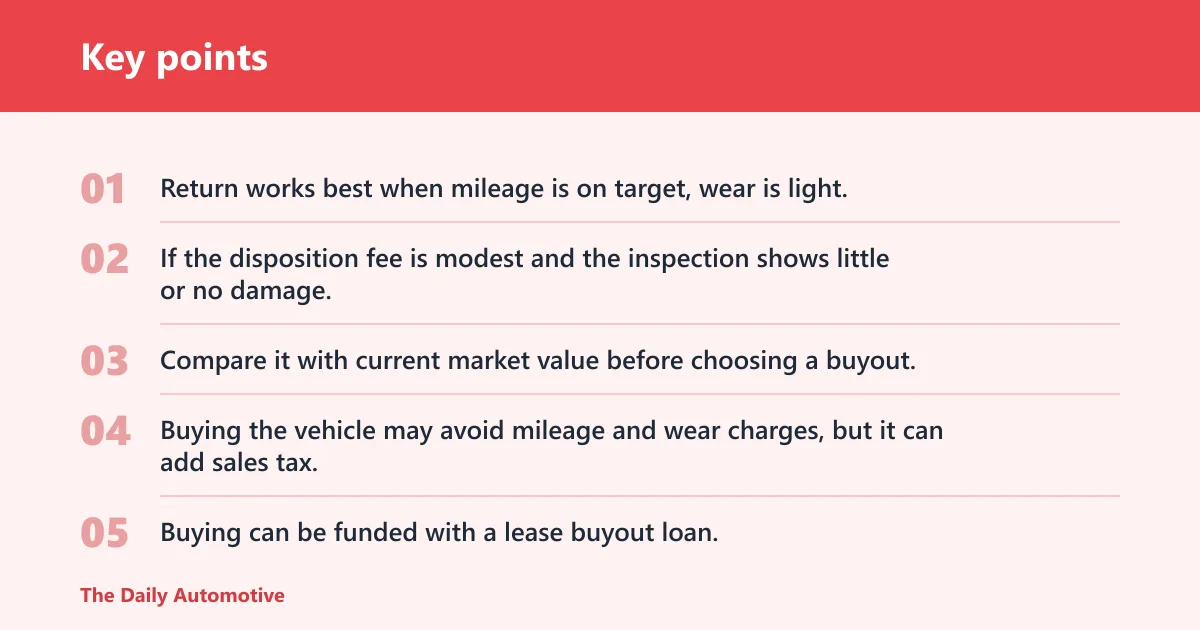
Return works best when mileage is on target, wear is light, and the car’s market value is close to the residual value. If the disposition fee is modest and the inspection shows little or no damage, the return path may be the cheapest clean exit.
Buy when the car is worth more than the buyout
Residual value is the contract buyout price. Compare it with current market value before choosing a buyout, because the difference can change the answer. Buying the vehicle may avoid mileage and wear charges, but it can add sales tax, DMV fees, and a possible purchase option fee. Buying can be funded with a lease buyout loan.
If dealer quotes, the lessor quote, and public market listings disagree, pay attention. The gap matters. A dealer trade-in number may be lower than a private-sale listing, while the lessor’s buyout number may include fees that do not show up in ads. That spread can change the best move.
Extend only with written terms
Lease extension is a short-term option offered by some lessors, but it is not guaranteed. The new term should spell out the monthly payment, mileage allowance, and any added conditions. Do not assume the old lease simply rolls forward; get confirmation from the leasing company first.
Lease-end decision worksheet
Use this worksheet as a text-only cost stack before you commit. Fill in the numbers from your contract, inspection, and lender quotes. Then compare the total cash outlay for each path, not just the headline payment.
| Line item | Return | Buyout | Extension |
|---|---|---|---|
| Base payment or buyout amount | None | Residual value | Monthly extension payment |
| Purchase option fee | None | Possible | None |
| Disposition fee | Possible | None | Usually none |
| Excess mileage charges | Possible | Usually avoided | Depends on extension terms |
| Wear-and-tear charges | Possible | Usually avoided | Depends on extension terms |
| Sales tax and DMV fees | None on return path | Possible | Possible if ownership changes later |
| Next-car costs | Yes, if you replace it | Only if you still change cars later | Delayed |
What to put in the worksheet: the residual value, the disposition fee, the mileage allowance, your current odometer reading, estimated wear charges, any purchase option fee, expected sales tax, and DMV fees. Then add replacement transportation if you need another car immediately.
Sample cost stack
One common decision point is a car that is 3,000 miles over the allowance. If the per-mile penalty is high, the return cost can jump quickly, even before wear charges are added. Another car may have low mileage but a buyout price above market value, which favors return instead.
A second decision point is the opposite: a lease with high mileage but a resale market that sits above the residual value. In that case, the buyout may absorb the mileage issue while leaving you with equity on paper. The only way to know is to stack the contract number against real market offers.
What happens at the end of a car lease term?
At the end of a car lease term, you usually return the vehicle, buy it, or extend the lease if the lessor permits it. The lessor may contact you before the lease expires, but you should still review the contract 60–90 days early, because mileage charges, wear charges, and fees can change the cheapest path.
What happens to my deposit at the end of a car lease?
If your lease includes a security deposit, the lessor usually applies it according to the contract after the final settlement is complete. That means any unpaid mileage, damage, tolls, tickets, or other charges can reduce what comes back, and some contracts may keep part of it to offset final amounts due.
Can I buy my leased car at the end of the lease?
Yes, if your contract includes a purchase option. The buyout price is usually based on the residual value, and some contracts add a purchase option fee. You may also owe sales tax and DMV fees, so compare the full purchase cost with market value before you decide.
Can I extend a car lease if I’m not ready to return it?
Sometimes, but not always. Some lessors may allow a short extension with a new monthly payment and mileage allowance, while others may not offer it at all. Confirm the terms in writing before the original lease ends, because an assumed extension can turn into a late-return problem.
What fees do you pay when you return a leased vehicle?
The most common return fees are the disposition fee, excess mileage charges, and wear-and-tear charges. You can also be billed for missing keys, manuals, cargo covers, accessories, unpaid tolls, parking tickets, or a late return. The final statement depends on the contract and the inspection results.
What should I check before a lease-end inspection?
Check the body, glass, tires, interior, and all original equipment before the inspection. Look for cracked glass, torn seats, deep scratches, and missing items that the contract requires. Gather service records, the V5C registration document, and servicing invoices so you can answer questions quickly if charges appear.
What happens if my leased car has wear and tear?
Normal wear and tear usually passes inspection, but chargeable damage does not. Minor scuffs and light stains are often acceptable, while major damage, cracked glass, and torn seats can bring extra charges. A pre-return inspection gives you time to decide whether to repair the item, return the car as-is, or buy it out.
How much are excess mileage charges at lease end?
There is no single number because the contract sets the per-mile rate. Mileage penalties are often charged on a per-mile basis, and the total can get large if you are far over the allowance. Check the contract and multiply the overage by the stated rate before you assume the cost is small.
Do I have to pay sales tax if I buy my leased car?
A lease-end purchase is often treated like a vehicle sale. The exact tax treatment depends on the state or local rules and the contract structure, so the buyout total should include sales tax, DMV fees, and any purchase option fee before you compare it with market value.
What happens at the end of a car lease uk
In the UK, the basic decision is still return, buy, or extend, but the paperwork is different. Most leasing companies contact you before expiry to arrange collection, and drivers should gather the V5C registration document and servicing invoices. Check the contract for mileage, condition rules, and collection steps.
Products related to this article
Sponsored / affiliate links. As an Amazon Associate I earn from qualifying purchases. I may earn additional commission from eligible campaigns.
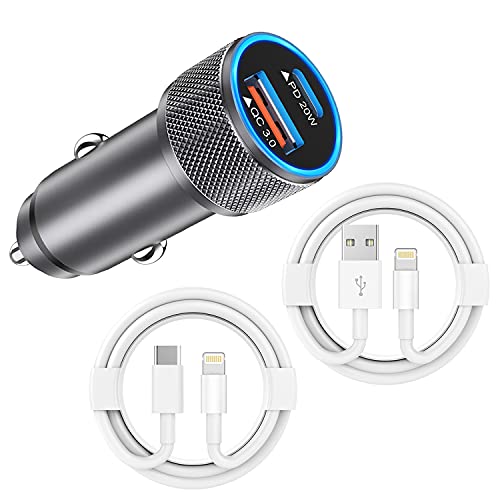 iPhone Car Charger,USB C Fast Car Charger[Apple MFi Certified] Apple Car Charging 38W Dual Port CarCharger Cigarette Lighter Adapter 2x3ft PD&QC 3.0 Lightning Cable for iPhone 14/13/12 Pro/11/Airpods
 Car A/C Repair Kit, 270PCS Rubber O-Ring Seal Kit + 40PCS Car Air Conditioner Valve Core Kit for R12 R134a A/C with Remover & Install Tool+10pcs R134a AC Valve Caps, Fix Refrigeration System