Can You Pay Off a Car Loan Early Without a Penalty?
Yes, many auto loans can be paid off early without a penalty, but check the contract first. A prepayment fee can wipe out interest savings if it costs more than the interest you would still pay. Miss the payoff date or the lender’s payment instructions, and you can trigger extra interest, duplicate payments, or a loan that stays open after you think it is closed. Here’s how to check for a penalty, compare the fee against the remaining interest, request the right payoff quote, and send the final payment cleanly.
This guide is part of our Car Dealer Money Guide: Negotiating, Financing, Leasing, Trading In and Selling series.
Spotting prepayment penalties in your loan agreement
Usually, yes. Most U.S. auto loans use simple interest, so paying early stops future interest from accruing on the unpaid balance. The catch is that some subprime and buy-here-pay-here contracts still include prepayment penalties, and a few states prohibit them for certain loans.
When early payoff is usually allowed
If your contract does not add a prepayment charge, you can generally pay the loan off before the term ends. Banks and credit unions often allow this, and many standard retail auto loans do too. The key is that the lender must give you the exact payoff amount for a specific date.
When a fee can still apply
A prepayment penalty is a fee for paying off a loan before the agreed term ends. It may be a flat fee, often in the $200 to $500 range, or a percentage of the remaining balance, often 1% to 5%. If that fee is larger than the interest you would avoid, early payoff may cost more than it saves.
What contract language matters most
Read the financing contract and the Truth in Lending disclosures first. Regulation Z requires key financing terms in a conspicuous, segregated section, often called the Fed Box. The CFPB says to review those disclosures and the contract closely, because that section is the first place to look for early payoff charges.
How do I know if my auto loan has a prepayment penalty?
Check the signed contract, the Truth in Lending disclosure, and the lender’s payoff terms. If a prepayment fee exists, it should be stated there. If the language is unclear, ask the lender for the exact clause in writing before you send money, because the payoff quote alone may not explain the fee structure.
Where to find the clause
Start with the Fed Box or other conspicuous financing section, then scan the payment and default sections for early payoff language. On precomputed contracts, look for refund terms tied to unearned finance charges. On simple-interest contracts, look for wording that says no penalty applies or that a fee may apply if the account is closed early.
How state law can limit enforcement
Some states prohibit prepayment penalties for certain loans. That does not mean every loan in those states is penalty-free, because contract type and lender category still matter. The enforceability question turns on the written contract, the loan type, and the state rule that applies to that transaction.
Lender type differences to watch
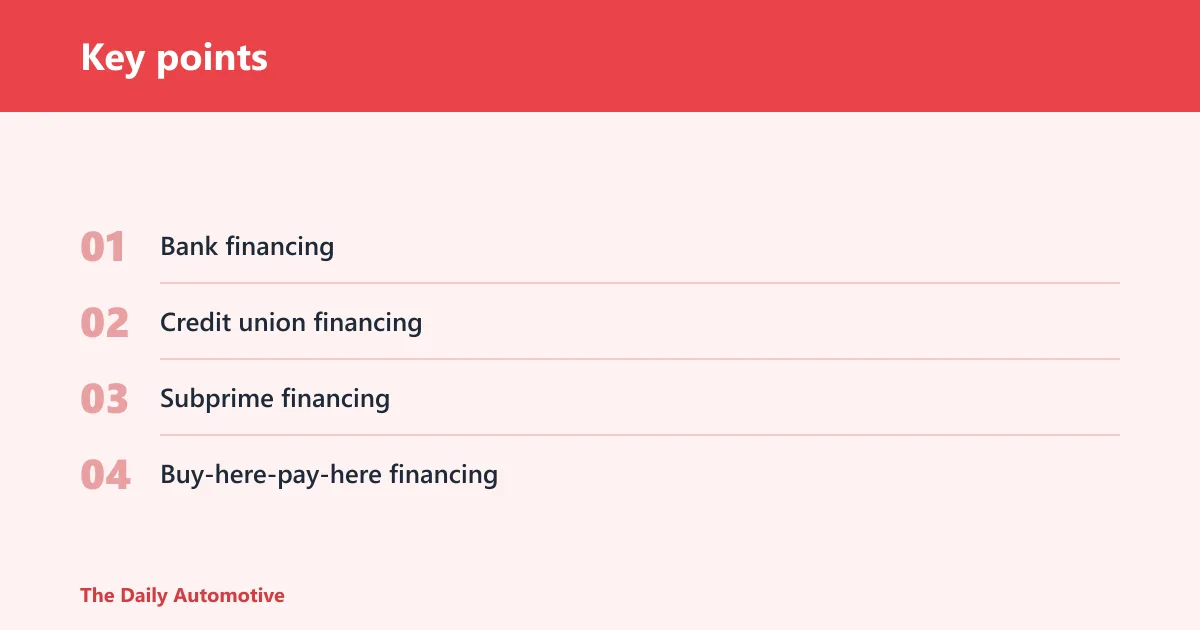
- Bank financing: Often simple-interest, with clear payoff instructions and standard wire, ACH, or certified check options.
- Credit union financing: Usually straightforward, but you should still verify whether any fee appears in the contract.
- Subprime financing: More likely to include a prepayment penalty or tighter payoff rules.
- Buy-here-pay-here financing: Payoff handling can be less standardized, so confirm the exact mailing address, acceptable payment method, and whether any fee applies.
What is a payoff quote on a car loan?
A payoff quote is the exact dollar amount needed to close the account on a specific date. It includes the balance, any interest accrued through the quote’s good-through date, and any other payoff charges the lender applies. It is not the same as your last monthly statement balance.
How to read the quote
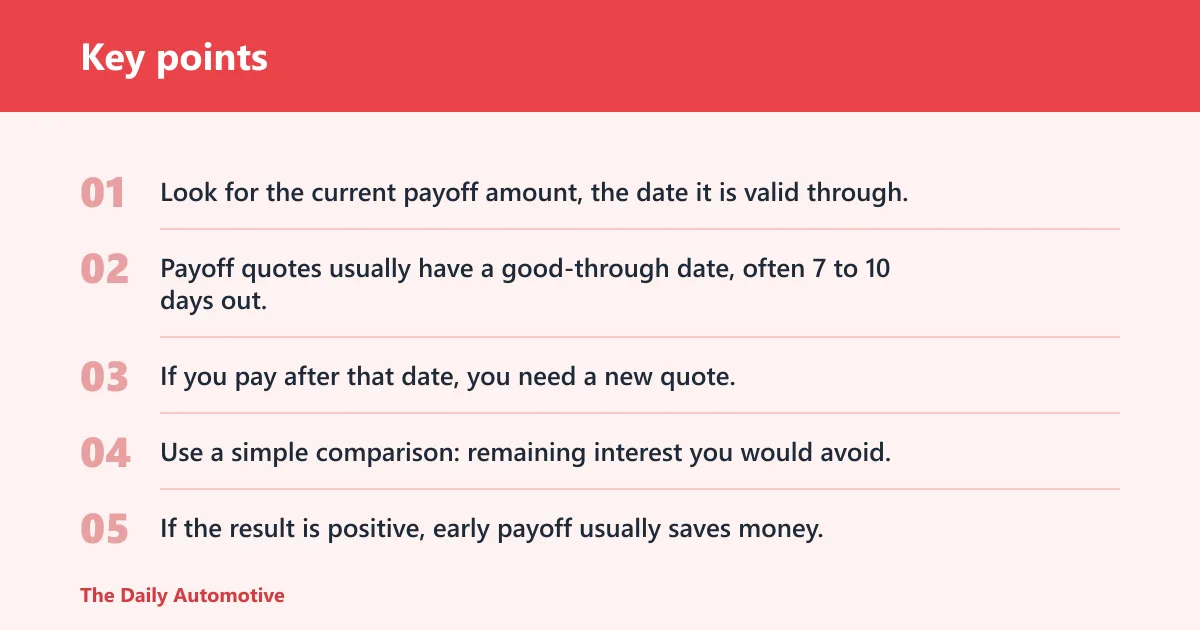
Look for the current payoff amount, the date it is valid through, and the address or payment channel the lender wants you to use. Payoff quotes usually have a good-through date, often 7 to 10 days out. If you pay after that date, you need a new quote.
| Payoff decision worksheet | Example entry | What to verify |
|---|---|---|
| Current payoff quote | $8,420.55 | Exact amount as of the lender’s stated date |
| Prepayment penalty | $300.00 | Flat fee or percentage, and whether it applies now |
| Estimated remaining interest | $540.00 | Interest you avoid if the loan closes on time |
| Quote expiration date | 2026-11-07 | Good-through date and last acceptable payment day |
| Break-even result | Save about $240.00 | Remaining interest minus penalty, adjusted for any refund rules |
Break-even method
Use a simple comparison: remaining interest you would avoid, minus any prepayment penalty, plus or minus any refund tied to a precomputed loan. If the result is positive, early payoff usually saves money. If the result is negative, keeping the loan may be cheaper.
Suppose your payoff quote is $8,420.55, the lender charges a $300 fee, and your remaining interest would have been about $540. In that case, the rough savings are $240 before any refund issue. If the quote expires before your payment arrives, the savings can shrink because the lender may add more accrued interest.
Does paying off a car loan early save interest?
On a simple-interest auto loan, usually yes. Interest accrues on the remaining balance, so paying sooner stops future interest from piling up. Extra principal payments can also reduce future interest, but only if the lender applies the extra money to principal instead of the next scheduled payment.
Simple-interest versus precomputed loans
Most U.S. auto loans use simple interest, so the interest charge changes as the balance falls. Precomputed interest loans work differently, because the finance charge is calculated upfront and built into the payment schedule. Early payoff on a precomputed loan may trigger an unearned finance charge refund, but the refund method depends on the contract.
Where Rule of 78s fits
Some precomputed loans use the Rule of 78s. That method can make the refund smaller than borrowers expect because more interest is assigned earlier in the schedule. Federal law limits the Rule of 78s on longer consumer credit transactions, so it is not universal, but it still appears in some older contracts.
Why the quote and refund method both matter
A payoff quote tells you what to pay now. The refund clause tells you whether part of the finance charge comes back later on a precomputed loan. A loan can look expensive to close early for two different reasons: a direct penalty, or a refund formula that returns less than you hoped.
What happens if I make extra principal payments on my car loan?
Extra principal payments can shorten the life of a simple-interest loan and reduce total interest, but only if the lender applies them to principal. If the money is posted as an advance payment instead, you may not save much interest. The payment instructions matter as much as the amount.
How to confirm principal-only application online
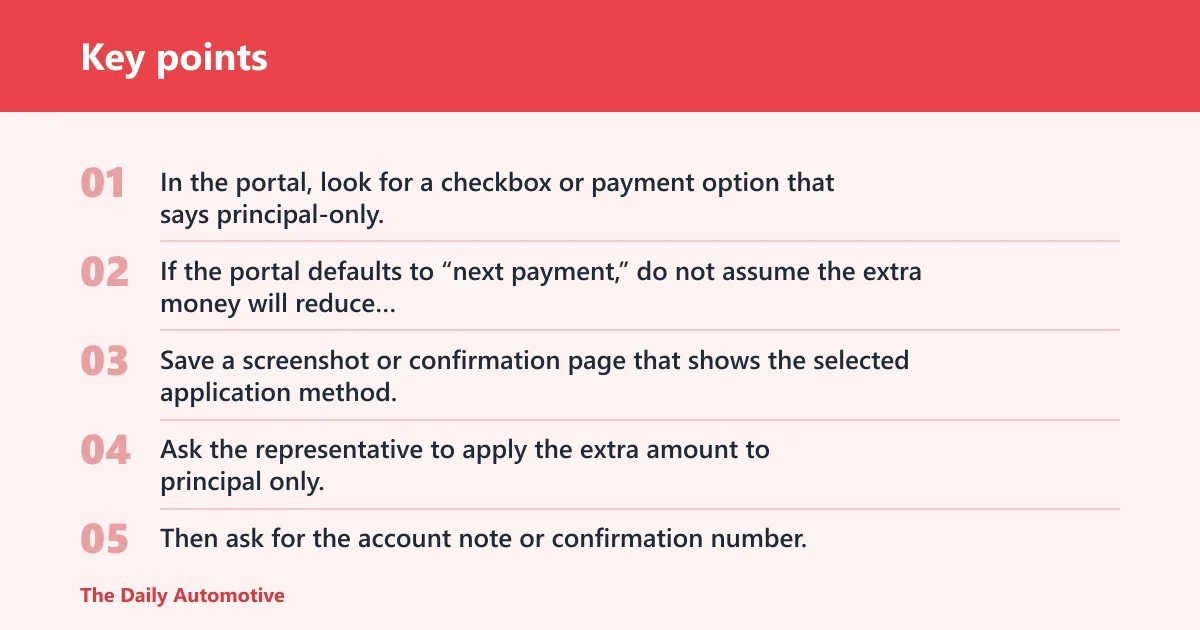
In the portal, look for a checkbox or payment option that says principal-only, extra principal, or additional principal. If the portal defaults to “next payment,” do not assume the extra money will reduce interest. Save a screenshot or confirmation page that shows the selected application method.
What to say on the phone
Ask the representative to apply the extra amount to principal only, not to future scheduled payments. Then ask for the account note or confirmation number. If the lender cannot clearly state how the extra funds will post, do not send the payment until you get written instructions.
What to put in writing
Send a short written instruction with the payment if the lender accepts it. State the account number, the amount, and that the excess should be applied to principal only. Keep a copy, because that document can help if the payment posts the wrong way.
A common mistake is mailing an extra payment, such as about $500, on a car loan and assuming the lender will automatically apply it to principal instead of holding it for the next payment. If the lender posts it as the next monthly payment instead, the payoff date may not move much. The next statement should show the principal reduction, not just a prepaid installment balance.
What to check on the next statement
Verify that the principal balance fell by the extra amount, minus any interest that accrued before posting. Also check that the payment was not split across future installments. If the statement does not match the instruction, contact the lender quickly and keep every record.
How to get a payoff quote
Request the quote directly from the lender and ask for the exact amount to close the account on a specific date. The quote should list the payoff balance, accrued interest through the good-through date, any fee, the expiration date, and the exact address or payment method to use.
- Ask for the payoff amount on the date you expect payment to arrive.
- Confirm whether a prepayment fee appears in the quote.
- Check the good-through date and whether weekends or holidays change posting.
- Verify the mailing address, wire instructions, ACH details, or portal path.
- Ask what happens if payment arrives late or short.
What can go wrong?
If the payment arrives after the good-through date, the quote can expire and the lender may add more interest. If it goes to the wrong address, the loan can stay open even though you sent the money. Both problems are avoidable if you verify the address and deadline before paying.
Will early payoff hurt credit?
Usually not in any lasting way. Paying off an installment loan can cause a small temporary dip because the account closes, but that effect is generally limited and temporary. The larger issue is cash flow: if payoff empties your emergency fund, keeping the loan a little longer may be the safer move.
When keeping cash may be smarter
If paying off the car would leave you with little or no emergency reserve, holding onto cash can matter more than shaving a few months of interest. A loan that costs a bit more may still be the better decision if it protects rent, utilities, or repair money.
How to weigh payoff against your emergency fund
Compare the after-fee savings from early payoff with the cash you would lose access to. If the savings are modest and the payoff would leave you exposed to one repair bill, keep the reserve. If the savings are clear and the fund stays intact, early payoff is easier to justify.
Frequently asked questions
Can I pay off my car loan early without a penalty?
Often yes, especially on standard simple-interest auto loans. But check the signed contract and the Truth in Lending disclosures before paying. Some subprime and buy-here-pay-here loans do include a prepayment penalty, and some state laws limit whether that fee can be enforced.
Will paying off my car loan early hurt my credit score?
It usually does not harm credit long term. A small temporary dip can happen when an installment account closes, but that effect is typically limited. If the payoff would drain your emergency fund, keeping some cash available may matter more than closing the loan immediately.
Products related to this article
Sponsored / affiliate links. As an Amazon Associate I earn from qualifying purchases. I may earn additional commission from eligible campaigns.
 Air compressor for tires that work off car outlet,Fit for BMW I3 (2013-2025),Suitable for BMW I3 150PSI portable tire inflator,12V DC compact air compressor
 Scosche Bluetooth FM Transmitter for Car Radio, Bluetooth Car Adapter with 20W USB-C Fast Car Charger and Aux Port for Wireless Music Streaming, Hands-Free Calls, Siri and Google Assistant