Pirelli Cinturato Tire Review for Commuters
For commuters, WeatherActive is the stronger Cinturato choice for rain-heavy daily driving and long highway stretches. P7 Blue fits better if lower rolling resistance matters more than all-season flexibility. Pick the wrong one, and you may give up wet-road confidence, cabin quiet, or value for the money.
Verdict for commuters

WeatherActive is the safer default for a commuter who wants one tire for mixed rain, steady highway use, and occasional cold snaps. P7 Blue fits a narrower job, efficient sedan commuting where wet grip matters, but all-weather flexibility does not. Bike commuters have a separate choice between Velo and Road based on setup and puncture needs.
The higher price makes more sense when you cover serious mileage, care about rain performance, and want fewer compromises at speed. It makes less sense for low-mileage drivers who mainly want the cheapest replacement that still handles basic commuter duty.
Say your commute is 55 miles a day on wet interstate lanes and broken suburban pavement. WeatherActive fits that brief because its focus is comfort, noise control, and wet-road confidence. A city driver covering only a few thousand miles a year may never recover the extra cost in fuel or tread-life savings.
Commuter fitment matrix
This matrix separates the Cinturato lineup by commute type first, then by model. Use it as a quick filter before you check your exact size, load index, speed rating, and the manufacturer listing for your vehicle.
| Model | Wet-climate priority | Highway miles per week | Expected comfort | Noise risk | Winter fallback need | Best-fit size range | Recommendation score | Skip if |
|---|---|---|---|---|---|---|---|---|
| WeatherActive | High | Moderate to high | Comfort-focused | Low to moderate | Low to moderate | Passenger-car commuter sizes; check the listing for your model | 9/10 for rain-heavy commuters | You want the lowest buy-in price or drive very little each year |
| P7 Blue | Moderate to high | High | Firm, efficiency-led | Moderate | High | 235/45R17-type sedan fitments are common in this class; check the listing for your model | 8/10 for efficient highway commuters | You need winter flexibility or want a tire centered on ride softness |
| Velo | High for rain-prone bike commuting | Bike commute mileage | Moderate | Low | High if you ride year-round | 700c x 26mm, 28mm, 32mm, 35mm | 8/10 for daily road-bike commuting | You need a simple tube-type setup or want maximum puncture defense |
| Road | Moderate to high | Bike commute mileage | Stable | Low | High if roads are rough and wet | 26mm, 28mm, 32mm, 35mm | 7/10 for tough, tube-type commuting | You need tubeless compatibility |
WeatherActive by commute type
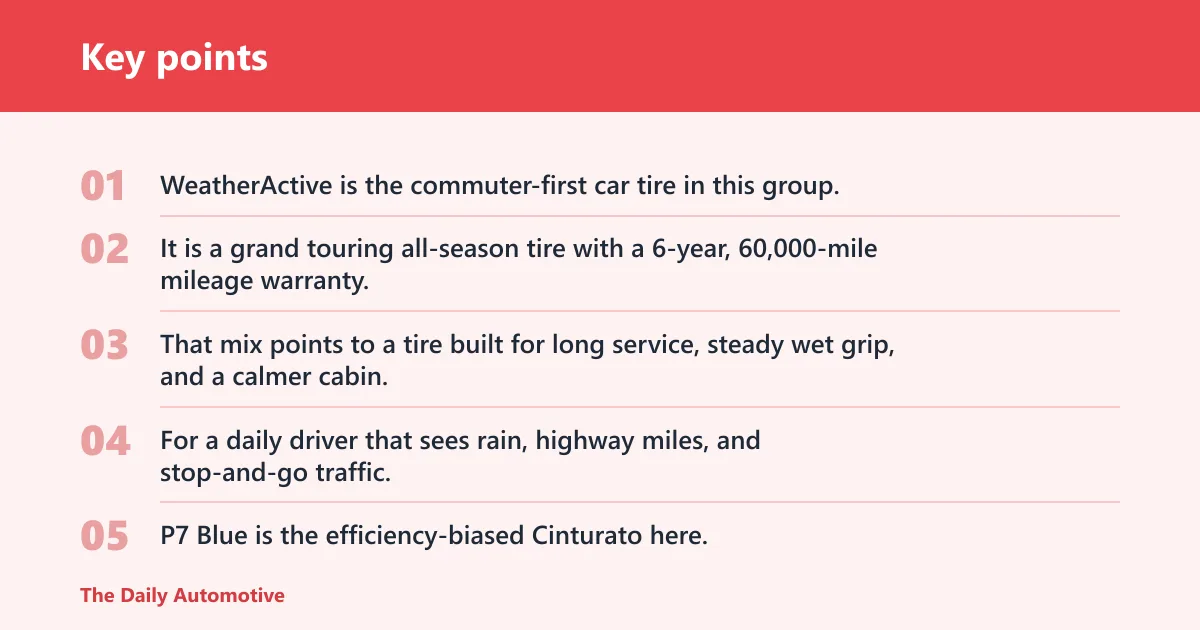
WeatherActive is the commuter-first car tire in this group. It is a grand touring all-season tire with a 6-year, 60,000-mile mileage warranty, a UTQG treadwear rating of 700, a UTQG traction rating of A, and a UTQG temperature rating of A. TireGrades describes it as premium priced.
That mix points to a tire built for long service, steady wet grip, and a calmer cabin. For a daily driver that sees rain, highway miles, and stop-and-go traffic, those are the traits that matter most.
P7 Blue by efficiency and sedan fitment
P7 Blue is the efficiency-biased Cinturato here. TireAdvise calls it eco-focused, and the design centers on reduced rolling resistance with wet grip emphasis. The price range in the US is about $140 to $200 per tire, and the tire is recommended for sedans, compact cars, and hybrid or electric vehicles.
It was tested in 225/45R17 on a 2022 Honda Accord, and the tread pattern is asymmetric. That size context matters because it shows where the tire tends to land: mainstream commuter sedans that want efficiency without giving up rain control.
Velo and Road for bike commuting
Velo is the more flexible road-bike option. It is commonly reported to use a 60 TPI casing and Armour Tech casing, and it is available in several 700c widths. BikeRadar describes it as a tubeless tyre, and it is also compatible with hooked rims.
Road is the tougher tube-type choice. It uses bead-to-bead puncture protection, comes in 26mm, 28mm, 32mm, and 35mm sizes, and Cycling Weekly says it is not tubeless compatible. If your commute includes rough shoulders, debris, or mixed weather, that puncture focus matters.
Skip-if flags and fitment checks
Skip WeatherActive if your annual mileage is low enough that premium pricing will be hard to recover. Skip P7 Blue if you need winter fallback or want a softer ride over sharp expansion joints. For either car tire, check the manufacturer’s listing for your exact load index and speed rating before you buy.
A common first-timer mistake is picking a commuter tire based only on a mild-looking sidewall instead of checking wet-grip ratings and noise levels. A 225/45R17 commuter sedan and a different trim of the same car can call for different ratings, so the fitment line on the sidewall matters as much as the model name.
Is WeatherActive good for daily commuting?
Yes, WeatherActive is a strong daily commuter pick when rain, highway time, and comfort all matter. The 60,000-mile warranty and UTQG 700 treadwear rating point to long life, while the UTQG traction A and temperature A ratings show a tire built to handle ordinary commuter duty without feeling fragile.
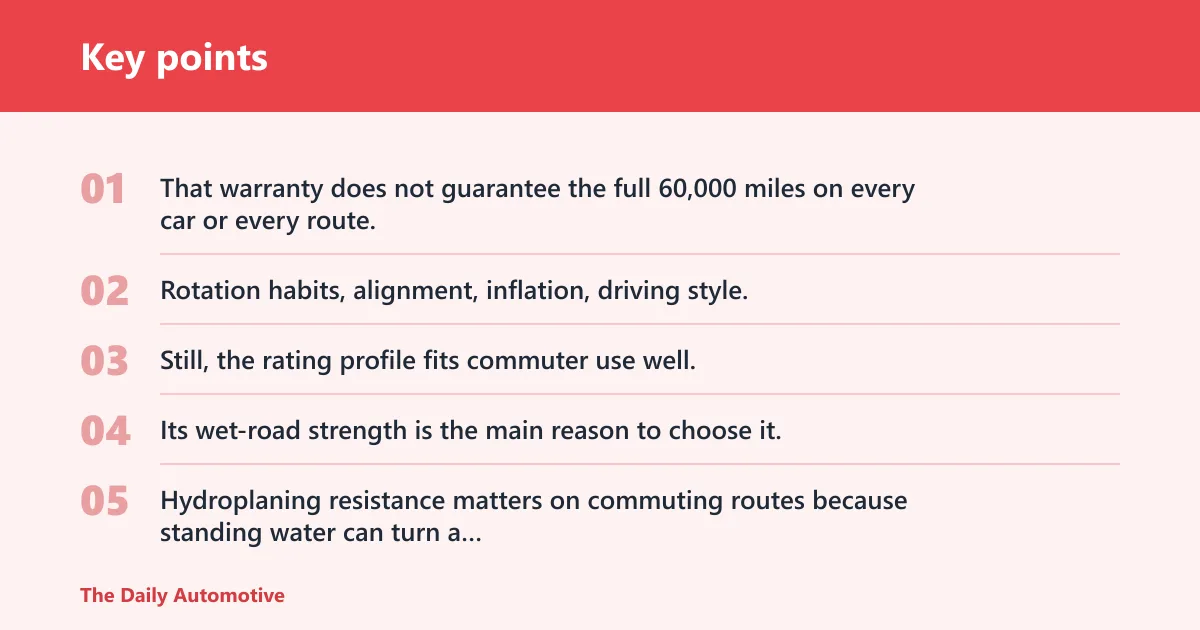
That warranty does not guarantee the full 60,000 miles on every car or every route. Rotation habits, alignment, inflation, driving style, and vehicle weight all affect tread life, so commuters who neglect maintenance will see shorter service. Still, the rating profile fits commuter use well.
Its wet-road strength is the main reason to choose it. Hydroplaning resistance matters on commuting routes because standing water can turn a routine lane change into a loss of steering feel. A tire that keeps its contact patch steadier in rain is worth paying for when bad weather is frequent.
The ride focus is clear too. WeatherActive is built around comfort and noise, so it suits drivers who spend long stretches at steady speed. That said, the premium price is harder to justify if your commute is short, slow, and dry for most of the year.
What the warranty means in practice
The mileage warranty is a value signal, not a guarantee of identical wear across all vehicles. If your car needs frequent rotations or has alignment sensitivity, the warranty is still useful, but it does not replace maintenance. Follow the vehicle manual for inflation, rotation, and alignment checks.
Wet traction and heavy rain
Wet traction is one of WeatherActive’s main reasons to exist. For commuters, the practical question is not whether a tire feels sporty in the dry. It is whether braking, lane changes, and merging remain predictable when the road is glossy and the water is deep enough to matter.
Some Cinturato sizes may also carry an EU wet grip label A. That label is useful for rain-focused commuting, but it is size-specific, so you should check the exact listing for the tire you plan to buy.
Noise and highway use
Highway noise should be manageable rather than annoying for most buyers in this category. WeatherActive is tuned for comfort and noise control, but no commuter tire is silent, and cabin sound will still depend on pavement texture, vehicle insulation, and inflation pressure.
If your current tires drone on coarse pavement, WeatherActive is the kind of upgrade that can reduce that background hum. If your car already has a quiet cabin and you drive little, the improvement may be smaller than the price jump.
Is P7 Blue the better commuter pick?
P7 Blue is the better commuter pick when efficiency matters more than all-weather flexibility. Its eco-focused design and reduced rolling resistance suit drivers who want to keep fuel use in check and who spend a lot of time on steady-speed roads. It also fits sedans, compact cars, hybrids, and EVs well.
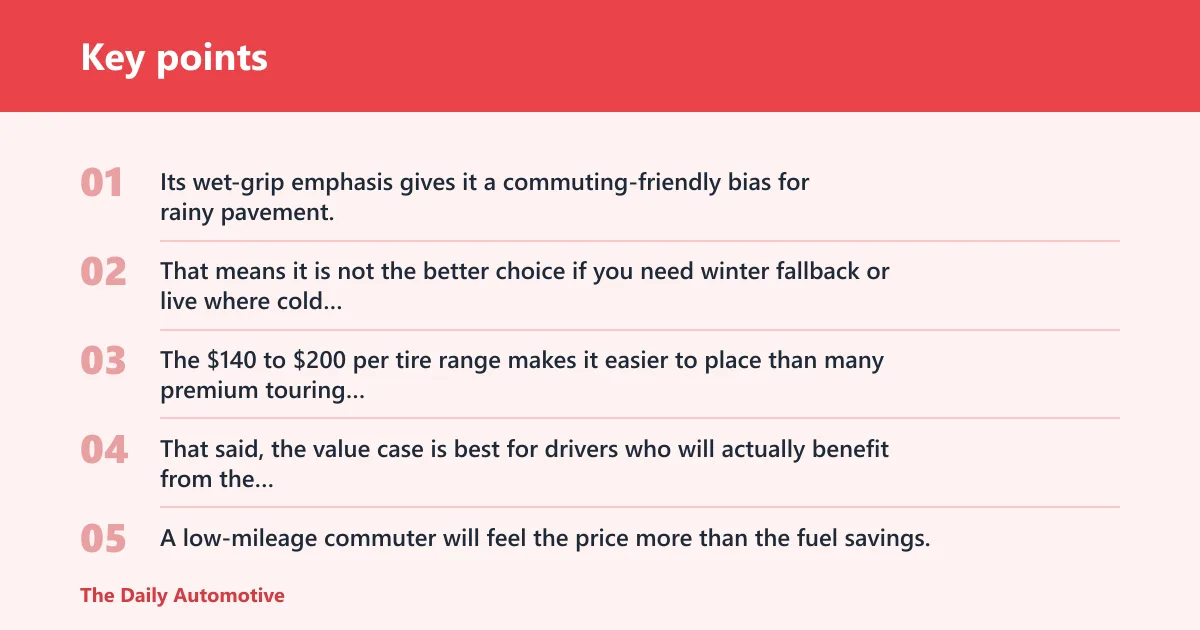
Its wet-grip emphasis gives it a commuting-friendly bias for rainy pavement, but it is still the summer tire in this comparison. That means it is not the better choice if you need winter fallback or live where cold snaps and slush are part of the route.
The $140 to $200 per tire range makes it easier to place than many premium touring options. That said, the value case is best for drivers who will actually benefit from the rolling-resistance focus. A low-mileage commuter will feel the price more than the fuel savings.
Where the eco focus matters
Reduced rolling resistance can help when your commute is long and repetitive. It is most useful for highway-heavy or mixed suburban routes where the car stays in motion for long periods. That is why the P7 Blue makes sense for efficient commuter sedans and many EV or hybrid applications.
Why some sizes may carry EU wet grip label
EU wet grip label A is a useful shorthand, but it does not apply to every size. For rain-heavy commuting, the label matters because it helps narrow the search to the versions that place more emphasis on wet-road benchmark performance. Check the listing for the exact size you need.
When WeatherActive beats P7 Blue
WeatherActive is the better all-around commuter tire if your route is wet, your driving is regular, and comfort matters. P7 Blue makes more sense if your route is mostly dry, your car is a sedan or compact, and fuel economy or reduced rolling resistance matters more than winter fallback.
For a commuter who wants one set of tires to handle more situations, WeatherActive is the safer buy. For a driver who wants a more efficiency-led summer setup, P7 Blue is the sharper fit.
Can bike commuters use Velo or Road year-round?
Yes, but they suit different riders. Velo is the more adaptable road-bike option because it is tubeless and hooked-rim compatible, while Road is the tube-type option built around bead-to-bead puncture protection. Both can work for year-round commuting if the route, wheel setup, and weather match the tire.
Velo comes in 700c x 26mm, 28mm, 32mm, and 35mm sizes, with a stated weight range of 300g to 420g. Road is available in 26mm, 28mm, 32mm, and 35mm sizes. The right choice depends on whether you value setup flexibility or puncture-focused simplicity.
Velo for mixed-surface commuting
Velo is the stronger pick if you want a commuter tire that can be set up tubeless. The 60 TPI casing and Armour Tech casing are meant to support endurance-oriented road use, and the size range gives you room to choose a wider option for rough pavement or a narrower one for faster rolling.
Road for simple tube-type commuting
Road is the better pick if you prefer a standard tube setup and want bead-to-bead puncture protection. It is designed for all-weather use, but it is not tubeless compatible. That makes it a straightforward choice for riders who value durability and do not want to manage sealant.
Which one fits mixed weather and rough pavement?
For mixed weather, both can work. For rougher pavement, Velo may be easier to tune because of the wider size options and tubeless support. For riders who prioritize puncture defense and a simpler install, Road is the more direct answer.
Suppose your ride home includes broken glass near bike lanes and a frequent wet stretch under an overpass. Road’s puncture protection is the appeal. Suppose you want lower-pressure comfort on the same route and are willing to run tubeless. Velo is the more adaptable option.
Pros and cons
Pros
- WeatherActive has a clear commuter brief: wet grip, comfort, and long wear.
- P7 Blue suits efficient sedan, hybrid, and EV commuting.
- WeatherActive’s 60,000-mile warranty gives value context for high-mile drivers.
- Velo and Road give bike commuters two distinct setup paths.
- Some Cinturato sizes may carry EU wet grip label A, which helps rain-focused buyers.
Cons
- WeatherActive’s premium pricing is hard to justify for low-mileage drivers.
- P7 Blue is less flexible if winter fallback matters.
- Wet grip labels and fitment details vary by size, so you must check the exact listing.
- Road is not tubeless compatible.
- Noise and ride quality still depend on the car, road surface, and inflation pressure.
Who it’s for
Highway-heavy commuters: WeatherActive is the better fit if you want calm road manners, rain confidence, and a warranty-backed tread life story. P7 Blue is a stronger choice only if fuel-saving bias matters more than all-season flexibility.
Wet-climate city drivers: WeatherActive is the cleaner buy because its comfort and wet-road emphasis match stop-go rain use. If your climate is wet but mild and you drive a sedan, P7 Blue can still fit the brief.
Budget-sensitive low-mileage drivers: Skip the premium path unless you will actually use it. A cheaper tire can make more sense if the car sees limited annual miles and mostly short, dry trips.
Bike commuters: Velo suits riders who want tubeless flexibility and size choices. Road fits riders who want a tube-type tire with bead-to-bead puncture protection and do not need tubeless compatibility.
Frequently asked questions
How long does the Pirelli Cinturato WeatherActive last?
WeatherActive carries a 6-year, 60,000-mile mileage warranty, which is the best durability clue in the listing. Actual tread life depends on rotation, alignment, inflation, and driving style, so commuters should treat the warranty as a guide, not a promise of identical wear on every vehicle.
Is the Pirelli Cinturato noisy on the highway?
WeatherActive is built with comfort and noise in mind, so highway noise should be a lower concern than on some less refined commuter tires. Still, road texture, wheel size, and cabin insulation can change the result. Quietness is a tendency here, not a guarantee.
Does the Pirelli Cinturato have good wet traction in heavy rain?
Yes, that is one of the main reasons to consider it for commuting. WeatherActive has UTQG traction A, and some sizes may also carry an EU wet grip label A. For heavy rain, hydroplaning resistance and predictable braking matter as much as dry grip.
Is the Pirelli Cinturato worth the premium price?
It is worth it for drivers who spend real time in rain, highway traffic, or long daily routes and want a tire that leans toward comfort and durability. It is a weaker value for low-mileage owners who will not benefit much from the warranty or the premium construction.
Which Pirelli Cinturato tire is best for commuting: P7 Blue or WeatherActive?
WeatherActive is the better all-around commuter tire for most drivers because it offers wet-weather confidence, comfort, and longer-wear positioning. P7 Blue is the better pick if you want an efficiency-first commuter tire for a sedan, compact car, hybrid, or EV and can live with a summer-tire setup.
Is the Pirelli Cinturato Velo good for year-round commuting on a bike?
Yes, if your route and setup match its design. Velo is an all-season road bike tire with 60 TPI casing, Armour Tech casing, tubeless compatibility, hooked-rim compatibility, and 700c x 26mm, 28mm, 32mm, and 35mm sizes. It suits riders who want flexible year-round use.
Products related to this article
Sponsored / affiliate links. As an Amazon Associate I earn from qualifying purchases. I may earn additional commission from eligible campaigns.