Comprehensive vs Collision: Which Coverage Do You Need?
Keep comprehensive if theft, hail, flood, fire, or animal strikes would be hard to pay for. Keep collision if your car is worth more than about 10 times the annual cost of the coverage, or if you still owe money on it. Dropping the wrong one can leave you paying thousands after a crash or non-crash loss. This guide shows how to choose comprehensive, collision, both, or neither based on vehicle value, financing, and local risk.
| Factor | Comprehensive | Collision | Winner |
|---|---|---|---|
| Loss type | Non-collision losses such as theft, vandalism, weather, fire, falling objects, and animal strikes | Crashes with vehicles or objects, plus rollovers and single-car crashes | Tie |
| Fault matters for payment | No | No | Tie |
| Typical annual cost | About $421 per year on average | About $473 per year on average | Comprehensive |
| Typical lender or lease pressure | Often required on financed or leased vehicles | Often required on financed or leased vehicles | Tie |
| Best fit | Cars exposed to theft, hail, flood, fire, or animal strikes | Cars with meaningful crash exposure or higher replacement risk from impacts | Tie |
That table is the short version. Comprehensive and collision solve different problems, and neither pays for damage to someone else’s car or property. Liability insurance does that, and most states require it.
Comprehensive vs collision: the core trade-off
Comprehensive covers non-collision physical damage. Collision covers crash-related damage to your own vehicle, even when you are at fault. If you want protection for both weather and impact losses, you usually need both; if one risk dominates and the other is small, you may not need both.
What each coverage pays
Comprehensive coverage is commonly reported to pay for theft, vandalism, weather events, fire, falling objects, and animal strikes. Collision usually pays for damage from accidents with another vehicle, a pole, a guardrail, or a rollover. Both are limited by the vehicle’s actual cash value if the car is totaled.
Say your parked SUV gets hail dents during a storm. That is the kind of loss comprehensive is built for. Suppose the same SUV slides on ice and hits a guardrail; that is collision, even if nobody else was involved.
What neither coverage pays
Neither comprehensive nor collision typically pays for damage you cause to other people’s vehicles or property. Neither usually pays for injuries to others, either. Liability insurance is the part of an auto policy that handles those claims, and state law usually requires it.
That split matters when you are choosing coverage. If your worry is “Who pays for my car?”, comprehensive and collision are the relevant pair. If your worry is “Who pays for the other driver?”, liability is the coverage you need to check first.
Where liability fits
Liability insurance sits outside the comprehensive-versus-collision decision. It covers the harm you cause to others and is the baseline coverage in most states. Comprehensive and collision are about damage to your own vehicle, and they are usually optional unless a lender or lessor requires them.
Do not treat “full coverage” as a formal policy name. In common use, it usually means liability plus comprehensive and collision, but insurers and lenders may use the phrase differently.
Coverage decision matrix
The right choice depends on vehicle value, whether the car is financed or leased, where it is parked, how much local loss risk you face, and how much deductible risk you can absorb. A newer car in a storm-prone area points one way; an older paid-off car in a low-risk garage points another.
| Scenario | Key facts | Recommended choice | Why |
|---|---|---|---|
| New lease, street parking | High vehicle value, lessor requires physical damage coverage, exposed to theft and weather | Both | Lease terms often require comprehensive and collision together |
| Paid-off 12-year-old sedan, garage parking | Low value, low theft exposure, modest crash exposure, deductible feels large relative to value | Drop both | Actual cash value may be too low to justify keeping both coverages |
| Financed crossover, suburban driveway | Loan balance remains, moderate weather risk, normal crash exposure | Both | Auto lenders often require both coverages on financed vehicles |
| Paid-off pickup, rural parking | Higher animal-strike risk, hail risk, low loan pressure, owner wants protection from non-collision loss | Comprehensive only | Comprehensive covers the non-collision risks that matter most here |
| Older coupe, heavy commuting | Paid off, still driven daily, crash exposure matters more than weather risk | Collision only | Collision protects against crash damage when the car still has enough value to justify it |
Vehicle value and total-loss exposure
Actual cash value is the usual payout cap for comprehensive and collision. If your car is totaled, the insurer generally pays up to that value, not what you paid for the car or what it costs to replace it with a newer one. When that value falls low enough, even a modest deductible can swallow a large share of the claim.
A common first-timer mistake is keeping both coverages only because the premium is “not that high.” Premium alone is not the test. The better question is whether the likely payout after deductible still matters enough to protect you from a major out-of-pocket loss.
Loan or lease requirements
Both comprehensive and collision are typically required by an auto lender. Lease contracts often require both as well, because the lessor still has a financial stake in the car. Gap insurance may help in some total-loss situations, but it does not replace physical damage coverage.
That means financing changes the answer. If you still owe money on the car, dropping either coverage can leave you exposed to a claim payment that does not fully clear the loan. Check the contract before you cut coverage.
Parking, theft, weather, and road risk
Comprehensive matters more when the car sits outside, is parked in a theft-prone area, or faces hail, flooding, falling branches, or animals on the road. Collision matters more when you drive often, park in tight spaces, or have a meaningful chance of hitting another vehicle or object.
Do not overread parking-lot damage. Some parked-car impacts are collision claims, not comprehensive claims, depending on what hit the car and how the policy is written. Read the collision wording before assuming every lot ding fits comprehensive.
Deductible tolerance and claim size
Both coverages have separate deductibles, and you can choose them independently on many policies. Progressive lists deductible choices for both as usually between $100 and $2,000. Higher deductibles generally reduce premium, but they also make small claims easier to absorb on your own.
If your deductible is $1,000 and the repair estimate is $1,250, a claim can leave very little net payment after the deductible and any premium effect. For a small loss, paying out of pocket can be cleaner.
What comprehensive coverage usually handles
Comprehensive coverage usually handles theft, vandalism, weather events, fire, and animal strikes. It also applies to falling objects such as branches or debris. It does not pay for crash damage that belongs under collision.
Theft, vandalism, fire, and weather
These are the standard comprehensive examples. Experian says comprehensive can cover theft, natural disasters, vandalism, and hitting an animal. In practice, hail, flood, and fire claims are common reasons people keep this coverage on older cars that still have value.
If the car lives outdoors in a hail corridor or an area with frequent storm damage, comprehensive often does more work than collision. The same is true if theft rates or vandalism are a local problem.
Animal strikes and falling objects
Animal strikes belong in the comprehensive bucket. So do damage from falling branches, roof debris, and similar non-collision events. That is why a deer strike is usually a comprehensive claim, not a collision claim.
Suppose a branch falls on a parked sedan during a windstorm and caves in the hood. That is comprehensive. If the sedan instead backs into a tree while leaving the driveway, that is collision.
What to check in the policy wording
Policies can vary on specific weather, flood, and object-fall wording. You should check whether the insurer lists flooding, falling objects, and animal strikes plainly in the comprehensive section. If a claim edge case matters to you, read that section before you buy.
What collision coverage usually handles
Collision coverage usually handles vehicle-to-vehicle crashes, impacts with poles or guardrails, and rollovers. It applies regardless of fault. The same source says collision insurance applies if you hit another car or a stationary object.
Vehicle-to-vehicle crashes
Rear-end crashes, side-swipes, and intersection impacts are collision claims when your own vehicle is damaged. Fault changes who pays and whether your premium may be affected, but it does not decide whether collision coverage responds.
That distinction matters. If another driver caused the crash, their liability insurance may reimburse you, but your own collision coverage can still pay faster while the claim works through fault and recovery.
Poles, guardrails, and other objects
Collision also handles impacts with stationary objects. That includes a pole, a barrier, a wall, or a tree if your vehicle hits it. Single-car slide-offs belong here too when the damage came from impact or rollover.
That is why collision matters even for careful drivers. Not every repair comes from another driver’s mistake. Some come from ice, a tight turn, or a brief lapse in judgment.
Rollovers and single-car crashes
Rollovers are part of collision coverage. So are many single-car crashes, from ditch drops to curb impacts with enough force to damage the suspension or body. If the loss came from the car striking something, collision is the usual fit.
How deductibles and actual cash value work
Comprehensive and collision each have their own deductible, and the numbers do not have to match. The payout is then limited by the car’s actual cash value if the vehicle is totaled. That means you can have a $250 comprehensive deductible and a $1,000 collision deductible on the same policy.
Separate deductibles for each coverage
One deductible can be lower than the other. A driver may choose a low comprehensive deductible if hail or theft risk is high, while keeping a higher collision deductible to control premium. The reverse can also make sense when crash exposure matters more than weather risk.
Higher deductibles generally lower premium. That trade-off is useful only if you can comfortably pay the deductible when a loss happens.
Why actual cash value caps payment
If the repair bill or total-loss value exceeds actual cash value, the insurer generally does not pay beyond that cap. That is why older cars can reach a point where the premium and deductible make the coverage less useful than it used to be.
This is the part many shoppers miss. Coverage limit, deductible, and actual cash value are different things. The deductible comes off the claim payment; the actual cash value sets the top end of what can be paid for the vehicle itself.
When a claim is too small to file
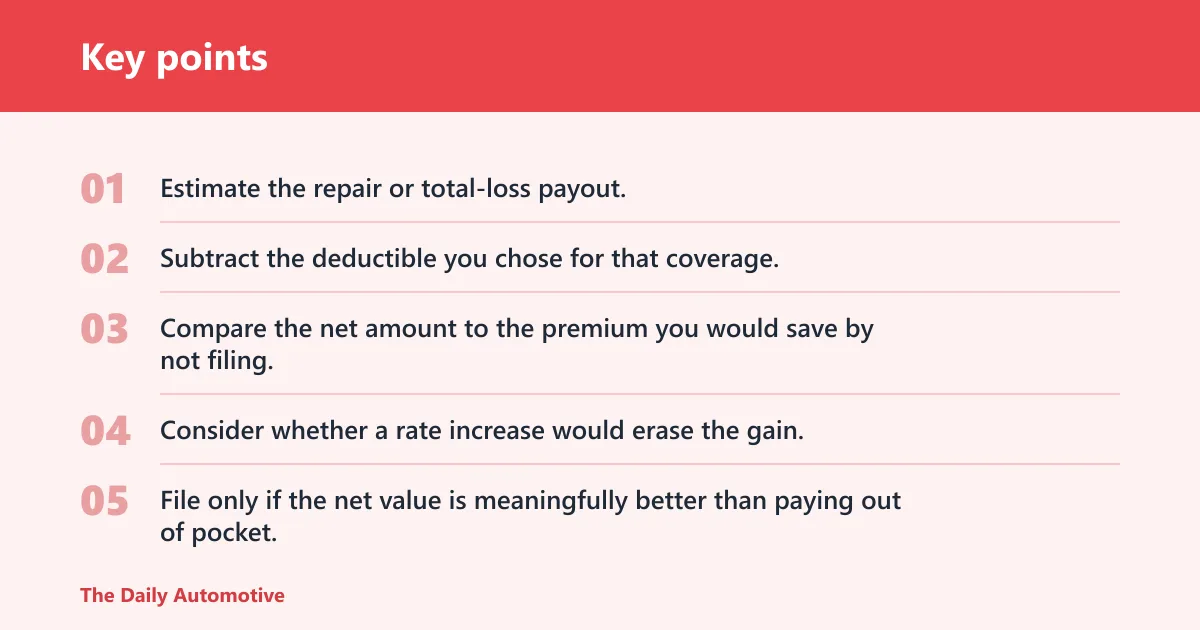
A claim may not be worth filing when the repair estimate barely exceeds the deductible. A small claim can also be a poor trade if the potential rate increase or surcharges outweigh the benefit of the payout. In that case, paying the repair yourself may cost less over time.
- Estimate the repair or total-loss payout.
- Subtract the deductible you chose for that coverage.
- Compare the net amount to the premium you would save by not filing.
- Consider whether a rate increase would erase the gain.
- File only if the net value is meaningfully better than paying out of pocket.
Choose Comprehensive if… / Choose Collision if…
Choose comprehensive if your bigger risk is theft, hail, flood, fire, falling objects, or animal strikes, and you could not comfortably replace the car on your own. Choose collision if the car still has enough value to justify crash protection and you drive enough that hitting another vehicle or object is a real concern. Many drivers need both; older paid-off cars may need neither.
Choose comprehensive if…
Choose comprehensive only if non-collision losses are the main threat. That usually fits cars parked outside, vehicles in hail-prone or theft-prone areas, and drivers who would struggle to cover a weather or animal loss out of pocket. It also fits owners who want protection from a covered loss that is not tied to fault.
Choose collision if…
Choose collision only if crash damage is the main risk and the car still has enough actual cash value to justify paying for that protection. That is common for drivers with a newer paid-off car, a meaningful commute, or a loan that is close to being paid down but not gone yet.
Choose both if…
Choose both if the car is financed or leased, or if both crash and non-collision losses would hurt. That is the most common answer for newer cars. It is also the safer choice when the vehicle still has enough value that a total loss would be expensive to replace.
Drop both if…
Drop both if the car is older, paid off, and the cost of repairing or replacing it would not justify the premium plus deductible risk. That choice is most reasonable when the car’s actual cash value is low, it is parked safely, and you could absorb the loss without throwing your budget off track.
Is comprehensive or collision worth it?
It is worth it when the likely payout after the deductible is large enough to matter and the chance of loss is real enough to justify the premium. It is not worth it when the deductible, small payout, and possible rate effect make the claim look thin. Financing often changes the answer because the lender may require both anyway.
Break-even checklist for claim size versus deductible
Use this short test before you keep or drop coverage:
- Estimate the car’s actual cash value.
- Check the deductible for comprehensive and collision separately.
- Ask whether the likely loss is bigger than the deductible by a useful margin.
- Compare the premium you pay each year to the size of the loss you want protected.
- Factor in the chance that filing a small claim could affect future pricing.
For example, if a $900 repair would trigger a $1,000 deductible, the coverage does almost nothing for that loss. If a storm or crash could produce a $4,000 bill, the same deductible may be perfectly reasonable.
How rate increases can change the math
Even a small claim can have a long tail if it affects future pricing. That does not mean you should never file. It means the deductible is not the whole story, and a claim that looks barely worth filing can become a poor deal after pricing effects are included.
When financing changes the answer
If the car is financed or leased, the answer often shifts toward keeping both coverages regardless of the break-even math. The lender or lessor usually gets the first say. If your contract requires physical damage coverage, dropping it can violate the agreement even if the car itself is old enough to seem expendable.
Frequently asked questions
What is comprehensive vs collision insurance?
Comprehensive covers non-collision losses such as theft, vandalism, weather, fire, falling objects, and animal strikes. Collision covers damage from crashes with vehicles or objects, including rollovers. Neither pays for other people’s injuries or property damage; liability insurance handles that part.
What’s the difference between comprehensive and collision deductible?
Each coverage has its own deductible, and they can be different. The comprehensive deductible applies to covered non-collision losses, while the collision deductible applies to crash damage. Higher deductibles usually lower premium, but they also increase what you pay when a claim happens.
Does full coverage include comprehensive and collision?
Usually, yes. In common insurance language, “full coverage” is not an official product name; it usually means liability plus comprehensive and collision. Insurers and lenders may use the phrase loosely, so it is safer to check the actual policy declarations page.
Do I need both comprehensive and collision insurance?
You often need both if the car is leased or financed, because lenders typically require them. If the car is paid off, the decision depends on vehicle value, parking exposure, local theft or weather risk, and whether a crash or non-collision loss would be hard to pay for.
How do comprehensive and collision deductibles work?
You choose a deductible for each coverage, and the insurer subtracts that amount from a covered claim payment. If the repair bill is near the deductible, the claim may not be worth filing. If the vehicle is totaled, actual cash value still caps the payout.
How much do comprehensive and collision coverage cost?
The same source says comprehensive insurance costs about $421 per year on average, and collision insurance costs about $473 per year on average. Your price can be higher or lower depending on the car, where it is garaged, your deductible choice, and your driving record.
Products related to this article
Sponsored / affiliate links. As an Amazon Associate I earn from qualifying purchases. I may earn additional commission from eligible campaigns.