Does Shopping for Car Loans Hurt Your Credit Score?
Yes, auto loan rate shopping can hit your credit, but scoring models may group similar inquiries for scoring within a limited shopping window that can vary by model, and lenders may use older FICO versions. Miss that window, and extra hard pulls can trim points off your score and raise borrowing costs. This guide explains how to compare lenders, work with dealers, and limit credit hits while you shop.
This guide is part of our Car Dealer Money Guide: Negotiating, Financing, Leasing, Trading In and Selling series.
Hard inquiries versus missed payments
Usually, yes, but only a little. A formal auto-loan application can trigger a hard inquiry, and that inquiry can cause a temporary score drop. The size of the drop varies by credit profile and scoring model. The bigger issue is timing: if you spread applications out, lenders may see more than one separate credit check.
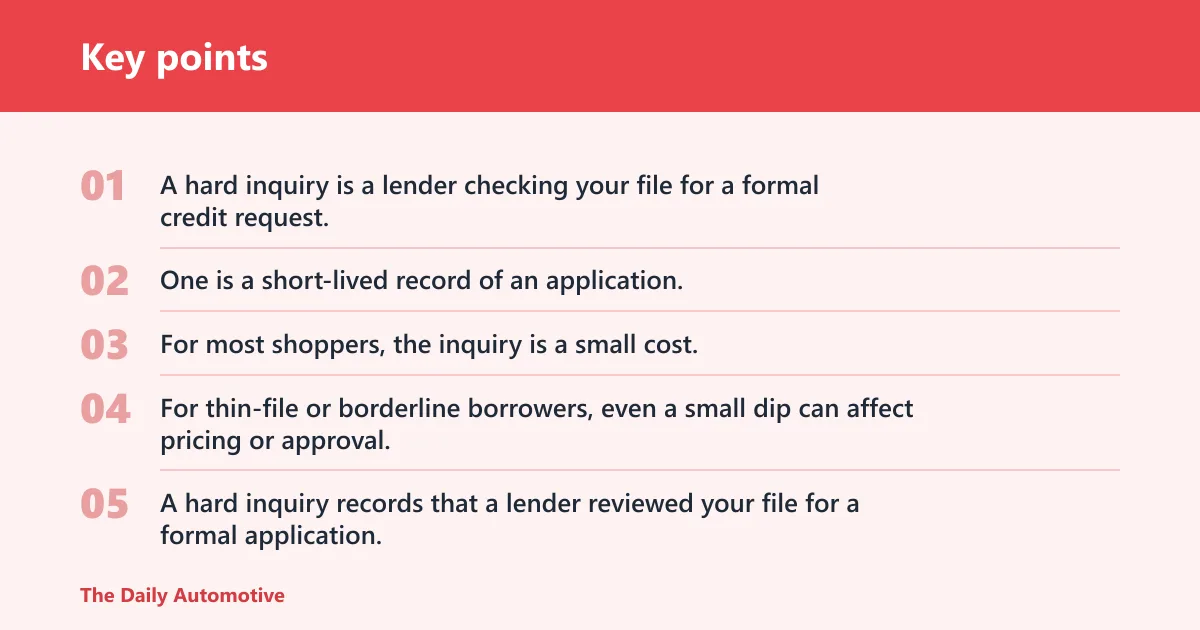
A hard inquiry is a lender checking your file for a formal credit request. It is not the same as a missed payment. One is a short-lived record of an application, while the other is a repayment failure that can damage scores for years. For most shoppers, the inquiry is a small cost. For thin-file or borderline borrowers, even a small dip can affect pricing or approval.
Why a hard pull is not the same as a payment miss
A hard inquiry records that a lender reviewed your file for a formal application. It can stay on a credit report for up to two years. A missed payment is different: once a payment reaches 30 days past due, it can be reported to credit bureaus, and that late mark can remain for seven years.
That difference matters because credit models weigh behavior, not just application activity. Payment history makes up 35% of a FICO Score. Amounts owed make up 30%, and length of credit history makes up 15%. One application is a small event. A late payment is a major one.
When the damage matters more for borderline borrowers
Prime shoppers often have room for a brief score dip. Thin-file buyers, near-prime borrowers, and people rebuilding credit may not. A small drop can shift an auto rate tier, change a lender’s decision, or reduce room to negotiate at the finance office.
Picture a shopper with a 680 score and thin credit history. A few points may not sound like much, but if the lender’s cutoff sits nearby, that drop can change the offer. The score impact is still small. The approval impact may not be.
Soft pulls vs hard pulls
Prequalification usually uses a soft inquiry, which does not affect credit scores. A formal loan application usually triggers a hard inquiry. At a dealership, those two steps can happen close together, so you need to know which one the finance office is using before you hand over consent.
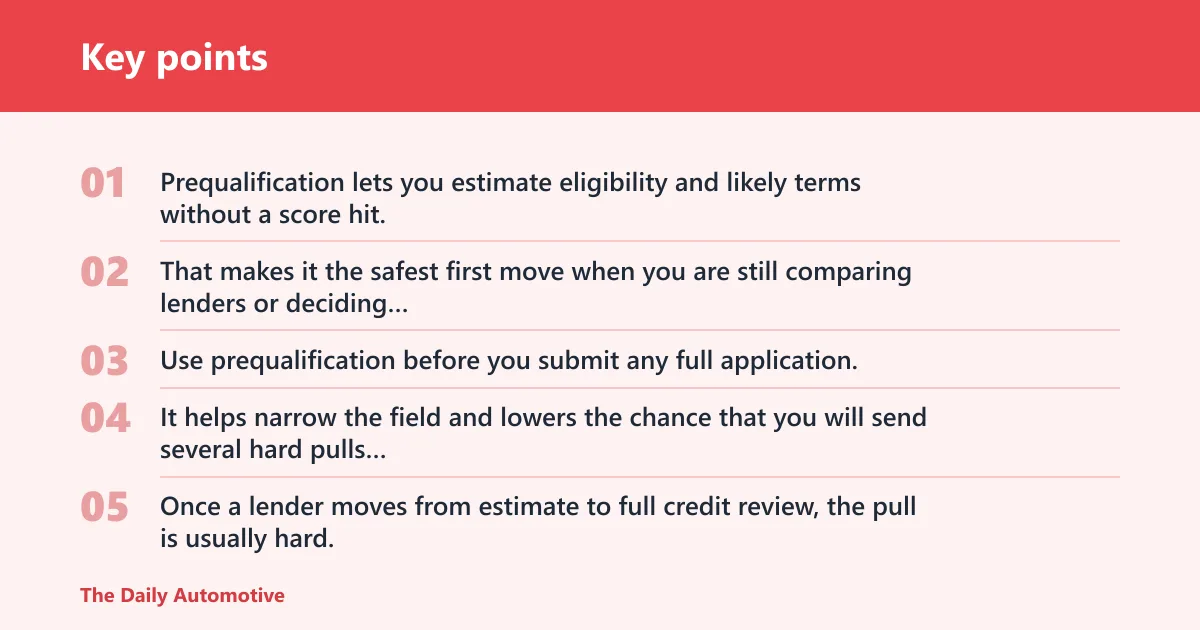
Prequalification usually uses a soft inquiry
Prequalification lets you estimate eligibility and likely terms without a score hit. That makes it the safest first move when you are still comparing lenders or deciding whether dealership financing is competitive.
Use prequalification before you submit any full application. It helps narrow the field and lowers the chance that you will send several hard pulls just to get the same basic answer.
Formal applications usually trigger a hard inquiry
Once a lender moves from estimate to full credit review, the pull is usually hard. That is normal. The risk comes from repeated full applications, duplicate submissions, or a dealer sending your file to several lenders after you already approved one offer, especially outside the shopping window.
Ask the finance manager which step is happening. If the application is only for prequalification, it should be soft. If it is a final credit application tied to a specific contract offer, expect a hard inquiry unless the lender says otherwise.
How to ask the dealer which pull was used
Use plain language: ask whether the credit check is a prequalification, a full application, or a lender submission for final approval. Then ask whether the lender used a soft or hard pull. If the answer is unclear, stop and get it clarified before another form is signed.
A common first-timer mistake is signing multiple forms during one dealership visit without checking whether each one authorizes a new inquiry. The paperwork can move fast. The credit hits can move faster.
Rate shopping rules
Rate shopping for the same type of loan can be treated as one event if the applications land within a limited scoring window. For auto loans, some scoring models group similar applications as rate shopping within a short window, but the exact window can vary. That lets you compare offers without taking a penalty for normal comparison behavior.
Why the shopping window matters
The window is what keeps rate shopping from looking like a pile of unrelated borrowing attempts. If you keep applications tight, the models are more likely to bundle them together. If you wait too long, each new hard pull can count on its own.
That matters at a dealership because financing often happens in bursts. A shopper may leave, come back later, and restart the process. If the second round falls outside the scoring window, the file can take another hit.
What happens if you wait too long and reapply
If you pause shopping and reapply later, the system may no longer treat the new application as part of the same rate-shopping event. That means the second round can add another hard inquiry, even if the loan type is unchanged.
Suppose you prequalify on Monday, wait three weeks, and then submit a fresh finance application on a different visit. That later application may not get the same scoring treatment as your first round. The result is simple: more credit checks, more risk.
Car loan credit-safe shopping checklist

Use this checklist before you sign anything at the dealership. It keeps the process focused on one goal: compare offers without creating avoidable hard pulls.
| Action | Likely inquiry type | Credit-risk level |
|---|---|---|
| Prequalify with the lender or dealer before a full application | Soft inquiry | Low |
| Ask whether the finance desk is running a soft pull or hard pull | Depends on the step | Low to moderate |
| Submit full auto-loan applications within the same tight shopping window | Hard inquiry, often grouped as rate shopping | Low to moderate |
| Avoid duplicate submissions to the same lender or repeated resubmits | Multiple hard inquiries possible | Moderate |
| Verify whether each lender used a soft or hard pull before moving on | Check before another pull | Low |
| Stop applying once you have your best offer in hand | No new inquiry if you stop | Low |
Dealer steps to limit duplicate submissions
Bring a short list of lenders you are willing to compare. Ask the dealer to submit only to those lenders and only during the same shopping window. Do not let the file bounce around the finance office after you already have a competitive offer.
Also check the credit authorization language. If a dealer says it will “shop the file,” ask how many lenders will receive it and whether each transmission counts as a new hard pull. That question is worth asking before the first submission, not after the third.
When to stop applying and take the best offer
Stop once you have a rate, term, and payment that fit your budget. Chasing one more quote can cost more in score impact than it saves in interest, especially if the new offer is only a small improvement.
A practical rule: if the next offer is unlikely to beat your current one by enough to matter over the full loan term, stop. One strong offer is better than three extra inquiries and a tired file.
Will the new loan affect your score later?
Yes. A new auto loan can change your score after the contract is signed, even if shopping itself caused only a small dip. The new account can lower the average age of your accounts, and the added debt can affect amounts owed. That is a different effect from the inquiry itself.
Average age of accounts can fall when the loan opens
A new account can lower the average age of your accounts, which can trim scores for a while. This is one reason a fresh loan can cause a temporary score dip even after the approval is final.
That effect is most noticeable when your file is already young. If your credit history is thin, one new auto loan can change the average more sharply than it would on a longer file.
New debt can change amounts owed
Amounts owed make up 30% of a FICO Score. When a loan opens, the new balance and payment obligation change the shape of your credit use. That does not mean the loan is harmful by itself. It means the file has changed.
On-time payments can help over time. The loan only turns into a positive credit signal if the account stays current.
What hurts more than shopping?
A 30-day late payment is a much bigger problem than a hard inquiry. Shopping usually causes a small, temporary dip. A late payment can be reported, stay on the report for seven years, and damage the most important part of the score: payment history.
Why a 30-day late payment is a bigger problem
Payment history is 35% of a FICO Score, so it carries the most weight. A missed payment can hurt credit more than other credit behavior. Once a payment is 30 days late, the account can be reported as delinquent, and that mark can follow the file for years.
That makes the 30-day threshold critical. Being a few days late on a bill is not the same as a 30-day-late report. Once the late mark hits the bureau, the problem becomes harder to undo.
How long late payments can stay on file?
A late payment can stay on a credit report for seven years. That is far longer than a hard inquiry, which can remain for up to two years. If you are choosing which risk to avoid, payment delays deserve more attention than one auto-loan inquiry.
Why payment history outweighs one inquiry
One inquiry may cost a few points for a short time. A late payment can lower scores more deeply and affect future lending decisions. For car shoppers, that means the smartest credit move is not avoiding every inquiry. It is avoiding avoidable late payments while rate shopping efficiently.
How much score impact should you expect?
The impact varies by file strength. A hard inquiry from applying can cause a temporary credit-score drop, but that number is only a general range and can vary widely by credit profile and scoring model. The approval effect can be more meaningful than the score effect if your file is thin or already near a lender cutoff.
Why thin-file and near-prime shoppers should be stricter
Thin-file shoppers have fewer positive accounts to cushion a new inquiry. Near-prime shoppers may sit closer to rate thresholds, so a small drop can matter more. That is why these borrowers should prequalify first and keep full applications tightly grouped.
If you are rebuilding credit, the safest path is simple: prequalify, compare, submit one clean set of full applications, and stop. Spacing out applications can turn a small credit event into a series of avoidable ones.
Why prime shoppers usually have more cushion
Prime borrowers usually have more room for a brief score dip because their files have stronger payment histories and more established accounts. Even then, there is no reason to waste inquiries. The goal is not to be careless because the score can absorb it. The goal is to avoid unnecessary credit checks altogether.
Frequently asked questions
How does shopping for a car loan affect my credit score?
Shopping can cause a small temporary dip if you submit formal applications. Prequalification usually uses a soft inquiry and does not affect scores. If multiple official applications happen within a limited shopping window, scoring may group them as rate shopping, which limits the damage from normal comparison shopping.
How much does a car loan affect your credit score?
A hard inquiry from applying can cause a temporary credit-score drop, but the size of the change varies by credit profile and scoring model. A new auto loan can also lower the average age of your accounts and change amounts owed. The size of the effect depends on the rest of your credit file.
Does applying for a car loan affect my credit score?
Yes. A formal application usually triggers a hard inquiry, which can lower scores temporarily. That inquiry can remain on a credit report for up to two years. The impact is usually small, but it can matter more if your file is thin or close to a lender cutoff.
Will multiple car loan applications hurt my credit score?
They can, especially if they fall outside the shopping window. Multiple official applications within a limited window may be treated as rate shopping, but separate applications spread out over time can create more than one hard inquiry. That is why timing matters as much as the number of lenders.
Does prequalification for a car loan hurt credit?
Usually no. Prequalification can use a soft inquiry that will not affect credit scores. It is the safest first step if you want to estimate terms before you submit a full application at the dealership or with a lender.
How long does a hard inquiry from a car loan stay on my credit report?
A hard inquiry can remain on a credit report for up to two years. The score effect is usually temporary, and the largest part of the impact tends to fade sooner. Still, the inquiry record itself can remain visible for a long time.
Can rate shopping for an auto loan count as one inquiry?
Yes. Credit scoring models may treat multiple inquiries in a limited time period as one event. For auto loans, applications submitted within a shopping window may be grouped together as rate shopping. That is why you should keep the shopping period tight and avoid reapplying later.
What hurts more, a hard inquiry or a missed car payment?
A missed payment hurts more. A hard inquiry usually causes a temporary drop, while a 30-day-late payment can be reported and remain on a credit report for seven years. Payment history also carries the most weight in a FICO Score.
Products related to this article
Sponsored / affiliate links. As an Amazon Associate I earn from qualifying purchases. I may earn additional commission from eligible campaigns.