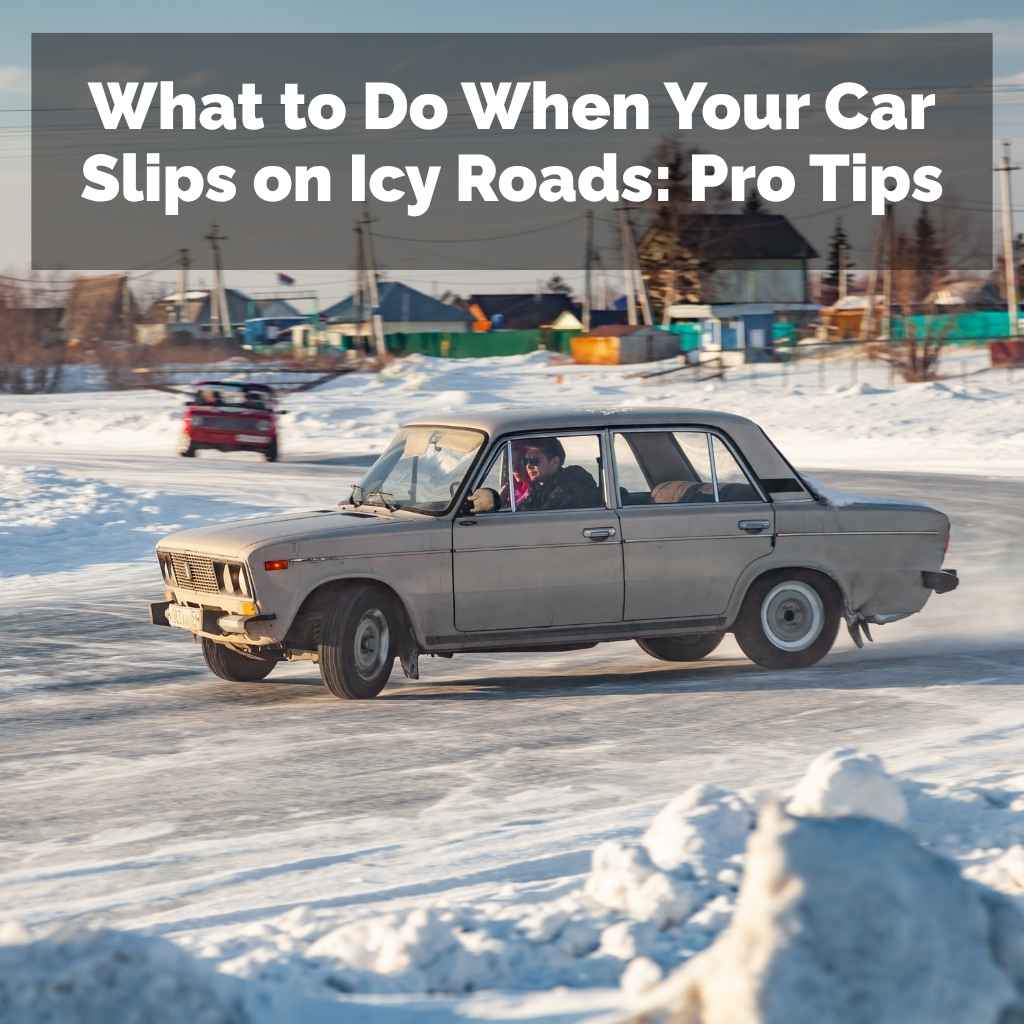
What to Do When Your Car Slips on Icy Roads: Pro Tips
It can be a bit scary when your car suddenly slides on a slippery icy road. Beginners often feel unsure about what to do in that tense moment. But don’t worry, staying calm is the first step.
We’ll walk you through exactly what to do with easy, step-by-step advice. Following these simple tips will help you handle these situations much better and keep you safe on the road. Let’s get you ready.
Staying Safe If Your Car Slips on Icy Roads
When your car loses grip on ice, it’s a tense situation that can catch many drivers off guard. Understanding the basic principles of car control during a skid is vital for avoiding accidents. Many drivers, especially those new to winter driving, may panic or react incorrectly, often making the situation worse.
This section covers the core actions you need to take when your vehicle starts to slide on ice. We will break down the instinctive but often wrong reactions and
Understanding Why Cars Slip on Ice
A car slips on ice primarily because the tires lose traction. Traction is the grip between your tires and the road surface. Ice is incredibly smooth and offers very little friction.
When this friction is reduced significantly, the tires cannot grip the road effectively. This means that when you try to steer, brake, or accelerate, the tires will just spin or slide instead of pushing the car in the intended direction. The thin layer of water that can form on top of ice, even at freezing temperatures, further reduces friction.
This phenomenon, called hydroplaning, can also happen on ice, making tires slide even more.
Factors like tire tread depth, tire pressure, and the type of tires you have all play a role in how well your car can grip icy surfaces. Worn tires have less tread to bite into the road. Underinflated or overinflated tires also don’t make optimal contact with the road.
Even the weight distribution of your car can affect traction. For instance, if your rear wheels are not getting enough weight, they are more likely to spin out, especially in rear-wheel-drive vehicles. Understanding these basic physics helps in appreciating why certain techniques work better than others when dealing with slippery conditions.
Tire Grip and Friction
Tire grip, also known as traction, is the force that allows your tires to hold onto the road. This grip is created by the friction between the rubber of the tire and the surface it’s rolling on. Friction happens when the microscopic bumps and ridges on the tire surface interlock with the microscopic bumps and ridges on the road surface.
Think of it like two pieces of sandpaper rubbing against each other; the rougher they are, the more they grip. When that road surface becomes smooth like ice, there are fewer interlocking points, drastically reducing friction.
The amount of friction depends on several factors. The type of tire rubber is designed to create grip under various conditions. Winter tires, for example, have special rubber compounds that stay flexible in cold temperatures and aggressive tread patterns with many small sipes (cuts) to increase grip on snow and ice.
The tire tread also helps to channel away water or slush, preventing the tire from riding on a slick layer. Tire pressure is also key; a properly inflated tire makes full contact with the road, maximizing the available grip area. Too little pressure and the tire can’t roll efficiently; too much pressure and the contact patch may become smaller, reducing grip.
The Role of Ice and Temperature
Ice itself is the primary culprit behind loss of traction. Its incredibly smooth surface offers minimal resistance to tires. Even a thin film of water on top of the ice, which can form due to friction from tires or ambient temperatures hovering around freezing, acts as a lubricant.
This makes the tires slide even more easily. At temperatures well below freezing, ice can be harder and potentially offer slightly more grip than very slick, wet ice, but it is still a dangerous surface for driving.
The temperature dictates how ice behaves. When the temperature is very cold, say -10°C (14°F) or below, the ice is hard and dry, offering slightly better friction. However, as the temperature gets closer to 0°C (32°F), ice can start to melt on the surface, creating that treacherous layer of water.
This is why black ice, which is often invisible and forms when thin layers of water freeze on the road, is particularly dangerous. It looks like a wet patch on the road but is actually a sheet of ice. Drivers often misjudge these conditions, thinking the road is just wet.
What to Do Immediately When Your Car Skids
When your car begins to skid, the most crucial thing is to remain calm and react correctly. Panicking can lead to jerky movements that worsen the skid. The primary goal is to regain control of the vehicle’s direction and speed.
This involves counteracting the skid by steering in the opposite direction of the slide while gently easing off the accelerator. Slamming on the brakes is almost always the wrong move, as it locks up the wheels and eliminates any remaining steering control. We will detail the precise steering and braking techniques to use.
The exact action depends on whether the skid is over the front wheels (understeer) or the rear wheels (oversteer). Understanding these differences is key to applying the correct counter-steer. For front-wheel skids, you need to steer into the skid, which means turning the wheel in the direction the car is sliding.
For rear-wheel skids, it’s the same principle: steer into the direction of the slide. The timing and smoothness of these actions are what separate a controlled recovery from an accident. We will also discuss what to do after you’ve regained control to ensure you can stop safely.
Counter-Steering: The Key Technique
Counter-steering is the most important technique to use when your car skids. It involves turning the steering wheel in the direction the rear of the car is sliding. For example, if your car’s rear end slides to the left, you turn the steering wheel to the left.
If the rear end slides to the right, you turn the steering wheel to the right. This might seem counter-intuitive because you’re steering into the slide, not away from it. The purpose is to realign the front wheels with the direction you want the car to go, helping to straighten out the vehicle.
The execution needs to be smooth and quick. As soon as you feel the car start to slide, you need to react. You steer into the slide, but as the car begins to straighten, you must quickly turn the steering wheel back to its original position or even slightly in the opposite direction to prevent overcorrection.
This is a rapid back-and-forth motion. Imagine you are trying to keep the car pointed straight by constantly adjusting the steering wheel based on where the rear of the car is going. Modern cars with stability control systems often help with this automatically, but understanding the manual technique is still valuable, especially in older vehicles or extreme conditions.
Front-Wheel Skid (Understeer)
A front-wheel skid, also known as understeer, happens when the front tires lose traction. This means the car wants to continue going straight, even if you’re trying to turn the steering wheel. It’s like the car is not responding to your steering input.
When this occurs, the correct action is to ease off the accelerator. Avoid braking suddenly, as this will further reduce the grip of the front tires. You may also need to slightly reduce your steering angle.
The goal is to allow the front tires to regain traction.
Once the tires regain grip, the car will start to follow your steering. You then need to smoothly adjust your steering to the desired path. It’s a delicate balance of reducing input to let the tires find grip and then resuming control.
Over-correcting can lead to a rear-wheel skid. The key is to be smooth and patient. Think of it as a gentle negotiation with the tires, rather than forcing the car to turn.
For instance, if you are trying to take a left turn and the front end starts to slide straight ahead, you would ease off the gas, perhaps slightly straighten the wheel, and wait for the tires to grip again before gently resuming the turn.
Rear-Wheel Skid (Oversteer)
A rear-wheel skid, or oversteer, is more common on slippery surfaces like ice. This happens when the rear tires lose traction, causing the rear of the car to slide or fishtail to the side. If the rear slides to the left, you need to steer to the left (counter-steer).
If the rear slides to the right, you steer to the right. This is the core principle of counter-steering. As you steer into the skid, the car will begin to straighten out.
Once the car is moving in the desired direction, you need to quickly bring the steering wheel back to a straight position to prevent overcorrection.
This is the situation where smooth, controlled counter-steering is most critical. If you over-steer, the car can start to skid in the opposite direction. The key is to be precise and anticipate the car’s movement.
For example, if you are driving straight and the rear of your car slides to the right, you would immediately turn the steering wheel to the right. As the rear starts to come back in line, you would then quickly turn the steering wheel back to the left to stop it from over-rotating. It’s a dance of rapid steering adjustments.
What Not to Do During a Skid
During a skid, certain reactions are common but detrimental. The most significant mistake is slamming on the brakes. When you brake hard on a slippery surface, your wheels can lock up.
Locked wheels have no rotational movement, and therefore, no ability to steer. The car will simply slide in the direction it was already going, like a sled. Another common error is over-steering or making sudden, jerky steering movements.
These abrupt actions can easily destabilize the car further and cause it to spin out of control.
Also, panic can lead to closing your eyes or looking down, which is the opposite of what you need to do. You need to maintain focus on the road ahead and on the direction you want to go. Some drivers also tend to overreact by turning the steering wheel too much in the direction of the skid, leading to a secondary skid in the opposite direction.
The goal is controlled, smooth adjustments, not violent reactions. Understanding these common pitfalls is as important as knowing the correct techniques.
Regaining Control and Preventing Future Skids
Once you’ve managed to stop a skid and regain some control, your focus shifts to safely bringing the vehicle to a stop or continuing at a safe speed. This involves gentle braking and steering. Preventing future skids requires a proactive approach to driving in icy conditions, including proper vehicle maintenance, appropriate tire selection, and adapting your driving habits.
We will discuss how to brake safely on ice and the essential preparations you should make before even encountering slippery roads.
Learning from a skid is also important. Analyze what caused it and how you reacted. This experience, while stressful, can make you a more aware and safer driver in the future.
The goal is to minimize the chances of skidding by driving defensively and being prepared for the worst conditions. We’ll also touch upon advanced safety features in modern cars and how they assist drivers. This proactive mindset is key to winter driving safety.
It’s about being a step ahead of the conditions.
Gentle Braking and Steering on Ice
After recovering from a skid, or if you need to slow down on ice, braking must be done with extreme caution. The best method is often referred to as “threshold braking,” where you apply enough pressure to slow down significantly without locking the wheels. If your car has Anti-lock Braking System (ABS), you can apply firm pressure to the brake pedal and allow the system to pulse the brakes for you.
You will feel a pulsing sensation in the pedal, and you should keep steady pressure. Do not pump ABS brakes.
If your car does not have ABS, you need to brake gently and intermittently. Apply the brakes until you feel the wheels starting to lock up or the car beginning to slide, then immediately release the pressure slightly until the wheels start rotating again. Repeat this process.
Steering should also be smooth and gradual. Avoid sharp turns. If you need to change direction, do so slowly and deliberately.
Anticipate turns and slow down well in advance. The goal is to maintain momentum without losing traction.
Vehicle Maintenance for Icy Conditions
Ensuring your car is in good condition is paramount for driving safely in icy weather. Tires are the most critical component. Ensure your tires have adequate tread depth.
For winter driving, consider using dedicated winter tires. These tires are made with special rubber compounds that remain flexible in cold temperatures, and they have aggressive tread patterns designed to grip snow and ice. Check your tire pressure regularly, as cold weather can cause it to drop, affecting tire performance.
Beyond tires, ensure your brakes are in good working order. Worn brake pads can significantly reduce your stopping power. Check your wiper blades and windshield washer fluid, especially the fluid’s antifreeze properties, to ensure clear visibility.
Also, check your defroster and heater to keep the windshield clear of fog and ice. A well-maintained car provides a much greater margin of safety when driving on slippery surfaces.
Driving Habits to Prevent Skids
Adapting your driving habits is crucial for preventing skids. The most important rule is to slow down significantly. Speed is your enemy on ice.
Drive at a speed that allows you to react to unexpected situations, typically much slower than you would on dry roads. Increase your following distance to at least three to four car lengths, or even more on icy surfaces. This gives you ample space to stop if the car in front brakes suddenly.
Avoid sudden acceleration, braking, and sharp turns. All your movements should be smooth and deliberate.
Be aware of road conditions. Look for signs of ice, such as patches of frost, bridges, overpasses, and shady spots, which tend to freeze first and remain frozen longer. Black ice is particularly dangerous because it is often invisible.
If you suspect ice, treat the road as if it’s completely covered. Accelerate gently from a stop and brake early and lightly. If you are driving a rear-wheel-drive vehicle, be extra cautious, as they are more prone to rear-wheel skids.
Always anticipate potential hazards and drive defensively.
Using Technology to Your Advantage
Modern vehicles are equipped with advanced safety technologies designed to help drivers maintain control in challenging conditions. Understanding and utilizing these systems can significantly enhance your safety on icy roads. Features like Electronic Stability Control (ESC) and Anti-lock Braking System (ABS) are invaluable tools.
We will explain how these technologies work and how they assist you when you encounter slippery surfaces. This section focuses on how to leverage these built-in systems effectively.
While these systems are sophisticated, they are not foolproof. They are aids, not replacements for careful driving. Knowing their limitations and how they function can help you react appropriately.
For instance, understanding what ABS does (and does not do) can prevent drivers from pumping the brakes incorrectly. Similarly, knowing when ESC might activate and what it does to stabilize the vehicle can provide reassurance and guide your response. Ultimately, technology complements good driving skills, making you safer on the road.
Electronic Stability Control (ESC)
Electronic Stability Control (ESC) is a computer-aided safety system that helps drivers maintain control of their vehicle during extreme steering maneuvers or when traction is lost. It works by detecting loss of steering control and then automatically applying individual brakes to help “steer” the car back onto the driver’s intended path. ESC sensors monitor the steering wheel’s angle, wheel speed, and vehicle yaw rate (how much the car is rotating).
If the system detects a significant difference between the driver’s intended direction and the car’s actual direction, it intervenes.
For example, if you’re trying to swerve to avoid an obstacle and the car starts to slide, ESC might sense that the rear of the car is fishtailing. It will then selectively apply the brakes to individual wheels. It might brake the front-left wheel to help the car turn left, or the rear-right wheel to slow down rotation.
ESC also reduces engine power if necessary to help the driver regain control. Most modern cars have ESC, and it’s generally always active unless you manually turn it off. It’s a critical safety feature for slippery conditions.
Anti-lock Braking System (ABS)
Anti-lock Braking System (ABS) is a safety system that prevents the wheels from locking up during heavy braking. When you apply the brakes hard, ABS sensors detect when a wheel is about to stop rotating. The system then rapidly pulses the brake pressure to that wheel, releasing and reapplying it many times per second.
This allows the wheels to keep rotating, albeit slowly, while still providing maximum braking force. This is crucial because rotating wheels allow you to steer.
With ABS, you can brake firmly and steer around obstacles simultaneously. Without ABS, if you lock the wheels by braking too hard, you lose all ability to steer, and the car will slide uncontrollably. When ABS is working, you will feel a pulsing or vibrating sensation in the brake pedal and hear a grinding noise.
This is normal. The key is to keep firm, steady pressure on the brake pedal and not to pump it. Let the ABS do its job.
ABS is particularly effective on slippery surfaces like ice, as it helps maintain a degree of steering control even under hard braking.
Tire Pressure Monitoring System (TPMS)
A Tire Pressure Monitoring System (TPMS) is a vital safety feature that alerts drivers when tire pressure is significantly low. Low tire pressure can severely compromise a tire’s grip, especially on slippery surfaces. Properly inflated tires provide the largest possible contact patch with the road, which is essential for traction.
When tire pressure is too low, the tire can deform in ways that reduce the effective contact area and can lead to instability, making it more likely for the car to skid.
In cold weather, tire pressure naturally drops. A TPMS warning light will illuminate on your dashboard if one or more tires are underinflated. This gives you an immediate alert to check your tires.
For optimal performance and safety on ice, it’s crucial to maintain the recommended tire pressure, which is usually found on a sticker inside the driver’s side doorjamb or in your owner’s manual. Regularly checking tire pressure manually, in addition to relying on TPMS, is still a good practice, especially before long drives or when anticipating very cold conditions.
Frequently Asked Questions
Question: What is the first thing to do if my car starts to slide on ice?
Answer: Stay calm and do not panic. Gently take your foot off the accelerator. Avoid slamming on the brakes.
Question: Should I steer into or away from the skid?
Answer: You should steer into the skid. This means turning the steering wheel in the direction the rear of the car is sliding.
Question: What if my car has ABS? How do I brake?
Answer: If your car has ABS, apply firm, steady pressure to the brake pedal and do not pump it. Let the system do its work.
Question: Are winter tires really necessary for driving on ice?
Answer: Yes, winter tires are highly recommended. They are made with special rubber compounds and tread patterns that provide significantly better grip on snow and ice compared to all-season tires.
Question: How can I prevent my car from skidding on ice in the first place?
Answer: Drive slowly, increase your following distance, avoid sudden movements like braking or steering, and ensure your tires have good tread and correct inflation.
Wrap Up
When your car slips on icy roads, remembering to stay calm and steer into the skid is key. Gentle braking, proper tire maintenance, and smooth driving habits significantly reduce the risk of skidding. Utilize your car’s safety features like ABS and ESC.
These pro tips empower you to handle slippery conditions with more confidence and safety.
Products related to this article
Sponsored / affiliate links. As an Amazon Associate I earn from qualifying purchases. I may earn additional commission from eligible campaigns.