Cabin Air Filter with Activated Carbon Review / Is It Worth It
An activated-carbon cabin air filter is often worth considering if odors, traffic fumes, or smoke bother you. Skip it if your top priority is maximum airflow in a dusty cabin, because carbon media can add slight restriction. Choose poorly and you keep smelling exhaust, mildew, or fuel, or you replace the filter more often than needed. This guide explains what activated carbon filters fix, what they do not, and the airflow tradeoff versus standard and premium particulate filters.
This guide is part of our Car cooling and climate control guide series.
Verdict
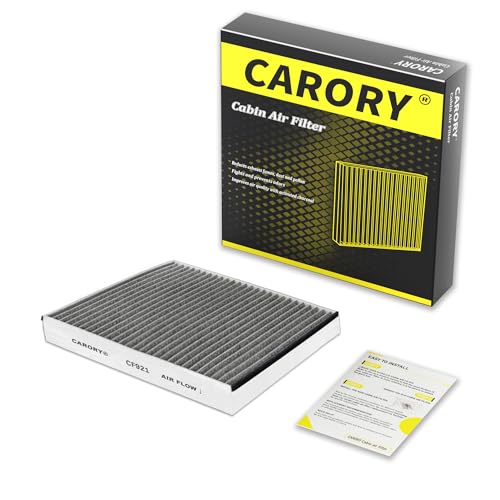
Based on published product details and typical use cases, activated carbon is the best overall option for odor plus value when fitment matches your exact year, make, and model. It is not a cure for HVAC faults. If the smell comes from a moldy evaporator, a blocked drain, or contamination in the outside-air intake, the filter alone will not solve it.
Pros and cons
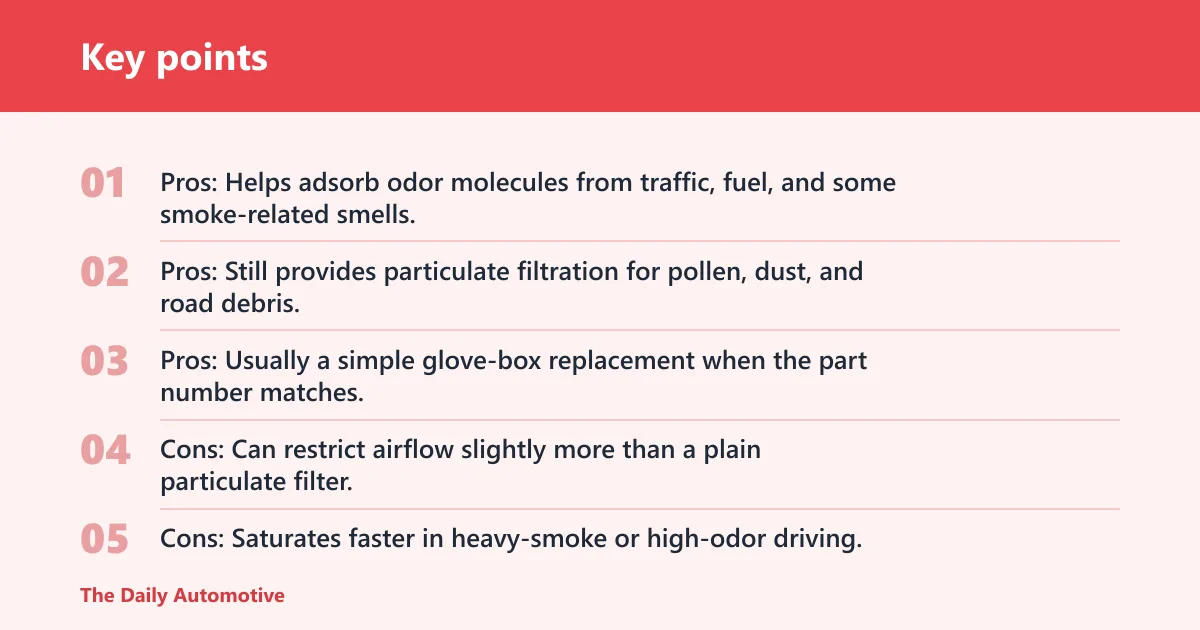
- Pros: Helps adsorb odor molecules from traffic, fuel, and some smoke-related smells.
- Pros: Still provides particulate filtration for pollen, dust, and road debris.
- Pros: Usually a simple glove-box replacement when the part number matches.
- Cons: Can restrict airflow slightly more than a plain particulate filter.
- Cons: Saturates faster in heavy-smoke or high-odor driving, so replacement interval matters.
- Cons: Does not fix evaporator mold, drain problems, or outside-air intake contamination.
Specs at a glance
| Spec | What to check |
|---|---|
| Media type | Particulate filter media with activated carbon layer |
| Primary target | Odors plus dust, pollen, and road particulate |
| Fitment | Vehicle-specific year-make-model lookup and OE equivalent cross-reference |
| Typical replacement interval | Often around one service interval; shorten it in smoke, dust, or heavy city traffic |
| Airflow tradeoff | May restrict airflow more than a non-carbon cabin filter if loaded with dust or saturated carbon |
| Best use | Odor control with normal particulate filtration |
Price and ownership cost
The cheapest activated-carbon pick in the sourced set is priced at $8.99, and Mann-Filter’s activated carbon cabin filter is priced at $10.62. Walmart also lists an activated carbon cabin filter for the Toyota RAV4, Camry, and Corolla at about $15.73. For a longer-view comparison, a PureFlow HEPA cabin air filter is listed at $23.78, while K&N’s washable and reusable cabin filter is priced at $44.99.
That matters because ownership cost is not just the sticker price. If a carbon filter lasts a normal service interval and actually removes the odor that bothers you, the monthly cost can be lower than buying a more expensive filter that does not solve the complaint.
Cabin air filter decision table
Use the table below by starting with your main symptom, then matching it to the air you drive through and how sensitive you are to reduced airflow. The last column is the part many buyers miss: sometimes the odor is not a filter problem at all.
| Driving conditions | Odor concern | Allergy concern | Smoke exposure | Airflow sensitivity | Replacement interval | Recommended filter type | Not the filter |
|---|---|---|---|---|---|---|---|
| City commuting behind diesel buses or delivery vans | High | Low to medium | Low | Medium | Shorten if odor sticks after a few months | Activated carbon cabin air filter | Check outside-air intake contamination if fumes persist with recirculation off |
| Wildfire season with visible haze | Medium | Medium to high | High | Medium | Shorten after heavy smoke days | Activated carbon if odor is the complaint; HEPA-style only if fitment exists | A cabin filter will not eliminate all smoke; also inspect the HVAC intake path |
| High-pollen region, spring and fall | Low | High | Low | Low to medium | Standard service interval | HEPA cabin air filter if available for your exact model; otherwise OEM-grade particulate filter | Persistent sneezing can also come from a dirty interior, not only the filter |
| Ride-hailing, passengers, food, and mixed odors | High | Low | Low to medium | Medium | Shorten if odor buildup is obvious | Activated carbon cabin air filter | Musty smell after rain can point to drain or evaporator issues |
| Owner wants maximum airflow and changes the filter often | Low | Low | Low | High | Normal | OEM-grade standard cabin air filter | Reduced airflow may come from a clogged blower intake or debris in the intake path |
Who it
An activated-carbon cabin air filter fits drivers who notice exhaust at stoplights, fuel smell in traffic, or lingering odor after passing trucks. It also makes sense for city cars, ride-hailing vehicles, and cabins that pull in a lot of outside air. It is a weaker match if your main goal is the highest possible airflow or the strongest allergy filtration.
Best matches
For a commuter in dense traffic, carbon media gives a real benefit because the cabin HVAC intake path pulls outside air, then brings in road dust, pollen, mold spores, diesel exhaust, and sometimes wildfire smoke. A common first-timer mistake is expecting a plain particulate filter to stop odor the way carbon can; it usually will not.
Suppose your compact sedan smells like cold exhaust each time you stop at a light. If the filter fit is correct and the intake path is clean, activated carbon is the right first upgrade. If the smell stays even with a fresh filter, look elsewhere in the HVAC system.
Who should skip it?
If your car already gets little outside air because you run recirculation often, and your only issue is weak airflow, carbon may not be the best spend. The same is true if your cabin odor is actually coming from a wet evaporator or blocked drain; those problems need service, not a different filter.
What works
Activated carbon does two jobs. The base filter media catches particulate matter such as dust, pollen, and road debris, while the carbon layer adsorbs many odor compounds. That is why it often beats a plain OEM-style particulate filter when smell, not just dirt, is the complaint.
Odor adsorption and particle capture
Carbon helps cut traffic fumes, fuel vapor traces, and some smoke-related odor. It does not mean the cabin becomes scent-free. It means the filter cuts smell entering through the outside-air path, especially when odor is the main reason you want an upgrade.
Compare that with a standard OEM-grade cabin air filter: it is usually vehicle-specific and factory-correct, which is good for fitment by model, but it usually puts more weight on particulate capture than odor control. Mann-Filter’s activated carbon cabin filter is described as OEM-grade, which is the kind of part many buyers want when they want factory-like fit with added odor control.
Where it helps more than a plain cabin filter
Activated carbon is most useful when the cabin complaint is tied to the air coming through the HVAC intake, not to the car itself. City driving behind diesel exhaust, long freeway merges near traffic, and seasons with nearby wildfire smoke are all situations where carbon has a clearer payoff than a plain filter.
HEPA-style cabin filters, by contrast, are about particle filtration. Bosch’s option is labeled HEPA-grade, not activated carbon, so it is a better fit for fine particles and allergy use cases than for odors. Fitment also matters more with HEPA-style parts because not every vehicle has a true HEPA cabin filter option.
What does not?
An activated-carbon cabin air filter does not fix HVAC faults. If the air smells musty only when the AC turns on, the problem may be a moldy evaporator core, a clogged cabin drain, or contamination at the outside-air intake. A new filter can help, but it will not clean a dirty evaporator.
Common failure cases
Blocked cabin drain symptoms often include damp carpet, water around the passenger footwell, or odor after rain. Moldy evaporator symptoms often show up as a sour smell the moment the blower starts. Outside-air intake contamination can mean leaf debris, nests, or heavy dust that keeps getting pulled in after the filter.
Say the cabin smells stale only after the AC has sat unused overnight. A fresh activated-carbon filter may reduce the odor, but if the evaporator is loaded with biofilm, the smell will return fast. That is a service issue, not a media upgrade issue.
Alternatives

A-Premium activated carbon cabin air filter. Based on the manufacturer details, this is the better value play for select Chevrolet and GM fitments when you want odor reduction without paying premium prices. The drawback is simple: it is still fitment-specific, so you need to confirm the exact OE reference and dimensions before buying.
HEPA cabin air filter options. Walmart lists a PureFlow HEPA cabin air filter at $23.78, and that is the kind of choice that makes sense when particle control matters more than odor. The catch is that HEPA-style cabin filters are not universal, and they do little for fuel or exhaust smell compared with activated carbon.
Washable reusable cabin air filter. K&N’s cabin filter is described as washable and reusable, and it is priced at $44.99. That gives it long-term value for owners who want reuse, but the tradeoff is maintenance washing and a stronger particle-only emphasis than odor control.
OEM-grade standard cabin air filter. Mann-Filter’s activated carbon cabin filter is described as OEM-grade, and that category is what you want when factory replacement fit is the priority. If your complaint is dust or pollen more than smell, an OEM-grade standard filter can be enough, and it usually avoids the small airflow penalty that carbon media can bring.
Should you buy it?
Buy activated carbon if odor is the problem and your exact vehicle has a good fitment match. That applies most to city drivers, ride-hailing cars, and vehicles that regularly see traffic fumes, diesel exhaust, or smoke. It is also the safer first upgrade when you want more odor control without jumping straight to a costly HEPA or reusable setup.
When the upgrade is worth the extra cost
The upgrade is worth it when the filter will actually be exposed to the problem you want to fix. A car that spends its life in freeway traffic or smoky air gets more value from carbon than a garage-kept weekend car. The practical question is cost per month: a low-priced carbon filter that you replace on schedule can be cheaper than a premium filter that does not address the smell.
When a standard filter is enough
If your issue is mostly dust or pollen, and you do not smell exhaust, fuel, or lingering odors, a standard OEM-grade cabin air filter is often enough. That is especially true if the vehicle’s HVAC already moves air well and you do not want any extra restriction. Fitment lookup still matters either way, because the right year-make-model and OE equivalent cross-reference prevent gaps and bypass.
- Confirm the exact year, make, and model first.
- Check OE part numbers and vehicle-specific dimensions.
- Choose carbon for odor, HEPA for particles, or washable only if you want reuse and will maintain it.
- Replace sooner if smoke, dust, or traffic odor loads the filter fast.
- If the smell remains, inspect the evaporator, drain, and outside-air intake path.
Frequently asked questions
Is an activated carbon cabin air filter worth it?
Yes, if odors, exhaust, or smoke are the real complaint. It is less compelling if you only want the highest airflow or the strongest allergy filtration. The value comes from solving a specific problem without moving to a much more expensive filter type.
What does activated carbon do in a cabin air filter?
Activated carbon adsorbs many odor-causing compounds while the base media traps particulate matter. That means it can cut traffic fumes, fuel smell, and some smoke odor, while still catching dust and pollen. It does not remove every smell, and it does not fix HVAC contamination.
Will an activated carbon cabin filter reduce airflow in my car?
It can reduce airflow slightly more than a plain particulate filter, especially as it loads with dust. The effect is usually modest when the filter is fresh and the fit is correct. If maximum airflow matters most, an OEM-grade standard filter is the safer choice.
How often should I replace an activated carbon cabin air filter?
Most drivers should follow the vehicle service interval, then shorten it in smoke, heavy traffic, or dusty conditions. Carbon saturation and dirt loading both reduce performance, so a filter that still looks clean may already be past its useful odor-control window in the right conditions.
What is the difference between activated carbon and HEPA cabin filters?
Activated carbon targets odor plus particles. HEPA-style cabin filters focus on fine particles and allergy-related use cases, but they have odor-control limits and narrower fitment availability. If smell is the complaint, carbon usually wins. If particles are the issue, HEPA is often the stronger pick.
Will a cabin air filter fix musty AC smells?
Sometimes, but not always. Fresh media can reduce a stale smell that comes from a dirty filter, yet moldy evaporators, clogged drains, and outside-air intake contamination often keep the odor alive. If the smell returns quickly after replacement, the filter is probably not the main cause.
Products related to this article
Sponsored / affiliate links. As an Amazon Associate I earn from qualifying purchases. I may earn additional commission from eligible campaigns.