
2015-2017 Ford F-150 Sony Sound Diagram
Figuring out the 2015–2017 Ford F-150 Sony Sound System Diagram can seem tricky when you’re new to car audio. Many people find themselves confused by all the wires and connections. This guide makes it simple.
We will walk through everything step-by-step so you can understand your truck’s sound system. Get ready to learn about your F-150’s audio setup without any confusion.
Understanding Your Ford F-150 Sony Sound System
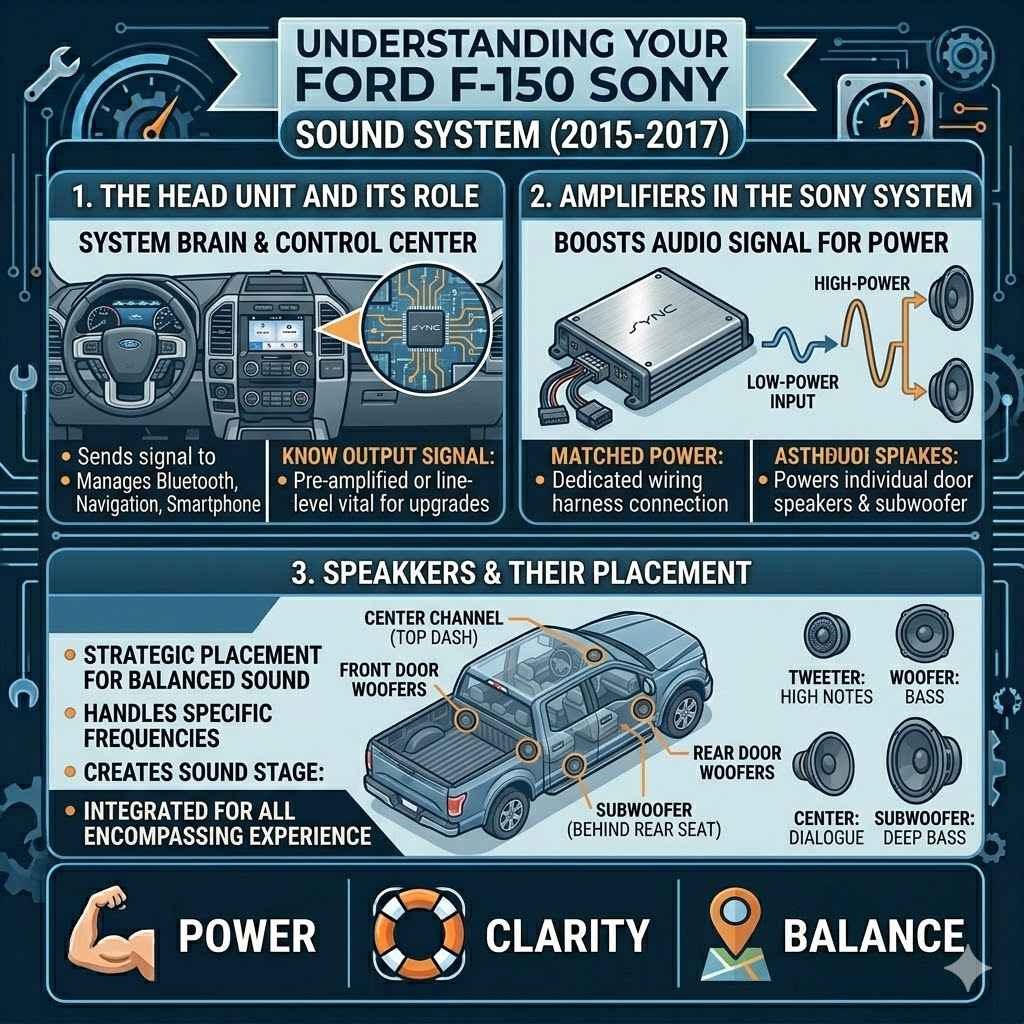
This section looks at the specific components that make up the Sony sound system in your 2015-2017 Ford F-150. We will break down what each part does, from the head unit to the speakers and any amplifiers. Knowing these parts helps you understand how they connect and work together.
This knowledge is key for anyone wanting to upgrade or troubleshoot their audio.
The Head Unit and Its Role
The head unit is the brain of your truck’s sound system. It’s where you control music, volume, and settings. For the 2015-2017 F-150 with the Sony system, the head unit manages all audio signals.
It sends these signals to the amplifiers and speakers. Modern head units also offer features like Bluetooth, navigation, and smartphone integration.
Understanding the head unit’s output is vital. It determines the type of audio signal sent to other components. This signal could be pre-amplified or a direct line-level signal.
Knowing this helps when choosing aftermarket parts or connecting new devices.
Amplifiers in the Sony System
Amplifiers boost the audio signal from the head unit. This makes the sound louder and clearer. The Sony system often includes a factory amplifier to power the speakers.
This amplifier is designed to work with the specific speakers and head unit in your F-150.
A factory amplifier uses its own wiring harness to receive signals and power. It then sends the amplified signal to each speaker. The size and power of the amplifier are matched to the speaker’s capabilities.
This prevents distortion and damage.
Speakers and Their Placement
Your F-150’s Sony system features a set of speakers strategically placed throughout the cabin. These include door speakers, possibly a center channel speaker, and a subwoofer. Each speaker is designed to produce specific sound frequencies.
For instance, woofers handle bass, while tweeters handle high notes.
The placement of speakers is important for creating a good sound stage. This refers to how the sound seems to come from different points in front of you. The Sony system aims for a balanced audio experience.
Understanding speaker types and their roles helps in appreciating the system’s design.
Decoding the 2015–2017 Ford F-150 Sony Sound System Diagram
This section focuses on reading and interpreting the actual wiring diagrams for the 2015-2017 Ford F-150 Sony sound system. We will explain common symbols, wire colors, and connection points. A good diagram is like a map for your truck’s audio.
It shows how everything connects, helping you troubleshoot issues or plan modifications.
Common Symbols and Wire Colors
Wiring diagrams use symbols to represent different electronic components. For example, a line might show a wire, while a circle could indicate a connection point. Wire colors are also a universal language in automotive wiring.
Each color often signifies a specific function, like power, ground, or a speaker output.
Knowing these standard symbols and colors is essential. It helps you quickly identify what each wire does. For instance, red wires often mean power, while black typically means ground.
Speaker wires usually have a stripe to help distinguish positive from negative.
Understanding Connector Pinouts
Connectors are plugs that link different parts of the sound system. A pinout diagram shows what each pin on a connector is for. This is critical for making correct connections.
For example, one pin might be for the constant power, another for the accessory power, and others for speaker signals.
When working with the 2015–2017 Ford F-150 Sony Sound System Diagram, looking at the pinouts for the head unit, amplifier, and speakers is very helpful. This tells you exactly which wire goes into which slot on the connector. Getting this right prevents system damage and ensures everything functions as it should.
Power and Ground Connections
Every electronic device needs power and a ground connection to work. Power wires supply electricity. Ground wires provide a return path for the electricity, completing the circuit.
In car audio, reliable power and ground connections are paramount for performance and to avoid noise.
The diagram will show where the system draws its power from. This often includes a constant power source (always on) and an accessory power source (turns on with the ignition). Proper grounding involves connecting to a clean metal part of the vehicle’s chassis.
This ensures a solid connection.
Speaker Wiring and Outputs
Each speaker in the system is connected to the amplifier or head unit via dedicated wires. These wires carry the amplified audio signal. The diagram will map out which wire goes to which speaker.
It also shows the polarity (positive and negative) for each speaker.
Correct speaker wiring ensures the speakers move in sync. If polarity is reversed for a speaker, it can cause sound cancellation, leading to a weaker bass response. The diagram helps confirm these connections are made properly.
Troubleshooting Common Sound System Issues
This section addresses frequent problems people encounter with their truck’s audio. We will cover things like no sound, distorted audio, or specific speakers not working. Using the 2015–2017 Ford F-150 Sony Sound System Diagram is your best tool for diagnosing and fixing these issues.
No Sound from Any Speakers
When the entire system is silent, the problem could be with the power supply or a blown fuse. First, check the fuses related to the audio system. The diagram can help locate these fuses in the vehicle’s fuse boxes.
If fuses are good, check if the head unit is receiving power.
Next, consider if the amplifier is powered on. Some amplifiers have indicator lights. If there’s no power to the head unit or amplifier, it could be a wiring issue.
The diagram shows the power feed lines, helping you trace the problem.
One or More Speakers Not Working
If only one or a few speakers are silent, the issue is likely with that specific speaker’s wiring or the speaker itself. First, check the wire connections at the speaker. Ensure they are secure and not loose.
Then, use the diagram to follow the wire back to the amplifier or head unit.
The problem could be a broken wire in the door jam or a faulty connection at the source. It’s also possible the speaker has failed. If you have a multimeter, you can test the speaker’s resistance.
Distorted or Poor Sound Quality
Distorted sound can happen for several reasons. It might be due to an overloaded amplifier, a speaker pushed beyond its limits, or issues with the audio source. If the distortion occurs at higher volumes, the amplifier might not be powerful enough, or the speakers are not handling the power.
Check the wiring for any signs of damage or poor connections. Sometimes, interference from other electronic components can cause noise. The diagram can help identify which wires carry audio signals and where they run, allowing you to check for potential sources of interference.
Intermittent Audio or Static
Intermittent audio or static often points to a loose connection or a wire that is partially broken. Vibration can cause these connections to make and lose contact. The diagram helps pinpoint potential areas where wires might be rubbing or stressed, like in door jambs or under seats.
Carefully inspect all visible wiring and connectors related to the audio system. Pay attention to areas that move when doors open or close. A loose ground connection can also cause static and humming sounds.
Upgrading Your F-150 Sony Sound System
This section provides guidance on how to improve your existing Sony sound system. We’ll cover common upgrades like replacing speakers or adding an aftermarket amplifier. The 2015–2017 Ford F-150 Sony Sound System Diagram is your roadmap for successful modifications.
Replacing Factory Speakers
Upgrading your speakers can significantly enhance sound quality. You can
You’ll need to ensure the new speakers fit the openings. Many aftermarket speakers come with adapter brackets for specific vehicles. Using the diagram, you can identify the existing speaker wires and how they connect.
This makes it easier to wire the new speakers correctly.
Adding an Aftermarket Amplifier
For more power and better sound, consider adding an aftermarket amplifier. This involves tapping into the factory system’s power and speaker-level signals. The diagram is crucial here.
It shows the best points to draw power and ground.
You’ll need to run new power and ground wires to the amplifier. The diagram helps locate the vehicle’s battery and chassis ground points. You will also need to run signal wires from the head unit or factory amplifier to the new amplifier.
Integrating a Subwoofer
Adding a subwoofer can provide the deep bass that factory systems often lack. You can install a powered subwoofer (which has a built-in amplifier) or a separate subwoofer and amplifier. The diagram helps identify where to run the subwoofer signal wire and how to connect power.
A common method is to use a line-output converter. This takes the speaker-level signal from a rear speaker and converts it to a low-level RCA signal that an amplifier can use. The diagram shows which wires are for the rear speakers.
Example of a Common Upgrade Scenario
Let’s say you want to add a small amplifier and new front speakers to your F-150.
- First, consult the 2015–2017 Ford F-150 Sony Sound System Diagram to identify the factory wiring for the front door speakers and the main power feed.
- You will run a new power wire from the battery to the new amplifier, ensuring it’s fused properly. A clean chassis ground is also essential, which the diagram helps locate.
- To send audio to the new amplifier, you can use a line-output converter connected to the factory front speaker wires. The diagram shows the color codes for these wires.
- New aftermarket speakers will be installed in the front doors. Their wiring will connect to the new amplifier’s outputs.
- Finally, you will connect the new amplifier’s outputs to the new front speakers, ensuring correct polarity.
Statistics on Car Audio Systems
The car audio market is significant. Many people invest in improving their car’s sound. Statistics show how popular these upgrades are.
According to a recent survey, about 30% of car owners have upgraded their car audio systems at least once. This indicates a strong interest in better sound quality. For trucks like the Ford F-150, which are often used for long drives or work, a good audio system enhances the experience.
| Year | Global Car Audio Market Size (USD Billion) |
|---|---|
| 2020 | 10.5 |
| 2021 | 11.2 |
| 2022 | 11.9 |
This table shows the steady growth of the car audio market. This trend suggests more and more people are looking for ways to improve their in-car entertainment. Access to clear diagrams, like the 2015–2017 Ford F-150 Sony Sound System Diagram, is key for DIY enthusiasts.

Frequently Asked Questions
Question: Where is the factory amplifier located in a 2015-2017 Ford F-150 with the Sony system?
Answer: The factory amplifier for the Sony system in these F-150 models is typically located behind the rear passenger-side seat, mounted to the truck’s body or a bracket.
Question: What wire colors are used for the front door speakers in the 2015-2017 F-150 Sony system?
Answer: While wire colors can vary slightly, for the front door speakers in the Sony system, you’ll often find variations of brown, blue, and gray wires. Always refer to a specific diagram for your truck’s exact configuration.
Question: Can I use the factory head unit with an aftermarket amplifier?
Answer: Yes, you can. You will likely need a line-output converter to change the speaker-level output from the factory head unit into a low-level RCA signal that most aftermarket amplifiers can accept.
Question: What is the purpose of a ground loop isolator?
Answer: A ground loop isolator is used to prevent humming or buzzing noises that can occur when there are multiple ground points in a car’s audio system. It breaks the ground loop, eliminating the noise.
Question: How do I know if my factory speakers are damaged?
Answer: Signs of damaged speakers include buzzing, rattling, crackling sounds, distorted audio, or no sound coming from a specific speaker at all. You can also test them with a multimeter to check for continuity.
Wrap Up
This guide has walked you through the 2015–2017 Ford F-150 Sony Sound System Diagram. You have learned about its parts, how to read diagrams, and troubleshoot issues. You also know how to upgrade your system.
Use this knowledge to confidently work on your truck’s audio.