Autel OBD2 Scanner Review for Sensor Troubleshooting
If you only need basic fault-code confirmation, a simpler reader can work, but if the symptom is intermittent or the data needs to be watched while the fault appears, the AL519 is the most practical fit in this group.
The error means the scanner is not just showing a stored fault; it is helping you confirm whether the sensor signal, wiring, or related system is actually behaving as expected during operation.
Verdict
If your diagnosis needs ABS or SRS coverage, the AL619 is the next step. If you need deeper diagnosis, service functions, or active tests, the MX900 or MK808BT Pro is the stronger choice. If budget is the main constraint, the INNOVA 5310 OBD2 Scanner can handle basic live-data diagnosis and ABS/SRS code reading at a lower price point.
Specs at a glance
| Model | Best for | Key sensor-diagnosis detail | Price tier | One drawback |
|---|---|---|---|---|
| Autel AutoLink AL519 | Entry-level sensor checks | All 10 modes of OBDII test; live PCM datastream; live O2 sensor test data; graphs data; one-click I/M readiness | $59.99 | Basic OBD2 class, so it is not the right fit for active tests |
| Autel AutoLink AL619 | ABS and SRS code coverage | Sold as a code reader with ABS and SRS support | $99.99 | Useful for basic sensor trouble, but it stays in the code-reader tier |
| Autel MaxiDiag MD806 Pro | Lower-cost diagnostic tool | Code reading/clearing with sensor live data basics | $229 | Less reach than a tablet-style advanced tool |
| Autel MaxiCheck MX900 | Midrange service and diagnosis | Diagnostic tablet with service functions and sensor data access | $559 | Higher cost than a simple reader |
| Autel MaxiCOM MK808BT Pro | Advanced diagnostic use | Handheld/tablet scan tool with advanced diagnostic use and live data support | $549 | More tool than a casual code-reader buyer needs |
Who it
An Autel scanner is useful when you need to narrow a fault by observing live data, freeze frame, graphing, and whether the code returns after a repair. That is most helpful for a check-engine light, and even more so for intermittent sensor faults that do not stay failed long enough to be obvious from a code alone.
DIY drivers chasing a check-engine light
If the car has a P-code and runs poorly only sometimes, start with the AL519. That combination is enough to separate many sensor problems from wiring or connector issues.
Home mechanics diagnosing intermittent faults
Intermittent faults need freeze frame, live data, and graphing because the code alone rarely explains the whole story. A scan tool that can hold data while the symptom appears gives you a better view of sensor voltage, airflow, pressure, or speed signals than a reader that only clears faults.
Buyers who want ABS and SRS coverage too
For ABS wheel speed and airbag-related faults, the AL619 is the first model in this set that is clearly aimed at those systems. If the job also needs deeper sensor checks or service functions, the MK808BT Pro or MX900 is the stronger route.
What works
The functions that matter most for sensor diagnosis are live data, graphing, freeze frame, ABS/SRS access, active tests, and reset functions. Live data confirms whether a sensor signal is plausible. Graphing makes a drifting or drop-out signal easier to spot. Freeze frame tells you what the vehicle saw at the moment the fault set. Reset functions help confirm the repair.
Live data and graphing
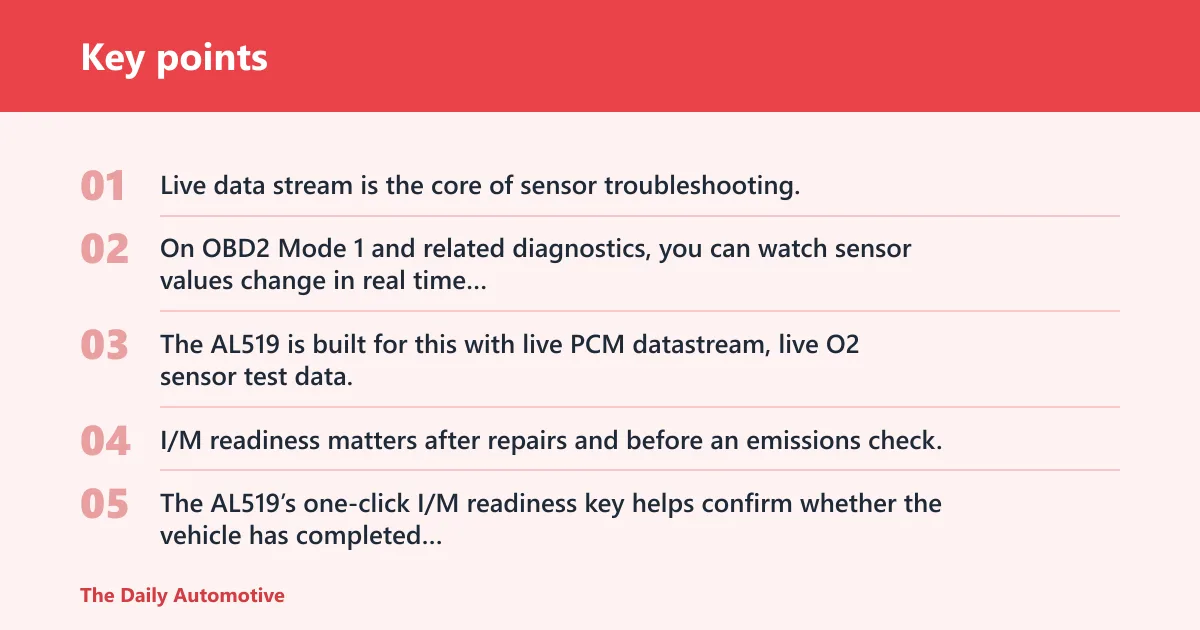
Live data stream is the core of sensor troubleshooting. On OBD2 Mode 1 and related diagnostics, you can watch sensor values change in real time and compare them against engine behavior. The AL519 is built for this with live PCM datastream, live O2 sensor test data, and graphing on 1996 and newer vehicles.
I/M readiness and post-repair checks
How each tier fits sensor work
The AL519 is the lightest useful sensor tool in this group. The AL619 adds ABS and SRS coverage, which matters when the fault is outside the engine computer. The MD806 Pro moves into a more capable diagnostic tier with live data basics. The MX900 and MK808BT Pro are better when you want deeper service functions or more advanced diagnostic reach.
What does not?
A code reader stops short when you need an active test. It can tell you that a fault exists, and it can often show useful live data, but it cannot command components on and off the way a bi-directional scanner can. That matters for confirming whether a sensor circuit or a related actuator is actually behaving as expected.
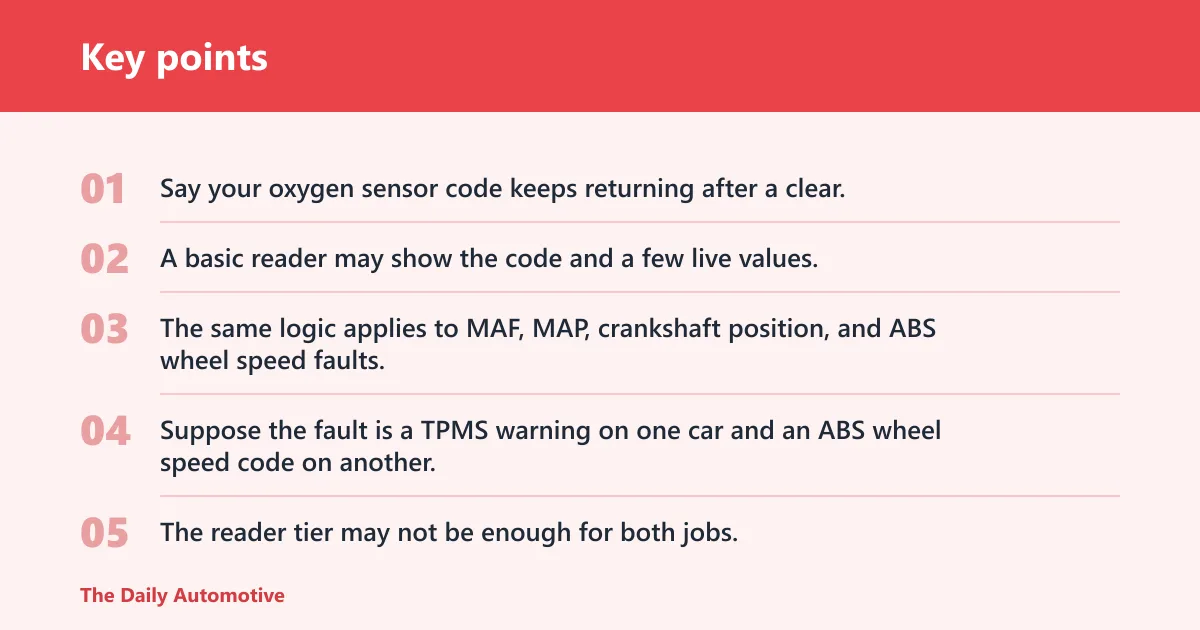
Say your oxygen sensor code keeps returning after a clear, but the signal looks slow only under load. A basic reader may show the code and a few live values, yet a graphing tool plus freeze frame gives a clearer picture of when the fault happens. The same logic applies to MAF, MAP, crankshaft position, and ABS wheel speed faults.
Suppose the fault is a TPMS warning on one car and an ABS wheel speed code on another. The reader tier may not be enough for both jobs, because the support you need depends on the vehicle system, not just the connector shape. Always check model-specific coverage before you buy.
Sensor troubleshooting matrix
This table matches common fault types to the scanner functions that actually help isolate the problem before you replace parts.
| Fault type | Live data | Graphing | Freeze frame | ABS/SRS access | Active tests | Reset functions | Suggested Autel tier |
|---|---|---|---|---|---|---|---|
| O2 sensor | Yes | Yes | Yes | No | Helpful, but not required | After repair, use readiness | AL519 for live-data-only diagnosis; MK808BT Pro or MX900 if you need deeper checks |
| MAF | Yes | Yes | Yes | No | Useful for confirmation | After repair, use readiness | AL519 or MD806 Pro for basic diagnosis; MK808BT Pro for more advanced work |
| MAP | Yes | Yes | Yes | No | Helpful on some vehicles | After repair, use readiness | AL519 is enough for many cases; MX900 if you want service functions too |
| ABS wheel speed | Sometimes | Helpful | Helpful | Yes | More useful on higher tiers | May need system reset | AL619 for ABS/SRS codes; MK808BT Pro or MX900 for deeper diagnosis |
| Crankshaft position | Yes | Yes | Yes | No | Useful if supported | After repair, use readiness | AL519 for quick checks; MD806 Pro for more basic coverage |
| TPMS | Sometimes | Helpful | Sometimes | No | Rarely essential for diagnosis | May need relearn/reset | MX900 or MK808BT Pro if your vehicle support includes the needed service |
Which Autel model fits which sensor job?
The right Autel model depends on whether you need live data only, ABS and SRS coverage, or active-test capability. For plain engine-sensor checks, the AL519 is the cleanest fit. For brake and airbag codes, the AL619 is the better match. For broader service and deeper diagnostics, move to the MX900 or MK808BT Pro.
AutoLink AL519 and AL619
The AL619 is the better choice when the fault lives in ABS or SRS, but it is still a code-reader class tool.
MaxiDiag MD806 Pro
The MD806 Pro sits in a lower-cost diagnostic tier with code reading, clearing, and sensor live data basics. It is a step up from a bare reader, but it is still aimed at straightforward diagnosis rather than active testing or broad system work.
MaxiCOM MK808BT Pro and MaxiCheck MX900
The MK808BT Pro and MX900 are the right step when the fault is hard to pin down or the car needs more than live data. The MK808BT Pro is positioned for advanced diagnostic use at about $549, and the MX900 adds service functions and sensor data access at about $559. Both are more appropriate when you want a larger diagnostic toolbox, not only code reading.
Alternatives
The INNOVA 5310 OBD2 Scanner is a practical alternative if you want ABS and SRS support with live data in a simpler code-reader package. Its drawback is the same one that defines its class: it can help you confirm a fault, but it is not the same as a bi-directional tablet when the job calls for active tests or broader system access.
The Autel MaxiCheck MX808S is the stronger alternative if you want a bidirectional OBD2 scan tool with 3000+ active tests and 28+ service functions. The tradeoff is cost and complexity. For a shopper who only needs sensor live data and readiness checks, that is more tool than necessary.
Should you buy it?
For budget sensor work, the AL519 is the best starting point. It gives you the live data, graphing, O2 data, and readiness check features that solve a lot of real-world sensor questions without pushing you into tablet pricing.
If you want ABS and SRS coverage, the AL619 is the better fit. If you want deeper diagnosis, the MK808BT Pro or MX900 is the better buy. For most home mechanics, the right move is simple: start with the least expensive Autel that still gives you live data for the system you are troubleshooting.
Frequently asked questions
Is an Autel scanner good for sensor troubleshooting?
Yes, if the model can show live data and graph signals. That is what helps separate a failing sensor from a wiring issue or a one-time code. The AL519 is the clearest fit for that job because it combines live PCM datastream, live O2 data, graphing, and readiness checks.
Which Autel scanner reads live sensor data?
The key is not just reading the code. You want a tool that can show changing data while the engine runs, then let you compare that signal to the symptom.
Can an Autel OBD2 scanner test oxygen sensor data?
Yes, if it includes live O2 sensor test data. The AL519 explicitly does. That helps you watch switching behavior and compare it with fuel trim, load, and temperature-related changes before you replace the sensor.
Do I need a bi-directional scanner to diagnose a bad sensor?
Not always. Many sensor faults can be narrowed down with live data, graphing, and freeze frame. A bi-directional scanner becomes useful when you need active tests to command components and confirm whether the sensor circuit reacts the way it should.
Which Autel model is best for ABS and SRS sensor codes?
The AL619 is the clear Autel choice in this group for ABS and SRS support. If the diagnosis needs deeper system access or active tests, the MK808BT Pro or MX900 is the better step up.
Will the Autel AL519 show live O2 sensor data?
Yes. That is one of its defining features.
What Autel scanner is best for a home mechanic?
For most home mechanics focused on engine sensors, the AL519 is the best fit because it keeps the price low while still covering the functions that matter most. If ABS and SRS codes are part of the job, the AL619 is the better home-shop choice.
Is the Autel MK808S worth it for sensor diagnostics?
It can be, if you need bidirectional control and more than basic live data. For simple sensor checks, it is more tool than many drivers need. For intermittent faults, service functions, and broader system work, the higher capability is easier to justify.
Products related to this article
Sponsored / affiliate links. As an Amazon Associate I earn from qualifying purchases. I may earn additional commission from eligible campaigns.