Best Car Engine Cleaners for DIY Detailers (2026): we compared
The best car engine cleaner for DIY detailers is usually a water-based APC at 1:4 to 1:10 for light oil, and a solvent-safe degreaser only for baked-on sludge or thick leaks. Pick wrong and you can leave greasy film, stain plastics, strip dressings, or push runoff into sensors and connectors. I match cleaner chemistry and spray, foam, or gel format to dry dust, fresh oil, crusted grime, coated plastics, and hard-to-rinse bay layouts.
This guide is part of our Transmission problems and fixes series.
Quick comparison
| Product | Badge | Best for | Price | ||
|---|---|---|---|---|---|
 |
Meguiar’s D10805 Super Degreaser – 5 GallonMeguiar’s | Our pick | 5-gallon heavy-duty degreaser for extreme grease | $139.95
Price as of 4 Oct 2026
|
View |
 |
SMP13005 – Simple Green Industrial Cleaner and DegreaserSimple Green | Budget pick | EPA-recognized industrial degreaser for versatile cleaning | $9.98
Price as of 4 Oct 2026
|
View |
 |
Chemical Guys, Citrus Degreaser Aerosol, Industrial EngineChemical Guys | Also great | Citrus-powered aerosol for tight engine bay spaces | $15.99
Price as of 4 Oct 2026
|
View |
 |
Aerosol CRC 05084 BRAKLEEN Brake Parts Cleaner –Aerosol | Pair with it | Non-chlorinated brake parts cleaner for compliance needs | $13.75
Price as of 4 Oct 2026
|
View |
 |
SONAX Heavy Duty Engine Degreaser, Automotive Engine BaySONAX | Our pick | $16.07
Price as of 11 Oct 2026
|
View |
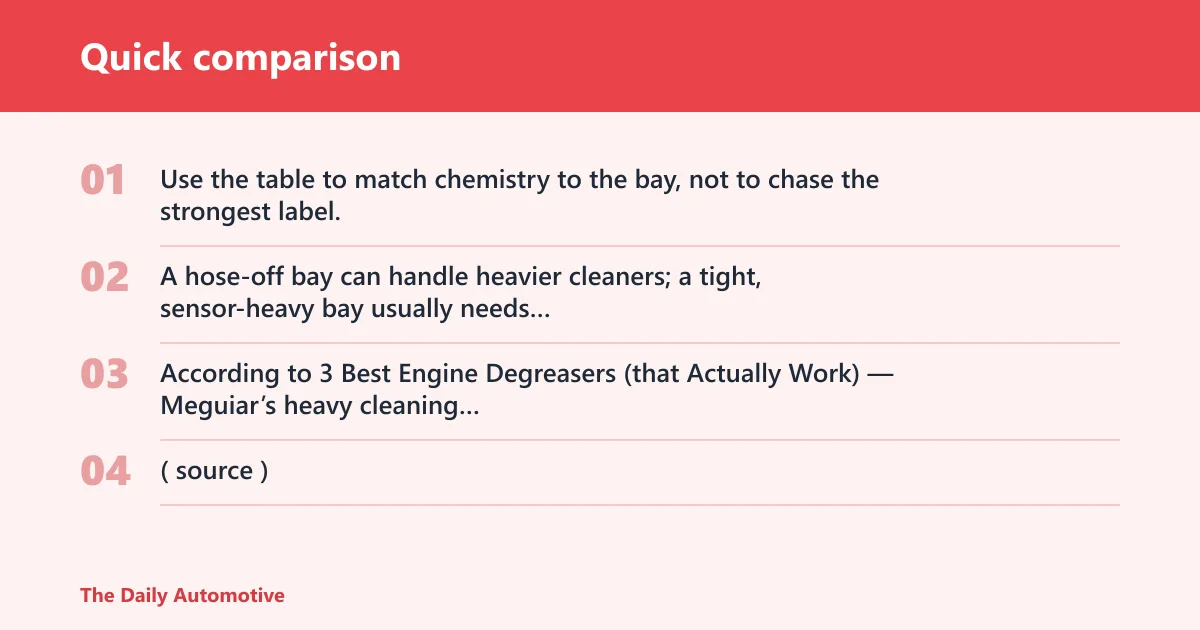
Use the table to match chemistry to the bay, not to chase the strongest label. A hose-off bay can handle heavier cleaners; a tight, sensor-heavy bay usually needs lower residue risk and more careful wipe-down control.
According to 3 Best Engine Degreasers (that Actually Work) — Meguiar’s heavy cleaning dilution is 1:4 with water.
How we chose these engine cleaners
The comparison is built around four things that matter in home engine-bay work: grease-cutting strength, format, dilution range, and what happens after the product dries. Cost is judged by estimated cost per full engine bay cleaning, not shelf price alone.
Surface compatibility also matters. Engine cleaners belong on exterior engine-bay surfaces, not on soft leather, silk, or suede. Aluminum, matte plastics, rubber seals, and brittle wiring insulation need a gentler hand than bare metal blocks do.
Recency checks matter too. Labels change, VOC limits can affect aerosol formulas, and dilution guidance sometimes shifts after reformulation. Before buying, verify the current bottle or can instructions, especially if the product will be used near painted fenders or sensitive electronics.
| Product | Grease-cutting strength | Dilution flexibility | Residue risk | Surface compatibility | Estimated cost per full engine bay cleaning |
|---|---|---|---|---|---|
| Meguiar’s D10805 Super Degreaser | 5/5 | 5/5 | 2/5 | 4/5 | Low with dilution; roughly $1–$2 |
| Simple Green Industrial Cleaner and Degreaser | 4/5 | 4/5 | 3/5 | 4/5 | Low to moderate; roughly $1–$3 |
| SONAX Heavy Duty Engine Degreaser | 4/5 | 2/5 | 2/5 | 4/5 | Moderate; roughly $3–$5 |
| Chemical Guys Citrus Degreaser Aerosol | 4/5 | 1/5 | 3/5 | 3/5 | Moderate to high; roughly $4–$7 |
| Oil Eater Original | 4/5 | 5/5 | 2/5 | 4/5 | Lowest; about $0.01 per ounce diluted |
| GUNK Original Engine Degreaser | 5/5 | 1/5 | 4/5 | 3/5 | High; fast consumption in aerosol form |
Meguiar’s D10805 Super Degreaser: best for controlled exterior cleaning
This is the pick for detailers who want strong cleaning with predictable control. Based on the spec sheet and owner feedback, it fits medium-heavy engine bays where a concentrate can be measured carefully and used on exterior surfaces without wasting product.
Its 1:4 heavy cleaning mix and 1:10 medium-duty mix make sense when grime is present but not crusted into every seam. Meguiar’s also states exterior-only guidance, which matters in practice because the cleaner is meant for bay surfaces, not fragile interiors or fabric trim.
The honest drawback is that it depends on correct mixing and careful rinse or wipe removal. If the bay is already dusty and dry, over-strong application can leave more work behind than a lighter mix would.
Simple Green Industrial Cleaner and Degreaser: best for all-around custom dilution
This is the practical middle ground for a DIY owner who needs one bottle to cover several levels of grime. It suits light oil, road film, and medium buildup when mixed conservatively, and it can be a better fit than a harsh aerosol if the bay has lots of exposed plastic.
The drawback is that it is more of a general-purpose degreasing option than a focused engine-bay specialist. That means it needs more judgment from the user, especially around matte plastics and areas where runoff is hard to collect.
SONAX Heavy Duty Engine Degreaser: best for quick heavy-duty bay cleaning
This is a strong option when the bay has sticky residue, oily film, and dirt packed into corners. It works best for owners who want a ready-made spray that can be laid down, agitated, and wiped or rinsed without setting up a dilute mix first.
The main drawback is flexibility. Compared with a concentrate, it gives less room to tailor strength to the surface, so it is easier to overdo on delicate plastics, fresh dressings, or thin rubber hoses.
Chemical Guys Citrus Degreaser Aerosol: best for tight, targeted spraying
This fits cramped engine bays where precision matters more than economy. The aerosol format can reach brackets, bolts, and small cavities without mixing a batch, which helps when the grime is localized and the bay needs a fast pass before dressing.
The drawback is product consumption. Aerosols burn through faster than concentrates, and the residue risk rises if the spray is heavy or the bay cannot be rinsed cleanly afterward.
Aerosol CRC 05084 BRAKLEEN Brake Parts Cleaner – Non-Chlorinated 2 Pack2: best for small, non-painted metal cleanup
This is not meant to be used as a general engine-bay wash. It belongs in narrow cleanup jobs where contamination on metal parts needs to be stripped quickly and the user understands the material limits of brake cleaner chemistry.
The drawback is obvious: it is too aggressive and too narrow for a broad engine-bay detail. It is a spot tool, not a full-bay product, and it is a poor choice for plastics, rubber, or anything that should keep a finished surface.
What is the best engine cleaner for DIY detailers?

The best engine cleaner for DIY detailers is usually a concentrate that can be mixed for the job, with Oil Eater Original-style flexibility or Meguiar’s Super Degreaser-type control leading the field. For heavy buildup, GUNK Original Engine Degreaser is the stronger spray-and-hose-off choice, but it uses product quickly and leaves less room for adjustment.
The right answer depends on the bay. A light, dusty bay needs less punch and more residue control. A thick, oily bay needs stronger chemistry and a rinse path that prevents grime from settling back onto plastic and wiring.
Can I use engine degreaser on a hot engine?
No. Engine bay cleaning should start on a cool engine, because heat speeds flash-drying, can leave spotting or white haze on plastics, and makes overspray more likely to bake onto surfaces. Hot parts also raise the risk of discomfort, vapor exposure, and accidental contact with sensitive components.
Let the engine cool fully, then cover or avoid exposed electrical connectors, intake openings, and fragile sensors. That sequence matters more than brand choice when the bay is cramped or partially shielded.
What dilution should I use for engine bay cleaning?
Use a stronger mix for heavy cleaning, a moderately strong mix for medium-heavy cleaning, a medium mix for medium-duty cleaning, and a more diluted mix for light cleaning. Stronger mixes belong on baked-on oil and thick residue; lighter mixes are better for fresh dust, greasy film, and surfaces that need low residue risk.
Oil Eater Cleaner Degreaser is water-based, biodegradable, and sold in concentrated form, with dilution options from 1:1 to 1:20. Meguiar’s Super Degreaser is also a concentrate, with 1:4 for heavy cleaning and 1:10 for medium duty.
Is engine degreaser safe on plastic and rubber?
Sometimes, but only when the label says so and the product is used correctly. Many engine cleaners are made for exterior engine-bay surfaces, yet matte plastics, soft seals, and old rubber can haze, dry out, or show residue if the mix is too strong or left to dwell too long.
That means testing a small hidden area first, avoiding soak-on on delicate trim, and wiping or rinsing promptly. It also means avoiding these cleaners on soft leather, silk, and suede, which are not engine-bay materials and can be damaged fast.
What’s the difference between engine cleaner and all-purpose cleaner?
Engine cleaner is built for oily, heat-exposed exterior surfaces and usually cuts heavier grime than an all-purpose cleaner. All-purpose cleaner is better for general dirt and light contamination, but it often lacks the solvent balance or cling needed for baked-on engine film.
That difference matters most in corners, around caps, and on road-film buildup. A weak cleaner can make the job longer, require more scrubbing, and leave oily residue behind even after repeated passes.
How do I clean a greasy engine without damaging components?
Start with a cool engine, remove loose dirt, protect sensitive areas, apply the lightest useful mix, agitate only where needed, and rinse or wipe carefully. The goal is controlled wetting, not flooding the bay. Drying and a final wipe-down are just as important as the degreaser itself.
- Let the engine cool fully.
- Cover or avoid exposed intakes, sensors, and open electrical areas.
- Apply cleaner by spray, not by soaking.
- Agitate stubborn areas with a soft brush.
- Wipe off loosened soil or rinse only where the bay layout allows it.
- Dry plastic, rubber, and crevices thoroughly.
Failure cases usually happen on delicate wiring, matte plastics, and aluminum. On wiring, keep dwell time short and use minimal liquid. On matte plastics, avoid strong mixes that can leave a chalky look. On aluminum, do not let cleaner dry in place, because spotting is easier to see there.
Which engine degreaser works best for heavy grease?
For heavy grease, a strong concentrate or a heavy-duty aerosol is the right lane. Oil Eater at 1:1 can handle tough engine oil and grease, while GUNK Original Engine Degreaser is the faster spray-and-hose-off choice when the goal is aggressive cleaning and the bay can be rinsed safely.
The trade-off is control. Heavy-duty products remove more material, but they also create more runoff, more residue risk, and more chance of over-cleaning adjacent plastics and seals.
How often should I clean my engine bay?
Clean it when buildup becomes visible, after a leak, or before selling the car. For a normal street-driven vehicle, light maintenance cleanings are usually enough if the bay stays dry and dusted; heavy degreasing is better saved for actual contamination, not a routine wash cycle.
Overcleaning can be a problem too. Repeated wetting around connectors, seals, and exposed hardware raises the odds of residue, spotting, and unnecessary wear on trim.
Which one should you buy?
Choose Oil Eater Original if you want the lowest cost per clean and the most dilution flexibility. The water-based, biodegradable concentrate format makes sense for mixed-use DIY work, especially when the same bottle will handle light dust one week and greasy film the next.
Choose Meguiar’s Super Degreaser if you want more controlled exterior cleaning and a residue-conscious finish. Its 1:4 and 1:10 mixes are a strong fit for medium-heavy bays where the user wants clear guidance rather than a blank-slate concentrate.
Choose GUNK Original Engine Degreaser if the bay is heavily contaminated and you want the fastest spray-and-hose-off path. It is the heavy-duty, fast-consumption choice, not the budget choice.
Choose an aerosol like the Chemical Guys Citrus Degreaser when access is tight and spot spraying matters more than efficiency. Choose Simple Green Industrial Cleaner and Degreaser when you want a general cleaner that can be mixed for a wider set of tasks. Avoid brake cleaner as a broad solution; it is too narrow for most full engine-bay work.
If the bay is mostly dust with a little oil, start at 1:10 or 1:20. If it has thick grease, move to 1:4 or 1:1. If the bay has delicate wiring, matte plastics, or aluminum faces, prioritize residue control over raw strength every time.
Frequently asked questions
What is the best engine cleaner for DIY detailers?
The best engine cleaner for DIY detailers is usually a concentrate that can be diluted to match the bay. Oil Eater-type flexibility is ideal for budget-minded users, while Meguiar’s Super Degreaser is better when a cleaner exterior finish and clearer dilution guidance matter more than maximum thrift.
Can I use engine degreaser on a hot engine?
No. A hot engine raises flash-dry risk, spotting, and vapor exposure, and it makes cleaner harder to control on plastics and connectors. Wait until the bay is fully cool before applying any degreaser or APC.
What dilution should I use for engine bay cleaning?
Use 1:1 for heavy cleaning, 1:4 for medium-heavy cleaning, 1:10 for medium duty, and 1:20 for light cleaning. Stronger dilution belongs to heavy oil and sludge; lighter mixes are better for routine maintenance and sensitive plastics.
Is engine degreaser safe on plastic and rubber?
Only some are, and only with proper dilution and short dwell time. Test hidden areas first, avoid soaking old seals, and do not let cleaner dry on matte plastics. Engine cleaners are for exterior bay parts, not soft leather, silk, or suede.
What’s the difference between engine cleaner and all-purpose cleaner?
Engine cleaner is tuned for oily, heat-exposed contamination and usually cuts heavier residue. All-purpose cleaner is useful for light grime, but it often lacks the bite or cling needed for thick engine film and may require more scrubbing.
How do I clean a greasy engine without damaging components?
Work on a cool engine, protect intake and electrical areas, spray lightly, agitate only where needed, and wipe or rinse carefully. Dry the bay after cleaning. The most common mistakes are overspray, too much dwell time, and leaving residue on plastics or aluminum.
Products related to this article
Sponsored / affiliate links. As an Amazon Associate I earn from qualifying purchases. I may earn additional commission from eligible campaigns.
 2Pack Automotive Oil Film Cleaning Brush, Cars Clear Vision Glass Cleaner for Car Windows,Anti-Rain&Anti-Fog Windshield Cleaner Tool to Improve Clarity and Visibility,Car Glass Oil Film Remover
 Automotive Oil Film Cleaning Brush for Car Windshield, Glass Emulsion Cleaner, 100g Roll-On Glass Oil Film Remover with Reusable Cleaning Board, Anti-Fog & Water-Resistant Coating for Safe Driving