Can I Drive an Uninsured Car If I Have Insurance?
In most states, the vehicle itself must be insured to be legally driven on public roads, even if the driver has their own insurance. It may still be possible for your policy to respond to a claim if the car fits permissive-use or other covered-auto rules, but that is a coverage question, not a road-legality guarantee. This guide separates road legality, policy terms, and whether the car counts as a covered auto.
Quick answer
Driving an uninsured car and having your own insurance are different questions. A state may allow the drive only if the car meets registration and insurance rules, while your insurer may still deny part or all of a claim because the vehicle does not fit the policy language. For state-law questions, check your state DMV or insurance department; for policy questions, check the declarations page, definitions, and exclusions.
That is why the answer depends on three checks: whether the drive is legal, whether your policy extends to you in that car, and whether the car qualifies as a covered auto under the policy wording. Miss one check, and coverage can fail even with your own policy in force.
A common mistake is assuming comprehensive coverage gives permission to drive any car. It does not. Comprehensive coverage pays for certain non-collision losses if the policy applies, but it does not make an uninsured vehicle legal to drive or covered in every case.
Why legality and insurance are separate
State law controls whether the vehicle may be driven on public roads, whether it must be registered, and what proof of insurance may be required. Your policy controls whether an insurer will defend you, pay a third-party claim, or repair damage to the car you were driving.
Those two systems overlap, but they are not the same. A car can be legal to operate only if it meets the state’s rules and the owner’s registration and insurance duties. At the same time, your own personal auto policy may or may not extend to a borrowed or non-owned vehicle.
Uninsured car decision matrix

Use this table as a quick filter. It is not a coverage promise. The actual answer depends on the declarations page, definitions, exclusions, and any endorsement that changes how the policy treats non-owned vehicles, rentals, or a temporary substitute vehicle.
| Scenario | Likely liability coverage | Likely physical damage coverage | What to verify on the policy |
|---|---|---|---|
| Your own car | Usually yes, if listed and premiums are current | Usually yes if you carry collision and comprehensive coverage | Named vehicles, coverages, deductibles, exclusions |
| Borrowed car | Sometimes, under permissive use | Often limited or absent unless the policy says otherwise | Permissive use, non-owned vehicle, regular use exclusions |
| Friend’s car | Sometimes, if the owner gave permission and the use fits the policy | Often only if your policy or the owner’s policy allows it | Who is primary, household member rules, exclusions |
| Family member’s car | Sometimes, but household rules often matter | Often narrow unless the policy treats it as eligible | Household member, regular use, resident relative language |
| Rental | Commonly included as a covered situation | Sometimes included, sometimes limited to what your policy buys | Rental car coverage, territory limits, loss-use wording |
| Newly purchased car | May be covered briefly after purchase | May be covered briefly if your policy extends to a newly acquired vehicle | Notification deadline, automatic coverage window, replacement language |
| Temporary replacement | Often yes if your insured car is being repaired, stored, or serviced | May be covered as a temporary substitute vehicle | Temporary substitute automobile wording, reason your car is unavailable |
| Non-owned car | Some coverage may extend, especially liability | Usually more limited than liability | Non-owned vehicle definition, regular use, named-driver limits |
How to read the chart
The liability column asks whether your policy may pay third-party injuries or property damage if you are found legally responsible. The physical damage column asks whether your policy may pay for damage to the car itself through collision or comprehensive coverage.
Those are different promises. A policy can extend liability in a non-owned situation while still refusing to pay for the borrowed car’s bent bumper or smashed glass. That is one of the most common claim surprises.
Where the answer usually lives
Look first at the declarations page, then the definitions section, then exclusions. If the policy uses terms like covered auto, non-owned auto, temporary substitute, or newly acquired vehicle, those definitions often control the result more than the marketing language on the front page.
Can I drive an uninsured car if I have insurance?
Sometimes, yes, if the car fits a covered category under your policy and the owner permitted you to drive it. But your own insurance does not automatically attach to every uninsured car. If the vehicle is a regular-use car, a household member’s car, or one excluded by the policy, coverage can fail.
When your own policy may extend
A personal auto policy may cover a vehicle you newly acquired after the policy began. A replacement vehicle may be covered under a personal auto policy. Rental vehicle coverage may be included as a covered situation. A temporary car used while your vehicle is being repaired, stored, or serviced may be covered.
Liability insurance may follow the driver in some non-owned situations, but that shorthand can mislead. The owner’s policy is often primary on permissive use, and the order depends on policy wording and the facts of the trip. Do not assume your policy is the only one that matters.
When it usually will not
If the vehicle is in your household, available to you on a regular basis, or driven without valid permission, the insurer may deny coverage. Named-driver restrictions can also block a claim if you are not an approved driver for that vehicle or class of vehicle.
Suppose your friend lends you a sedan for a two-mile errand, and you have permission. That can fit a permissive-use scenario. Now change one fact: you use the same car every weekday for a month. That regular-use pattern is exactly where many policies stop treating the car as a simple borrowed vehicle.
Which coverages may follow you?
Only some coverages may extend to non-owned vehicles, and even then, only within policy terms. Liability coverage is the most likely to extend in a non-owned situation. Uninsured motorist protection and medical payment protection may also extend, but the policy language controls.
Liability coverage on a non-owned vehicle
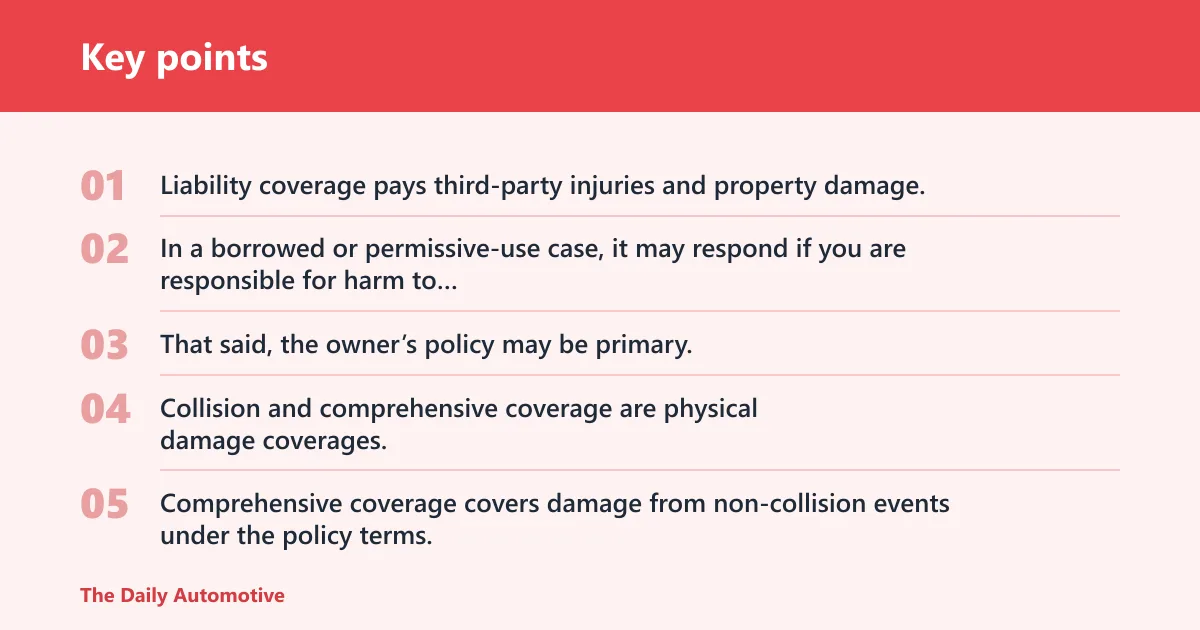
Liability coverage pays third-party injuries and property damage. In a borrowed or permissive-use case, it may respond if you are responsible for harm to someone else. That said, the owner’s policy may be primary, and your own policy may act as excess or may not apply if the vehicle is excluded.
Collision and comprehensive coverage
Collision and comprehensive coverage are physical damage coverages, and they are often more limited on a non-owned car than liability coverage. Comprehensive coverage covers damage from non-collision events under the policy terms, such as theft, hail, or fire, but it does not by itself answer whether you are allowed to drive the car.
Can you drive an uninsured car if you have comprehensive insurance? Not because of comprehensive coverage alone. The policy still has to allow the use, and the car still has to fit a covered category. Otherwise, comprehensive may pay nothing.
Medical payments and uninsured motorist coverage
Medical payments coverage may extend to occupants in some non-owned situations, depending on the policy wording. Uninsured motorist protection can also come into play if another driver causes the loss and lacks insurance, but that is separate from whether your own policy covers the car you were driving.
The main point is simple: a policy may protect people in one way and still leave the vehicle itself outside coverage. That distinction matters after a crash, because a denied physical damage claim can leave you paying to fix the borrowed car even when some liability protection applies.
When a car may count as a covered auto
Some vehicles fall into policy buckets that are broader than a plain borrowed car. That is where many readers get tripped up. The policy may treat a temporary substitute vehicle, a newly acquired vehicle, or a rental car differently from a random uninsured car sitting in someone else’s driveway.
Temporary substitute vehicle
A temporary substitute vehicle is often used while your own car is being repaired, stored, or serviced. A temporary substitute automobile is described as a covered auto type on some policies. That is not the same as any random car you borrow because it was convenient.
If your insured sedan is in the body shop after a fender-bender, and you are using a borrowed hatchback only until repairs finish, the policy may treat that hatchback differently than if you kept it for weeks as a second daily driver.
Newly acquired vehicle
A personal auto policy may cover a newly acquired vehicle after you buy it, but the coverage window depends on the insurer and the policy terms. That usually means you need prompt notification and an update to the policy so the new car becomes an explicitly covered auto.
Do not assume the grace period lasts indefinitely. If you buy a car on Friday and wait too long to call, the insurer may argue the automatic coverage period ended before the loss or citation happened.
Rental car
Rental car coverage may be included as a covered situation. That does not mean every rental is fully protected. The limits, deductibles, and damage rules can differ from your owned car, and some policies or credit-card benefits fill gaps only for certain losses.
What usually breaks coverage
Most coverage failures come from policy exclusions, not from the fact that you have insurance somewhere else. The car may be outside the policy’s definition of a covered auto, or the driver may fall into an excluded category. Either way, the claim can fail even when the driver had permission.
Regular use and household member issues
Regular-use exclusions often block coverage when you use a car often enough that the insurer expected it to be listed. Household member language can also matter if the vehicle belongs to someone who lives with you or if the policy treats that car as available for household use.
Named-driver and permissive-use restrictions
Some policies limit who may drive a car, or they may condition coverage on permissive use. If the owner did not give valid permission, coverage can fail. If a policy only names certain drivers, an uninsured borrowed car can become a problem fast.
No valid permission from the owner
Permission matters because a borrowed vehicle is not automatically covered just because you are insured. If the owner did not allow the use, the driver may face a claim denial, and the vehicle owner’s insurer may also dispute the loss. That is a common failure point in disputes over uninsured cars.
Can I drive a friend’s or family member’s uninsured car?
Sometimes, but this is where people most often overread their own policy. A friend’s car or a family member’s car may fit permissive use, yet household-member exclusions, regular-use rules, and owner-policy conditions can still block coverage. A borrowed car is not automatically a covered auto.
Borrowed car from a friend
The article says a personal auto policy may cover you temporarily while using a borrowed car. That temporary word matters. Short, permissive use is the common fact pattern; regular use is where coverage problems start. Confirm whether the vehicle is outside any exclusion before you drive it.
Family member’s car in the same household
Family cars are more likely to trigger policy wording about resident relatives, household members, or vehicles available for regular use. If the car lives in the same driveway, insurers often look hard at whether it should have been scheduled on the policy or listed under a different driver arrangement.
What to confirm before you turn the key
- Ask whether the owner gave valid permission.
- Check whether the car is a temporary substitute, rental, newly acquired vehicle, or simply borrowed.
- Read the non-owned, household member, and regular-use exclusions.
- Confirm whether liability, collision, comprehensive, medical payments, and uninsured motorist coverage apply.
- Verify whether the owner’s policy or your policy is primary.
What to check before you drive
The safest answer usually comes from the policy itself. Start with the declarations page for the listed coverages, then read the definitions and exclusions, then call the insurer or agent if any term is unclear. That is faster than guessing after a crash or traffic stop.
Declarations page clues
Look for the vehicles listed, the coverage types, the deductible amounts, and any endorsement that changes permissive use, rental coverage, or non-owned vehicle terms. If the car is not listed and the policy does not treat it as a covered auto, the gap may be obvious right there.
Definition and exclusion sections
Search for phrases such as non-owned vehicle, covered auto, temporary substitute vehicle, newly acquired vehicle, household member, regular use, and permissive use. Those words often decide whether the policy follows you into someone else’s car.
Questions to ask your insurer or agent
Ask these in plain language: Does my policy cover me in a borrowed car? Does it apply to a friend’s uninsured car? Does it change if the owner lives with me? Does collision or comprehensive apply to a rental or temporary substitute vehicle? Get a direct answer before driving.
Frequently asked questions
Can I drive an uninsured car if I have insurance on another car?
Sometimes, but only if the car fits your policy’s non-owned or permissive-use rules and the owner allowed the use. Insurance on another car does not automatically transfer to every vehicle. Coverage can fail if the car is a regular-use vehicle, a household member’s car, or otherwise excluded.
Can I drive an uninsured car if I have insurance: yes in some cases, no?
Yes in some cases, no in others. The answer depends on legality, permission from the owner, and whether your policy treats that car as a covered auto. Liability may extend in limited non-owned situations, but physical damage coverage is usually narrower and may not apply at all.
Can I drive an uninsured car if I have fully comp insurance?
Comprehensive coverage alone does not let you drive an uninsured car. It only addresses certain losses if the policy applies. You still need permission from the owner, and you still need the vehicle to fit a covered category such as a temporary substitute vehicle, rental, or eligible borrowed car.
Can I drive an uninsured car if I have my own insurance?
Having your own policy helps, but it is not blanket permission. Your liability coverage may extend in a borrowed-car situation, and your policy may cover you temporarily while using a borrowed car. That said, exclusions for regular use, household members, or named drivers can shut coverage down.
Can I drive a car without insurance if I have insurance?
Sometimes, but you should not treat that as a general rule. A car without its own insurance may still be driven legally only if state rules are satisfied and your policy extends to that use. If the car is outside the policy terms, you may face citations and denied claims.
Can you drive an uninsured car if you have comprehensive insurance?
Comprehensive insurance does not answer the permission question by itself. It may pay for some non-collision damage under the policy terms, but it does not automatically make an uninsured car legal to drive or covered for every loss. Check the car’s status under your policy first.
Products related to this article
Sponsored / affiliate links. As an Amazon Associate I earn from qualifying purchases. I may earn additional commission from eligible campaigns.
 Front Car Seat Covers for Dogs, Waterproof Dog Car Seat Cover for Truck SUV
 Touch Up Paint for Cars, 3-Pack - White Car Scratch Repair Pen, Color Accurate Automotive Touch Up Paint, Long-Lasting Scratch Resistance, Fast-Drying & User-Friendly, Safe & Water-Resistant for Automotive & Household Touch-Ups