Leather Interior Detailing Cost / Price / How Much
Leather interior detailing typically costs $75 to $250 for cleaning and conditioning, $200 to $500 with protection, and $500 or more if dye repair, scuff repair, or seat restoration is included. Skip the right service, and leather can stay dirty, sticky, dried out, or worn past the point where repair stays affordable. This guide breaks quotes into cleaning, conditioning, protection, and restoration so you can compare prices line by line.
Typical cost range
For most cars, leather-focused interior work sits inside the broader range for professional interior detailing, which typically costs $100 to $300. Basic interior cleaning can start around $75, while heavily soiled interiors can cost $400 or more. The final bill depends on how much of the cabin is leather, how dirty it is, and whether the shop is charging for cleaning only or for deeper correction.
Leather work is priced differently from generic interior detailing because it takes separate labor. A quick vacuum and wipe-down does not remove body oils from bolsters, dye transfer from denim, or grime packed into seams. Once a shop has to clean seats, treat staining, condition the material, and protect it, the quote moves beyond a standard cabin wipe-down.
Typical price bands by service depth
Broad interior packages still matter, because they frame the floor and ceiling. A partial interior detail is listed at $60 to $180. A standard interior detail is shown at $100 to $175, and a full interior detail is shown at $150 to $400. If leather care is added, the total rises further.
That spread is normal. A clean daily driver with light dust may need only seat cleaning and a conditioning step. A neglected family SUV with pet hair, food residue, and dye transfer may need multiple labor passes, plus stain treatment or odor work.
What is included in a leather interior detail?
A leather interior detail should separate basic cleaning from conditioning and protection. At minimum, a shop should vacuum debris, clean leather surfaces with a leather-safe product, wipe residue from bolsters and seams, and finish by drying the material properly. Conditioning and protection are often separate line items, and you should ask before assuming they are included.
A basic interior clean usually covers vacuuming, surface wiping, and glass cleaning. A full interior detail goes further with more time on seats, trim, touch points, and stubborn grime. A deep-clean or restoration tier adds stain treatment, pet hair removal, odor work, and, when needed, leather repair or color correction.
Leather cleaning, conditioning, and protection
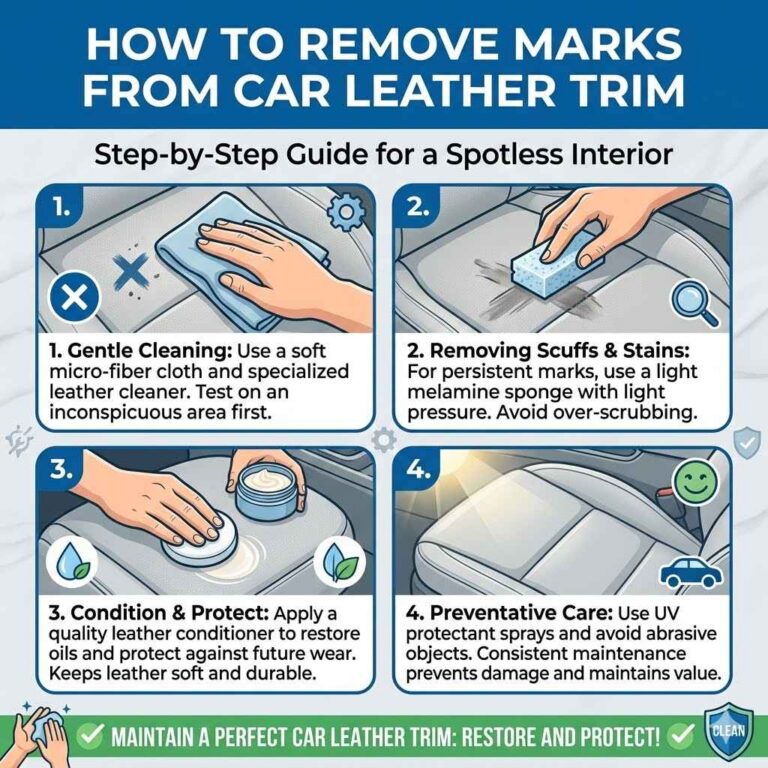
Leather cleaning removes soil. Leather conditioning helps soften the surface and replace some lost moisture after cleaning. Protection adds a barrier against future wear, body oils, and staining. Those are different tasks, and some shops price them separately.
Leather conditioning is listed as a $50 to $100 add-on, and leather conditioning and stain removal are grouped as $20 to $150 add-ons in some price guides. That wide range reflects how much product is used, whether the leather is dry or cracked, and whether the service is limited to seats or extended to trim panels and armrests.
What should be covered on seats, bolsters, trim, and stitching?
A proper quote should spell out seat faces, side bolsters, headrests, center armrests, trim pieces, and stitching lines. Those seams hold grit and body oils. Perforated leather needs careful product use so liquid does not sit in the holes or soak into foam underneath.
Suppose a sedan has light dust on the front seats but sticky buildup on the driver bolster and a ring of denim transfer on the seat edge. A fair quote should separate light cleaning from spot treatment, because the edge work takes more time than the flat panel.
Leather quote decoder table
| Service type | Typical price range | What should be included | Common upsells | Red flags |
|---|---|---|---|---|
| Front seats only | $80 to $300 | Vacuuming, leather-safe cleaning, seam brushing, wipe-down of visible residue | Conditioning, stain treatment, protection, pet hair removal | Quoted as “cleaned” without seat count, no mention of seams or bolsters |
| Full cabin leather cleaning | $100 to $300 | All leather seating surfaces, touch points, armrests, and trim cleaned with a pH-balanced leather-safe product | Conditioning, protection, odor treatment | Cleaner type not named, or quote skips rear seats and trim |
| Leather conditioning | $50 to $100 add-on | Post-clean conditioning for softness and moisture support | Protection package, crack-prevention care, trim conditioning | Bundled without saying whether it is separate or included |
| Leather protection | Often bundled or added to a higher-tier detail | Applied after cleaning and conditioning to help resist future soil and wear | Longer-term protection package, UV-oriented care | No explanation of duration, coverage, or whether seats are prepped first |
| Stain or dye transfer treatment | $20 to $150 add-on | Spot treatment for denim transfer, dark marks, and embedded stains | Extra labor for repeated passes, color correction, leather repair | Quoted as “deep clean” with no mention of what stains are excluded |
| Pet hair removal | $20 to $150; commonly adds $80 to $100 or more in tougher cases | Embedded hair removal from seats, seams, floor edges, and cargo areas | Odor treatment, extra vacuuming, trim brushing | No surcharge disclosed even when hair is visibly embedded in fabric and seams |
| Odor treatment / ozone | $50 to $250 | Odor source evaluation, deodorizing steps, and ozone treatment when appropriate for smoke or pet odor | Cabin filter replacement, antimicrobial cleaning | Promised as a cure for all odors without source removal |
| Heavy restoration | $500 or more | Deep cleaning plus dye repair, scuff repair, seat restoration, or correction of severe wear | Panel recoloring, stitching repair, multi-step restoration | Low quote that ignores cracking, dye loss, or damaged bolsters |
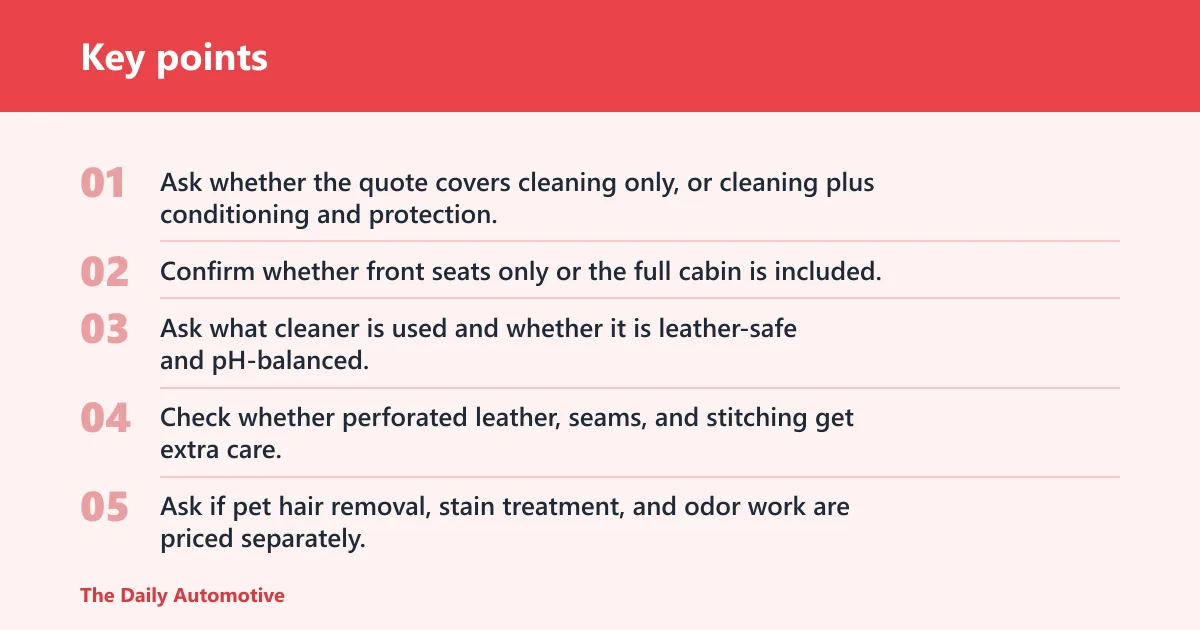
Fair quote checklist
- Ask whether the quote covers cleaning only, or cleaning plus conditioning and protection.
- Confirm whether front seats only or the full cabin is included.
- Ask what cleaner is used and whether it is leather-safe and pH-balanced.
- Check whether perforated leather, seams, and stitching get extra care.
- Ask if pet hair removal, stain treatment, and odor work are priced separately.
- Get any restoration, dye repair, or scuff repair written out before work starts.
Why do leather detailing prices vary so much?
Leather detailing prices vary because labor, not just product, drives the bill. A clean sedan with lightly soiled seats is a short job. A truck with cracked leather, dye transfer, and dog hair in every seam is a long one. Vehicle size, interior condition, and service depth all move the price in different directions.
Interior detailing labor often assumes a shop rate that has to cover time, chemicals, towels, brushes, extractors, and wear on equipment. A 2-hour leather cleanup and a 6-hour restoration job should not cost the same, even if both start with the same base package.
Vehicle size changes labor time
Sedans usually cost less because there is less seating surface, fewer trim pieces, and shorter cleanup time. SUVs and trucks often run $180 to $350 for a full detail, and vans can cost more still because there is simply more cabin to clean. More square footage means more seat area, more seams, and more time spent moving through the cabin.
The labor impact is real. A larger cabin can turn a 2-hour job into a 4-hour job before any deep leather treatment begins. That is why a quote that looks high on paper may be normal for a three-row SUV or work truck.
Interior condition changes the final bill
Wear matters. Dry leather, cracked bolsters, heavy body-oil buildup, pet hair, and dye transfer all add labor. A surface that looks dirty in one pass may need multiple rounds of cleaning and inspection before it is ready for conditioning or protection.
A common first-timer mistake is assuming a cracked, sun-faded leather seat will cost the same to detail as one that only needs a light cleaning. Some of it is transfer from jeans or belts, and some of it is wear in the topcoat. Those are different problems, and the latter may move the job into restoration pricing.
Materials and equipment add cost too
Cleaners, conditioners, brushes, microfiber towels, low-moisture applicators, and extraction equipment all have costs. So do odor treatments and specialty products for dye transfer or severe staining. A quote that is too low may be skipping one of those steps rather than saving you money.
How much do add-ons change the price?
Add-ons can change the bill as much as the base detail itself. Leather conditioning is often the first extra charge, followed by stain or dye transfer treatment, pet hair removal, and odor work. The more labor the shop has to spend on seams, bolsters, and problem spots, the higher the total.
Leather conditioning and protection
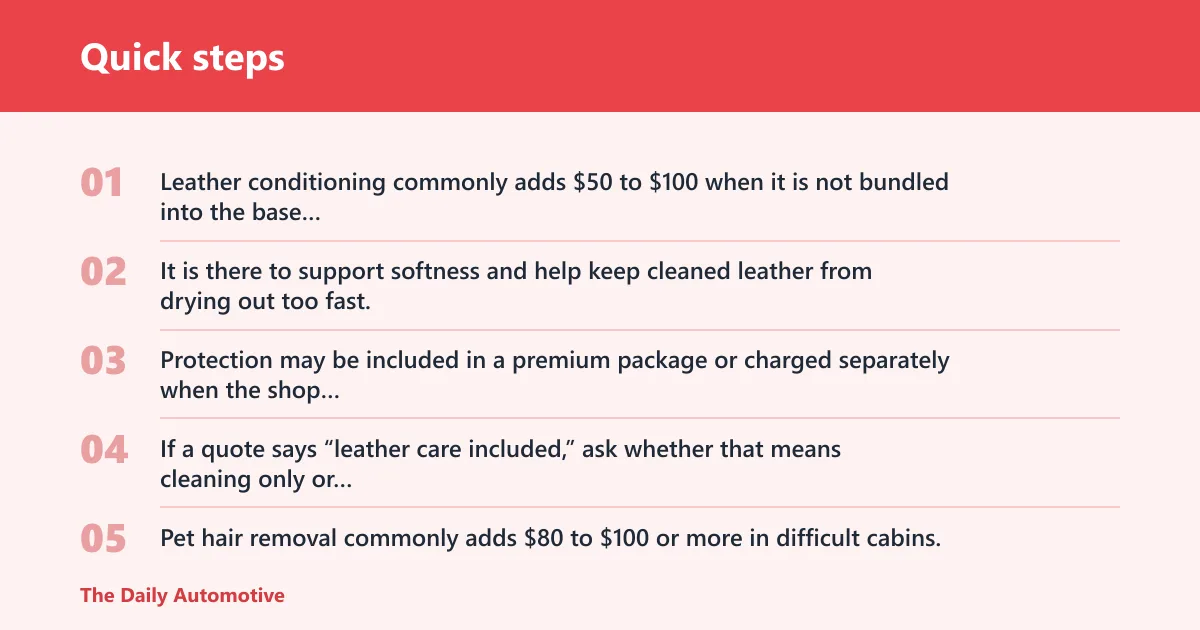
Leather conditioning commonly adds $50 to $100 when it is not bundled into the base package. It is there to support softness and help keep cleaned leather from drying out too fast. Protection may be included in a premium package or charged separately when the shop applies a dedicated protectant after cleaning.
If a quote says “leather care included,” ask whether that means cleaning only or cleaning plus conditioner and protectant. Those are not the same service.
Pet hair, stains, and odor work
Pet hair removal commonly adds $80 to $100 or more in difficult cabins, though some guides list it at $20 to $150. Embedded hair in seams, carpet edges, and seat tracks takes time. If the cabin also smells of smoke or pets, odor elimination is listed at $50 to $250, and ozone treatment is often used for that kind of work.
Stain or dye transfer treatment is commonly listed as a $20 to $150 add-on. That range can climb when the leather has repeated denim transfer, dark scuffs, or stains that need repeated spot treatment. Safe product use matters here; a harsh solvent can strip finish or leave the leather patchy.
Say your SUV has tan leather with dark dye transfer on the driver seat, plus a dog’s worth of embedded hair in the second row. The quote should not look like a basic clean. It should clearly show cleaning, pet hair removal, stain work, and, if needed, odor treatment as separate items.
What should you ask for in a quote?
Ask for a line-by-line quote, not a single total. You want to know whether the shop is pricing cleaning, conditioning, protection, stain treatment, pet hair removal, and odor work separately. You also want the quote to say which seats are covered and whether the job includes front seats only or the full cabin.
- Ask what products will touch the leather and whether they are leather-safe and pH-balanced.
- Ask whether perforated leather, stitching, and seams receive special care.
- Ask if protection is included or only offered as an upgrade.
- Ask whether spot treatment for dye transfer or stains is included in the base price.
- Ask whether pet hair and odor work are separate charges.
- Ask how much time the shop expects for the job, because time often tracks with labor depth.
Frequently asked questions
How much does leather interior detailing cost?
Leather interior detailing typically starts around $75 for light cleaning and can move to $250 or more when conditioning is added. If protection is included, the total often rises to $200 to $500. Heavy dye repair, scuff repair, or restoration can push the price to $500 or more.
Why do leather seat detailing prices vary so much?
Prices vary because seat condition, vehicle size, and service depth change the labor. Light cleaning is quick. Dye transfer, cracking, pet hair, and heavy soil take longer and may need repeated passes or specialty products. That is why one quote can be much higher than another.
How much extra does leather conditioning add to the bill?
Leather conditioning is commonly a $50 to $100 add-on when it is not bundled into the detail. Some guides group conditioning with stain removal as $20 to $150 add-ons. The price depends on how much leather is treated and whether the shop is also applying protection.
Do SUVs and trucks cost more for leather interior detailing?
Yes. SUVs and trucks often cost more because they have more surface area, more seats, and more labor time. A full detail on those vehicles is often listed at $180 to $350, and vans can be higher still when the cabin is large or heavily used.
How can I avoid hidden fees on a leather interior detail?
Get the quote in writing and make sure it lists what is included and what is extra. Ask specifically about pet hair, stains, odor treatment, conditioning, protection, and restoration. If the shop will not separate those line items, the final bill can rise fast once the work starts.
Products related to this article
Sponsored / affiliate links. As an Amazon Associate I earn from qualifying purchases. I may earn additional commission from eligible campaigns.