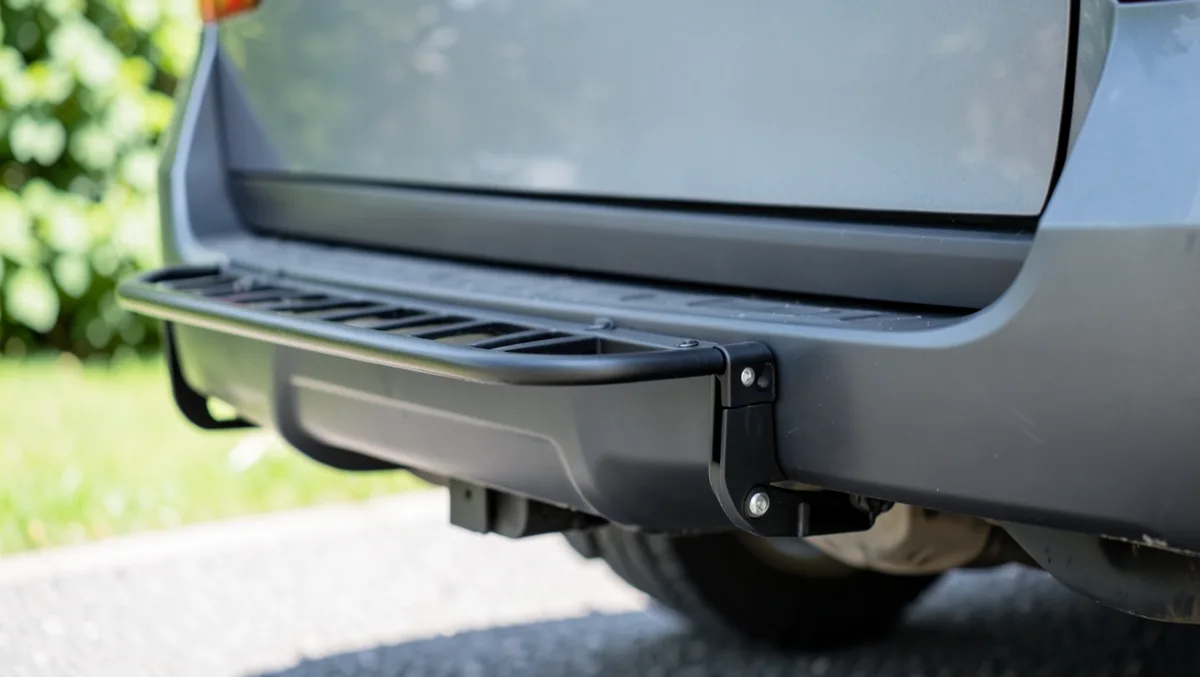
Tricycle Rack for Car: Best Hitch Racks for Trikes
A hitch-mounted tricycle rack only works when your adult trike or e-trike fits the rack’s wheelbase, track width, weight limit, and hitch class; many trikes need a platform-style rack, not a hanging one. Skip those checks and the rack can bottom out, block the rear camera, or exceed the hitch’s tongue weight. This guide covers fitment, hitch specs, ramp and fold-up features, and the rack types you should verify before checkout.
What a trike hitch rack must fit?
A trike rack has to match the hitch receiver, the trike’s length, its tire size, and the vehicle’s rear clearance. A 2-inch hitch receiver is the common fit point, but the vehicle hitch rating still has to match the load. Adult tricycles, recumbent trikes, and e-trikes can fail fitment for different reasons, even when the wheel size looks similar.
2-inch receiver fit comes first
Many hitch-mounted trike racks are built around a 2-inch receiver. That is the size you will see most often, but the receiver on the vehicle still needs to be confirmed before purchase. Cars, SUVs, trucks, vans, trailers, and RVs can all use 2-inch receivers, yet the hitch class and tongue-weight rating are not the same across those vehicles.
MOONCOOL supports up to 170 lbs, fits wheelbases from 42 to 59 inches, and fits fat tires up to 5 inches wide. NAIZEA is compatible with a 2-inch receiver and supports up to 170 lb, or 77 kg. H&ZT fits wheelbases from 42.1 to 59 inches. LILYPELLE is designed for 2-inch hitch receivers.
Why trike geometry fails generic bike racks
A generic bike rack often fails on a trike because a trike is wider behind the seat, longer at the rear axle, and less forgiving at the wheel support points. Recumbent trikes can be especially awkward because the frame can sit low and extend farther back. If the rack assumes two wheels in line, the third wheel can sit outside the cradle pattern.
That is why a purpose-built trike carrier matters. Adult tricycles are usually heavier and longer than standard bikes, and e-trikes add battery mass and motor hardware. The rack needs secure wheel retention, not a loose center tube clamp and a hope-and-pray strap layout.
What weight and wheelbase matter?
Weight and wheelbase are the two numbers that decide most of the fit. A common benchmark weight limit for adult trikes is about 170 lb, though the rack’s real limit still has to account for the trike, battery, basket, and accessories. Wheelbase matters just as much, because a trike can be light and still fail if the rear wheels sit outside the support range.
Why 170 lb is the common benchmark
For many adult trikes, 170 lb is the number buyers will see again and again. It works as a useful cutoff for pedal trikes and some e-trikes, but not every electric trike belongs in that group. If your setup includes a cargo box, a heavy battery, or a rear basket full of gear, check the full loaded weight, not just the frame.
For heavier e-trikes, a rack with stronger wheel retention and anti-wobble hardware matters more than a basic low-price carrier. A rack may list a limit that sounds close enough, but a small margin disappears fast once the trike is loaded and the vehicle hits highway bumps.
Why most racks cite 42 to 59 inches
The wheelbase is commonly found in a rough range of about 42 to 59 inches. MOONCOOL fits wheelbases from 42 to 59 inches, and H&ZT fits wheelbases from 42.1 to 59 inches. That range covers many adult trikes, but not all. Long recumbent trikes and some cargo trikes can exceed it, especially if the rear axle sits far behind the seat.
Frame shape matters too. A trike with a low rear boom, odd axle spacing, or a frame that forces the wheels off-center can run out of strap length or cradle space even when the published wheelbase looks close enough.
When an e-trike needs more rack
An e-trike usually needs more rack than a light pedal trike. The battery and motor push the total weight up, and the rack has to manage that mass over bumps and during braking. If the listing does not state a clear load limit for an e-trike, treat it as a warning and verify the manufacturer’s listing for your exact model.
Loading effort changes too. A heavier e-trike is harder to lift, harder to center, and more likely to need a ramp or a second person. If you want one-person handling, the folding rack design and ramp geometry matter as much as the weight rating.
Trike fitment checklist
Check this list before checkout. It focuses on the four most common failure points: weight, tire width, wheelbase, and rear clearance. If any one of them is off, the rack may fit on paper and fail in the driveway.
| Total trike weight | Tire width | Wheelbase | Hitch size | Rear-clearance risk | Loading method | Pass/fail |
|---|---|---|---|---|---|---|
| Under 170 lb | Up to 5 inches | 42 to 59 inches | 2-inch receiver | Low if hatch clears when folded | Lift-on, no ramp needed | Pass |
| Near 170 lb | Up to 5 inches | 42 to 59 inches | 2-inch receiver | Medium; camera and plate may be blocked | Ramp recommended | Pass, with caution |
| Over 170 lb | Up to 5 inches | 42 to 59 inches | 2-inch receiver | High; departure angle and sway risk rise | Ramp and second person preferred | Fail |
| Under 170 lb | Over 5 inches | 42 to 59 inches | 2-inch receiver | Medium; cradle width and strap fit can fail | Depends on cradle size | Fail |
| Under 170 lb | Up to 5 inches | Outside 42 to 59 inches | 2-inch receiver | High; overhang can block lights or plate | Depends on frame shape | Fail |
Real-world failure points to check
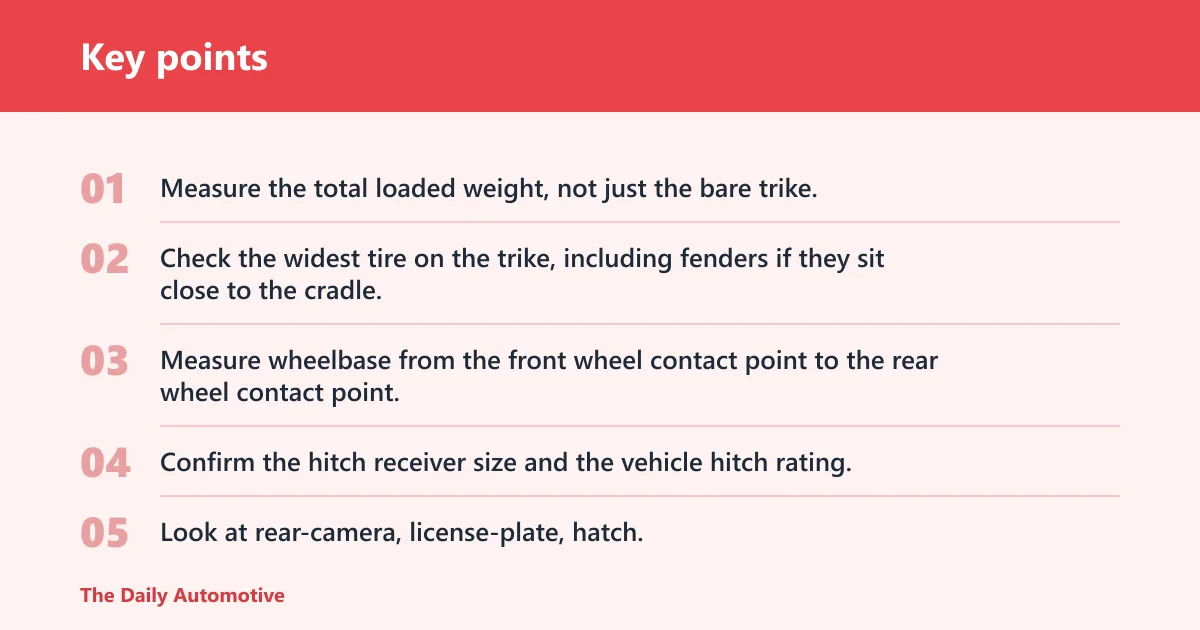
- Measure the total loaded weight, not just the bare trike.
- Check the widest tire on the trike, including fenders if they sit close to the cradle.
- Measure wheelbase from the front wheel contact point to the rear wheel contact point.
- Confirm the hitch receiver size and the vehicle hitch rating.
- Look at rear-camera, license-plate, hatch, and tailgate clearance with the rack folded and loaded.
- Inspect the strap path so it does not rub on paint, brake cables, or battery wiring.
Say your trike weighs 165 lb, but the rear basket adds 12 lb once loaded. That setup is no longer a “close enough” 170 lb case. The rack may still carry it, but only if the manufacturer allows that combined load and the vehicle hitch rating leaves room for the extra mass.
A common first-timer mistake is measuring only tire width and ignoring wheelbase. A 4-inch fat tire can fit a rack cradle, yet a recumbent trike with a long rear end can still miss the support rails by several inches.
Do tricycle racks fit fat tires?
Many trike racks fit fat tires up to 5 inches wide, but that does not mean every 5-inch tire will sit securely in every cradle. The tire has to match the rack’s cradle shape and strap length. If the tire sits too high or too low, the strap can rub the sidewall or fail to cinch down evenly.
What 5-inch tire clearance really means
“Fits up to 5 inches” usually means the rack is built with wide cradles and enough strap length for fat tires. It does not guarantee room for every tread block, sidewall shape, or fender combo. A deep tread can change how the tire sits in the cradle and may need more strap tension than a smooth touring tire.
Why adjustable cradles and tie-down straps matter
Adjustable wheel cradles help line up the tires so the trike sits square on the rack. Tie-down straps keep the wheels from lifting or shifting when the vehicle hits bumps. Those two features matter more on trikes than on standard bikes because three-wheel layouts can wiggle at the rear if one wheel sits higher than the others.
Fenders can create their own problem. If the strap lands on a fender edge instead of the tire, the fit may feel secure at first and loosen as the rack flexes. Check the cradle placement against the actual tire sidewall, not just the outer width on paper.
How do you keep a trike stable?
Stability comes from three things: anti-wobble hardware, correct strap routing, and enough rear clearance for the loaded rack. On the highway, a trike with long overhang can sway more than a standard bike, so the rack has to control side-to-side movement as well as vertical bounce.
Anti-wobble hardware and stabilizer hardware
Anti-wobble or stabilizer hardware can reduce motion at the hitch connection. That matters on heavier trikes because the load sits farther from the bumper and amplifies movement. Use the locking pin, stabilizer bolt, or other anti-wobble device the rack provides, and confirm the vehicle hitch itself is rated for the load.
Do not rely on the hitch pin alone if the rack includes a stabilizer. The extra hardware is there to reduce sway, especially at highway speeds and over rough pavement.
Strap routing and abrasion checks
Run straps over the tire, not across brake lines, display wiring, or sharp frame edges. Check for abrasion where the strap crosses the tire or rim. If the strap path is off-center, the trike can yaw slightly, and that small twist becomes visible as sway once the vehicle accelerates.
Rear overhang also matters. The farther the trike extends beyond the bumper, the more careful you need to be with departure angle, driveway entry, and parking-lot dips. A folding rack helps with storage, but the folded position still has to clear the hatch, tailgate, and rear camera.
Hitch rack versus trailer transport
The core trade-off is simple. A hitch rack is easier to store and usually easier to load for short trips, while a trailer handles awkward shapes and very heavy trikes with more breathing room. The best choice depends on how much weight you need to carry, how often you load alone, and how much rear clearance your vehicle has.
| Option | Best for | Loading effort | Rear access | Storage | Main drawback |
|---|---|---|---|---|---|
| Hitch rack | Cars, SUVs, vans, trucks with a 2-inch receiver | Moderate; ramp helps | Can block hatch, plate, or camera | Folds up on some models | Clearance and wobble limits |
| Trailer | Heavy cargo trikes or odd frame shapes | Lower lift height, but more setup | Usually leaves rear access alone | Needs parking space | More length, more parking burden |
Choose a hitch rack if…
Choose a hitch rack if your vehicle has a verified 2-inch receiver, your trike stays within the rack’s weight and wheelbase range, and you want faster loading for regular road trips. It also makes sense when you need folding storage and do not want to tow a trailer.
A hitch rack fits best when you can still open the hatch or tailgate with the rack folded or unloaded, and when the rack does not block the rear camera enough to make backing unsafe.
Choose a trailer if…
Choose a trailer if your trike is heavier than the rack limit, the frame shape refuses to sit square in the cradles, or the rear overhang would block lights and plate visibility. A trailer also helps when you need more room for a long recumbent trike or a cargo trike with an odd center of gravity.
If rear bumper clearance is already tight, a trailer may be the cleaner option. It avoids the hitch-mounted lever effect that can magnify sway on long, heavy trikes.
What is the best hitch rack for an adult tricycle?
The best hitch rack for an adult tricycle is a purpose-built platform rack that matches the trike’s weight, wheelbase, tire width, and hitch receiver size. For many buyers, that means a 2-inch receiver model with adjustable cradles, tie-down straps, and anti-wobble hardware. If the trike is an e-trike, check the load limit carefully before checkout.
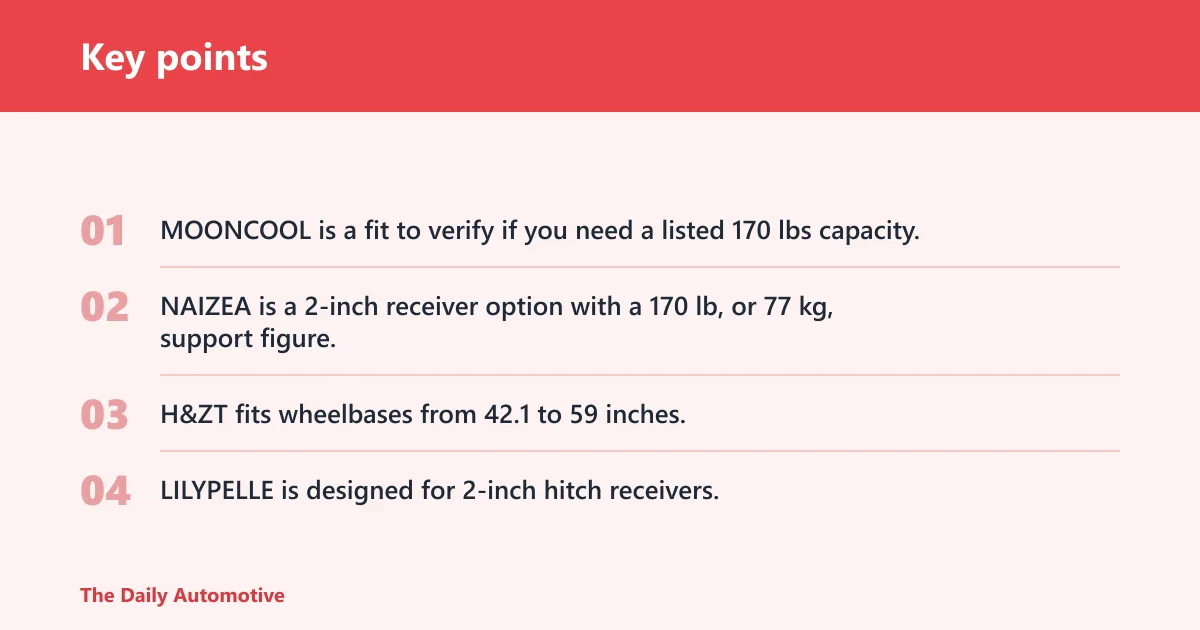
MOONCOOL is a fit to verify if you need a listed 170 lbs capacity, wheelbase support from 42 to 59 inches, and fat-tire room up to 5 inches. NAIZEA is a 2-inch receiver option with a 170 lb, or 77 kg, support figure. H&ZT fits wheelbases from 42.1 to 59 inches. LILYPELLE is designed for 2-inch hitch receivers.
Will a trike rack fit a 2-inch hitch receiver?
Many trike racks are built for a 2-inch hitch receiver, so the answer is often yes. The important part is verifying that the vehicle’s receiver size and hitch rating match the rack and the loaded trike. A 2-inch receiver on a car is not the same as a 2-inch receiver on a truck or RV.
LILYPELLE is designed for 2-inch hitch receivers, and NAIZEA is compatible with a 2-inch receiver. Even then, confirm the vehicle manual and the hitch label before buying.
How much weight can a trike hitch rack hold?
Many shoppers will see 170 lb as the common benchmark. That number works for a lot of adult trikes and some e-trikes, but it is not a universal answer. The safe number is the one on the specific rack listing, combined with the vehicle hitch rating and the weight of the trike as loaded.
MOONCOOL supports up to 170 lbs, and NAIZEA supports up to 170 lb, or 77 kg. For a heavier e-trike, check whether the manufacturer lists higher capacity or whether the rack is meant for a different load class.
What wheelbase do most trike racks support?
Most trike racks support wheelbases roughly from 42 to 59 inches. That range covers many adult tricycles and some e-trikes, but it does not cover every recumbent or cargo trike. Measure the trike from wheel contact point to wheel contact point before you buy, because axle spacing and frame shape can push a setup outside the safe range.
MOONCOOL fits wheelbases from 42 to 59 inches, and H&ZT fits wheelbases from 42.1 to 59 inches. If your trike is outside that span, a hitch rack may be the wrong tool.
Can I use a car bike rack for an e-trike?
Only if the rack is built for the weight, width, and geometry of an e-trike. A regular car bike rack often lacks the loading platform, wheel support, and stabilizer hardware needed for a heavier electric trike. An e-trike usually needs a higher load rating and better wheel retention than a standard pedal bike.
Lectric’s rack collection includes a trike adapter kit for a hitch rack, and Lectric’s vehicle rack page says the rack accommodates up to 2 eBikes. That is a reminder to check the exact model page before assuming a bike rack will work for an e-trike.
How do you keep a trike from wobbling on a hitch rack?
Use anti-wobble hardware, keep the straps tight on the tire, and confirm the wheel cradles match the tire width. Wobble usually comes from movement at the hitch connection, loose strap routing, or a trike that sits off-center in the rack. Highway sway is the real problem, not just driveway movement.
CycleSimplex says it has made trike and bike racks for over 25 years, and it builds racks for one trike, one trike plus one bike, two trikes, or a LWB tandem bike. It also says its racks can handle e-bikes and e-trikes. That range shows why stabilizer hardware and rack layout matter for heavier loads.
What should I check before buying a tricycle rack for my car?
Check the vehicle hitch class, the receiver size, the rack’s weight limit, the trike’s wheelbase, the tire width, and the rear clearance around your hatch, bumper, plate, and camera. A folding rack can help with storage, but folding does not solve a poor fit. The right rack still has to leave room for the vehicle’s rear end.
Also confirm that the loading method works for your strength level. A ramp can make a heavy e-trike manageable for one person, while a lift-on rack may be fine for a lighter adult trike. Follow the vehicle and product manual, and never exceed the vehicle’s hitch rating.
Products related to this article
Sponsored / affiliate links. As an Amazon Associate I earn from qualifying purchases. I may earn additional commission from eligible campaigns.