How to Sell a Car Privately Step by Step
Sell privately by pricing the car from comparable listings, screening buyers, and releasing the title only after verified payment clears and any lien is paid off. Skip those checks and you can lose the car, the money, or both. This guide walks you through pricing, paperwork, safe payment, title transfer, and required post-sale notices.
Why a private sale can pay more
Private-party value is usually higher than dealer trade-in value, so it is the better starting point if you want more money. Use dealer trade-in as the fallback benchmark, not the target, because it shows what a quick exit is worth if the private sale stalls.
Set your fallback price before you
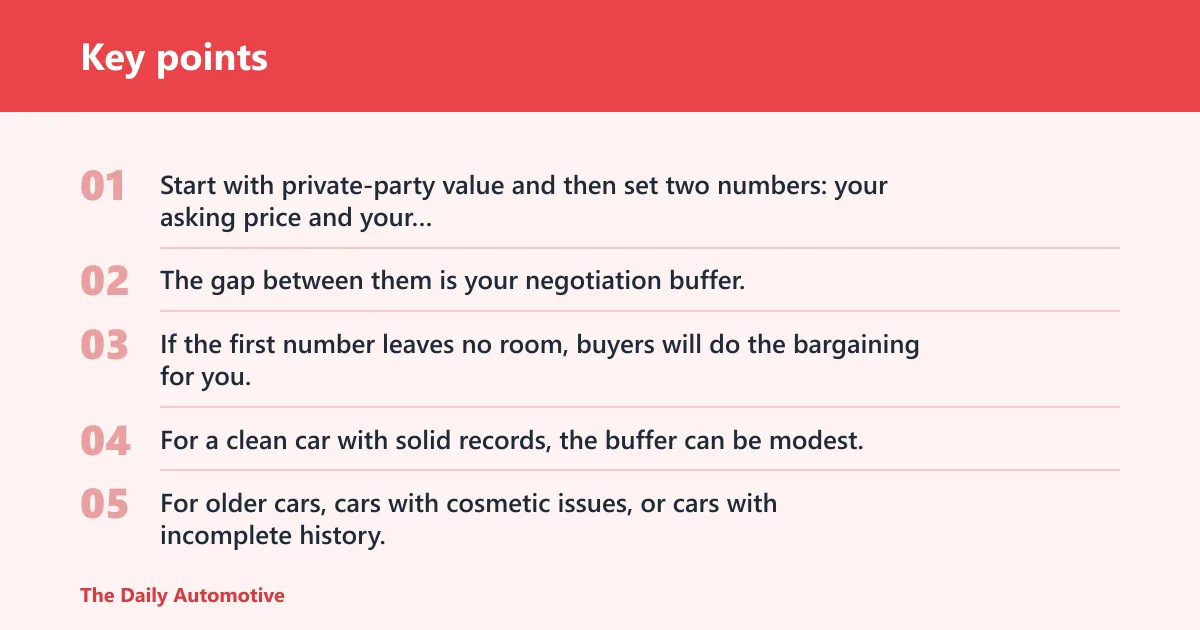
Start with private-party value and then set two numbers: your asking price and your minimum acceptable price. The gap between them is your negotiation buffer. If the first number leaves no room, buyers will do the bargaining for you.
For a clean car with solid records, the buffer can be modest. For older cars, cars with cosmetic issues, or cars with incomplete history, the buffer should be wider because buyers will price in their own risk.
Decide whether a quick dealer offer is the backup plan
If the private sale drags on, a dealer trade-in can keep the deal moving. That matters most when you need speed, when buyer traffic is weak, or when you are carrying a loan and want a clean exit. Use the trade-in quote as a stop-go check, not as a starting point.
What paperwork do you need first?
You need the title in hand before you list the car, because that document is what transfers ownership. If the title is lost, replace it first even though it takes time. If money is still owed, get the lien payoff letter or bank payoff letter before you start talking price. (Caranddriver)
Maintenance and repair records help show the car was cared for, and a vehicle-history report can show prior owners and accidents. Buyers often ask for those items before they visit, so gather them before you publish the listing. In the UK, sellers should also have the V5C, MOT certificates, and service records.
Paperwork to gather before the first message
- Vehicle title, or replacement title if the original is missing
- Lien payoff letter if there is still a loan
- Maintenance and repair records
- Vehicle-history report
- UK V5C / log book and the transfer section
- MOT certificates and service records for UK sales
Say your car is parked in the driveway with no title in the folder. Stop there. A missing title is a paperwork problem, not a pricing problem, because ownership cannot move cleanly until the title is found or replaced.
How do you price the car?
Use private-party value as the asking-price anchor, then set a minimum acceptable price that you will not go below. Compare that against dealer trade-in value so you know the floor if the private sale slows down. The point is to avoid guessing while a buyer is standing there.
A simple method works best: list slightly above your target, leave room for small negotiation, and decide in advance where you stop. If the car needs tires, has cosmetic damage, or is missing records, the buffer should absorb those objections instead of turning every call into a debate.
A simple pricing sequence
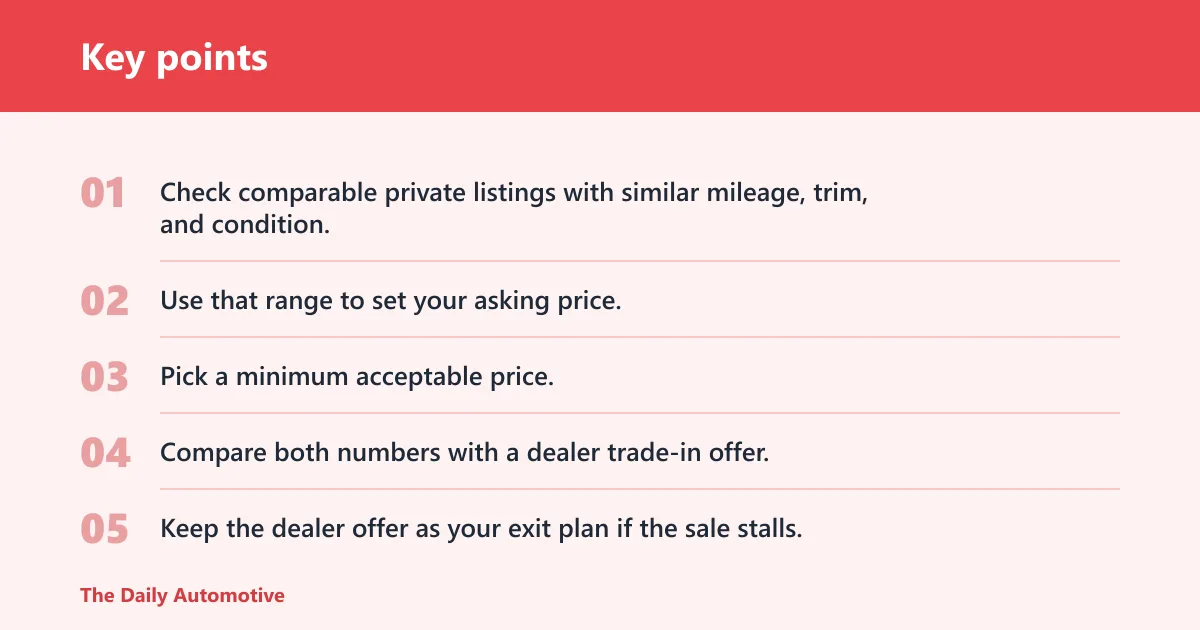
- Check comparable private listings with similar mileage, trim, and condition.
- Use that range to set your asking price.
- Pick a minimum acceptable price.
- Compare both numbers with a dealer trade-in offer.
- Keep the dealer offer as your exit plan if the sale stalls.
Suppose the comparable listings cluster near your target, but your car needs a front-brake job. That does not mean the car is unsellable. It means your minimum price should reflect the repair cost and the buyer’s time, while the dealer offer gives you a clean benchmark if the private route stalls.
Prepare the car and the listing
Clean the car inside and out, then take clear photos in daylight from every angle. Include the odometer reading in the set. Buyers expect plain pictures, a direct condition description, mileage, and any known issues.
Write the ad around facts that matter to a buyer: title status, mileage, service history, accident history if any, and whether the car has a lien. If the ad hides obvious problems, the deal usually falls apart later, after time has already been wasted.
What to include in the listing
- Exterior photos from all sides
- Odometer reading
- Mileage and trim level
- Known issues and recent repairs
- Title status and whether there is a lien
- Maintenance records and vehicle-history report availability
A common first-timer mistake is posting only polished exterior shots and skipping the odometer, service file, and title status. That usually creates more messages, but fewer serious buyers.
What should you check before a test drive?
Before any test drive, verify that the buyer has a valid license and is insured to drive it. Accompany the drive, keep the keys under control until you are ready, and choose a short route that avoids high-speed roads if possible. The point is to reduce risk before the engine starts.
Do not hand over the keys and step away. Set ground rules first: who drives, where the route goes, whether anyone else rides along, and where the car comes back. If the buyer resists those basics, pause the deal.
Test-drive stop-go checks
- Check the buyer’s license before the drive begins
- Confirm insurance coverage for the drive
- Ride along or remain in the car
- Keep the keys until the drive starts
- Agree on route and time before leaving
Car privately step by checklist
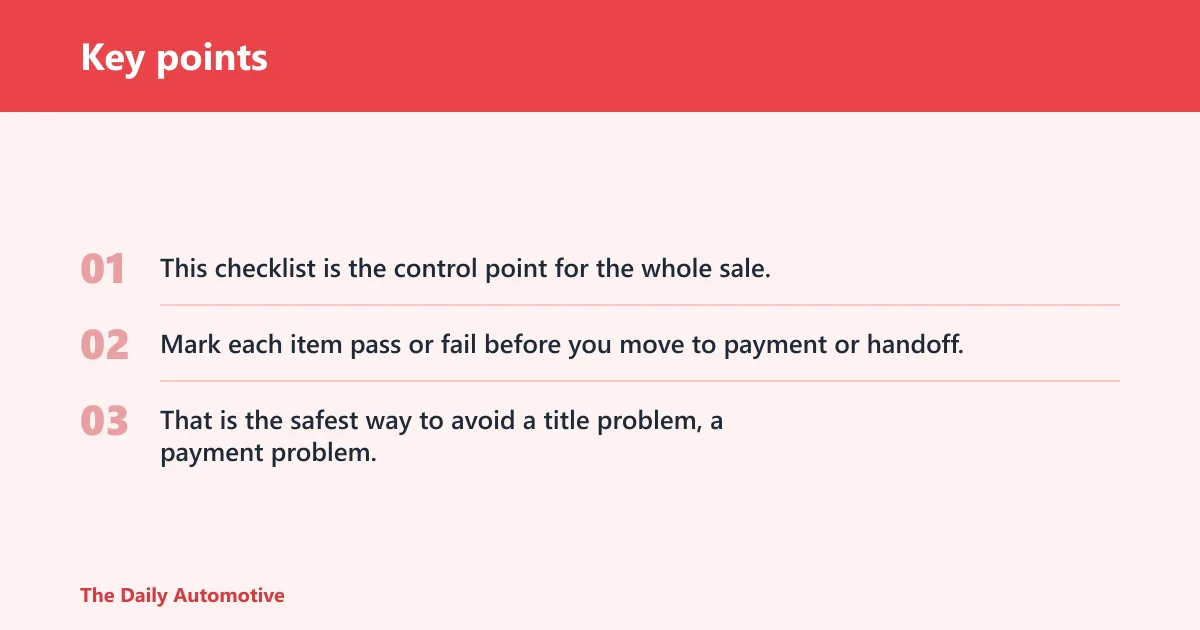
This checklist is the control point for the whole sale. Mark each item pass or fail before you move to payment or handoff. If one item fails, stop and fix it first. That is the safest way to avoid a title problem, a payment problem, or a dispute after the keys are gone.
| Checkpoint | Pass means | Fail means | Red flag: pause the deal |
|---|---|---|---|
| Paperwork ready | Title, records, and required transfer forms are in hand | Missing title, missing service file, or missing transfer form | Yes, if the title cannot be produced |
| Title and lien status confirmed | Title is clear, or payoff steps are documented | Unknown lien status or no payoff letter | Yes, if payoff timing is unclear |
| Payment method verified | Funds are verified and cleared before release | Payment type changes at the last minute | Yes, if the buyer wants speed over verification |
| Handoff completed | Title or log book signed, keys handed over, and authority notified | Keys or documents still retained without a reason | Yes, if transfer paperwork is unsigned |
| Sale type | What to verify first | Who controls the funds or payoff | Red flag that means stop |
|---|---|---|---|
| Cash sale | Count and verify the cash before handing over keys | Seller, until verified | Buyer wants immediate handoff before counting |
| Financed buyer | Confirm the lender’s process before you sign anything | Buyer’s lender may facilitate the transaction | Lender instructions are missing or change late |
| Loan-balance sale | Confirm payoff amount and title-release timing | Lender, often through payoff coordination | Payoff letter is missing or the title release is unclear |
Can I sell my car privately if I still owe money on it?
Yes, but only if you coordinate the payoff and title release before you hand over the car. If the car has a lien, get a bank letter saying it is paid off, and confirm how the lender will release the title after the payoff lands. A dealer can also handle payoff if you still owe less than the car is worth.
The timing matters. Do not promise a same-day handoff if the lender still controls the title and the payoff process is not documented. That is where private sales turn into avoidable delays.
How payoff coordination works
- Ask the lender for the payoff amount and payoff instructions.
- Get the lien payoff letter or bank letter in writing.
- Confirm how long title release normally takes after payment.
- Collect verified funds first.
- Release the car only after the lender and title steps are settled.
How do you get paid safely?
The safest approach is to wait until the money clears before you hand over the keys, title, or log book. A bank transfer is usually the cleanest payment option. If the buyer wants another method, treat cashier’s checks, wires, and escrow differently and do not rush the handoff.
Cashier’s checks can be forged. Wire transfers can be reversed only in limited situations, but you still want confirmation from your bank that the funds are available. Escrow can help when funds and title need protection, especially if a loan payoff is involved, but it usually charges a fee.
Payment methods, caution level, and hold point
- Cash: verify it in person before any transfer
- Bank transfer: wait for funds to clear before release
- Cashier’s check: verify with the issuing bank, then wait if needed
- Wire transfer: confirm receipt and availability with your bank
- Escrow: use when payoff or title handling needs third-party control
If the payment story changes at the last minute, the sale should stop. A buyer who moves from bank transfer to “I’ll send a check tomorrow” has changed the deal, and that is reason enough to pause.
What do you do after you’ve sold your car?
After the sale, sign over the title or log book, hand over the keys and required documents, and keep proof that the transfer happened. In the UK, the buyer should receive the tear-off section of the V5C. The same logic applies elsewhere: complete the transfer, then confirm the authority knows the car changed hands.
If there was a lender involved, make sure the payoff and release steps are finished and keep copies of every receipt, transfer record, and signed form. That paperwork is your proof if a question comes up later.
Frequently asked questions
How do I sell my car privately?
Use a simple sequence: prepare paperwork, set an asking price from private-party value, meet serious buyers, verify insurance and license for test drives, and accept payment only after it is confirmed. Keep the title and keys until the transfer is complete.
What should I do before a private test drive?
Check the buyer’s license, confirm insurance coverage, and keep the keys under your control until you are ready to move. Ride along or stay with the vehicle, choose a simple route, and set rules before the drive starts. If the buyer resists, do not continue.
How do I get paid safely when selling a car privately?
Wait for cleared funds before you hand over the title or keys. Bank transfer is usually the cleanest route, while cashier’s checks and wires need verification. Escrow can help when a lien payoff or title-release process needs a third party, but it is not a reason to skip verification.
What do I do after I’ve sold my car?
Sign the title or V5C transfer section, give the buyer the keys and required documents, and keep proof of the sale. Then notify the right authority or lender if that applies where you live. Do not treat the handoff as finished until the paperwork trail is complete.
Products related to this article
Sponsored / affiliate links. As an Amazon Associate I earn from qualifying purchases. I may earn additional commission from eligible campaigns.