Is It Illegal to Drive with Snow on Your Car Roof?
It can be illegal if snow on your roof blocks your view, blows off and endangers others, or turns your car into an unsafe road hazard. Some states also have roof-snow laws and fines. Tickets, crash liability, and insurance disputes can follow. This guide explains how officers and insurers judge roof snow.
Is it illegal to drive with roof snow?
The short answer is that the answer changes by state and by what the snow does on the road. Some places have a specific snow-removal law. Others use general safety, blocked-view, or reckless-driving rules when snow on the car creates a hazard.
That means the roof is not always the whole issue. Visibility problems, snow falling off, covered lights, and the vehicle’s behavior in traffic all matter. A clear windshield does not make driving legal if a slab of roof snow could slide off into traffic.
When roof snow becomes a traffic violation instead of just a bad habit
Roof snow becomes a traffic problem when it affects what you can see, what other drivers can see, or whether the car is a hazard. Officers usually care less about the pile on top and more about whether that pile makes the vehicle unsafe or illegal to drive.
Suppose a sedan enters a highway with a thick slab still on the roof. If it breaks loose and hits the windshield of the car behind it, the stop is no longer about appearance. It is about a preventable road hazard that may support a citation or a crash claim.
State snow-law decision table
State rules do not line up neatly. Some states have explicit snow-removal laws. Others lean on general safety, equipment, or reckless-driving rules. Use the bucket that best matches your state, then check the local code for the exact standard before you drive.
| State type | What officers look for | Likely enforcement trigger | Likely penalty range based on cited examples |
|---|---|---|---|
| Explicit snow law | Whether snow or ice was removed as required before driving, plus any listed exceptions | Visible snow buildup, unsafe departure, or a report tied to an active snow-removal statute | Often a fine in the tens to hundreds; cited examples include fines that can start around $50-$100 and may reach several hundred dollars |
| General safety law | Obstructed view, covered lights, mirrors, or plate, and whether the car can be driven safely | Snow blocks glass or equipment, or debris creates an unsafe condition under the traffic code | Usually ticket-based; cited examples put some penalties in the $50-$100 range and up into the several-hundred-dollar range |
| Reckless-driving fallback | Whether the snow or ice creates a clear danger to other road users | Ice or snow flies off, or the vehicle is driven in a way that endangers traffic | Can be much steeper; cited examples say penalties can exceed $500 and sometimes reach $1,000 after fees and surcharges |
| No specific rule found | Obstruction, unsafe equipment, debris risk, and the driver’s overall conduct | Police use local traffic law rather than a dedicated roof-snow statute | Varies by city and state; obstruction or unsafe-driving citations are often the starting point |
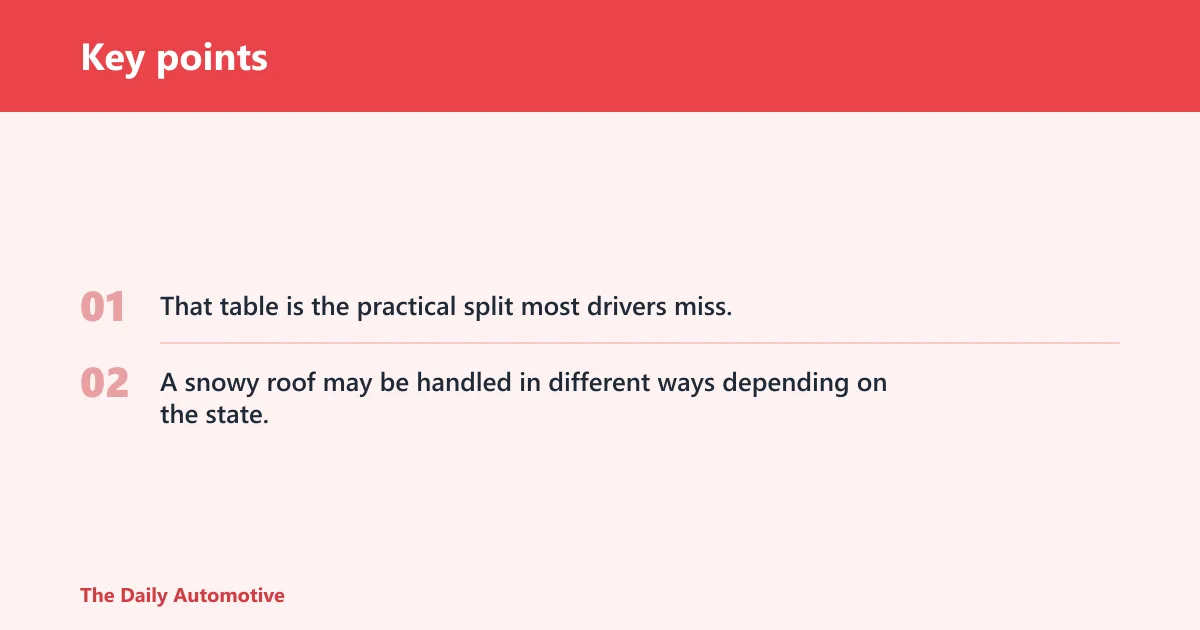
That table is the practical split most drivers miss. A snowy roof may be handled in different ways depending on the state, including a specific snow-removal rule, a general obstruction rule, or, in more serious cases, a reckless-driving charge.
What officers look
Officers usually look for signs that the vehicle is unsafe to drive, not just messy. The usual concerns are a blocked windshield or front windows, covered lights or mirrors, and snow that can blow off or slide into traffic. A car that weaves, drifts, or carries a dangerous slab of snow can draw attention fast.
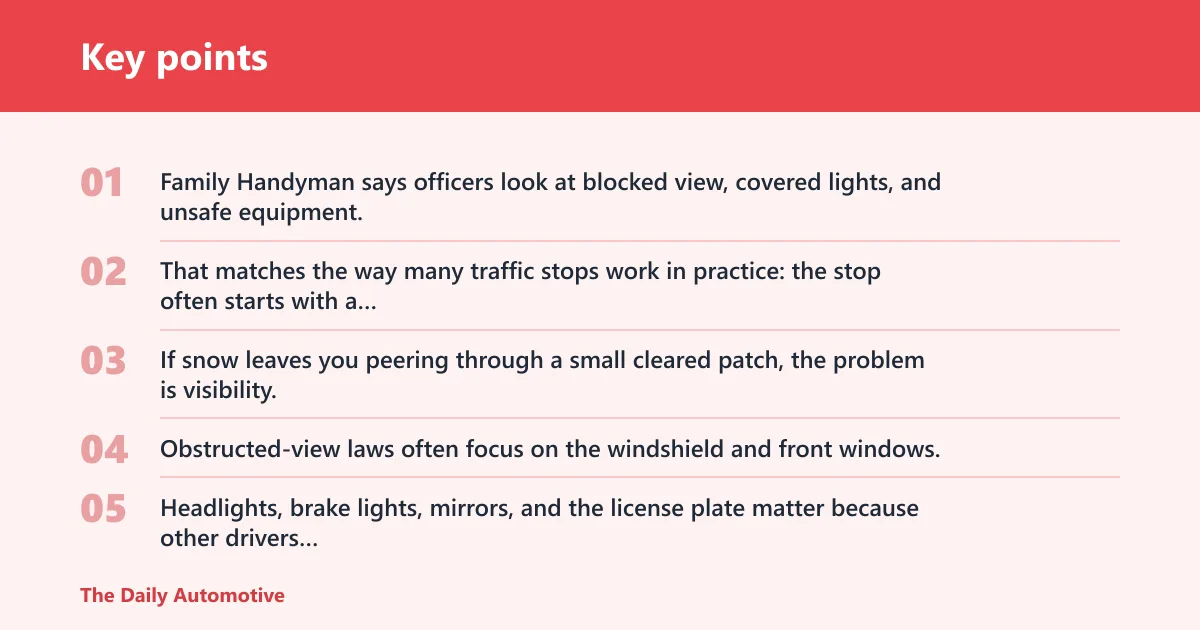
Family Handyman says officers look at blocked view, covered lights, and unsafe equipment. That matches the way many traffic stops work in practice: the stop often starts with a visible hazard, then expands if the snow is thick enough to create a wider safety problem.
Blocked windshield or front windows
If snow leaves you peering through a small cleared patch, the problem is visibility. Obstructed-view laws often focus on the windshield and front windows, and that can be enough for a ticket even if the roof itself is not named in the statute.
Covered lights, mirrors, or license plate
Headlights, brake lights, mirrors, and the license plate matter because other drivers and officers need to see them. Snow on these parts can turn an ordinary winter drive into an equipment violation, especially if the vehicle is hard to identify or its signals are hidden.
Snow that can blow off or slide into traffic
The same source says roof snow can slide onto your windshield or fly off and strike other cars. That is the hazard many drivers miss. The roof pile may look stable at rest, then break loose at speed or under braking and create a sudden visibility or debris problem.
Vehicle behavior that suggests an unsafe road hazard
If the car is moving as though the driver cannot see well, cannot signal clearly, or cannot control the vehicle safely, officers may treat it as more than a simple cleanup issue. General traffic laws often care about whether the vehicle is an unreasonable road risk in real conditions.
Do you need to clear the whole car?
Yes, in practice you should clear more than the windshield. Roof, hood, trunk, mirrors, windows, and headlights all matter because snow can break loose from any of those surfaces and can hide key parts of the car. The goal is not cosmetic cleanliness. It is a vehicle that can be seen and controlled safely.
The same source says many states and cities ticket drivers for snow left on their cars while driving, and AAA winter guidance often points to roof buildup as a common issue. That lines up with what matters on the road: the roof is dangerous, but it is not the only surface that can create a citation or a crash risk.
Why the roof matters even when you can see out
The roof matters because a clean windshield does not stop a roof slab from coming off later. A driver may leave with full forward visibility and still create a hazard a mile down the road when wind, speed, or braking loosens the snow. That is why officers and insurers pay attention to the whole vehicle.
Say your SUV has a 4-inch layer on the roof but the glass is scraped clean. The first half-mile may feel uneventful. Then a gust hits at highway speed, the snow sheet moves, and the driver behind suddenly loses sight through a burst of white debris.
Clear these surfaces before moving
- Roof
- Hood
- Trunk
- Mirrors
- Windows
- Headlights
- Brake lights
- License plate
Keep items out of airbag zones and the driver’s view and check local laws. Follow the vehicle and product manual; never exceed the vehicle’s rated roof, hitch, tow, or payload limit in the owner’s manual.
Can roof snow count as reckless driving?
Yes, in some states it can. Roof snow may support reckless-driving exposure when the snow or ice creates a real danger to other road users, especially if it flies off or the driver keeps going despite a clear hazard. The exact label depends on the state code and the facts officers can observe.
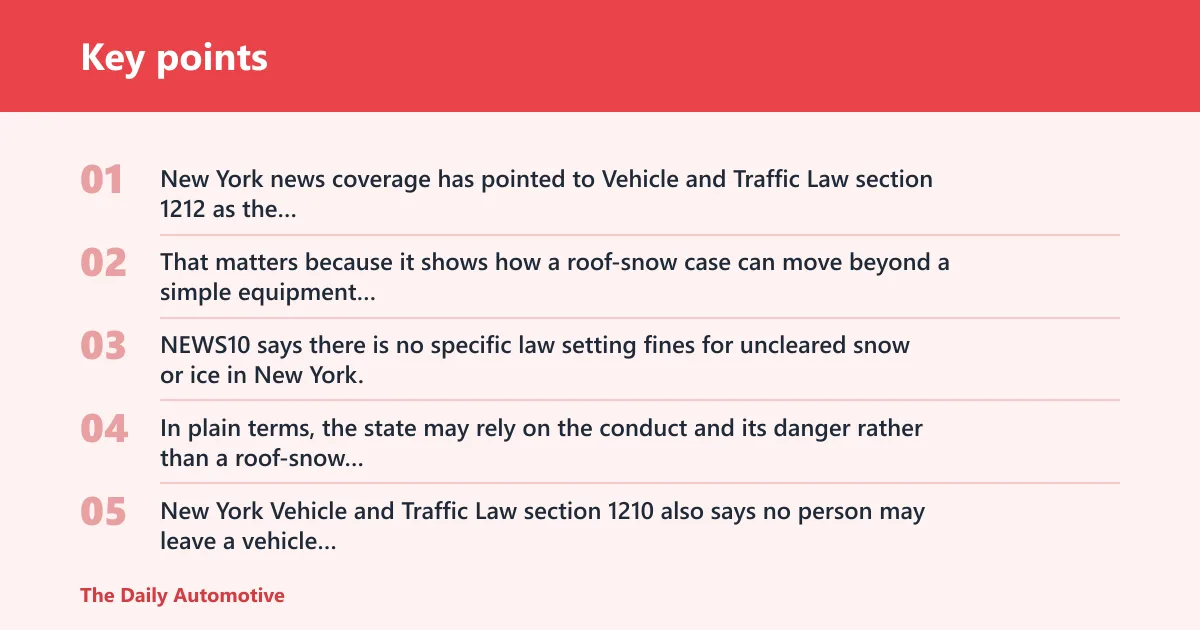
New York news coverage has pointed to Vehicle and Traffic Law section 1212 as the reckless-driving basis when ice falls onto another car. That matters because it shows how a roof-snow case can move beyond a simple equipment ticket and into a more serious traffic charge when the danger is concrete.
Why New York Vehicle and Traffic Law section 1212 matters
NEWS10 says there is no specific law setting fines for uncleared snow or ice in New York, but it also cites reckless-driving law 1212 as a possible basis if ice falls onto another car. In plain terms, the state may rely on the conduct and its danger rather than a roof-snow statute alone.
New York Vehicle and Traffic Law section 1210 also says no person may leave a vehicle unattended without first stopping the engine, locking the ignition, removing the key, and setting the brake. That is a separate rule, but it shows how New York traffic law often looks at vehicle control and safety together.
How the New York snow law is described in news coverage
The same report notes exceptions during active snowfall or during an about 3-hour window. That gives New York drivers a clearer rule than many states have.
Do not assume that exception covers a long wait or a full commute. If the snow has already built above the threshold and the situation no longer fits the exception, the vehicle can still become a ticketable hazard.
Tickets, fines, and liability
Fines vary by state, city, and charge. The same source says fines can start around $50-$100 and can climb into the several-hundred-dollar range. It also says penalties can exceed $500 and sometimes reach $1,000 after fees and surcharges. The number depends on the statute and what the snow caused.
That difference matters. An obstruction ticket for a blocked windshield is one thing. A citation tied to debris, an unsafe vehicle, or reckless driving is another. The second type is usually where the legal and financial consequences get heavier.
What can happen after snow flying off your car causes a crash?
If snow or ice flies off your roof and causes a crash, liability can spread beyond the ticket. The driver who left the snow in place may face blame for creating the hazard, especially if the danger was easy to avoid. Insurance carriers may also treat the event as preventable and disputed.
That is the practical difference between driving law and crash liability. A citation answers whether the car was legal to operate. A liability claim asks whether the driver created a foreseeable hazard that caused damage, injury, or both. Those are related questions, but they are not the same.
How insurers may view avoidable snow-related damage
Insurers often look at whether the driver took reasonable steps before moving the car. If the roof snow was obvious and could have been cleared in minutes, the claim may draw more scrutiny. If the vehicle was operated with a blocked view or loose snow, the claim may be harder to defend.
Before you drive in snow
Clear the vehicle before you move it. The safest approach is to remove roof snow, clean the glass, and check the lights and plate before starting out. If the snow is too heavy or still falling hard enough to rebuild quickly, wait until you can clear the car properly.
- Brush snow off the roof first.
- Clear the hood and trunk.
- Remove snow from all windows.
- Clean headlights, brake lights, mirrors, and the plate.
- Check that your view is open in every direction.
- Confirm the car is not shedding snow as you pull away.
Picture a compact car parked under about 6 inches of fresh snowfall. The driver scrapes a narrow slot in the windshield and leaves the rest. That car may move, but it is not ready. The roof can still dump snow onto traffic, and the limited view can turn a short trip into a violation.
When to wait instead of driving off too soon
Wait if the car still has a thick roof load, if your lights or plate remain covered, or if the falling snow is so heavy that you cannot keep the car clear long enough to drive safely. A few extra minutes in the lot can prevent a stop, a crash, or an insurance fight later.
Frequently asked questions
Is it illegal to drive with snow on your car roof?
Sometimes yes, sometimes no. The answer depends on the state or city rule, whether the snow blocks visibility, and whether it can blow off or slide into traffic. In some places, a dedicated snow-removal law applies. In others, obstruction or reckless-driving rules do the work.
Can you get a ticket for driving with snow on your roof?
Yes. The same source says many states and cities ticket drivers for snow left on their cars while driving. Officers usually look for blocked view, covered lights, or unsafe equipment. The ticket may be a simple traffic citation or something more serious if the snow creates a clear road hazard.
Does snow on a car roof count as reckless driving?
It can. When snow or ice endangers other road users, some states may use reckless-driving laws rather than a dedicated roof-snow rule. NEWS10 cites New York Vehicle and Traffic Law section 1212 as a possible basis if ice falls onto another car, which shows how serious the conduct can become.
Do I need to clear snow off my hood, roof, and trunk?
Yes. The safest move is to clear the roof, hood, trunk, mirrors, windows, headlights, brake lights, and plate before driving. The roof is the most overlooked part, but the other surfaces matter too because they can block visibility or send snow into traffic once the car starts moving.
How much can the fine be for driving with snow on my car?
The same source says fines can start around $50-$100 and rise into the several-hundred-dollar range. It also says penalties can exceed $500 and sometimes reach $1,000 after fees and surcharges. The exact amount depends on the state, the charge, and whether the snow caused danger or damage.
Can snow flying off your roof cause liability after a crash?
Yes. If snow or ice flies off and contributes to a crash, the driver may face liability for creating a preventable hazard. Insurers may also question whether the driver took reasonable care before driving. The legal issue is not only the ticket; it is whether the snow caused the collision.
Products related to this article
Sponsored / affiliate links. As an Amazon Associate I earn from qualifying purchases. I may earn additional commission from eligible campaigns.