What to Do If You Are Stranded in Your Car in a Snowstorm
If your car is buried, you are isolated, or visibility is near zero, stay with the vehicle unless a short, clearly visible walk reaches shelter. Breaking that rule can cost warmth, signal, fuel, and time. This guide gives a stay-or-leave checklist plus an hour-by-hour plan for surviving a snowstorm roadside emergency.
What should you do first?
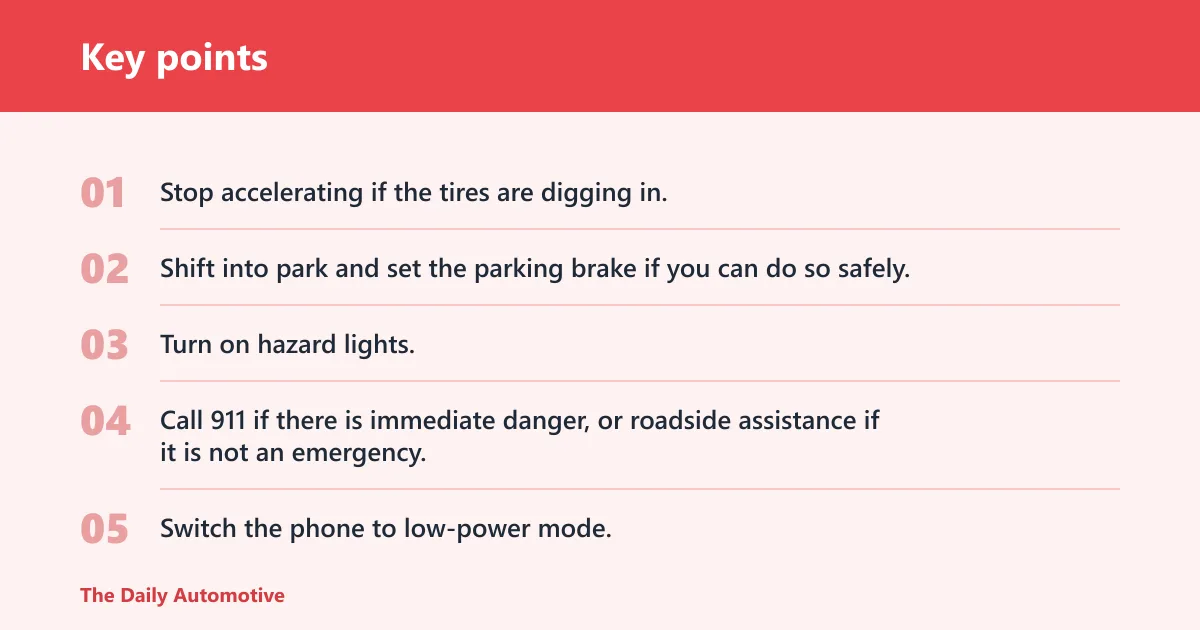


Stop the wheels from spinning, turn on hazard lights if traffic is a factor, and call 911 if there is immediate danger or roadside assistance for a non-emergency breakdown. Then give your exact location in the clearest form available, because rescue time depends on how precisely you can be found. Stay calm and conserve phone battery while you wait.
First-minute actions
- Stop accelerating if the tires are digging in.
- Shift into park and set the parking brake if you can do so safely.
- Turn on hazard lights.
- Call 911 if there is immediate danger, or roadside assistance if it is not an emergency.
- Switch the phone to low-power mode.
- Send your location if the phone can share it.
What to say on the call
Use this call script: “I am stranded in a car in the snow on [highway name], near [mile marker], [direction of travel], near [nearest exit or road], and [visible landmark]. The car is [stuck / partly stuck / disabled].”
If you are on a road with flowing traffic, say whether the car is partly in a lane, on the shoulder, or off the roadway. That detail helps responders decide how to approach.
Stay, self-rescue, or leave?
Stay in the vehicle when visibility is poor, rescue is likely, or the route away from the car is not clearly safe. Attempt a short self-rescue only if the snow is shallow and the path is open. Leave only for a visible nearby shelter you can reach without exposure to drifting snow or traffic.
| Branch | Use it when | What to do |
|---|---|---|
| Stay in the car | Whiteout conditions, drifting snow, unknown terrain, or rescue is likely | Signal for help, conserve heat, and wait inside the cabin |
| Short self-rescue | Snow is shallow, the car is not pinned, and a clear route exists | Try a few gentle rocking attempts before giving up |
| Leave for shelter | A nearby building or structure is visible and safely reachable | Go only if you can see the destination and reach it without losing your bearings |
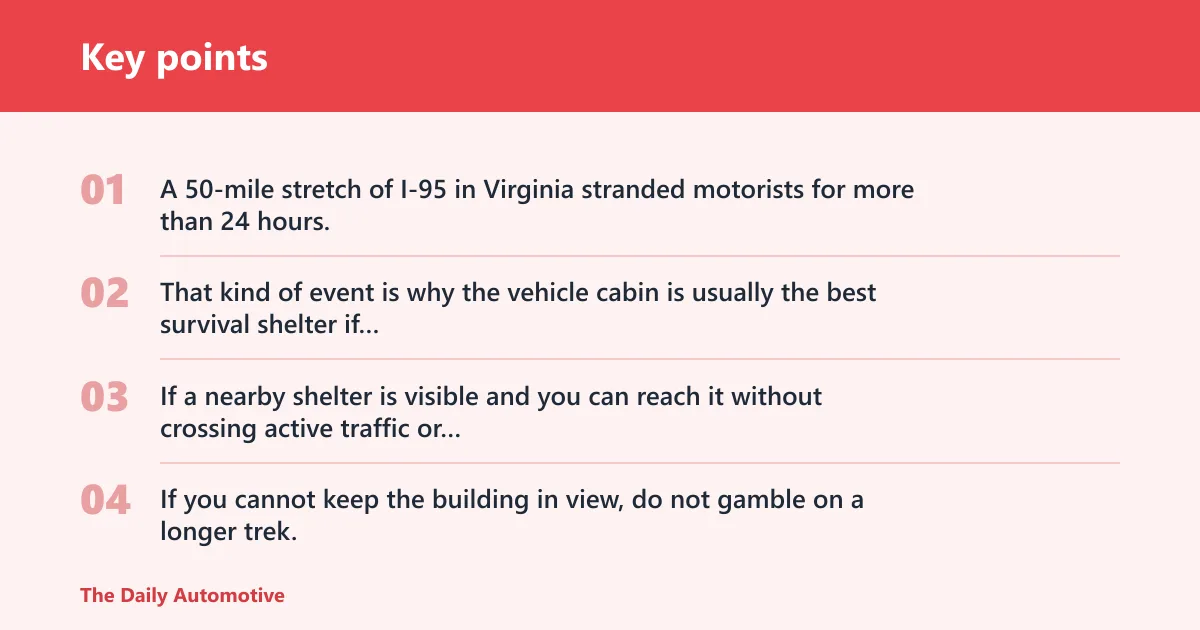
That kind of event is why the vehicle cabin is usually the best survival shelter if rescuers can see it.
If a nearby shelter is visible and you can reach it without crossing active traffic or losing your bearings, leaving may make sense. If you cannot keep the building in view, do not gamble on a longer trek.
Car survival checklist
This checklist is the practical core. Use it in order. It focuses on visibility, air quality, heat, and battery life, because those are the things that turn a delay into a danger.
What checklist
| Step | Action | Why it matters |
|---|---|---|
| 1 | Clear the tailpipe before you run the engine | Snow blocking the tailpipe can cause carbon monoxide to back up into the cabin |
| 2 | Turn on hazard lights while traffic is a factor | They help rescuers and nearby drivers see the car |
| 3 | Fasten the seat belt if the vehicle is near traffic | It reduces risk if another vehicle slides toward you |
| 4 | Run the engine in short intervals instead of continuously | It conserves fuel and lowers carbon monoxide risk |
| 5 | Crack a downwind window about an inch while the engine runs | It gives airflow as a carbon monoxide safeguard |
| 6 | Use the dome light at night if the engine is running | It uses little power and improves visibility to rescuers |
| 7 | Put the phone in low-power mode | It helps preserve charge for calls and location sharing |
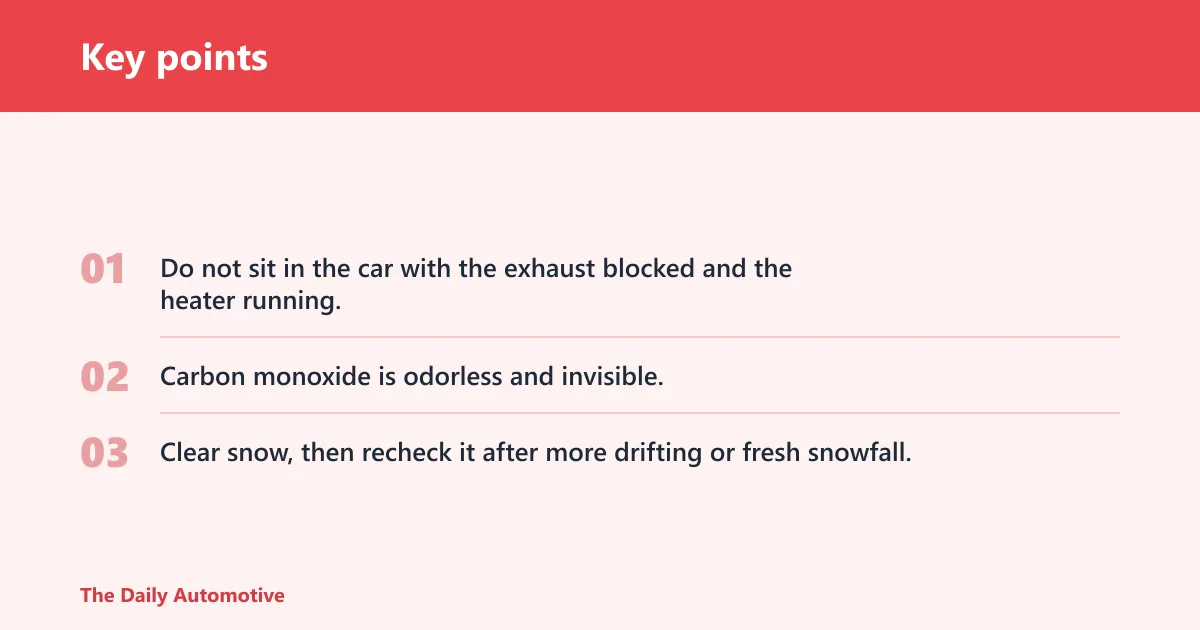
Do not sit in the car with the exhaust blocked and the heater running. Carbon monoxide is odorless and invisible, and the risk rises fast when idling with a blocked exhaust. Clear snow, then recheck it after more drifting or fresh snowfall.
How do you avoid carbon monoxide?
Keep the tailpipe clear, use the engine in short cycles if conditions allow, and make sure there is some airflow when the heater is on. Carbon monoxide is odorless and invisible, so you cannot rely on smell or warning signs to judge safety. Exhaust blockage is the main danger.
Engine cycle routine
- Clear snow from the tailpipe.
- Crack a window slightly if conditions allow airflow without creating a bigger exposure problem.
- Run the engine and heater in a short cycle as needed.
- Shut it off and recheck the tailpipe after drifting snow or fresh accumulation.
- Keep the interior quiet and monitor for any change in how you feel.
Warning signs matter. If anyone becomes drowsy, confused, unusually weak, nauseated, or hard to wake, stop the engine, get fresh air immediately, and call for help. Do not keep “testing” the heater after those signs appear.
A common mistake for first-timers is leaving the engine on too long after clearing the exhaust once, then assuming the tailpipe will stay clear. In falling snow, it may not. Drift can rebuild around the pipe fast, and the car can trap exhaust again.
How do you stay warm without wasting fuel?
Use insulation first, then use the engine in short intervals. Dry layers, hats, gloves, and covered feet hold heat better than movement or panic. Avoid sweaty exertion, because damp clothing pulls heat away from the body once activity stops.
Body-heat plan
- Keep coats, hats, and gloves on.
- Tuck blankets or extra clothing around exposed skin.
- Limit movement to small motions that do not cause sweating.
- Share close body heat if there are other passengers and it is safe.
- Use the engine only in short intervals as needed.
Picture two adults in a sedan with dry coats and one spare blanket. If they stay still and layer up, they will usually keep heat better than by walking around the cabin or exercising until sweat soaks the shirt. Warmth management is about slowing heat loss, not chasing warmth through motion.
What supplies do you need if you might be trapped in your car overnight?
Bring a winter emergency kit before travel, because the useful items are the ones already in the car. The basics are water, a flashlight, first-aid supplies, a phone charger, food, a shovel, traction aid, extra warm clothing, and a jumper pack. Add compact heat-retention gear that does not take much room.
What checklist
| Item | Why it matters | Notes |
|---|---|---|
| Water | Hydration during a long wait | Keep bottles from freezing if possible |
| Flashlight | Light for checking the cabin and signaling | Test batteries before winter travel |
| First-aid supplies | Basic wound care and minor injury response | Include any personal items you rely on |
| Phone charger | Preserves calling and location-sharing ability | Keep a cable in the vehicle year-round |
| Thermal survival bag | Reflects body heat back to the user | Mylar-lined and packs down to the size of a soda can |
The thermal survival bag matters because it gives you another layer of insulation without taking up much space. It can reflect the vast majority of body heat back to the user, and its small packed size makes it easy to keep with the vehicle kit.
Passengers with higher risk
Children, older adults, and people using medical devices or medication need closer attention in a roadside wait. They may lose heat faster, dehydrate sooner, or need a tighter plan for charging, dosing, and comfort. Make those needs part of the first call, not an afterthought.
Kids and infants
Keep children buckled, dry, and layered. If an infant is present, keep extra blankets, a spare hat, and any feeding supplies within reach. Check hands, feet, and face often for cold stress, and avoid overbundling that causes sweating once the engine heat comes on.
Older adults
Older adults may be more sensitive to cold and less able to recover from it. Keep them seated and insulated, reduce unnecessary movement, and ask about dizziness, chest discomfort, confusion, or numbness. If any of those appear, treat the situation as urgent and update the rescue call.
People with medical devices or medication
If a passenger uses a portable medical device, relies on batteries, or needs medication on schedule, say that clearly to dispatch. Keep devices charged, protect medicines from freezing if possible, and mention any time-sensitive need in the first call. Do not assume responders will guess it matters.
How often should you run the engine if you are stuck in snow?
Run the engine and heater for a short cycle when you need heat, then shut it off and conserve the cabin’s stored warmth. That cycle helps stretch fuel, limits exhaust exposure, and gives you a regular chance to recheck the tailpipe, battery, and passengers.
First-hour and overnight plan
- Call for help and share the exact location.
- Clear the tailpipe and set hazard lights if traffic is nearby.
- Use low-power mode on the phone.
- Bundle up and keep movement small.
- Run the engine for a short cycle as needed.
- Recheck the exhaust after each snowfall, drift, or plow pass.
- At night, use the dome light only when needed and keep the seat belt fastened if near traffic.
Do not wait until everyone is shivering hard before you start the heating cycle. A steady routine works better than a desperate one. If fuel is getting low, shorten nonessential phone use and keep the cabin closed between engine cycles.
When is it safe to leave your car during a snowstorm?
Leaving is justified only when a clearly safer option is visible and reachable without exposure risk. That means a nearby shelter you can actually see, a short route you can keep oriented on, or a hazard that makes the vehicle itself unsafe. An active train track or blind curve changes the calculation immediately.
Do not leave for an unknown destination in a whiteout. Walking through a blizzard is dangerous because people can become disoriented within minutes. If the shelter is not visible, the car is still the better shelter in most cases.
When leaving may be justified
- The car is on an active train track.
- The car is on a blind curve and traffic cannot see it.
- A visible shelter is nearby and reachable safely.
- The vehicle is in immediate danger from a road hazard that is worse than the walk.
Frequently asked questions
What should I do first if I get stranded in my car in a snowstorm?
First, stop spinning the tires, turn on hazard lights if traffic is a factor, and call 911 if there is immediate danger or roadside assistance if it is not an emergency. Then give the highway name, about the mile marker, travel direction, nearest exit, and any visible landmark. Switch the phone to low-power mode right away.
Should I stay in my car or walk for help during a blizzard?
Stay in the car unless you can see a nearby shelter and reach it safely without losing your bearings. Walking through a blizzard can leave you disoriented within minutes, and the vehicle cabin is usually the best survival shelter if rescuers can see it. Leave only for a clearly safer option.
How often should I run the engine if I’m stuck in snow?
Run the engine and heater in a short cycle when needed, not continuously. Between cycles, keep the cabin closed and recheck the tailpipe after any drift or fresh accumulation. If the exhaust blocks again, stop the engine until it is clear.
How do I keep carbon monoxide from killing me in a stuck car?
Clear snow from the tailpipe before idling and keep rechecking the exhaust. Carbon monoxide is odorless and invisible, so drowsiness or confusion should be treated as a warning, not ignored. Stop the engine if symptoms appear.
What supplies do I need if I might be trapped in my car overnight?
Keep water, a flashlight, first-aid supplies, a phone charger, food, a shovel, traction aid, extra warm clothing, a jumper pack, and a thermal survival bag in the vehicle before winter travel. Add a winter emergency kit with basics you may need without leaving the car. The best kit is the one already packed when the storm starts.
What should I tell 911 if I am stranded on the highway in snow?
Say the highway name, mile marker, direction of travel, nearest exit, and any visible landmark. Also give the number of people in the car and whether the vehicle is on the road, shoulder, or in a drift. Clear location details help responders find you faster.
Products related to this article
Sponsored / affiliate links. As an Amazon Associate I earn from qualifying purchases. I may earn additional commission from eligible campaigns.