Is A Car AC Or DC Voltage? Essential Answer
A car’s electrical system primarily uses DC (Direct Current) voltage. While the AC (Alternating Current) from your home wall outlets is different, your car’s battery and most of its components run on DC. Understanding this difference is key to keeping your car running smoothly and safely.
Ever found yourself staring at a car repair manual or a friend who’s really into cars, and they start talking about volts, amps, AC, and DC? It can feel like a secret language, right? Especially when you’re trying to figure out why a certain part might not be working or what kind of tool you might need. One of the most common questions that pops up is simple: “Is a car AC or DC voltage?” This can seem a bit confusing because we often hear about “alternating current” in our homes for power, but cars are a bit different.
Don’t worry, though! It’s not as complicated as it sounds, and understanding it will actually make you feel more in control of your car’s care. We’re going to break it down in a way that’s easy to swallow, so you can stop scratching your head and start feeling confident. Stick with me, and by the end of this, you’ll know exactly what kind of voltage your car uses and why it matters to you as a driver.
Understanding Car Voltage: DC is the Star Player
Think of your car’s electrical system like a one-way street for electricity. That’s essentially what Direct Current (DC) is. The electricity flows in a single direction. This is crucial for the sensitive electronics and components inside your vehicle. When you turn your car key, or push that start button, you’re engaging a system that’s designed to work with this constant, predictable flow of power.
The Heart of the System: The Battery
The main source of power for your car’s electrical system is its battery. Car batteries are specifically designed to provide DC voltage. You might have seen markings on your battery, often indicating its voltage (like 12 volts). This 12-volt DC power is what keeps everything from your headlights and radio to your fuel pump and engine computer running. It’s a stable supply that your car’s intricate systems rely on to function correctly and safely.
Why DC is Preferred in Cars?
There are several good reasons why DC voltage is the standard for car electrical systems:
- Simplicity and Stability: DC provides a steady, unidirectional flow of current. This makes it much easier for the various electronic components in a car to use without needing complex conversion mechanisms built into every single part.
- Component Compatibility: Most automotive components, especially electronic ones like sensors, control modules, and even simple light bulbs, are designed to operate on DC power. Using AC could damage them or cause them to malfunction.
- Battery Power: Cars run on batteries, and batteries naturally produce DC power. It’s the most direct and efficient way to power the car straight from its stored energy source.

What About AC in a Car? It’s Not What You Think!
So, if your car is all about DC voltage, where might you hear about AC in relation to your car? This usually comes up in a couple of contexts, and it’s important to distinguish them from the car’s main electrical system:
The Alternator: The Bridge Between Systems
Your car has a component called an alternator. Its job is quite important: it generates electricity while the engine is running to keep the battery charged and power the car’s electrical systems. Interestingly, the alternator produces AC voltage as a byproduct of its operation. However, it has a crucial built-in component called a rectifier (made of diodes) that immediately converts this AC voltage into DC voltage before it reaches the battery or the rest of the car’s systems. So, while AC is generated, it’s quickly transformed into the DC your car needs.
To understand this better, think of the alternator as a small power plant. It spins with the engine, and that motion creates electricity. But the electricity it initially creates is in a form that’s not directly usable by your car. The rectifier acts like a translator, changing the “language” of the electricity from AC to DC. This is a vital step because if the raw AC from the alternator were to reach your car’s electronics, it could cause serious damage.
For more about how alternators work and their role in your car’s charging system, you can check out resources like this explanation from HowStuffWorks, which details the process clearly.
Inverters: Bringing Home Power to Your Car
You might also encounter AC voltage in your car if you use an accessory called a power inverter. This device plugs into your car’s DC power outlet (like the cigarette lighter socket) and converts the car’s 12-volt DC power into 110-volt or 220-volt AC power – similar to what you get from a wall socket at home. This is useful for charging laptops, running small appliances, or powering devices that require AC input while you’re on the go. However, it’s important to remember that the inverter itself is doing the conversion; the car’s primary electrical system is still DC.
When choosing a power inverter, consider the wattage needed for your devices. A small inverter might only power a phone charger, while a larger one could handle a small tool. Make sure the inverter is designed for automotive use and doesn’t draw too much power from your car’s DC system, especially when the engine is off, as this can drain your battery.
AC vs. DC: Key Differences Explained for Your Car
Let’s break down the fundamental differences between AC and DC voltage as they relate to your car.
| Feature | DC (Direct Current) | AC (Alternating Current) |
|---|---|---|
| Direction of Flow | Flows in one direction only. | Flows back and forth, changing direction periodically. |
| Source in Car | Car battery, and rectified output from the alternator. | Produced by the alternator before rectification; used by some specialized components (rare) or via an inverter. |
| Typical Car Use | Powers the vast majority of car systems: lights, radio, ECUs, sensors, ignition, wipers, power windows, etc. | Not directly used by most car systems. Primarily converted by the alternator’s rectifier for battery charging and DC use. |
| Standard Voltage in Car | Typically 12 Volts (sometimes 24V in larger vehicles like trucks). | Alternator generates AC internally, but it’s converted to DC. Household AC is much higher (e.g., 120V/240V). |
| Safety & Electronics | Stable and predictable for sensitive automotive electronics. | Can be more damaging to DC-designed electronics if not properly managed or converted. |
Why the Alternator’s AC is Different
The AC generated by the alternator is a kind of raw electrical energy. Its voltage and frequency can vary significantly depending on engine speed. This electrical “noise” and fluctuating nature make it unsuitable for direct use by your car’s sensitive electronics and battery. The rectifier’s job is to smooth out these fluctuations and ensure the electricity is converted into a steady, consistent stream of DC power. This process is often referred to as “rectification.”
You can find more in-depth technical explanations of rectification and how diodes work in circuits on educational sites like those from Khan Academy, which can offer a deeper dive for those interested.
Practical Implications for Car Owners
So, why is it important for you, the car owner, to know this? Understanding that your car runs on DC voltage has a few practical benefits:
1. Choosing the Right Accessories
When you buy accessories for your car, like phone chargers, dash cams, or portable coolers, they will almost always be designed to plug into a 12-volt DC power outlet. If you find an accessory that requires AC power, you’ll need to purchase a separate power inverter. Always check the specifications of any accessory to ensure compatibility with your car’s DC system.
2. Understanding Jump-Starting
When you need a jump-start, you’re connecting your car’s DC battery to another car’s DC battery. The cables transfer this DC power. It’s crucial to connect positive to positive and negative to negative to avoid short circuits and damage to the electrical systems of both vehicles. This is a direct application of knowing your car runs on DC.
3. Basic Troubleshooting
If a component isn’t working, knowing your car uses DC helps you think about the problem. For example, if your headlights aren’t coming on, it’s unlikely to be an “AC issue.” Instead, you might look at DC-related causes: a blown fuse (which protects DC circuits), a faulty DC bulb, bad wiring in the DC circuit, or an issue with the switch controlling the DC power. This foundational knowledge simplifies troubleshooting.
4. Battery Maintenance
Car batteries are DC power sources. Proper care, like ensuring a good connection at the terminals and avoiding draining the battery with accessories when the engine is off, directly impacts its ability to provide that crucial DC current. Understanding battery health is directly tied to the DC nature of your car’s core power.
Dispelling Common Myths
Sometimes, terms get used loosely, leading to confusion. It’s worth clarifying a few points:
- “My car’s electrical system is AC.” This is generally incorrect. While AC is generated and converted within the system, the usable power is DC.
- “I need to convert my car’s power to AC for my devices.” This is only true if the device specifically requires AC power. Many portable electronics have AC adapters that internally convert AC to DC for charging, meaning a DC car charger is often more direct and efficient.
- “The alternator is an AC generator.” While it _produces_ AC internally, its primary function is to supply DC power to the car after rectification. It’s a nuanced point, but the end result for the car is DC.
A Quick Look at Voltages
It can be helpful to see how different voltages fit together, especially for a car owner:
| Power Source | Type | Typical Voltage | Use Case |
|---|---|---|---|
| Car Battery | DC | 12 Volts | Primary power for car systems. |
| Alternator (Internal Generation) | AC | Varies (e.g., 13-15 Volts AC before rectification) | Raw power before conversion to DC. Not directly used. |
| Alternator (Output) | DC | Typically 13.5 – 14.5 Volts | Charges battery and powers car when engine is running. |
| Household Outlet | AC | 120 Volts (North America) or 230 Volts (Europe/elsewhere) | Powers home appliances and electronics. |
| Car Power Inverter | AC (Converted from DC) | 120 Volts / 230 Volts (same as household) | Powers AC devices from car’s DC power. |
This table clearly shows how the different types of voltage interact within and around your vehicle. The primary, consistent power source for your car is the 12V DC coming from the battery and the regulated DC output from the alternator.
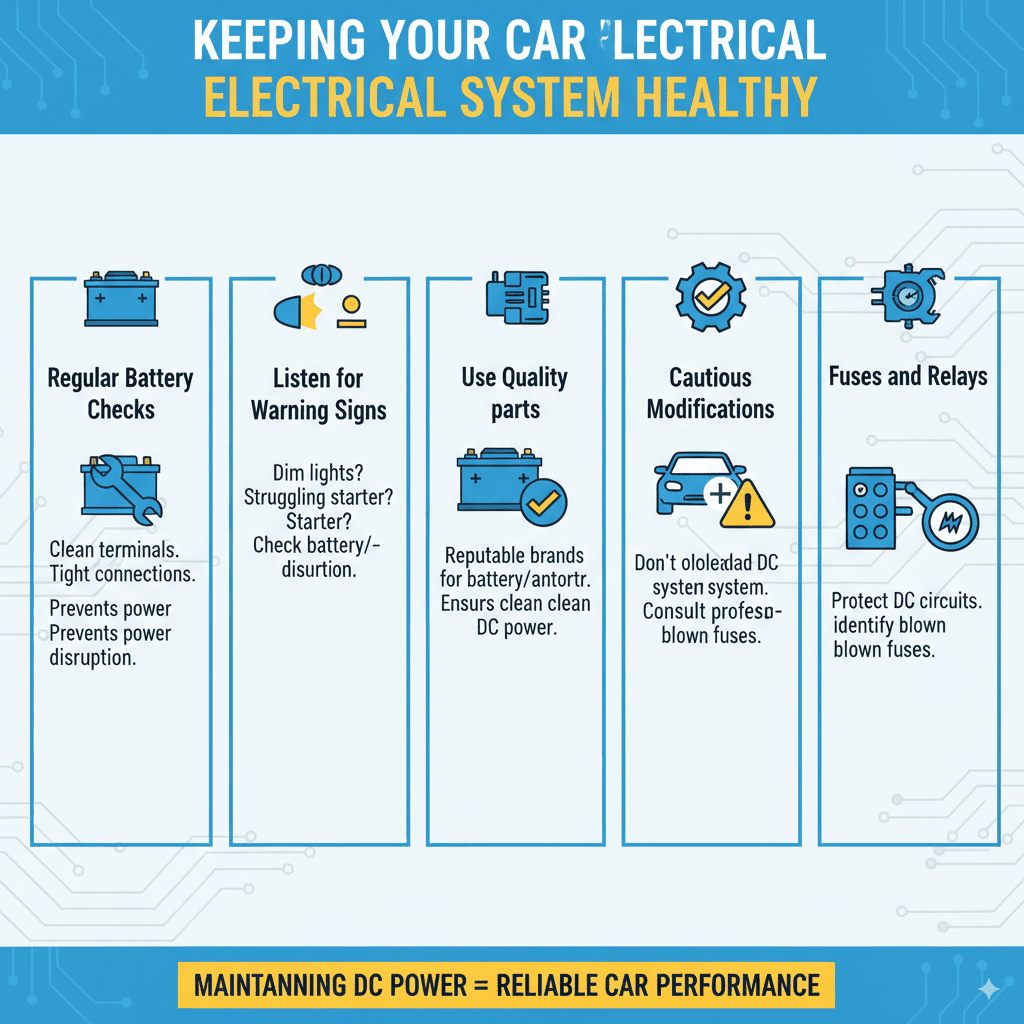
Keeping Your Car’s Electrical System Healthy
Maintaining your car’s electrical system involves ensuring the DC power it relies on is clean and consistent. Here are a few tips:
- Regular Battery Checks: Ensure your battery terminals are clean and the connections are tight. A corroded or loose terminal connection can disrupt the flow of DC power, leading to starting issues or intermittent electrical problems.
- Listen for Warning Signs: Pay attention to dimming headlights, flickering dashboard lights, or a struggling starter motor. These can all be indicators of a problem with the charging system (alternator) or the battery’s ability to supply or maintain DC voltage.
- Use Quality Parts: When replacing components like the alternator or battery, opt for reputable brands. A faulty alternator might not convert AC to DC properly, or a poor-quality battery might not hold its DC charge effectively.
- Be Cautious with Modifications: If you’re adding aftermarket accessories that draw a lot of power, ensure your car’s electrical system (the DC system) can handle the load. Consult a professional if you’re unsure. Overloading the DC system can lead to blown fuses, damaged wiring, or premature battery failure.
- Understand Fuses and Relays: These components are critical in protecting the DC circuits in your car. Learn where your fuse box is and how to identify a blown fuse – a common DC circuit problem. Many car owner manuals will show you the layout and function of fuses and relate them to specific DC systems like the radio, lights, or ignition.
By understanding that your car operates on DC voltage, you’re better equipped to care for its electrical health. It simplifies how you think about problems and solutions, making car maintenance less daunting.
Frequently Asked Questions (FAQ)
What are the main components of a car’s DC electrical system?
The main components include the battery (the primary DC power source), the alternator (which generates AC and converts it to DC), the starter motor (which uses DC to crank the engine), fuses and relays (for circuit protection), wiring harnesses (to conduct DC power), and all the various electrical devices like lights, the radio, power windows, sensors, and the engine control unit (ECU).
Can I use a standard household extension cord in my car?
No, absolutely not. Household extension cords are designed for AC voltage and are not compatible with your car’s DC system. They could cause damage or be a fire hazard. If you need to power AC devices, you must use a car-specific power inverter.
How does the alternator’s AC get converted to DC?
The alternator uses a component called a rectifier, typically made of diodes. Diodes are electronic components that allow current to flow in only one direction. By arranging diodes in a specific circuit, they effectively “chop off” or redirect the negative parts of the AC wave, smoothing it out into a pulsating DC, which is then further regulated to provide a steady DC output.
What happens if my car’s alternator produces bad AC that isn’t fully converted to DC?
If the alternator doesn’t rectify the AC to DC properly, the resulting power sent to the car’s systems will be unstable and potentially contain residual AC “noise.” This can cause various problems, such as flickering lights, erratic behavior of electronic modules (like the radio or dashboard), premature failure of sensitive electronics, and ultimately, a dead battery because the battery isn’t being charged effectively with clean DC power.
Is it safe to work on my car’s electrical system?
Yes, with caution. While car electrical systems operate at a relatively low voltage (12V DC), it’s still electricity. Always disconnect the battery (negative terminal first) before working on electrical components to prevent short circuits and electrical shock. Wear safety glasses, and if you’re unsure about a repair, it’s always best to consult a qualified mechanic.
Does my car’s computer system use AC or DC voltage?
Your car’s computer systems, like the Engine Control Unit (ECU) or Powertrain Control Module (PCM), operate on DC voltage. They require a stable and consistent supply of DC power to function correctly and process the information from various sensors.
If my car uses DC, why do I sometimes hear about “charging voltage” which seems to fluctuate?
The “charging voltage” you might hear about (often around 13.5V to 14.5V when the engine is running) is the regulated DC output from the alternator. This voltage is intentionally higher than the battery’s resting voltage (around 12.6V) to force current into the battery and recharge it. The voltage can fluctuate slightly based on the electrical load (e.g., headlights on vs. off) and the battery’s state of charge, but it remains within a stable DC range managed by the voltage regulator within the alternator or the car’s computer.
Conclusion
So, to wrap it all up, the essential answer to “Is a car AC or DC voltage?” is that your car’s primary electrical system runs on DC (Direct Current) voltage.