What Is a Collision Damage Waiver and Is It Worth It?
A collision damage waiver is a rental-car damage contract, and it is worth buying only if you lack equivalent coverage or want to cap a large deductible. Otherwise, it often duplicates protection you already have. Skip it badly, and you can face repair bills, loss-of-use charges, and a claims headache after a minor scrape. This guide compares CDW with personal auto insurance, credit card coverage, and common rental terms in the U.S., Canada, Europe, and other markets.
Quick answer
A collision damage waiver, or CDW, is a rental-car coverage agreement, not standard auto insurance. It waives the rental company’s right to charge you the full damage cost after a covered incident, but it often still leaves you with an excess or deductible. Rental desks sell it separately because they are shifting risk, not handing out free protection.
That difference matters. If the car is damaged, the waiver can limit what the rental company bills you, but it does not erase every possible charge. In some cases, you still owe a fixed excess, and in some markets the waiver is bundled with theft protection or loss damage wording.
CDW, LDW, and what each one means
Loss damage waiver, or LDW, is another label rental companies use for nearly the same idea. On some sites and in some countries, CDW and LDW refer to the same umbrella product, while the wording shifts to include theft, loss-of-use language, or both. The label changes by country and company, but the risk-transfer idea is similar.
That label difference is one reason renters get confused. A “waiver” can sound like full protection, yet the policy language may still leave exclusions, a deductible, or separate charges for downtime and fees. Read the actual terms, not just the counter sign.
What CDW usually covers
CDW usually covers damage to the rental vehicle itself, meaning the rental company agrees not to pursue you for the full repair bill within the waiver terms. In some markets or policy versions, theft protection and loss-of-use language are included too. In others, they are not.
Even when the waiver applies, an excess or deductible can still remain. Finder says rental damage excess can be as high as $8,000, which is why a “covered” rental can still leave meaningful out-of-pocket exposure. The point is risk reduction, not automatic zero cost.
Some insurers and card programs also address a narrower slice of the risk. The same source says car rental excess insurance is generally included with comprehensive travel insurance. That can matter if you want to cap the leftover bill after the waiver or policy pays first.
What CDW usually does not cover
Common exclusions include underbody and overhead damage, and Finder also lists tyres, windscreen, headlight and wheel damage as often excluded. Those are some of the most common repair items on rental invoices because they are easy to damage and expensive to replace.
CDW may also exclude reckless, deliberate, drunk, or off-road damage. That means a waiver can fail at exactly the moment the rental company thinks the driver violated the contract. If the car leaves paved roads, or if the damage happened during prohibited use, expect tighter scrutiny.
Loss of use charges can also sit outside basic protection. A rental company may calculate them using the car’s daily rental rate plus taxes and fees while the vehicle is in the shop. Towing and administrative fees may also be excluded unless the policy wording says otherwise.
Picture a compact SUV that clips a parking barrier and bends a wheel. The visible body damage looks minor, but the invoice can stack the wheel repair, towing, admin fees, and a few days of loss of use. The deductible may be the smallest line on the bill.
Who already covers the risk?
Before buying CDW, check the coverage you may already have in this order: personal auto insurance, credit card rental coverage, and travel insurance or third-party rental cover. These sources do different jobs, and each has its own limits, exclusions, and country rules.
Personal auto insurance often extends to rentals in the U.S. and Canada for personal use, says Experian. But that usually means you should confirm both collision and comprehensive coverage, because the rental car can be subject to the same deductible and the same premium consequences if you file a claim.
Credit card rental car coverage may cover damage and theft, and sometimes loss of use and towing, but only if you use the card and satisfy issuer conditions. Policy terms vary by issuer, so the card benefit is not automatic and not universal. Travel insurance may include excess cover too, but you need the wording in hand.
A common first-timer mistake is assuming “I have insurance” means the rental desk can be skipped. That may be true for one renter in one country with one card and one policy, and false for the next renter across the border or in a different vehicle class.
CDW decision table
This table shows when CDW is usually worth buying, when it is mainly a deductible cap, and when it is often duplicate protection. It is a decision aid, not a substitute for the policy wording on your rental agreement, insurer declaration page, or card benefit guide.
| Renter scenario | Likely coverage sources | Remaining out-of-pocket risk | CDW usually worth buying? |
|---|---|---|---|
| No personal auto insurance | Possible credit card benefit, if eligible; otherwise none | Full repair bill, loss of use, fees, and any deductible under a card or travel policy | Usually yes, unless a valid card or travel policy clearly covers the rental |
| High-deductible policy | Personal auto insurance with collision and comprehensive | Your deductible, plus premium impact if you file a claim | Often yes if the waiver cost is lower than the deductible risk you want to cap |
| Business trip | Employer policy, corporate card, or personal coverage | Deductible, excluded charges, and possible delay while claims are sorted | Often yes for convenience and cleaner expense handling, but confirm employer rules |
| International rental | Possible card benefit or travel insurance; local coverage may be included by market | Country-specific excess, excluded parts, fees, and any gap in the card benefit | Often yes if local cover is not standard or the excess is high |
| Premium credit card coverage | Card benefit, if the issuer allows the country and vehicle type | Exclusions, loss-of-use gaps, and any missing theft or fee coverage | Usually no, unless the rental is outside the card’s rules or the vehicle is excluded |
| Luxury car rental | Possible personal, card, or third-party cover with restrictions | Higher excess, tighter exclusions, and more expensive repair exposure | Often yes because vehicle value and repair costs raise the downside sharply |
Is a collision damage waiver worth it?
It is worth it when you are buying convenience, capping a deductible, or closing a gap you cannot otherwise cover. It is less compelling when you already have equivalent protection through personal auto insurance, a qualifying card, or a travel policy that covers rental damage. In that case, CDW may be duplicate protection.
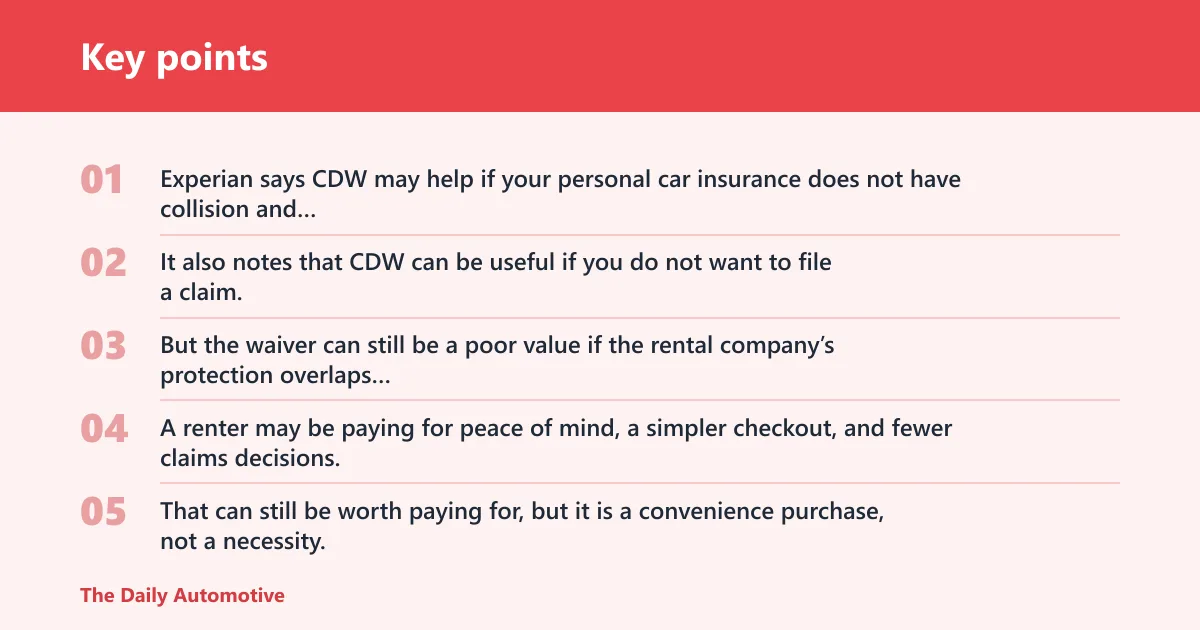
Experian says CDW may help if your personal car insurance does not have collision and comprehensive coverage, and it may also help if you have a high deductible. It also notes that CDW can be useful if you do not want to file a claim. That is real value for some renters.
But the waiver can still be a poor value if the rental company’s protection overlaps with benefits you already carry. A renter may be paying for peace of mind, a simpler checkout, and fewer claims decisions, not for materially better coverage. That can still be worth paying for, but it is a convenience purchase, not a necessity.
Suppose you are picking up a midsize sedan for a week, and your personal policy deductible is about $1,500. If the rental desk offers CDW at a daily rate that buys down your exposure to a small excess, the waiver may be acting as a deductible cap. If your card already covers the same loss with a similar excess, it is probably duplicate protection.
What should you check before you decline?
Check the coverage order first: auto policy, card, then rental desk. Then verify the exact country, vehicle class, and rental-company terms. A policy that works for a domestic compact car may fail for a luxury SUV abroad.
Also check the exclusions, the deductible, and whether the benefit covers loss of use, towing, and administrative fees. Finder’s figures show why this matters: the visible excess may be one number, but the extra charges can stack beyond it. If the policy wording is vague, ask for written confirmation before pickup.
Use this checklist before you sign:
- Confirm whether your personal auto policy extends to the rental car in that country.
- Check whether your card requires you to pay with that card and decline the rental counter’s waiver.
- Look for limits on vehicle type, rental length, and country coverage.
- Read the exclusions for tyres, windscreen, roof, underbody, wheels, and headlights.
- Ask whether loss of use, towing, and administrative fees are covered.
- Get the excess or deductible amount in writing.
Coverage rules differ by country and rental company. iCarhireinsurance says Europe, Africa and Australasia normally include basic CDW or LDW as standard, while the USA and Canada may require separate purchase. That alone can change the right answer at the counter.
Frequently asked questions
What is a collision damage waiver?
A collision damage waiver is a rental-car agreement that waives the company’s right to charge you the full damage cost for covered incidents. It is not standard auto insurance. In many cases, there is still an excess or deductible, plus exclusions that limit what the waiver actually pays for.
Is a collision damage waiver worth it on a rental car?
It can be worth it if you have no equivalent coverage, have a large deductible, or want to avoid a claim altogether. It is often not worth it when your personal auto policy, card benefit, or travel insurance already covers the same risk with similar or better terms.
What does a collision damage waiver cover?
It usually covers damage to the rental vehicle itself and may include theft or loss-of-use language depending on the company and country. Coverage is limited by the contract, and the waiver can still leave you with a deductible, plus possible exclusions for fees and certain parts.
What doesn’t a collision damage waiver cover?
Common exclusions include tyres, windscreen, headlights, wheels, roof, and underbody damage. Reckless, deliberate, drunk, or off-road damage may also be excluded. Towing, administrative fees, and loss of use are sometimes excluded unless the wording says they are included.
Do I need a collision damage waiver if I have car insurance?
Maybe not, but only if your personal auto insurance actually extends to the rental and includes collision and comprehensive coverage. The same source says this often applies in the U.S. and Canada for personal use. Check your deductible and whether a claim could affect your premium.
What is the difference between collision damage waiver and loss damage waiver?
Some companies use CDW and LDW as different labels for the same umbrella concept. LDW often includes theft or loss wording, while CDW may focus more narrowly on collision damage. The practical difference depends on the rental company and country, so read the policy language, not the acronym.
Products related to this article
Sponsored / affiliate links. As an Amazon Associate I earn from qualifying purchases. I may earn additional commission from eligible campaigns.
 Kalttoy Auto Body Damage Dent Repair Fix Blemishes Indentations Tool Pulling Bridge Dent Removal Glues Tabs Hand Tools Not Damage Paint Removal Sheet Glues Tabs Tools
 Kalttoy Car Dent Repair Body Damage Fix Tool Pulling Bridge Puller Dent Removal Glues Tabs Hand Repair Tools Car Puller Auto Body Kit Glues Sticks Suction Cup Metalhammers T-bar