
Can Bad Fuse Drain Car Battery? Essential Fixes.
Don’t let a drained battery leave you stranded! A bad fuse can drain your car battery if it’s stuck in a “closed” position, causing a circuit to remain active. This guide shows you how to find and fix these tricky issues easily, saving you time and money.
Ever found your car battery dead when you know you charged it or didn’t leave any lights on? It’s a frustrating mystery, and often, the culprit isn’t a faulty battery at all but something much smaller: a fuse. Many drivers don’t realize that a blown or damaged fuse can actually cause a car battery to drain. How can something so small cause so much trouble? It all comes down to how your car’s electrical system works.
If a fuse gets stuck in a closed or “on” position, it can keep a car component running even when the car is off. This constant draw of power can quickly deplete your battery overnight or even in just a few hours. But don’t worry! Figuring out if a fuse is stealing your battery’s life and how to fix it is a lot simpler than you might think. We’ll walk through it step-by-step, making car care easy and stress-free.
Understanding How Fuses and Batteries Work Together
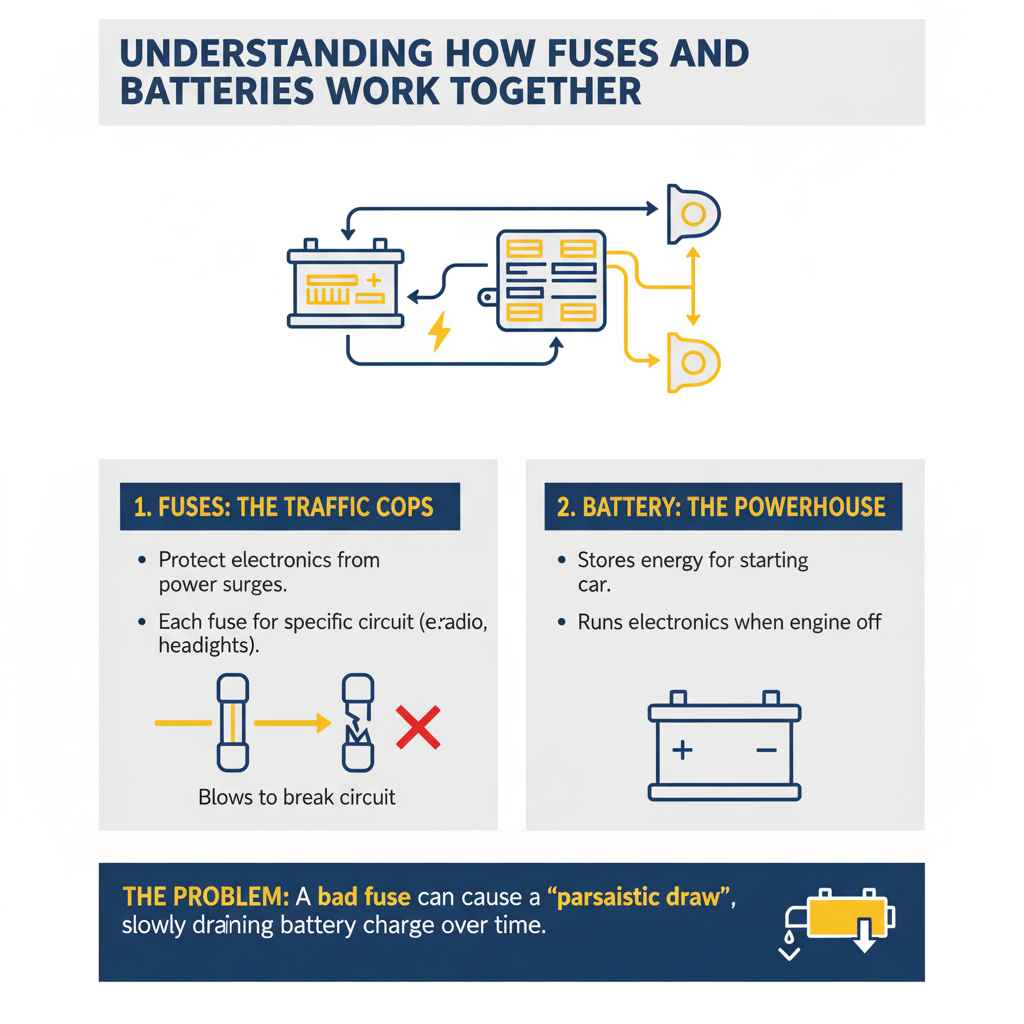
Your car’s electrical system is like a complex network of roads, and fuses are the traffic cops. They protect your car’s delicate electronics from sudden surges of electricity that could cause damage. Each fuse is designed to protect a specific circuit – like the radio, headlights, or even the computer system. When too much electricity flows through a fuse, it blows, breaking the circuit and stopping the flow of power. This is a safety feature.
Your car battery is the powerhouse, storing the energy needed to start your engine and run all the electrical components when the engine isn’t on. Normally, when you turn your car off, all these circuits shut down, and the battery gets a rest. However, if a fuse malfunctions and doesn’t break the circuit properly, it can act like a tap that’s still dripping water, slowly draining the battery’s charge over time.
Can a Bad Fuse Really Drain Your Car Battery?
Yes, a bad fuse absolutely can drain your car battery, but it’s usually not what most people think of as “bad.” A fuse is typically considered “bad” or “blown” when the metal strip inside has melted due to an electrical overload, and the circuit it protects stops working. In this common scenario, a blown fuse prevents a component from drawing power, so it wouldn’t drain the battery.
The kind of “bad” fuse that drains a battery is one that doesn’t blow when it should, or, more commonly, a fuse that gets stuck in a “closed” or “on” position. This can happen due to manufacturing defects, physical damage to the fuse block, or even corrosion. When a fuse is stuck in this state, it allows a circuit to continue drawing power even after the ignition is turned off and the car is parked. This continuous, low-level drain is often enough to completely deplete a healthy car battery over several hours or days, leading to a no-start situation.
Types of Fuse Failures That Cause Drains
- Stuck Closed Fuse: This is the most common culprit. The fuse physically or electronically remains in a state where current is allowed to pass, even when it shouldn’t.
- Corrosion in Fuse Holder: Sometimes, the metal contacts within the fuse holder can corrode. This can create a path for current to leak through, similar to a stuck fuse.
- Wiring Issues Near the Fuse Block: While not the fuse itself, a short circuit in the wiring connected to the fuse block could create a draw that mimics a faulty fuse problem.
Identifying the Signs of a Battery Drain
A battery drain caused by a faulty fuse might not always be obvious at first. Your car might start fine for a while before suddenly refusing to turn over. Here are some common symptoms to watch out for:
- Your car battery dies overnight or after being parked for a few hours. This is the most direct sign.
- The car struggles to start, making slow cranking noises.
- You find yourself needing to jump-start your car frequently.
- Certain electrical components (like the clock or radio presets) reset inexplicably, indicating a constant low power draw.
- You might notice a specific component not turning off when it should, like a dome light that stays dimly lit or a radio that doesn’t completely shut down.
Essential Tools You’ll Need
Don’t worry, you don’t need a mechanic’s workshop to tackle this! For most of these fixes, you’ll only need a few basic tools.
- Owner’s Manual: This is your map! It shows the location of your fuse boxes and details what each fuse controls.
- Fuse Puller: While you can sometimes use needle-nose pliers or even your fingers, a fuse puller is a small, inexpensive tool that makes removing fuses much easier and safer, preventing you from bending the prongs or damaging the fuse.
- Multimeter (Optional but Recommended): This fancy tool can measure voltage and resistance and is key for pinpointing exact electrical drains. You can find basic analog multimeters for under $20 from most auto parts stores or online retailers.
- Replacement Fuses: It’s always good to have a variety pack of fuses on hand, as you might need to replace a fuse that is genuinely blown, not just stuck.
- Screwdriver or Nut Driver: Some fuse box covers require a screwdriver to access.
- Gloves and Safety Glasses: Always protect yourself when working on your car.
You can find many of these tools at your local auto parts store or online. For example, a reliable and affordable multi-use tool kit can be found at many hardware stores, often including the screwdrivers you might need.
Step-by-Step Guide: Diagnosing and Fixing a Fuse Drain
Let’s get your car back to its reliable self. Follow these steps carefully.
Step 1: Locate Your Fuse Boxes
Most modern cars have at least two fuse boxes: one under the dashboard on the driver’s side and another under the hood. Your owner’s manual is your best friend here. It will have diagrams showing their exact location and a chart that lists each fuse and its function. For example, checking a guide on reading your owner’s manual can be super helpful before you start.
Step 2: Perform a Visual Inspection (The Simplest Check)
With your car off and keys out of the ignition, open the fuse box cover. Look for any fuses that appear obviously damaged, burnt, or melted. If you see one, carefully remove it using a fuse puller and inspect it. A blown fuse will have a broken or melted metal strip inside. If you find a blown fuse that controls a non-essential component (like a radio or interior light), replacing it might solve your mystery.
Step 3: The “Key Off” Draw Test (The Most Effective Method)
This is where a multimeter becomes incredibly useful for checking for parasitic battery drain. A parasitic draw test checks how much electrical current is being used by the car when the ignition is off.
- Ensure the Car is “Off”: Turn off the ignition, remove the keys, and open the doors and hood. Let the car sit for about 15-30 minutes. This allows the car’s computer systems to go into “sleep mode,” which is crucial for an accurate reading. If you test too soon, some modules may still be awake and drawing power, giving a false high reading.
- Disconnect the Battery: First, disconnect the negative (black) terminal of your car battery. This is critical for safety and to prepare for the next step.
- Connect the Multimeter: You’ll set your multimeter to measure amperage (usually labeled with “A” or “mA”). Connect the red probe of the multimeter to the disconnected negative battery cable, and the black probe to the negative battery terminal post. Your multimeter should now be in series with the battery, measuring all the current flowing out of it.
- Check the Reading: With everything disconnected and in sleep mode, a healthy car should have a very low parasitic draw, typically less than 50 milliamps (mA), or 0.05 amps. Consult your car’s service manual for the specific acceptable draw for your vehicle. You can find service manuals online or at auto parts stores.
- Identify the Draining Circuit: If your multimeter shows a draw significantly higher than the specified limit, you need to find which circuit is causing it. You do this by individually pulling out fuses one by one. After pulling each fuse, watch the multimeter reading.
- The “Aha!” Moment: When you pull a fuse and the amperage reading on the multimeter drops significantly (close to the acceptable limit), you’ve found the circuit that’s causing the drain.
Example: Imagine you’re testing, and the reading is 150 mA. You pull the fuse for your interior lights, and the reading drops to 25 mA. This tells you the interior light circuit is drawing too much power when it shouldn’t be.
If you find a circuit with a high draw, the problem might be a faulty component within that circuit, or as we’ve discussed, a fuse that’s stuck in the “on” position. If the fuse you removed was visibly intact but part of a high-draw circuit, it’s a strong candidate for being stuck closed.
Step 4: Test Fuses Suspected of Being Stuck
Once you’ve identified a circuit with excessive current draw using the multimeter test, and the fuse looks intact, you need to test that specific fuse more closely. The best way to be sure if a fuse is stuck “on” is to test its continuity.
Continuity Testing Fuses:
- Remove the suspect fuse from the fuse box.
- Set your multimeter to the continuity setting (often represented by a wavy line or a speaker symbol).
- Touch one probe of the multimeter to one metal tab of the fuse and the other probe to the opposite metal tab.
-
What to Expect:
- Good Fuse: You should hear a beep or see a “0.00” reading, indicating continuity (electricity can flow through).
- Blown Fuse: The meter will show “OL” (Open Loop) or no beep, indicating the circuit is broken.
- Stuck Closed Fuse: This is tricky because a visually intact fuse should show continuity when the car is off and the circuit is supposed to be off. This is where the parasitic draw test is key. If that particular fuse, when in place, causes a high draw, but the fuse itself appears intact and shows continuity when tested out of the circuit, it’s likely contributing by not allowing a component to fully shut off due to a subtle internal fault or a fuse box issue.
If the fuse shows continuity and is part of the draining circuit, the problem might be within the component it powers (e.g., a shorted wire in a door lock actuator that keeps it active) or sometimes, less commonly, a faulty fuse holder.
Step 5: Replace the Faulty Fuse or Address the Circuit
Based on your findings:
- If you found a genuinely blown fuse: Replace it with a new fuse of the exact same amperage rating. Using a fuse with a higher rating is dangerous and can cause fires. You can find replacement fuse kits at any auto parts store.
-
If you identified a circuit with a draw and the fuse looks okay: This is where it gets more complex.
- Rule out the fuse itself first: Try replacing the fuse with a brand-new one of the correct rating, even if the old one looked fine. Sometimes, internal fuse failures aren’t visible.
- Check the component: If replacing the fuse doesn’t solve the draw, the problem is likely with the component connected to that fuse. This could be anything from a stuck relay to a malfunctioning electronic module.
- Wiring issues: A short in the wires connected to the component or fuse can also cause a drain. This might require professional diagnosis if you’re not comfortable with intricate wiring.
Table: Common Circuits Prone to Parasitic Draw
Here are some common car circuits that, if faulty, can cause battery drains.
| Circuit Name | Typical Fuse Location | Potential Problem | Common Symptoms (Beyond Battery Drain) |
|---|---|---|---|
| Interior Lights/Dome Light | Under dashboard | Stuck switch, faulty control module. | Lights don’t turn off, flicker. |
| Radio/Infotainment System | Under dashboard | Faulty head unit, amplifier, or wiring. | Radio won’t turn off, strange noises, glitches. |
| Power Locks/Windows Motor | Under dashboard/Driver’s door | Stuck lock actuator, faulty window motor, pinched wires. | Locks/windows operate intermittently or not at all. |
| ECU (Engine Control Unit) Memory / Car Alarm System | Under hood / Under dashboard | Faulty module, improper aftermarket alarm installation. | Check engine light, alarm malfunctions or false alarms. |
| Trunk Light/Glove Box Light | Trunk area / Under dashboard | Stuck switch, wiring short. | Lights stay on when they shouldn’t. |
When to Call a Professional
While many fuse-related battery drain issues are DIY-friendly, there are times when it’s best to seek expert help. If you’ve gone step-by-step and are still stumped, or if your multimeter readings are confusing, it’s a good idea to take your car to a trusted mechanic. They have specialized diagnostic tools and experience that can quickly pinpoint complex electrical issues, especially those involving computer modules or intricate wiring harnesses. For instance, understanding how to properly test your car battery before you even start diagnosing, can sometimes rule out other issues.
Also, if you suspect a problem with the main fuse box itself (e.g., damaged terminals, melted plastic), or if you’re uncomfortable working with electrical systems, that’s a clear sign to let the professionals handle it. Safety first is always the best policy. For example, if you’re dealing with a modern vehicle with complex integrated electronics, a seasoned technician will be better equipped to handle it.

Frequently Asked Questions (FAQs)
Q1: How long does it take for a bad fuse to drain a car battery?
A: It varies greatly depending on the circuit the faulty fuse is affecting and the size of your battery. A small, constant drain from a faulty component could take days to fully deplete a battery, while a more significant “stuck on” circuit might drain it completely overnight.
Q2: Can a fuse cause a car to not start even if it’s not a drain issue?
A: Absolutely! If a fuse controlling a critical system like the starter, fuel pump, or ignition system blows, your car won’t start. This is different from a drain issue, as a blown fuse stops power to a component, rather than allowing a continuous unintended draw.
Q3: What is “parasitic draw”?
A: Parasitic draw refers to the small amount of electrical current your car’s electronics consume when the engine is off and all accessories are supposedly turned off. A normal parasitic draw is very low. An abnormal one, or a “parasitic drain,” means a circuit is drawing too much power when it shouldn’t be.
Q4: Is it safe to drive with a blown fuse?
A: It depends on what the fuse controls. If it’s for a non-essential item like a radio or interior light, it’s generally safe to drive. However, if it controls vital systems like your headlights, brakes, or engine functions, it can be dangerous. Always consult your owner’s manual.
Q5: Should I replace a blown fuse with one of the same amperage?
A: YES! This is critical. Always replace a fuse with one of the exact same amperage (the number printed on top). Using a higher amperage fuse is dangerous – it can overheat and cause fires because it won’t blow when it should, potentially damaging expensive electronics.