How Much Does It Cost to Fix a Car Heater Core?
Fixing a car heater core typically costs about $800 to $1,500, and can be around $2,000 or more on vehicles with difficult dash removal; diagnosis alone often runs about $100 to $200. Skip the wrong diagnosis and you can pay for dashboard labor twice, or keep losing coolant and cabin heat. This guide explains what the estimate should include, which symptoms point to a heater-core failure, and when the real problem is elsewhere.
Heater core cost table
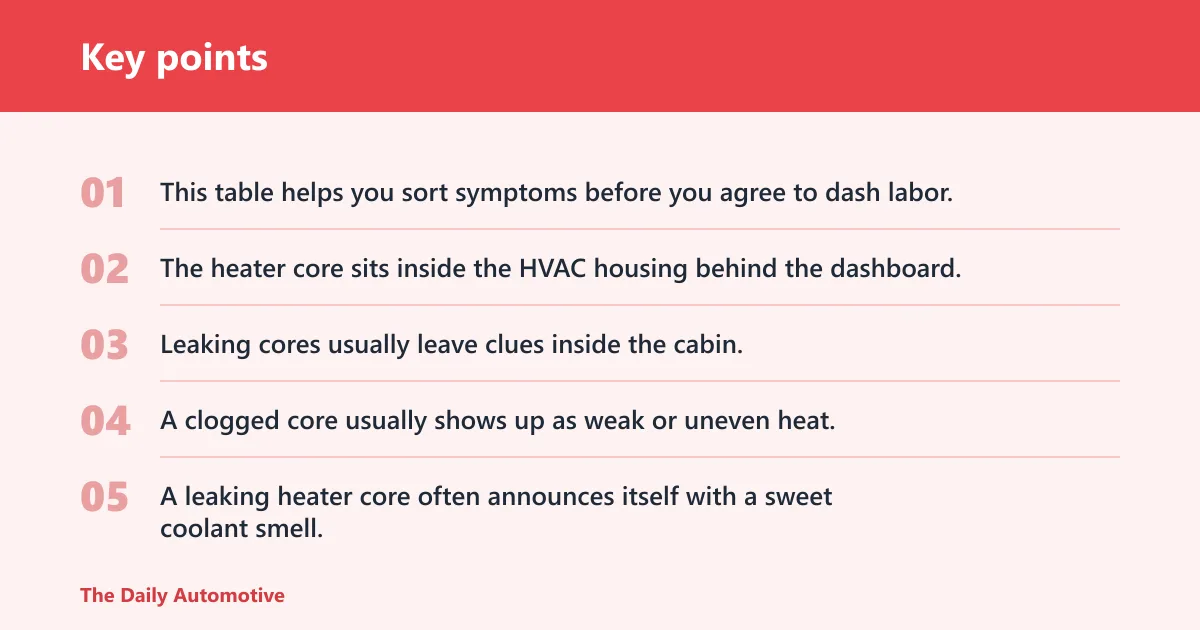


This table helps you sort symptoms before you agree to dash labor. The heater core sits inside the HVAC housing behind the dashboard, so the biggest cost is usually access, not the part itself.
| Symptom pattern | Likely root cause | Expected DIY spend | Expected shop spend | Heater-core replacement the right fix? |
|---|---|---|---|---|
| Sweet coolant smell, damp carpet, fogging glass | Leaking heater core or heater hoses | $100 to $300 for parts if the core is the issue; more if hoses and coolant are needed | Usually within $800 to $1,500; can climb higher with difficult dash access | Often yes, if the leak is confirmed at the core |
| Weak heat, lukewarm vents, heat that changes after a flush | Blocked or clogged heater core, low coolant, or trapped air | Low cost if a flush, bleed, or coolant service solves it | Often lower than full replacement if the core can be restored | Not always; confirm flow before replacing the core |
| No heat, but engine temperature seems normal | Blend door actuator, heater control valve, thermostat, or air pocket | Varies by part and access | Varies by diagnosis and labor | Only after those checks fail |
| Fogged windows with coolant smell | Interior heater-core leak spraying vapor into the HVAC box | Usually not a small fix if the core itself leaks | Often a dash-out repair | Usually yes |
| Overheating plus coolant loss | Cooling-system leak, possibly the heater core, hose, cap, or another leak point | Depends on leak source | Depends on diagnosis and access | Maybe, but confirm the leak source first |
Leaking cores usually leave clues inside the cabin. A clogged core usually shows up as weak or uneven heat, especially when the engine is otherwise at normal temperature.
Leak symptoms and likely cause
A leaking heater core often announces itself with a sweet coolant smell, fogged inside glass, wet carpet on the passenger side, or a steady loss of coolant. If the leak is serious, engine overheating can follow. In that case, the core may be the source, but the cooling system still needs a full leak check.
Clog symptoms and likely cause
A blocked or clogged heater core restricts coolant flow through the small tubes in the cabin heat exchanger. The result is weak heat, lukewarm vents, or heat that improves after a flush or coolant bleed. Rust, scale, and debris can build up inside the passages, especially after poor maintenance or contaminated coolant.
No-heat versus blend door or valve faults
No heat does not automatically mean the heater core has failed. A blend door actuator can mimic a bad core by failing to direct air through the hot side of the HVAC box, and it may click behind the dash. On some vehicles, a heater control valve can stick open or closed and block hot coolant from reaching the core.
DIY spend, shop spend, and replacement call
If the fault is a core leak, DIY parts usually cost $100 to $300, while professional repair commonly lands much higher because the dashboard has to come apart. The average heater-core replacement cost is $1,031 to $1,304, with labor at $588 to $742 and parts at $443 to $561. Shop replacement can average $1,060 to $1,339, with labor at $603 to $761 and parts at $457 to $578.
Say your sedan starts fogging the windshield on a cold morning, the passenger carpet feels damp, and the coolant reservoir drops over a week. That pattern points more strongly to a leaking heater core than to a blend door fault, because the failure is moving coolant into the HVAC case.
What a heater core does
The heater core is the cabin heat exchanger. Hot engine coolant passes through it, and the HVAC blower pushes air across its fins to warm the cabin. Because it lives behind the dashboard or in the heater box, replacing it is labor-heavy and often requires partial disassembly of the interior.
Where it sits in the HVAC case
Most heater cores are buried inside the HVAC assembly, not mounted where you can reach them easily from under the hood. That location is why a simple-looking heating complaint can turn into a long repair once the dash panels, ducts, and related components have to come out.
Why dash access drives labor cost
Labor is often the largest share of the bill. Typical replacement often takes 5 to 7 hours or more, and a heater-core replacement can take six to eight hours. Some vehicles need as long as 15 hours. The hours rise when the dashboard, steering column pieces, airbags, center stack trim, or HVAC housing are difficult to remove.
What replacement labor usually includes
A proper estimate should list more than the core itself. It should include labor hours, new coolant, refill and bleed time, and any related HVAC steps needed for access. On some vehicles, the estimate may also need AC refrigerant discharge and recharge if the HVAC box or evaporator area must be opened.
How much does it cost to fix a heater core?
Most professional heater-core repairs fall in the $800 to $1,500 range, and difficult vehicles can run above that. The average heater-core replacement cost is $1,031 to $1,304, which reflects the labor-heavy nature of the job. Diagnosis alone often runs $100 to $200, and that money is worth spending before any dash teardown begins.
Parts cost versus total invoice
Parts are usually lower than the invoice total. The difference is labor, coolant, and the time needed to reach the heater box safely.
Why some quotes land in the high hundreds or low thousands
Two cars with the same symptom can get very different estimates. One may allow straightforward access to the heater box. Another may require steering column removal, center dash disassembly, or extra HVAC work, pushing the bill toward the low thousands.
How many hours does replacement take?
Most heater-core jobs take five to seven hours, and a common estimate is six to eight hours. Some vehicles take as long as 15 hours. The exact time depends on how deeply the dashboard and HVAC case are buried in the vehicle design.
Why some vehicles take longer
Platform design matters. Trucks, many Jeep applications, some Ford models, and several BMW platforms can vary widely in parts price and access time. In practice, the slowest jobs are the ones where the dash structure and HVAC box are tightly packaged, forcing more disassembly before the core can be reached.
What should appear on the estimate?
A fair quote should show the labor hours, the part price, coolant, shop supplies if applicable, and any added HVAC steps. If the vehicle needs AC system work to reach the heater box, that should appear too. A vague line item with only a total number is not enough detail for a repair this involved.
How do you know if the heater core is bad?
Look for a pattern, not one symptom. Sweet coolant smell, fogged windows, and wet carpet point toward a leak. Weak heat, especially with normal engine temperature, points more toward clogging, low coolant, trapped air, or a valve issue. Overheating raises the stakes because it can mean the system is losing coolant somewhere.
Sweet smell, fogged glass, or wet carpet
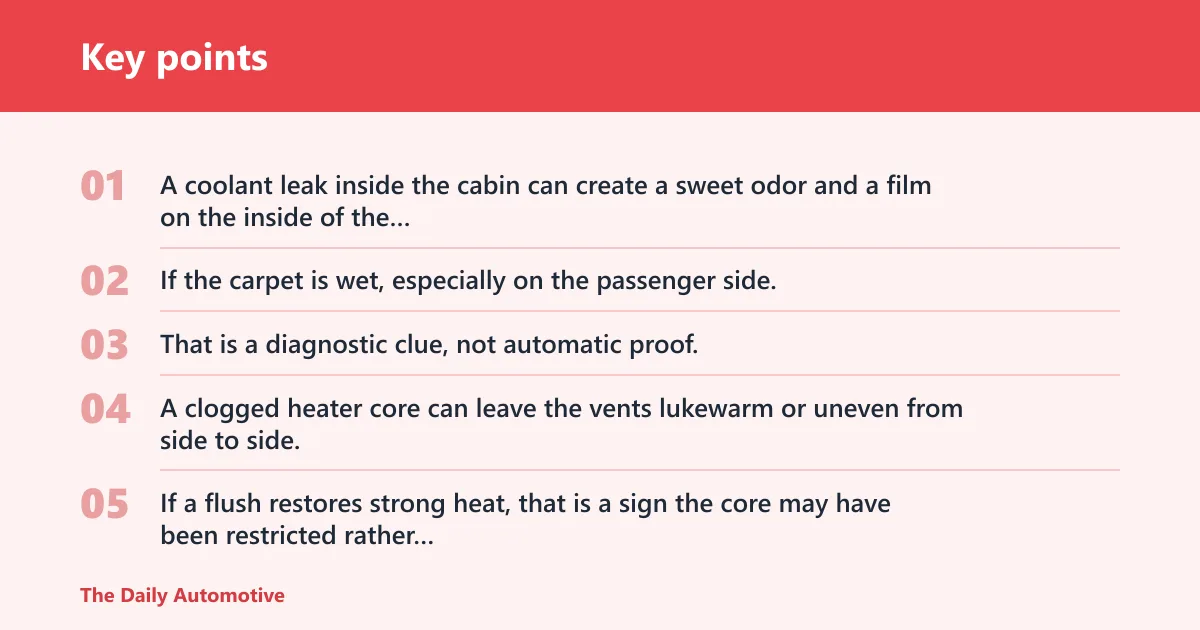
A coolant leak inside the cabin can create a sweet odor and a film on the inside of the windshield. If the carpet is wet, especially on the passenger side, the heater core or its nearby connections become a stronger suspect. That is a diagnostic clue, not automatic proof.
Weak heat from a clogged core
A clogged heater core can leave the vents lukewarm or uneven from side to side. If a flush restores strong heat, that is a sign the core may have been restricted rather than failed. Rust or debris inside the cooling system is a common cause of restricted flow.
Overheating linked to coolant loss
When a heater core leaks enough coolant, the engine can overheat. That makes the heating complaint a cooling-system complaint too. Any overheating warning deserves immediate attention, because continuing to drive can turn a heater-core problem into engine damage.
Suppose a compact SUV blows cold air at idle but warms up after a highway drive, and the coolant level keeps dropping. That can still be a heater-core clue, but it can also mean trapped air or another coolant-flow issue. The fix depends on which symptom shows up first and how the system behaves after bleeding.
When the real fix is not the heater core
A no-heat complaint can come from several places outside the core. Before spending on dash labor, check the thermostat, coolant level, trapped air, blend door actuator, heater control valve, blower operation, and hose temperature differences. The right diagnosis can save hundreds of dollars.
Thermostat, air pocket, or low coolant
If the engine never reaches normal operating temperature, the thermostat may be stuck open. If coolant is low, the heater core may simply be starved. Air pockets after cooling-system work can also block flow until the system is properly bled.
Blend door actuator problems
A failed blend door actuator can make one side of the cabin hot and the other cold, or it can keep the system stuck on cold air. Clicking behind the dash is a common clue. Replacing an actuator is very different from replacing a heater core, both in labor and cost.
Heater control valve failure
Some vehicles use a heater control valve to regulate coolant flow through the core. If it sticks open or closed, the cabin may lose heat even though the core itself is fine. That valve should be tested before committing to a full core replacement on a valve-equipped system.
Flush or hose repair first
If the core is only partially restricted, a flush may restore heat. If a hose is leaking or collapsing, replacing the hose can solve the problem without touching the dashboard. Those repairs cost far less than a full heater-core job and are worth checking early in the diagnosis.
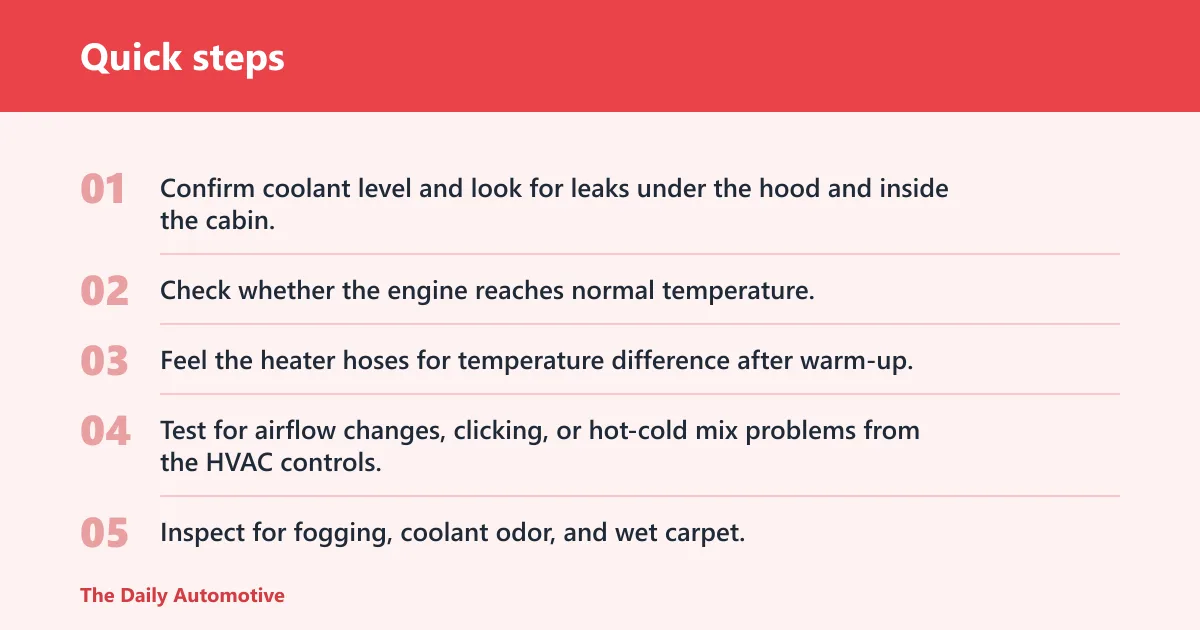
- Confirm coolant level and look for leaks under the hood and inside the cabin.
- Check whether the engine reaches normal temperature.
- Feel the heater hoses for temperature difference after warm-up.
- Test for airflow changes, clicking, or hot-cold mix problems from the HVAC controls.
- Inspect for fogging, coolant odor, and wet carpet.
- Ask the shop whether a flush, valve repair, hose repair, or air bleed should be tried before full replacement.
Can you drive with a bad heater core?
You may be able to drive short distances with a mildly clogged core, but a leaking core is a different problem. Coolant loss can lead to overheating, and a heavy leak can fog the windshield or soak the carpet. If the temperature starts climbing, stop driving and address the cooling-system fault immediately.
Leak risk and overheating
A leaking heater core can empty coolant from the system fast enough to cause engine overheating. That is the main danger, not the lack of cabin heat itself. If the coolant level drops, the warning light comes on, or the gauge climbs, the vehicle should not keep running.
Short-term driving limits
If the leak is small and the engine temperature stays normal, short trips to a repair facility may be reasonable with close monitoring. Keep coolant topped off only as a temporary measure. Do not treat that as a fix, because the leak will continue.
When to stop driving
Stop driving if the windshield keeps fogging, the cabin smells strongly of coolant, the carpet becomes wet, or the engine overheats. Those signs point to an active leak and a rising chance of bigger damage. Towing is safer than gambling on one more trip.
Frequently asked questions
Is a heater core expensive to fix?
It is often expensive compared with many cooling-system repairs because labor is so high. The part itself is usually not the main expense. What drives the total is the time needed to reach the heater core behind the dash and put everything back together correctly.
How much to replace a heater core in a car?
Some vehicles cost less, and some cost more, especially if dash removal is difficult or extra HVAC work is required for access.
How much will a shop charge to replace a heater core?
Many shops will quote roughly $800 to $1,500, with some jobs reaching $2,000 or more on hard-to-service vehicles. A good estimate should list labor hours, coolant, the heater core itself, and any related steps such as AC refrigerant service if access requires it.
How many hours does it take to replace a heater core?
Most vehicles need five to seven hours, and a heater-core replacement can take six to eight hours. Some vehicles take as long as 15 hours. The range depends on dashboard design, HVAC packaging, and whether related components must come out first.
How do you fix a heater core without replacing it?
If the core is clogged rather than leaking, a flush may restore heat. If the problem is a low coolant level, air pocket, hose leak, thermostat, blend door actuator, or heater control valve, fixing that issue may solve the complaint without replacing the core. Leak damage usually still means replacement.
Products related to this article
Sponsored / affiliate links. As an Amazon Associate I earn from qualifying purchases. I may earn additional commission from eligible campaigns.