Rally Car vs Rallycross Car: Key Differences
Choose Rally Car for long-stage grip, cooling, and repairability; choose Rallycross Car for short, contact-heavy races, shorter gearing, and faster response. Pick wrong, and you overspend on parts you do not need or break a car built for the wrong abuse. This guide breaks down chassis, suspension, drivetrain, safety gear, tires, budgets, and build priorities.
| Factor | Rally Car | Rallycross Car | Winner |
|---|---|---|---|
| Event format fit | Built for closed-road stage rallies, where the car runs timed tests over longer distances and changing conditions. | Built for short mixed-surface heats on a closed circuit, where launches and repeated starts matter more than endurance. | Rally Car |
| Suspension and ride height | Needs more suspension travel and more ground clearance to absorb bumps, ruts, and skid impacts. | Uses shorter, race-optimized suspension and a lower stance for sharper response and flatter cornering. | Rally Car |
| Gearing and differential setup | Gear ratios favor a wider speed range and traction over rough, changing road sections. | Shorter gearing and sharper differential behavior help the car launch hard and recover speed after each corner. | Rallycross Car |
| Repair and bodywork tolerance | Built to survive repeated hits from road debris and the occasional hard landing, with more attention on underbody protection. | Built for contact-heavy racing, so the car must tolerate bodywork damage, nose-to-tail taps, and quick turnaround between heats. | Rallycross Car |
What a rally car
A rally car is a closed-road stage-rally machine built to run timed sections over distance, often from a road-based shell or a purpose-built homologation model. The shell may be FWD, RWD, or AWD, but the setup always leans toward traction, suspension travel, underbody protection, and surviving rough surfaces.
Why the stage-rally format changes the build
Stage rallies reward a car that can keep working across many kilometres of gravel, tarmac, or mixed surfaces. That is why skid plates, reinforced suspension mounts, and a gravel setup matter more than sprint-style launch tuning.
Common beginner rally classes are often front-wheel-drive, especially Rally4, Rally5, and older R1 examples. That is where many new drivers start, because the cars are cheaper to run and easier to learn with than a full AWD build.
Common rally shells and drivetrains
Entry-level rally cars include the Ford Fiesta Rally4/R1, Renault Clio Rally5, and Peugeot 208 Rally4. Used-market listings often mention Group N, which can be a useful class-regulated comparison point when shopping for a legal, ready-to-run car rather than a generic project.
A rally car is not automatically road legal; That depends on the shell, registration status, and local rules, and those details vary by country and series.
What a rallycross car
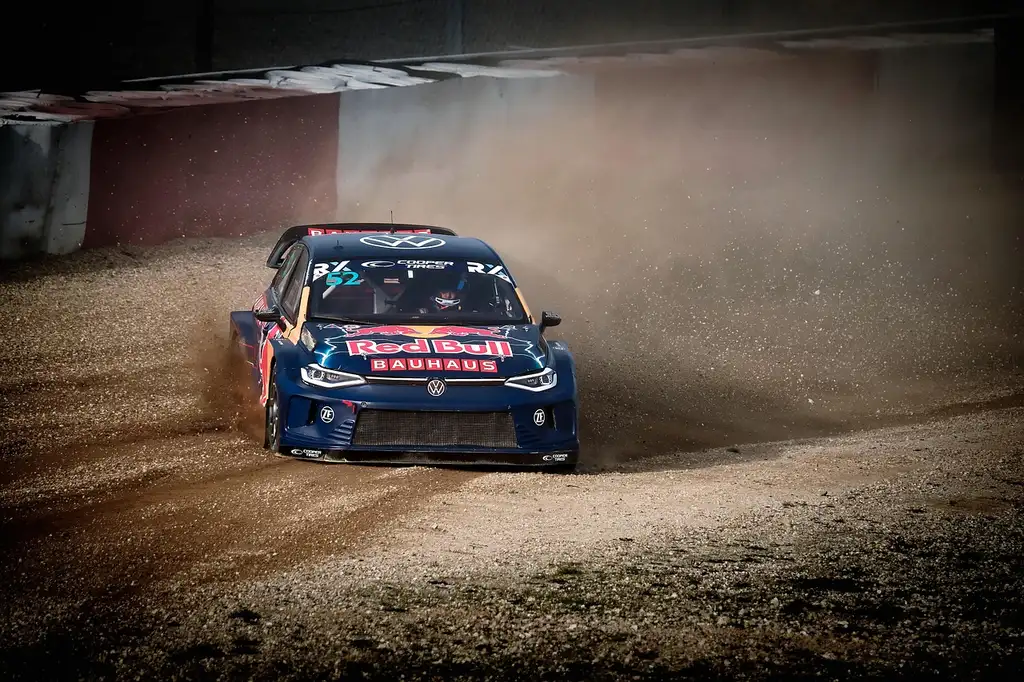
Rallycross is typically run as short, mixed-surface heats on a closed circuit, so the car generally needs quick acceleration, strong braking, and enough contact tolerance for close-quarter racing. Top categories often use AWD, but the key difference is the event format, not a single mandatory drivetrain.
Why rallycross setup is different
Rallycross rewards a hard launch, quick rotation into corners, and the ability to brake late, then do it all again within the next heat. The car therefore benefits from shorter gearing, more aggressive differential setup, and braking hardware that can take repeated hard stops.
That also means setup changes between heats matter more than they do in a stage rally. The car has less time to cool, less room for error, and more bodywork risk from contact.
Contact tolerance and turnaround time
Rallycross cars need to survive scrapes, nudges, and bent panels without turning every session into a rebuild. A rally car built only for stage use can be too delicate in the wrong places if you ask it to take repeated contact.
Rally car vs rallycross car: the core differences
The biggest difference is not the surface alone. It is the event format: rally uses longer timed stages on closed roads, while rallycross uses short heats on a closed circuit with more launches, more contact, and less time to cool or repair.
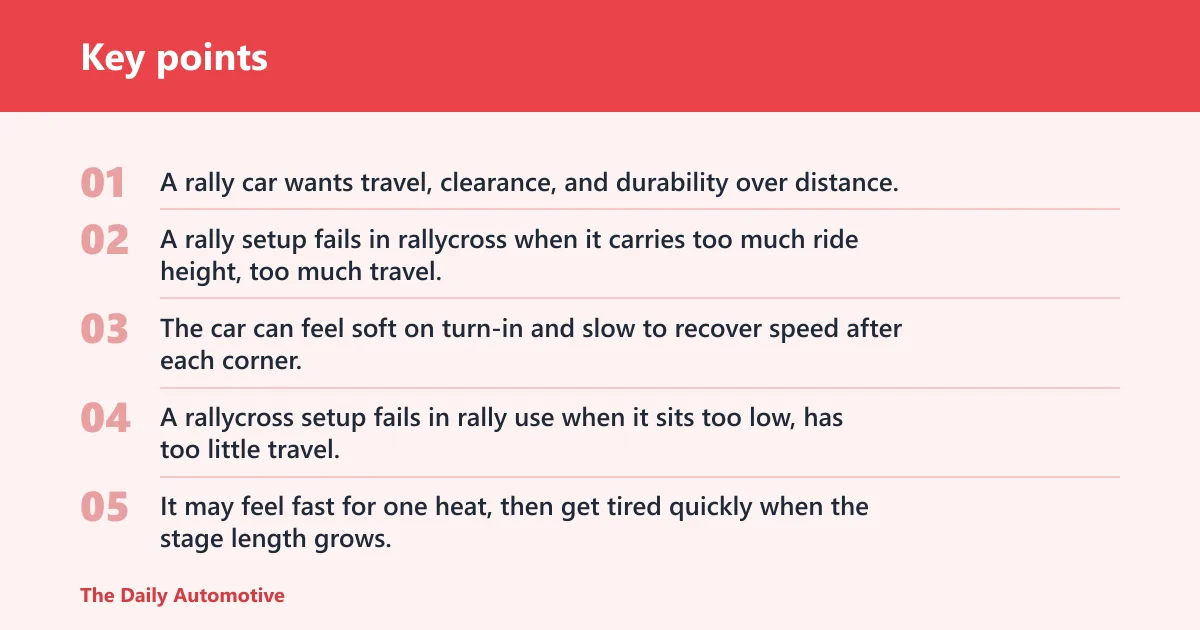
That changes almost every build choice. A rally car wants travel, clearance, and durability over distance; a rallycross car wants sharper response, shorter gearing, and stronger tolerance for repeated scrubbing and body hits.
Where each build goes wrong
A rally setup fails in rallycross when it carries too much ride height, too much travel, and gearing that feels lazy off the line. The car can feel soft on turn-in and slow to recover speed after each corner.
A rallycross setup fails in rally use when it sits too low, has too little travel, and wears through its brakes or tires over a longer stage loop. It may feel fast for one heat, then get tired quickly when the stage length grows.
Choose Rally Car if…
Choose Rally Car if you want stage rallies, longer service intervals, and a chassis that prioritizes broken-surface grip over launch violence. It is the safer default for a first build when your goal is learning pace notes, surviving rough roads, and keeping repair bills tied to the event you actually entered.
Choose Rallycross Car if…
Choose Rallycross Car if your series is short-course rallycross, your local event calendar is built around heats, and you want a car that can launch hard, brake late, and tolerate more contact. It makes sense when the abuse comes from side-by-side racing instead of long road sections.
Rally car decision table
This table maps the main build areas that change between the two disciplines. Use it before you buy parts, because the wrong setup often costs more to undo than to build correctly the first time.
| Build area | Rally Car | Rallycross Car | Wrong if you do X |
|---|---|---|---|
| Suspension travel | Longer travel to absorb ruts, landings, and broken surfaces. | Shorter travel for quicker response and tighter body control. | Fit short travel to stage rally and you will bottom out on rough roads. |
| Ride height | Higher clearance for gravel and underbody protection. | Lower stance for launches and cornering stability. | Run rallycross-height clearance in rally and you lose stability; run rally height in rallycross and you give away response. |
| Gearing | Ratios that keep the car useful across longer stage sections. | Shorter gearing for quick acceleration out of slow corners. | Use tall rally gearing in rallycross and the car feels sleepy off the line. |
| Differential setup | Tuned for traction over changing grip and rough patches. | Tuned for rapid rotation and hard launches. | Copy a rallycross diff setup into a stage car and you can make it nervous on loose surfaces. |
| Brake cooling | Built to manage heat across longer runs and repeated stages. | Built for repeated heavy stops in short heats. | Under-size cooling in rallycross and the brakes fade heat-soaked; overbuild for rally and you carry parts you may not need. |
| Tire choice | Chosen for stage surface, weather, and event regulations. | Chosen for repeated short sprints and mixed-surface grip. | Pick the wrong compound and the car may be fast for one section, then fall away as the surface changes. |
| Cage and safety priorities | Focus on homologated protection, shell integrity, and occupant safety on rough roads. | Focus on contact tolerance, rapid inspection, and safe repair after heats. | Build only for speed and ignore shell protection, and damage will snowball. |
| Spare-parts strategy | Carry parts for sustained wear, suspension damage, and underbody hits. | Carry body panels, brake parts, and quick-swap items for frequent contact damage. | Stock stage-rally spares for rallycross and you will miss the parts that fail most often. |
Are rally cars AWD or FWD?
Rally cars can be FWD, RWD, or AWD, so the answer depends on the class and budget, not on rallying itself. AWD is common in higher-performance examples, while FWD remains the normal entry point for many beginner classes because it keeps the car and the running costs simpler.
Where AWD is common
AWD shows up often in higher-tier rally machinery because it helps put power down on loose or changing surfaces. It is useful, but it is not mandatory for every rally car.
Where FWD fits
FWD is common in beginner rally classes such as Rally4 and Rally5, and older R1 cars still matter in the used market. The Ford Fiesta Rally4/R1, Renault Clio Rally5, and Peugeot 208 Rally4 are all familiar entry-level names, and Rally4 and Rally5 are both FWD.
How class rules shape the answer
Class rules decide what drivetrain makes sense. If the rules push you into a beginner FWD class, buying AWD parts because they sound faster is a waste of money and can make the car illegal for the series.
Which beginner classes and cars fit each path?
Rally4, Rally5, and older R1 cars fit the rally path best for beginners because they are class-regulated, widely understood, and easier to budget around than a custom AWD build. For rallycross, the better choice is the car that your local category accepts without expensive rework.
When a used car makes more sense
Start with the class before the car. Many first-time buyers should rent first, then buy once they understand the class, the running costs, and the parts pipeline.
Renting a rally car can cost about $1,000 to $6,000 per event. Buying a Rally5 car can cost around $55,000 to $100,000, and building a rally car can cost $12,000 to $36,000+ on paper. Those numbers are not interchangeable, because the cheapest path depends on how many events you plan to run and how much repair work the rules allow.
Used-market examples to watch
Budget self-build rally cars commonly include Honda Civics, VW Golfs, and Volvo 240s. Those cars can make sense when the rules allow them and the parts supply is strong, but they are not a substitute for a class-legal car.
Group N is worth a look when you want a used, class-regulated car with known parts and known limits. It is often a better reference point than trying to turn an arbitrary street car into something that passes scrutineering.
What to check before you buy or build
Check the regulations first. Class rules vary by country and series, and the wrong purchase can leave you with a car that is either illegal, overbuilt, or missing a required safety item.
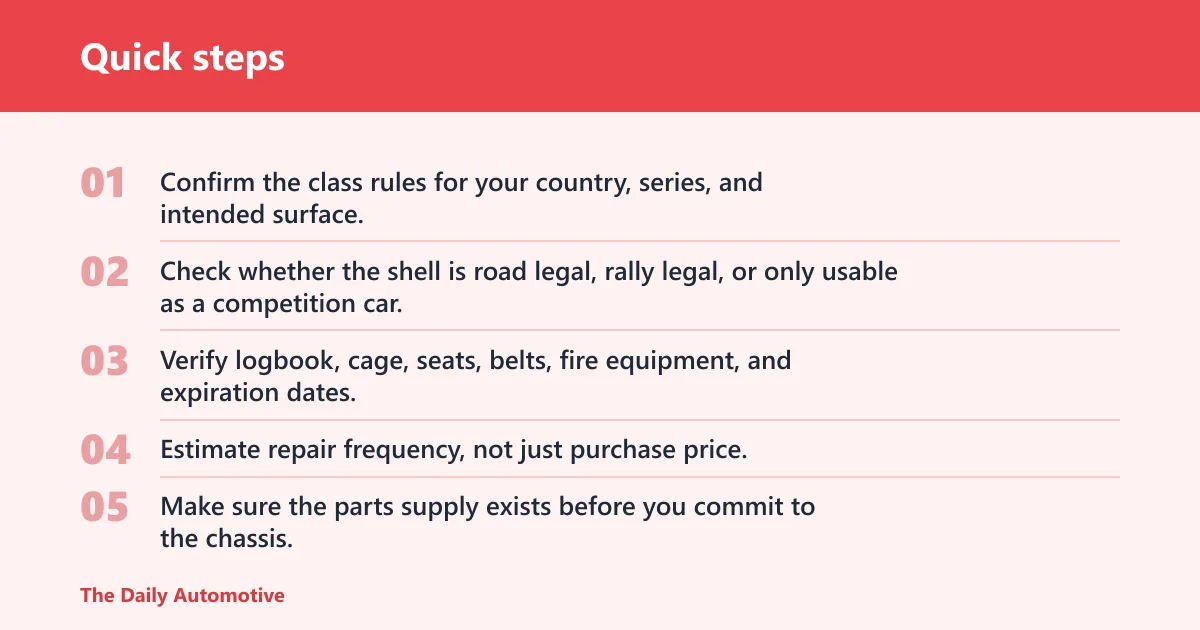
- Confirm the class rules for your country, series, and intended surface.
- Check whether the shell is road legal, rally legal, or only usable as a competition car.
- Verify logbook, cage, seats, belts, fire equipment, and expiration dates.
- Estimate repair frequency, not just purchase price.
- Make sure the parts supply exists before you commit to the chassis.
- Match the drivetrain to the class, not to internet advice.
Do rally cars have ABS?
Sometimes, but not always. ABS depends on the age of the car, the homologation package, and the class rules, so there is no blanket yes or no. If you are buying used, confirm what the series allows before assuming the brake system is legal as-is.
Are rally cars road legal?
Not automatically. Some shells begin life as road cars, but competition preparation, registration status, and local law decide whether the car can be driven on the street. A rally car can be competition-only even if the base model once had plates.
What are the best cars to turn into rally cars?
The best candidate is the one that fits your class, budget, and parts supply. For beginner and budget builds, the common names are Honda Civic, VW Golf, and Volvo 240, while the better modern entry-level route is often a Rally4, Rally5, or older R1 car that already matches the rulebook.
Frequently asked questions
What is a rallycross car?
A rallycross car is a short-course competition car for mixed-surface heats on a closed circuit. It needs quick launches, sharp braking, and enough contact tolerance to survive repeated close racing. That makes it different from a stage rally car, which is built for longer timed road sections.
What is a rally car?
A rally car is built for stage rallying on closed roads, where timed sections stretch over longer distances and the surface can change within the same event. It can be FWD, RWD, or AWD, but the setup always leans toward grip, travel, skid protection, and repairability.
What is the difference between rally and rallycross?
Rally uses longer timed stages on closed roads. Rallycross uses short mixed-surface heats on a closed circuit, with more launches and more contact. That difference drives the whole car choice: rally needs travel and endurance, while rallycross rewards response and rapid acceleration.
Are rally cars AWD?
Some are, but not all. AWD is common in higher-performance rally cars, yet beginner classes often use FWD cars because they are cheaper and easier to run. The right answer depends on the class rules and the level you want to enter.
Are rally cars FWD?
Many beginner rally cars are FWD, especially Rally4, Rally5, and older R1 examples. FWD is common because it keeps purchase price and running costs lower, and it suits entry-level classes where the rules are built around accessible cars.
How to get into rally car racing
Start by choosing the event format and the class you can actually enter, then check the rulebook before buying anything. Rent first if possible, because that often teaches more than a fast purchase. After that, buy the car that matches the class, parts supply, and repair budget.
Products related to this article
Sponsored / affiliate links. As an Amazon Associate I earn from qualifying purchases. I may earn additional commission from eligible campaigns.