Does Rustproofing Your Car Really Work?
Yes, rustproofing can pay off in salty, snowy climates, but the payoff is strongest on vehicles with clean metal and a proper application. If rust has already started, it slows damage more than it stops it. Done badly, it wastes money and can trap moisture or miss critical seams. This guide breaks down climate, vehicle age, application quality, and maintenance into a simple yes-or-no framework.
Does rust proofing your car work?
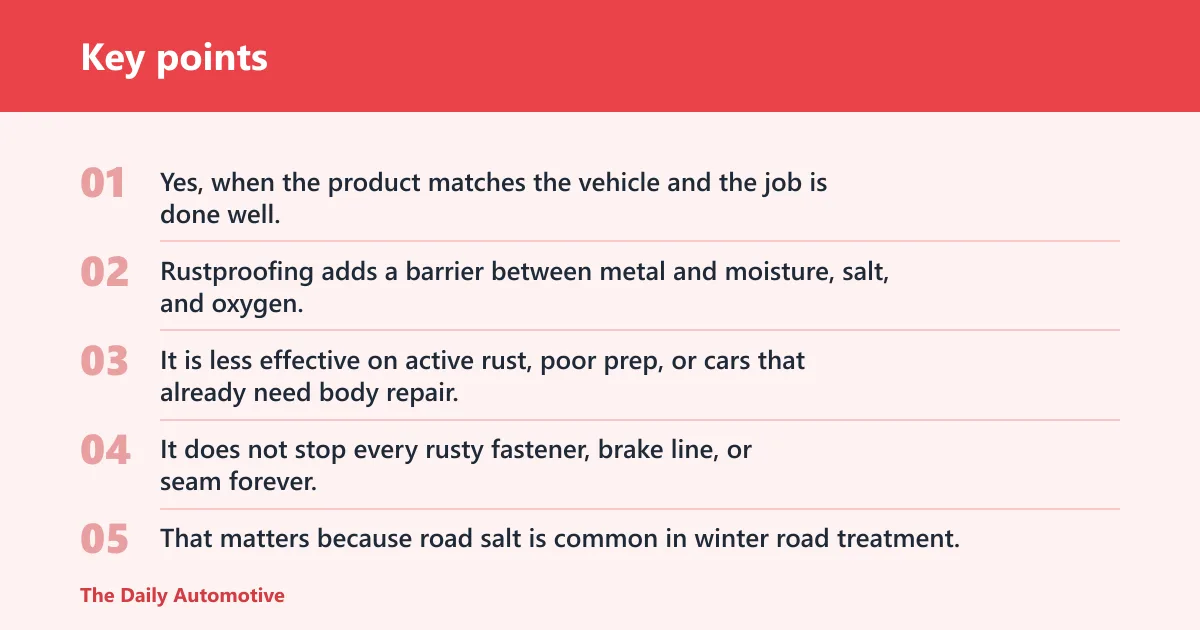


Yes, when the product matches the vehicle and the job is done well. Rustproofing adds a barrier between metal and moisture, salt, and oxygen, which can slow corrosion and help a car last longer. It is less effective on active rust, poor prep, or cars that already need body repair.
What it can and cannot do
Rustproofing slows corrosion. It does not stop every rusty fastener, brake line, or seam forever. That matters because road salt is common in winter road treatment, and it does the most damage when it stays on the underbody after driving. (Wikipedia)
Modern vehicles help themselves with factory corrosion protection. Galvanized steel, protective primers, and seam sealers reduce rust risk, but they wear down over time and vary by manufacturer and model. Motor1 notes that manufacturers often give multiple years and tens of thousands of miles of rust coverage, which shows factory protection is real but not permanent.
Why climate and maintenance change the result
Rustproofing gives the best return in salted-road use, coastal air, and long ownership. It gives less value if the car lives indoors, sees little winter exposure, or is sold quickly. Washing matters, too, because washing the undercarriage removes salt, but it is not the same as rustproofing.
Picture a sedan driven five days a week on salted roads. If the owner rinses the underbody often and starts with clean metal, rustproofing can slow damage in the places where factory coatings thin out first. If the same sedan already has flaky rust around seams and mounts, the coating will not reverse that damage.
Factory corrosion protection vs aftermarket
Factory protection helps, but it is not a lifetime shield. Modern cars after 2006 are described as using galvanized steel, and galvanized steel contains a coating of zinc. That zinc layer, plus primers and seam sealers, reduces rust risk, yet it still leaves exposed parts that age differently.
Where factory protection still wears down first
The first trouble spots are often brake lines, subframes, fasteners, seams, and edges where water lingers or chips the coating. Jalopnik notes that modern cars have factory rust protection that can be compromised over time. Once salt and moisture get into those areas, corrosion spreads faster.
Factory protection is also uneven. One model may hold up well for years, while another shows corrosion sooner in wheel wells or underbody joints. That is why aftermarket rustproofing can make sense even on a new car, especially in heavy salt regions.
How salt and moisture start rust
Rust forms when moisture, oxygen, and metal interact, and road salt speeds up the process on winter roads. The same source states that salt does not actually cause rust, but it speeds it up. The main problem is salt left on metal after the drive, especially on the underbody.
Why the underbody fails first
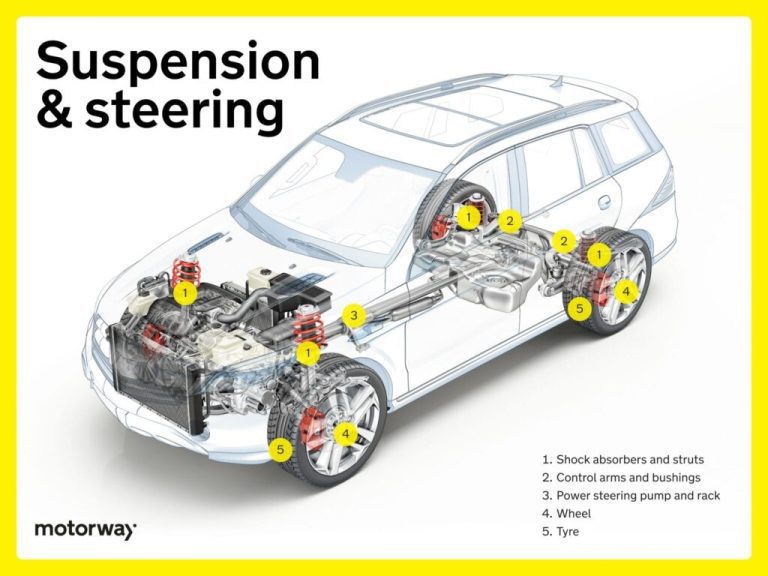
The underbody gets blasted by slush, packed snow, and spray from other vehicles. Fasteners, brake lines, control arms, subframes, and seams sit low and stay wet longer than painted body panels. If salt remains there, corrosion has time to work between wash cycles.
That is why a clean-looking car can still have hidden rust below. The exterior may look fine while the undercarriage, joints, and folds are losing protection.
Rustproofing types and what they cover
Not every treatment is the same. A true rustproofing product should be aimed at corrosion control, not just a glossy black coating. The coverage area, texture, and maintenance schedule matter more than the marketing name on the invoice.
Undercoating
Undercoating is a thick protective sealant applied to the underbody. It is often renewed annually. Ziebart says undercoating treatment will protect a vehicle for a year, which makes it a maintenance item rather than a one-time fix.
Oil spraying
Oil spraying is a rust control method that treats the underbody and cavities. It often uses thinner oil in hidden areas and a thicker coating on the undercarriage. A typical oil spraying service was priced at $100 to $150 in one cited source, which is useful only if the application reaches the right places and is kept up.
Penetr-Oil rust protection
Penetr-Oil rust protection is described as dripless and odourless. It is used on the underbody, joints, folds, seams, spot welds, and body panels. The service is paired with annual inspection and reapplication, and Ziebart says it carries an 8-year warranty against corrosion perforation.
Permanent Rust Protection
Permanent Rust Protection uses a rubberized undercoating plus a paraffin-based wax coating for upper body areas. It covers doors, side panels, inner fenders, hood, trunk, seams, and joints, and it carries a 10-year national warranty. That warranty only matters if the required maintenance is kept current.
Why application quality matters
Premier says a clear, drip-free application hardens after being sprayed. That kind of finish can be useful, but a coating still needs proper prep and careful coverage. A bad job can trap moisture under the coating or miss the very seams that rust first.
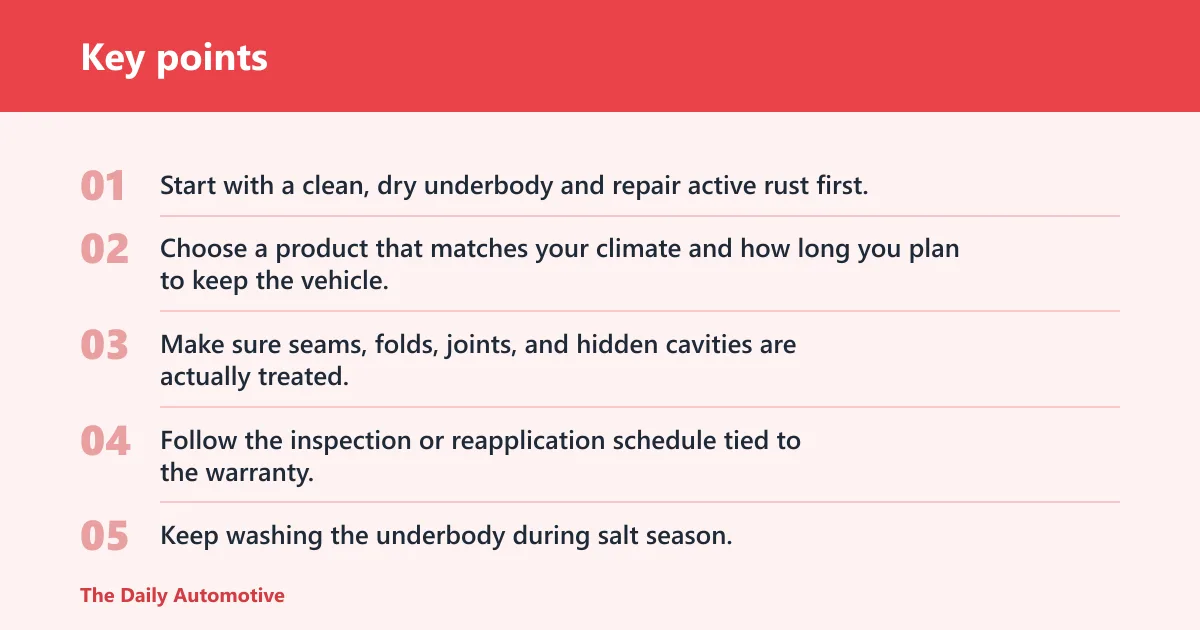
- Start with a clean, dry underbody and repair active rust first.
- Choose a product that matches your climate and how long you plan to keep the vehicle.
- Make sure seams, folds, joints, and hidden cavities are actually treated.
- Follow the inspection or reapplication schedule tied to the warranty.
- Keep washing the underbody during salt season.
Rustproofing decision matrix
Use this table to match the car’s condition to the driving environment. The safest choice for a car with active rust is not always another coating; sometimes body repair comes first. Cost should be weighed against exposure, age, and whether the service requires yearly upkeep.
| Vehicle age or condition | Driving environment | Recommended action | Red flags |
|---|---|---|---|
| New car | Salted winters, frequent highway use | Consider preventive rustproofing soon after purchase. Budget around the service level, not a cosmetic add-on. | Do not coat over damage, shipping film, or dirty panels. |
| Lightly used car | Mixed use with some winter driving | Good candidate for oil spraying or a warranty-backed treatment if metal is still clean. | If hidden rust already shows at seams or fasteners, inspect first. |
| Older car with surface rust | Any climate, especially salted roads | Repair rust before any coating. Rustproofing can slow further damage, but it is not the first step. | Bad idea to seal over scaling rust or perforation. |
| Salted-road commuter | Daily winter driving on treated roads | Strong candidate for annual or scheduled treatment plus frequent underbody washing. | Washing alone is usually not enough for this use pattern. |
| Coastal driver | Salt air, wet roads, year-round exposure | Choose a proper rustproofing service with inspection intervals and coverage of seams and cavities. | Skip cheap spray-only jobs that do not cover hidden metal. |
| Low-mileage garage-kept vehicle | Dry storage, limited winter exposure | Often enough to wash after bad weather and inspect the underbody yearly. Full treatment may not pay off. | Rustproofing can be low priority if the car stays dry and rarely sees salt. |
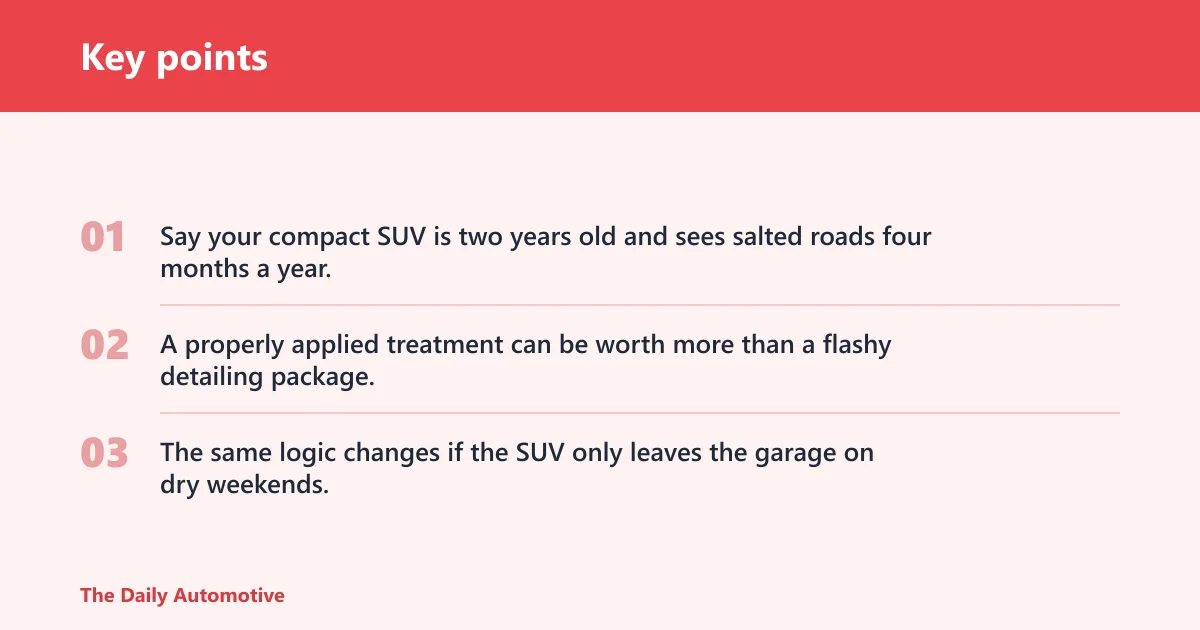
Say your compact SUV is two years old and sees salted roads four months a year. A properly applied treatment can be worth more than a flashy detailing package, because the risk is under the floor and inside seams, not on the paint. The same logic changes if the SUV only leaves the garage on dry weekends.
Is rustproofing worth it on your car?
It is worth it on many modern cars if they face winter salt, coastal air, or long ownership. It is usually less useful on garage-kept, low-mileage vehicles that avoid corrosion exposure. The biggest difference comes from age, climate, and whether the body is still clean enough for the coating to bond well.
New car
New cars are the best candidates because the metal is clean and factory protection has not been worn down yet. If you keep the car for years in a salted climate, rustproofing can help preserve subframes, fasteners, and seams before rust gets a foothold.
Lightly used car
A lightly used car with minimal rust can still benefit, especially if it spends winters on treated roads. This is often the sweet spot for aftermarket protection because the body is still worth preserving, and the coating can reach areas that have not started flaking yet.
Older car with surface rust
Older cars need a harder look. If rust is limited to light surface corrosion, treatment may still slow the spread after cleanup. If rust is scaling, perforated, or active around brake lines or mounts, body repair should come first.
Salted-road commuter
This is the strongest use case. Daily winter exposure means salt can stay on the underbody between washes, and that is where the damage grows. For this driver, rustproofing plus regular washing is more defensible than washing alone.
Coastal driver
Salt air keeps corrosion pressure high even when roads are dry. A coastal vehicle can benefit from a treatment that covers seams, joints, and cavities, because moisture and salt exposure do not wait for snow season.
Low-mileage garage-kept vehicle
If the car stays dry and only sees limited foul-weather use, the return is lower. Washing after storms and inspecting vulnerable areas may be enough. Full rustproofing is harder to justify unless the vehicle still gets regular salt exposure.
How often do you need to rustproof a car?
Most rustproofing needs inspection and, in many cases, reapplication. Spraying before every winter and again in the spring. That same source says rustproofing may last nearly 2 years if the vehicle isn’t driven much, which shows use pattern changes the schedule.
Annual inspection and reapplication
Annual inspection is common for undercoating and for services tied to a warranty. Ziebart’s Penetr-Oil rust protection depends on annual inspection and reapplication, and that kind of condition is not a fine print detail; it is part of keeping coverage alive.
Permanent Rust Protection also relies on maintenance to support its 10-year national warranty. If the service requires annual checkups, missing them can reduce the value of the warranty and leave spots untreated.
When a schedule should be shorter
Shorter intervals make sense for heavy salt use, rough roads, and vehicles that see a lot of splash from slush and brine. If the car is washed often but driven hard all winter, the protective layer still wears from abrasion and should be checked sooner rather than later.
Frequently asked questions
Does rust proofing really work on cars?
Yes, especially in salty, snowy climates and on cars that still have clean metal. It slows corrosion by blocking moisture, salt, and oxygen. It works less well after rust has started spreading, and poor application can trap moisture instead of protecting the body.
What is the best rustproofing for cars?
The best choice depends on the car’s age and how it is used. For newer or lightly used vehicles in harsh climates, a product that reaches seams, joints, and cavities is usually better than a simple cosmetic coating. Annual inspection helps keep the protection effective.
Is rustproofing worth it on a modern car?
Often yes, because modern cars still have brake lines, subframes, fasteners, and seams that can rust first. Galvanized steel and factory primers help, but they do not eliminate corrosion risk. The value is highest if the car sees winter salt or coastal air.
How much does rustproofing cost?
A typical oil spraying service was priced at $100 to $150 in one cited source. More complete treatments with warranties can cost more, especially for larger vehicles or services that cover both underbody and body cavities. Fair pricing depends on the amount of coverage and maintenance required.
Does rustproofing help if the car already has some rust?
Yes, but only after the rust is assessed. Light surface rust may still be manageable, while scaling rust or perforation needs body repair first. Coating over active corrosion can trap moisture and hide damage, which makes the problem worse over time.
Is washing your car enough instead of rustproofing?
Washing the undercarriage helps a lot, especially after salted-road driving. It is not the same as rustproofing, though. For a low-mileage, garage-kept vehicle, washing may be enough. For daily winter commuters, washing alone usually does not provide enough protection.
Products related to this article
Sponsored / affiliate links. As an Amazon Associate I earn from qualifying purchases. I may earn additional commission from eligible campaigns.