Do Cars Need Specific Coolant: Essential Tips
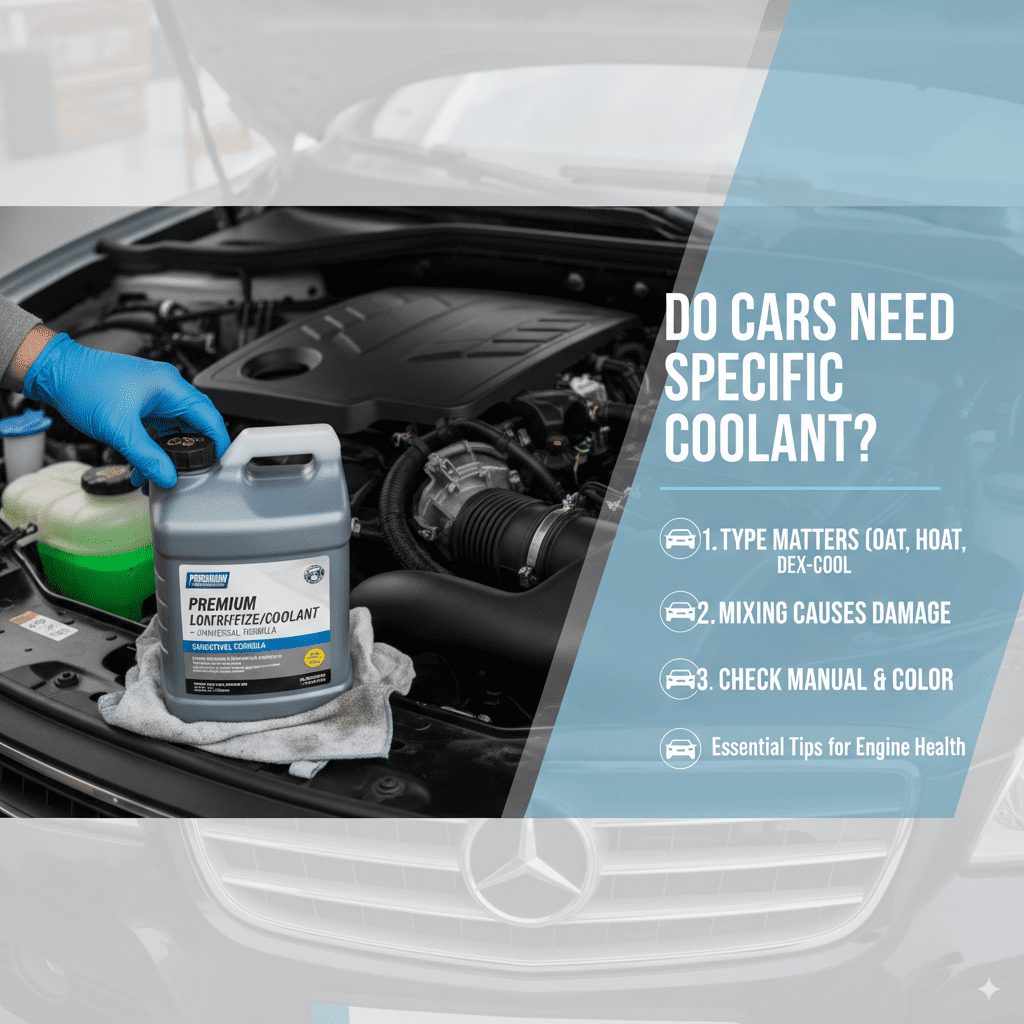
Yes, cars absolutely need specific coolant! Using the wrong type can cause serious engine damage, overheating, and costly repairs. Always check your owner’s manual to identify the correct coolant for your vehicle’s make, model, and year, ensuring optimal engine performance and longevity.
Ever popped your car’s hood and seen that colorful liquid in the overflow tank and wondered, “What exactly is that stuff, and does it matter which kind I use?” That’s your car’s coolant, and you’ve hit on a super important question! It’s a common point of confusion, and getting it wrong can lead to some big headaches for your engine. But don’t worry! As your friendly automotive guide, I’m here to break down exactly why your car needs specific coolant and what you need to know to keep your engine happy and cool. Let’s dive in and make sure you’re confidently making the right choice for your ride!
Why Coolant is Your Engine’s Best Friend
Think of your engine like your body. When you work out hard, your body generates heat. If you didn’t sweat, you’d overheat, right? Your car’s engine works similarly, but on a much more intense scale. Every time that engine fires up and starts working, it creates a tremendous amount of heat. If this heat isn’t managed, it can quickly damage vital engine components. That’s where coolant comes in. It’s not just “water with color”; it’s a carefully designed fluid that circulates through your engine, absorbing excess heat and carrying it away to the radiator, where it can be dissipated into the air.
Beyond just cooling, modern coolants do a lot more. They prevent the water in your cooling system from freezing in cold weather and boiling over in hot weather. They also contain special additives to prevent corrosion and rust within the metal parts of your cooling system. So, this isn’t just about keeping things from getting too hot; it’s about protecting the entire system from damage!
The Big Question: Do Cars Need Specific Coolant?
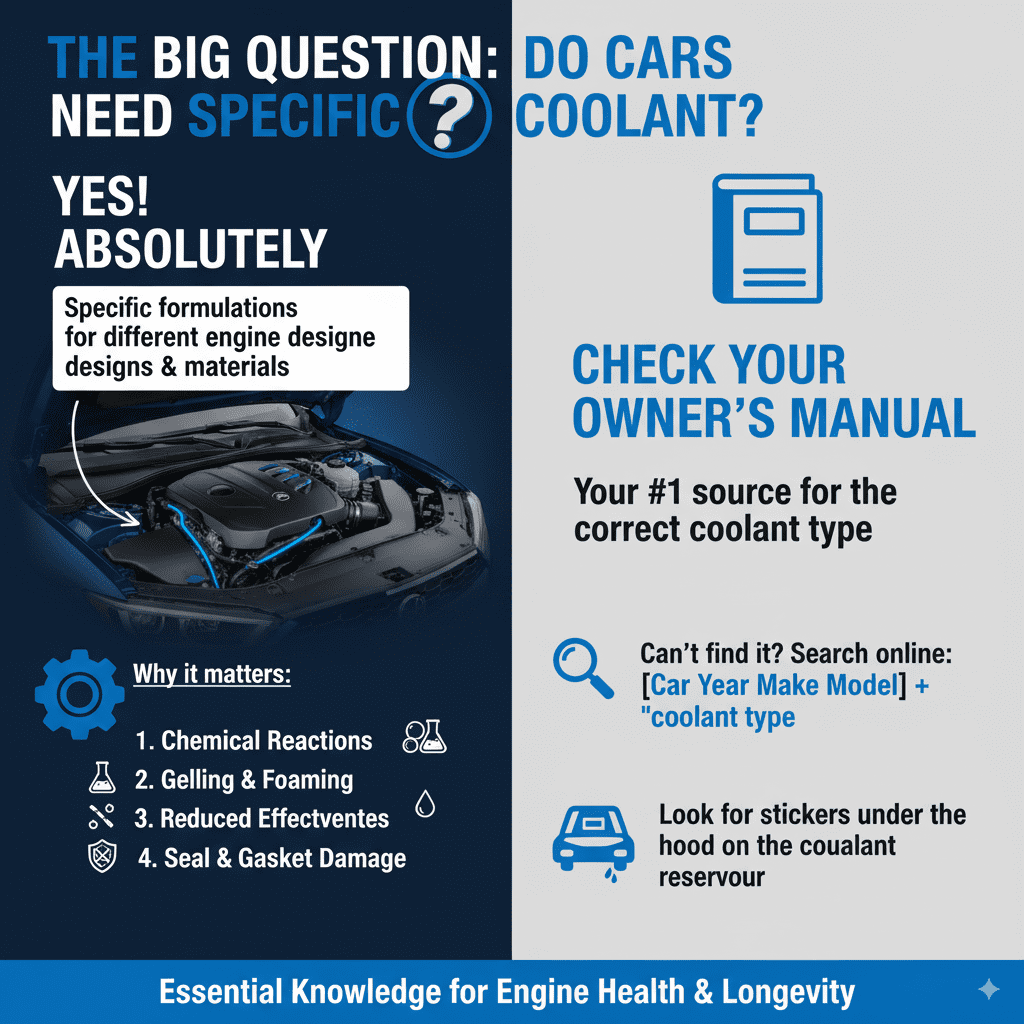
The short answer is a resounding YES! Your car does indeed need a specific type of coolant, and using the wrong one can be a recipe for disaster. This is one of the most critical maintenance points where “close enough” is definitely not good enough. Why? Because different car manufacturers and even different models within a manufacturer use different cooling system designs and materials. These designs require coolants with specific chemical compositions to work correctly and safely.
Mixing coolants, or using a universal coolant when a specific type is recommended, can lead to several problems:
- Chemical Reactions: Different coolant types have different chemical inhibitors. Mixing them can cause these inhibitors to become less effective or even react negatively, leading to corrosion.
- Gelling or Foaming: Some coolant types, when mixed, can form a sludge-like substance or foam, which can clog up your radiator and heater core, severely restricting coolant flow.
- Reduced Effectiveness: A coolant that’s not formulated for your specific system might not offer adequate freeze or boil protection, or its anti-corrosion properties might be insufficient for the metals used in your engine.
- Seal and Gasket Damage: The wrong coolant can degrade rubber seals and gaskets within the cooling system, leading to leaks.
This is why your owner’s manual is your best friend when it comes to coolant. It explicitly states the type of coolant recommended by the manufacturer. If you can’t find your manual, a quick search online for your car’s year, make, and model, followed by “coolant type,” will usually give you the answer. You can also often find this information on a sticker under the hood or sometimes even on the coolant reservoir itself.
Understanding Coolant Types: Decoding the Colors and Chemistry
You’ve probably noticed that coolant comes in different colors: green, orange, pink, yellow, blue, even purple. While color can be a quick indicator, it’s not the ultimate deciding factor. The real difference lies in the chemistry and the technology used to protect your engine. These technologies are what manufacturers specify.
Here’s a breakdown of the common technologies:
1. Inorganic Additive Technology (IAT)
This is the traditional type of coolant, often the bright green color you might have seen in older cars. IAT coolants use inorganic additives like silicates and phosphates to protect the cooling system from corrosion. While effective, these additives can deplete over time, meaning IAT coolants typically have a shorter service life compared to newer technologies.
2. Organic Acid Technology (OAT)
OAT coolants are designed for longer service intervals and use organic acids as their corrosion inhibitors. You’ll often find these in colors like orange or red. They don’t contain silicates or phosphates, which means they are gentler on seals and gaskets and are less likely to deplete quickly. However, OAT coolants should not be mixed with IAT coolants, as the different chemistries can cancel each other out, leading to corrosion.
3. Hybrid Organic Acid Technology (HOAT)
As the name suggests, HOAT coolants are a blend of IAT and OAT technologies. They combine the fast-acting protection of inorganic additives with the long-lasting protection of organic acids. These are common in many modern American and European vehicles and often come in yellow, blue, or orange colors. HOAT coolants offer excellent protection and extended service life. Again, mixing with other types is generally not advised without specific manufacturer approval.
4. Super Long Life / Extended Life Coolants
Some manufacturers use proprietary blends designed for extremely long service intervals, sometimes up to 100,000 miles or more. These are often based on OAT or advanced HOAT formulations. Examples include Dex-Cool (General Motors) and Ford’s Gold or Yellow coolants. It is crucial to use the exact type specified by the manufacturer for these extended-life systems.
A helpful chart from the U.S. Department of Energy on their vehicle technologies page can give you a good overview of different coolant types and their common applications. Always refer to your owner’s manual as the ultimate authority.
DIY Coolant Check and Top-Off: Essential Tips for Beginners
Performing basic checks on your coolant is a great DIY task that can save you money and prevent minor issues from becoming major problems. Here’s how to do it safely:
When to Check Your Coolant
- Regularly: Aim for at least once a month.
- Before Long Trips: It’s a good habit for peace of mind.
- If You Notice a Problem: If your temperature gauge is climbing higher than normal, or if you smell a sweet scent (a common sign of a coolant leak).
Safety First! The Golden Rule
NEVER, EVER open your radiator cap or coolant reservoir cap when the engine is hot or even warm. The cooling system is pressurized, and hot coolant can erupt violently, causing severe burns. Always wait until the engine has cooled down completely, which usually means waiting at least a couple of hours after the car has been driven.
How to Check Your Coolant Level
Most modern cars have a translucent plastic coolant reservoir (often called an overflow tank or expansion tank). This tank has “MIN” and “MAX” or “LOW” and “FULL” markings on its side.
- Ensure the engine is completely cool.
- Locate the coolant reservoir. It’s usually a white or translucent plastic tank with hoses connected to it, located near the radiator.
- Look at the level of the coolant inside the reservoir.
- The coolant level should be between the MIN and MAX lines.
Topping Off Your Coolant
If the level is below the MIN line, you’ll need to add coolant. Here’s where specificity really matters:
- Identify the Correct Coolant: This is the most crucial step. Check your owner’s manual or a reliable online source for your car’s specific coolant type.
- Get the Right Mix: Coolant is often sold as a concentrated liquid that needs to be mixed with distilled water, or as a pre-mixed 50/50 solution. Always use distilled water – tap water contains minerals that can cause corrosion and deposits in your cooling system.
- Locate the Reservoir Cap: On the reservoir tank, you’ll find a screw-on cap.
- Open Safely: Ensure the engine is cool. Slowly twist and remove the cap.
- Add Coolant: If your coolant is low, slowly pour the correct coolant mixture (either pre-mixed or your own 50/50 blend of concentrate and distilled water) into the reservoir until it reaches the MAX line. Do not overfill.
- Replace the Cap: Securely screw the cap back onto the reservoir.
- Check the Radiator: In some systems, especially older ones, the radiator itself can also be topped off. However, ONLY do this when the engine is completely cold. The radiator cap is usually a larger, metal cap on the radiator itself. If it has a sealing gasket, it’s designed to be pressurized. If you’re unsure, stick to topping off the reservoir, which is generally safer for beginner DIY.
Important Note on Coolant Concentration
The ratio of coolant to distilled water is important. A 50/50 mix is standard for most climates, providing good freeze and boil protection. In extremely cold regions, a 60/40 or even 70/30 mix of coolant to water might be necessary. Conversely, in very hot climates, a 50/50 mix is usually still optimal, as the water content is important for heat transfer. Using pure coolant concentrate is not recommended, as it doesn’t provide as good freeze protection and can actually reduce heat transfer efficiency. Always follow the coolant manufacturer’s instructions or your car’s manual recommendations for the proper mix.
When to Call a Professional
While checking and topping off coolant is a manageable DIY task, there are times when you should definitely leave it to the experts:
- Complete Coolant Flush and Replacement: This involves draining the old coolant, flushing the system, and refilling with the correct type. It’s crucial to use the right procedure and dispose of old coolant properly.
- Suspected Leaks: If you’re constantly having to top off your coolant, or if you see puddles of coolant under your car, it indicates a leak that needs professional diagnosis and repair.
- Overheating Issues: Persistent overheating that can’t be explained by low coolant levels could point to a faulty thermostat, water pump, radiator fan, or a clogged radiator.
- Uncertainty: If you are ever unsure about the type of coolant needed or the procedure for maintenance, it’s always best to err on the side of caution and consult a trusted mechanic.
A table below summarizes when to DIY and when to seek professional help:
| Task | Can I Do It Myself? | When to Call a Pro |
|---|---|---|
| Checking Coolant Level | Yes (when engine is cool) | N/A |
| Topping Off Coolant | Yes (if correct type is identified and engine is cool) | If unsure of coolant type or if level drops quickly (indicates leak) |
| Coolant Flush & Refill | Beginner: No (requires specific tools, disposal knowledge) | Yes (recommended for most beginners) |
| Diagnosing Overheating | Limited (can check fan, listen for noises) | Yes (due to complexity of system components) |
| Repairing Leaks | Beginner: No (unless very minor hose issue) | Yes (hoses, radiator, water pump, head gasket) |
The Environmental Impact of Coolant
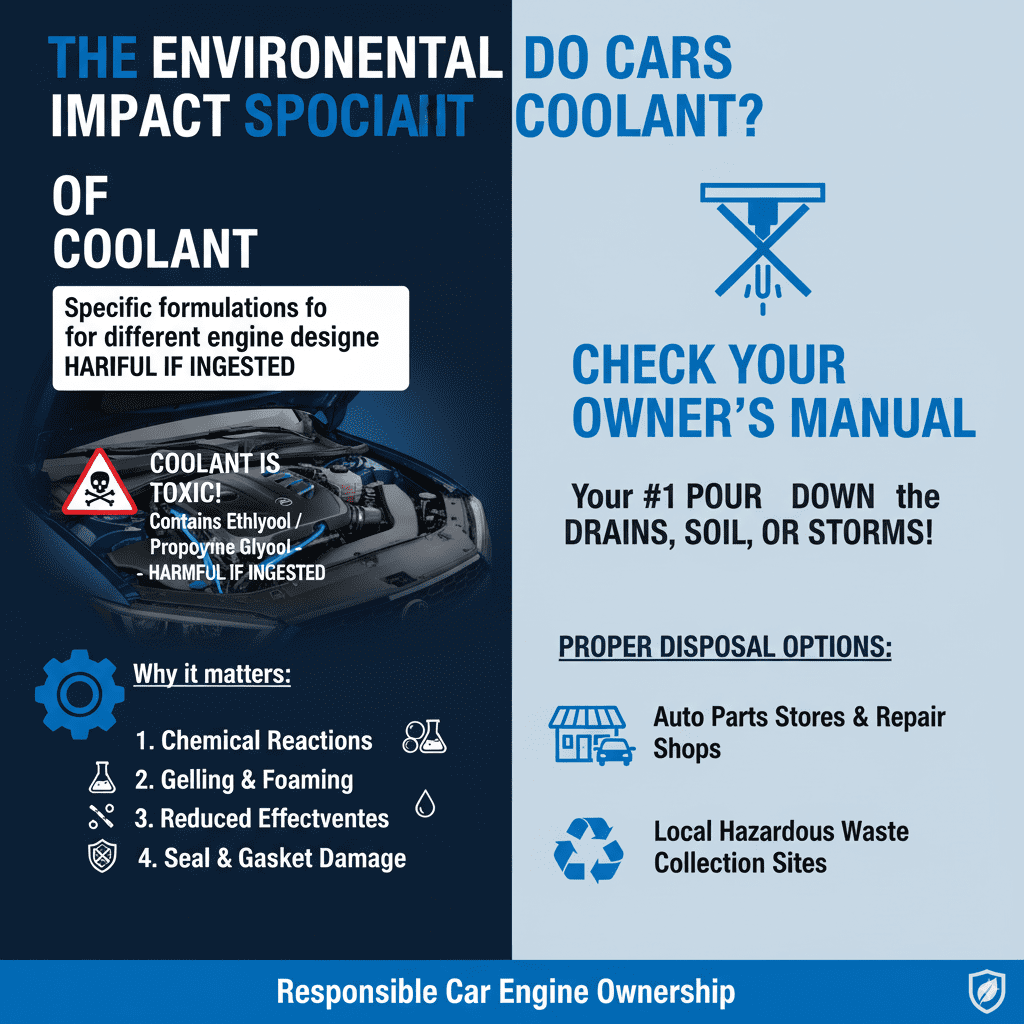
It’s important to remember that antifreeze/coolant is toxic. It contains chemicals like ethylene glycol or propylene glycol, which are harmful if ingested by humans or animals. Never pour used coolant down a drain, into the soil, or into storm drains. Many auto parts stores, repair shops, and local hazardous waste collection sites offer free or low-cost collection services for used automotive fluids. Properly disposing of old coolant is a critical part of responsible car ownership.
For more information on safe handling and disposal, you can refer to resources like the U.S. Environmental Protection Agency (EPA) guidelines on antifreeze recycling.
Frequently Asked Questions (FAQ)
Q1: What happens if I mix different colors of coolant?
A1: Mixing different coolant types, especially if they have different chemistries (like IAT and OAT), can cause chemical reactions. This can lead to the protective additives becoming ineffective, the coolant gelling up and clogging your system, or increased corrosion. It’s best to stick to one specific type recommended for your car. If you accidentally mix them, it’s wise to get your cooling system flushed and refilled with the correct coolant.
Q2: Can I just use water in my radiator if I run out of coolant?
A2: In a pinch, for a very short distance to get to safety, plain water might be better than nothing in an overheating situation. However, this should only be a temporary measure. Water alone doesn’t have the anti-corrosion properties, freeze/boil protection, or lubrication for the water pump that coolant provides. Driving with just water for extended periods will significantly increase the risk of engine damage.
Q3: How often should I change my coolant?
A3: The interval for coolant replacement varies greatly depending on the type of coolant. Traditional green coolants (IAT) might need changing every 2-3 years or around 30,000-50,000 miles. Newer OAT and HOAT coolants can last much longer, often 5 years or 100,000+ miles. Always consult your owner’s manual or the coolant manufacturer’s recommendations for the specific service interval for your vehicle.
Q4: My car is running hotter than usual. Could it be the coolant?
A4: Yes, it absolutely could be. Low coolant levels (due to leaks), incorrect coolant concentration, or degraded coolant that has lost its protective properties can all lead to overheating. If you notice the temperature gauge climbing, check your coolant level (when cool!) and look for any obvious leaks. If the problem persists, it’s time to see a mechanic.
Q5: What’s the difference between coolant concentrate and pre-mixed coolant?
A5: Coolant concentrate is pure antifreeze that needs to be mixed with distilled water, typically in a 50/50 ratio, to achieve the correct freeze and boil protection and optimal heat transfer. Pre-mixed coolant is already mixed 50/50 with distilled water, so it’s ready to use straight from the bottle. Using distilled water is crucial for both types to avoid introducing minerals into your cooling system.
Q6: Can I use a “universal” coolant in my car?
A6: “Universal” coolants are designed to be compatible with a wider range of vehicles, but they are not always the best choice, especially for modern cars with specific cooling system requirements or extended-life coolant systems. The safest bet is always to use the exact specified coolant type from your car’s manufacturer. If you are unsure or your vehicle isn’t listed as compatible on the universal coolant bottle, it’s best to avoid it and stick to the manufacturer’s recommendation.
Conclusion: Keeping Your Engine Cool and Your Wallet Full
Understanding your car’s coolant needs might seem like a small detail, but it’s a crucial one for maintaining the health and longevity of your engine. By now, you know that cars definitely need specific coolant, and using the wrong type is a gamble you don’t want to take. Always prioritize checking your owner’s manual to identify the correct coolant for your car – whether it’s green, orange, pink, or another color, its chemical composition is what truly matters.
Taking a few minutes each month to check your coolant level (when the engine is cold, of course!) and knowing how to safely top it off can prevent common and frustrating issues. Remember the safety first rule: never open a hot cooling system. And if you encounter anything beyond a simple top-off, or if you’re just not comfortable, don’t hesitate to reach out to a trusted mechanic. You’ve got this! By staying informed and taking these simple steps, you’ll keep your engine running smoothly, avoid costly repairs, and drive with confidence.