Why Car Batteries Drain Faster in Cold Weather
It’s a common problem many folks run into when the temperatures drop: their car battery just doesn’t seem to have the same get-up-and-go. You might wonder, Why Car Batteries Drain Faster in Cold Weather? It can feel tricky, especially if you’re not super handy with cars.
Don’t worry, though. This guide breaks down exactly what’s happening in simple terms. We’ll walk through the reasons step-by-step and give you easy tips to keep your car starting strong, no matter how cold it gets.
Understanding Car Battery Performance In The Cold
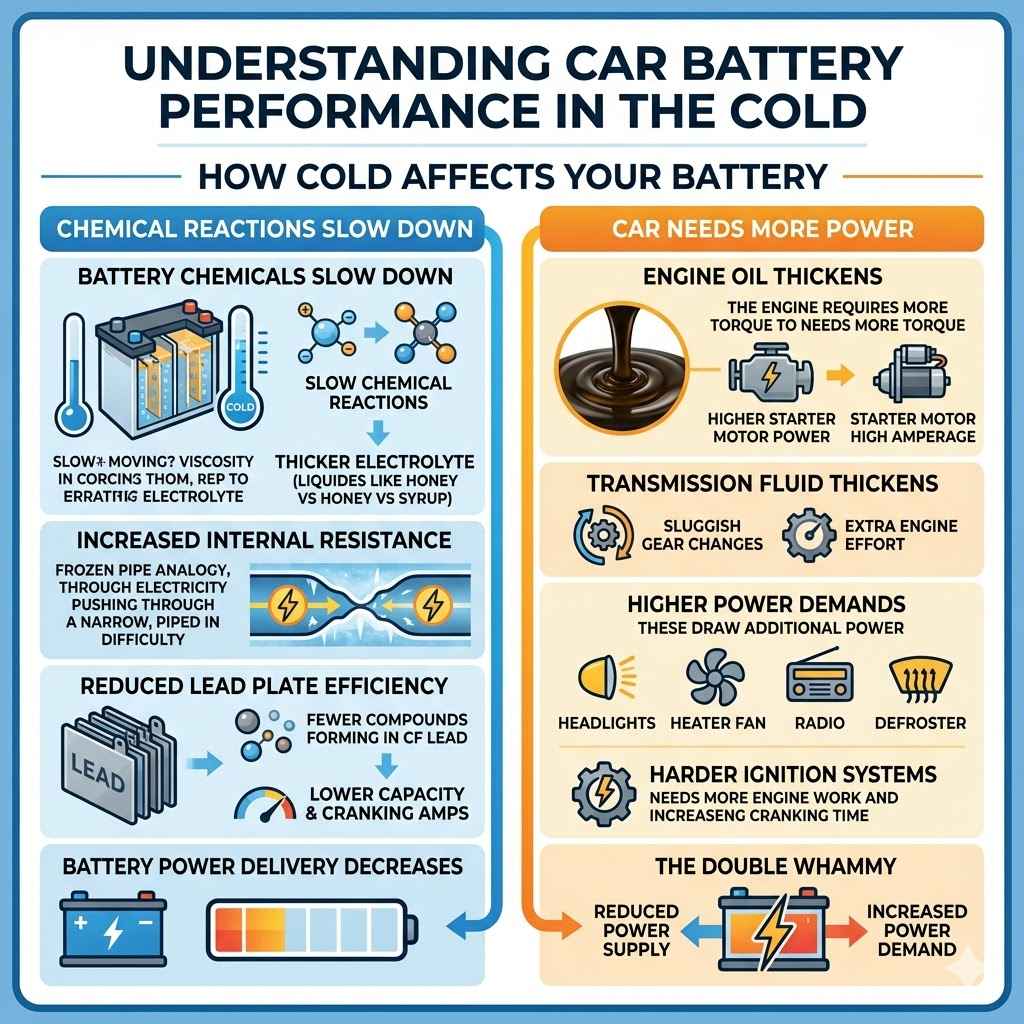
This section explains the basic science behind why cold weather impacts a car battery. We will look at how the chemical reactions inside the battery slow down when it’s cold, making it harder for the battery to provide power. We’ll also touch on how the car itself needs more power in the cold, creating a double whammy for the battery.
Chemical Reactions Slow Down
Car batteries work through chemical reactions. These reactions create the electricity your car needs to start and run. Think of it like a tiny power plant inside your battery.
In cold weather, these chemical reactions slow way down. This is because the cold makes the liquids inside the battery thicker and the tiny particles that move around don’t move as easily. It’s like trying to stir thick honey versus thin syrup – it takes more effort.
This slowing of chemical processes means the battery can’t produce as much power when you need it most, like when you turn the key to start your engine. So, even if the battery has a full charge, its ability to deliver that power is reduced.
The internal resistance of a car battery increases significantly in cold temperatures. This increased resistance acts like a roadblock for the flow of electricity. Imagine trying to push water through a narrow, frozen pipe versus a wide, open one; the flow is much slower and requires more force in the frozen pipe. This internal resistance makes it harder for the battery to send power to the starter motor, which is the part that cranks the engine.
Viscosity of the electrolyte fluid. The electrolyte in a car battery is a mixture of sulfuric acid and water. As temperatures drop, this fluid becomes more viscous, or thicker. This thickening hinders the movement of ions (electrically charged particles) within the battery. These ions are crucial for completing the electrical circuit and allowing the chemical reactions to occur. When their movement is slowed, the battery’s ability to generate and deliver current is compromised.
Reduced efficiency of the lead plates. The lead plates within the battery, which are where the chemical reactions primarily take place, also become less efficient in the cold. The chemical compounds that react to produce electricity form more slowly and in smaller amounts when exposed to low temperatures. This directly translates to a lower ampere-hour capacity and cranking amps available for the vehicle.
Car Needs More Power In The Cold
When it’s freezing outside, your car’s engine and other systems have to work a lot harder just to get going. This means they need more electrical power from the battery.
For example, the engine oil becomes thicker in the cold. This makes the engine harder to turn over, requiring more power from the starter motor. The starter motor is one of the biggest drains on your battery.
Also, things like your headlights, heater fan, and radio all draw power. When your battery is already struggling to provide power due to the cold, these extra demands can quickly deplete its reserves.
Engine oil thickens significantly in cold temperatures. This increased viscosity means the engine requires more torque, or turning force, from the starter motor to begin rotating. The starter motor, in turn, draws a much higher amperage from the battery during the cranking process. This prolonged and intensified demand places an extra burden on a battery that is already producing less power due to cold.
Transmission fluid also becomes more viscous, making gear changes sluggish and requiring more effort from the engine, which indirectly increases the load on the battery.
Ignition systems may need to work harder to ignite fuel in colder, denser air. While not a direct battery drain in the same way as the starter, any additional load on the engine translates to increased cranking time and thus higher battery demand.
Why Car Batteries Drain Faster In Cold Weather The Science
This section will get a bit more into the science, but we’ll keep it easy to grasp. We’ll explore how cold affects the battery’s capacity and its ability to deliver current. You’ll learn about CCA and why it’s important, and what happens to the battery’s overall lifespan in freezing conditions.
Cold Cranking Amps CCA Explained
CCA stands for Cold Cranking Amps. It’s a measurement of how much power a battery can deliver at a freezing temperature, specifically 0 degrees Fahrenheit (-18 degrees Celsius). Think of it as the battery’s ability to give a strong, quick burst of energy.
A battery with a higher CCA rating is better equipped to handle the demands of starting an engine in cold weather. When it’s cold, the engine needs more power to crank, and the battery has to deliver that power quickly. If the CCA is too low for the conditions, the battery might not be able to provide enough power, leading to a no-start situation.
You can usually find the CCA rating printed on the battery itself. It’s a good idea to know this number, especially if you live in an area with harsh winters.
CCA is defined as the number of amps a lead-acid battery can deliver for 30 seconds at a temperature of 0°F (-18°C) while maintaining a voltage of at least 7.2 volts. This specific test simulates the strenuous conditions of starting a cold engine. A higher CCA rating indicates a greater ability to start an engine in cold temperatures.
The average CCA for a car battery ranges from about 350 to 700 amps, but some high-performance batteries can have even higher ratings. The manufacturer of your vehicle specifies the minimum CCA requirement for your car. Using a battery with a CCA rating below the recommended level is a common reason for starting issues in cold weather.
When the temperature drops, the chemical reactions that produce electricity inside the battery slow down, as mentioned before. This directly impacts the battery’s ability to produce its rated CCA. So, a battery rated for 500 CCA might only deliver 300 CCA at 0°F, and even less at lower temperatures.
Battery Capacity And Voltage Drop
Battery capacity refers to how much energy a battery can store. It’s often measured in amp-hours (Ah). A higher amp-hour rating means the battery can supply a certain amount of current for a longer time.
In cold weather, the battery’s capacity effectively decreases. Even if it’s fully charged, it can’t deliver as much stored energy as it could in warmer temperatures. This is because the chemical reactions are sluggish.
This reduced capacity leads to a voltage drop. When you try to start your car, the voltage can drop significantly. If the voltage drops too low, there isn’t enough power to engage the starter motor and get the engine turning.
A battery’s effective capacity is reduced by up to 50% in freezing temperatures compared to its performance at room temperature. This means a battery that might power your car for days in summer could struggle to start it after sitting overnight in sub-zero conditions. This diminished capacity is a direct consequence of the slowed chemical kinetics within the battery.
The voltage drop during cranking is a critical indicator of battery health and cold-weather performance. A healthy battery in warm weather might see a drop to 10-11 volts. In cold weather, this same healthy battery might drop to 9-10 volts, while a weak or older battery could drop below 7.2 volts, failing to start the engine.
Modern vehicles also have more electronic accessories that remain active even when the car is off (like alarm systems, memory for radio presets, and onboard computers). These continuous low-level drains, when combined with reduced battery capacity in the cold, can lead to a deeply discharged battery by morning.
Impact On Battery Lifespan
Constantly operating a car battery in cold, demanding conditions can shorten its overall lifespan. Each time you start your car in the cold, the battery is put under significant stress.
This repeated stress can cause wear and tear on the battery’s internal components. Over time, this can lead to a decrease in its performance and eventually, premature failure.
Regular maintenance and understanding the battery’s limits in winter can help extend its life. It’s like pushing a person too hard every day; eventually, they’ll get worn out faster.
Frequent deep discharges in cold weather can accelerate sulfation, a process where lead sulfate crystals form on the battery plates. While some sulfation is normal, excessive sulfation can permanently reduce the battery’s ability to hold a charge and deliver power, significantly shortening its operational life.
Extreme cold can also lead to the freezing of electrolyte in a discharged battery. If the electrolyte freezes, it can cause the battery case to crack or warp, leading to irreversible damage and complete battery failure. This is why it’s critical to ensure a battery is adequately charged before extreme cold.
While cold is a significant factor, it’s important to remember that battery lifespan is also affected by charging system health, driving habits (frequent short trips vs. long drives), and the overall age of the battery. However, winter conditions often exacerbate pre-existing weaknesses and accelerate the decline of an otherwise healthy battery.
Common Signs Your Car Battery Is Struggling In The Cold
This part covers what you might actually notice when your battery isn’t happy with the cold. We’ll talk about slow engine cranks, clicking sounds, and dashboard warning lights. Knowing these signs helps you address a problem before it leaves you stranded.
Slow Engine Crank
The most common sign is a slow, struggling engine crank. Instead of the engine turning over quickly and smoothly, you’ll hear it laboring, as if it’s having a hard time getting going.
This is the battery trying its best to provide enough power, but the cold has made it difficult. It’s like trying to lift a heavy weight with stiff muscles – it takes more effort and seems slower.
If you hear this, it’s a strong signal that your battery might not be up to the task of starting your car in the current temperature.
A slow crank sounds noticeably different from a normal start. It’s characterized by the starter motor turning the engine over at a reduced speed. This sluggishness is a direct result of the reduced cranking amps the battery can supply due to the cold, and the increased resistance of the engine components.
Listen carefully to the starter sound. A rapid, consistent cranking sound indicates the battery is likely healthy and providing sufficient power. A slow, grinding, or hesitant sound is a clear warning sign that the battery is struggling to meet the demand.
If you only experience this slow crank on very cold mornings but it seems to resolve itself after the car has warmed up, it points strongly to the cold weather impacting battery performance rather than a completely dead battery. However, it’s a sign that the battery’s reserve power is diminished.
Clicking Sounds When Starting
Sometimes, instead of a slow crank, you might hear a rapid clicking sound when you turn the key. This usually means the battery has enough power to engage the starter solenoid, but not enough to actually turn the engine over.
The solenoid is like a switch that sends power to the starter motor. The clicking is the sound of this switch trying to engage repeatedly. If it can’t get enough juice, it disengages, then tries again, creating the clicking noise.
This is a classic symptom of a weak battery, and it’s often more pronounced in cold weather when the battery’s power output is already reduced.
The clicking sound is typically made by the starter solenoid. When you turn the ignition key, the solenoid is energized and attempts to engage the starter motor. If the battery voltage drops too low under load (due to cold and weakness), the solenoid disengages. This rapid on-off cycle, driven by the insufficient power, produces the characteristic rapid clicking sound.
This issue is distinct from a complete lack of sound, which might indicate a totally dead battery or a connection problem. The clicking implies there’s some power, but not enough to complete the starting process. It is a definitive sign the battery is severely depleted or unable to deliver sufficient current.
Often, if you hear clicking, you might be able to start the car after a few attempts, or by jump-starting it. However, this doesn’t fix the underlying battery issue; it just provides a temporary boost, highlighting how much the battery is struggling on its own.
Dashboard Warning Lights
Your car’s dashboard has warning lights for various systems. If your battery is struggling, you might see the battery warning light illuminated on the dashboard.
This light indicates a problem with the charging system or the battery itself. In cold weather, it can be a direct signal that the battery isn’t performing as it should, or that the alternator isn’t keeping up with the increased demand.
Sometimes, other lights might flicker or behave erratically when the battery is weak, as the electrical system isn’t getting stable power.
The battery warning light is a crucial indicator. It is typically illuminated when the vehicle’s computer detects that the battery is not receiving enough voltage from the alternator to maintain a proper charge, or if the battery’s internal voltage is too low. In cold weather, the increased load can cause the alternator to work harder and potentially fall behind, triggering this light.
Other electrical systems might also behave strangely. Headlights might dim when you accelerate or use other accessories. Power windows might operate more slowly. These are all signs that the electrical system is not receiving consistent or adequate power, often stemming from a weakened battery.
While the battery light often points to the battery itself, it can also indicate issues with the alternator or the voltage regulator. It’s important to have a mechanic check the entire charging system to pinpoint the exact cause if this light comes on, especially in cold weather.
Tips To Prevent Your Car Battery From Draining In The Cold
This section offers practical advice to help you avoid battery trouble when winter hits. We’ll talk about simple maintenance checks, using battery warmers, and how driving habits play a role. These are easy steps anyone can take.
Regular Battery Maintenance
Keeping your battery in good shape is key, especially before winter arrives. This includes checking the battery terminals for corrosion. Corrosion can prevent a good electrical connection.
You should also check the electrolyte levels if your battery is not a sealed “maintenance-free” type. If the levels are low, add distilled water. A full charge is also crucial.
Consider having your battery tested at an auto parts store. They can tell you its health and CCA rating.
Clean battery terminals are vital for efficient power transfer. Corrosion appears as a bluish-white powder and can be cleaned off with a wire brush and a solution of baking soda and water. Ensure you disconnect the battery cables before cleaning to avoid electrical shorts. Reconnect them securely after cleaning.
For non-sealed batteries, check the electrolyte levels periodically. If the liquid level is below the indicator marks on the battery cells, add only distilled water until the plates are covered. Overfilling can cause the electrolyte to spill out when the battery expands slightly in warmer temperatures.
Professional battery testing can reveal the battery’s state of health, its actual CCA output, and its overall charge. Many auto parts stores offer this service for free. This test can predict potential failure before it happens, allowing you to replace the battery proactively.
Using Battery Warmers Or Blankets
For those in extremely cold climates, a battery warmer or blanket can be a good investment. These devices are plugged in and keep the battery at a warmer temperature.
By keeping the battery warmer, you help maintain the efficiency of the chemical reactions inside. This means the battery can deliver more power when you need it to start your car.
They are particularly useful for vehicles that sit for long periods or are driven only on short trips, as they don’t always get enough time to fully recharge.
Battery warmers are typically electric heating pads that attach to the battery. They are designed to gently raise the battery’s temperature, often to around 50°F (10°C) or higher, even when ambient temperatures are well below freezing. This elevated temperature ensures the electrolyte remains less viscous and chemical reactions can proceed more effectively.
When choosing a battery warmer, ensure it is designed for automotive use and is compatible with your battery size. Follow the manufacturer’s installation and usage instructions carefully to ensure safe operation. They are usually plugged into a standard household outlet.
A battery blanket serves a similar purpose by insulating the battery and trapping engine heat. While not actively heating the battery, it can significantly reduce heat loss, helping to maintain a higher internal temperature than would otherwise be possible. This can be a simpler, less energy-intensive solution than an active warmer.
Driving Habits To Consider
How you drive your car can also affect your battery’s health in winter. Taking short trips frequently means your battery doesn’t have enough time to fully recharge.
Longer drives allow the alternator to replenish the battery’s charge properly. Try to combine errands or take a longer drive once a week if possible.
Also, try to turn off unnecessary electrical accessories like the radio or defroster when you start the car, especially if it’s very cold. This reduces the initial load on the battery.
Frequent short trips prevent the alternator from fully recharging the battery. Each start-up consumes a significant amount of energy, and if the engine isn’t run long enough, the battery is left in a depleted state. This cycle weakens the battery over time and makes it more vulnerable to freezing.
When starting your car in extremely cold weather, minimize the use of accessories that draw a lot of power. This includes the heater fan on high, rear defroster, and powerful audio systems. Let the engine run for a minute or two before engaging these accessories to give the battery a chance to provide initial starting power.
Consider plugging in your vehicle if you have an engine block heater and battery warmer. This allows the engine to heat up, reducing the strain on the battery during starting, and also keeps the battery at a more optimal temperature.
When To Consider Battery Replacement
This section helps you decide when it might be time to get a new battery. We’ll look at battery age, consistent performance issues, and what to do if your battery has frozen. It’s better to replace it before it fails completely.
Battery Age
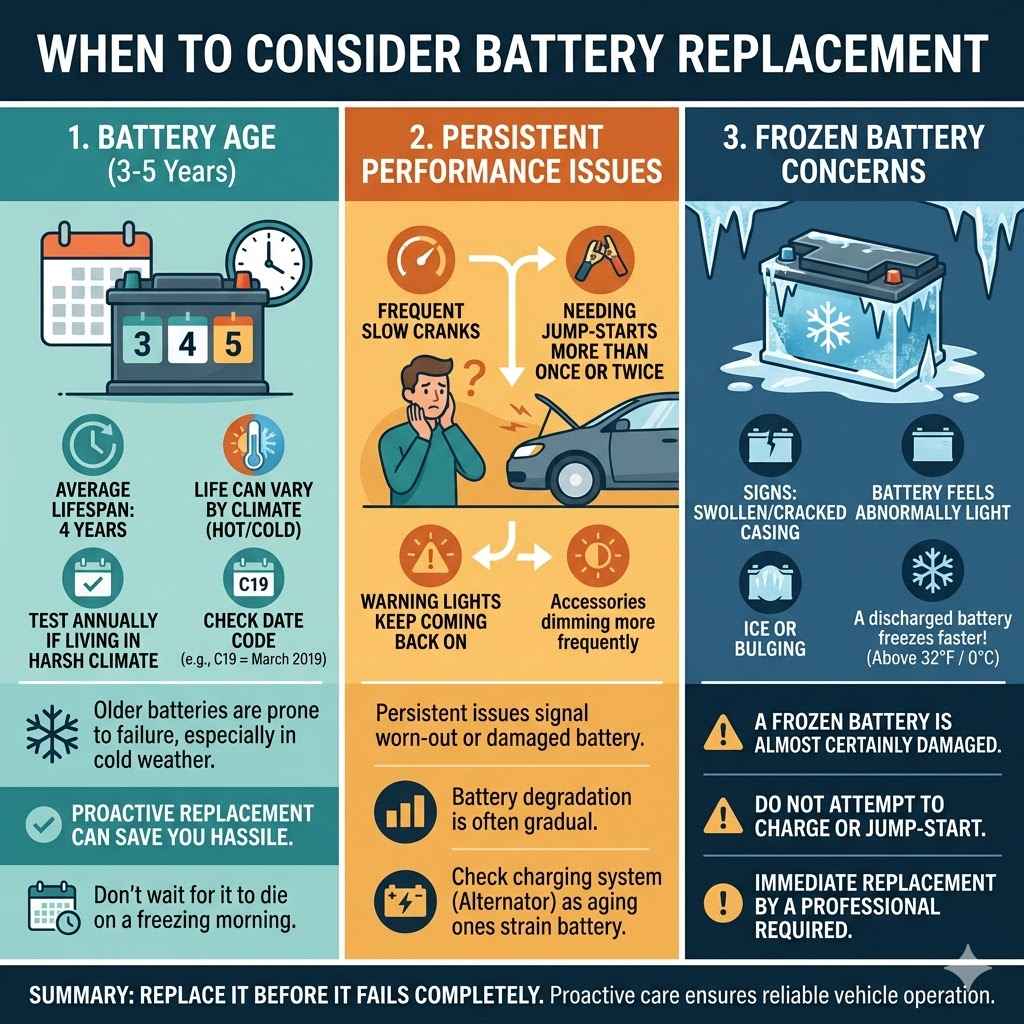
Car batteries typically last between 3 to 5 years. If your battery is older than this, especially if it’s approaching the 5-year mark, it might be more prone to failure, particularly in cold weather.
Don’t wait for it to die on a freezing morning. If your battery is getting old, consider testing it and being prepared to replace it, even if it seems to be working fine for now. Proactive replacement can save you a lot of hassle.
The average lifespan of a car battery is around 4 years. However, this can vary greatly depending on climate, driving habits, and battery quality. In extreme climates, like those with very hot summers and very cold winters, batteries may have a shorter life.
If your battery is approaching the 3-year mark and you live in a harsh winter climate, it’s wise to get it tested annually. A battery that might have lasted longer in a temperate zone might fail prematurely under winter stress.
When checking the date code on a battery, it’s usually a sticker with letters and numbers. The first letter often indicates the month (A=January, B=February, etc.), and the number indicates the year. For example, “C19” would mean March 2019.
Persistent Performance Issues
If you’re consistently noticing problems, even after taking steps to care for your battery, it might be time for a new one. This includes frequent slow cranks, needing jump-starts, or warning lights that keep coming back on.
These persistent issues signal that the battery may be worn out or damaged internally and can no longer hold a sufficient charge or deliver adequate power, regardless of the temperature.
Don’t ignore these signs. A failing battery can leave you stranded at the worst possible time.
If your car requires jump-starts more than once or twice during a cold spell, it’s a strong indication that the battery is not holding a charge effectively. While a jump-start can get you going, it doesn’t solve the underlying problem.
Battery performance degradation is often gradual. You might notice the engine cranking slower on more occasions, or accessories dimming more frequently. These subtle changes, when they become regular occurrences, point towards a battery nearing the end of its service life.
It’s also worth noting that if your car’s charging system (alternator) has been recently repaired or is known to be aging, this can put extra strain on the battery, potentially shortening its life. A comprehensive check of both the battery and alternator is advisable if persistent issues arise.
Frozen Battery Concerns
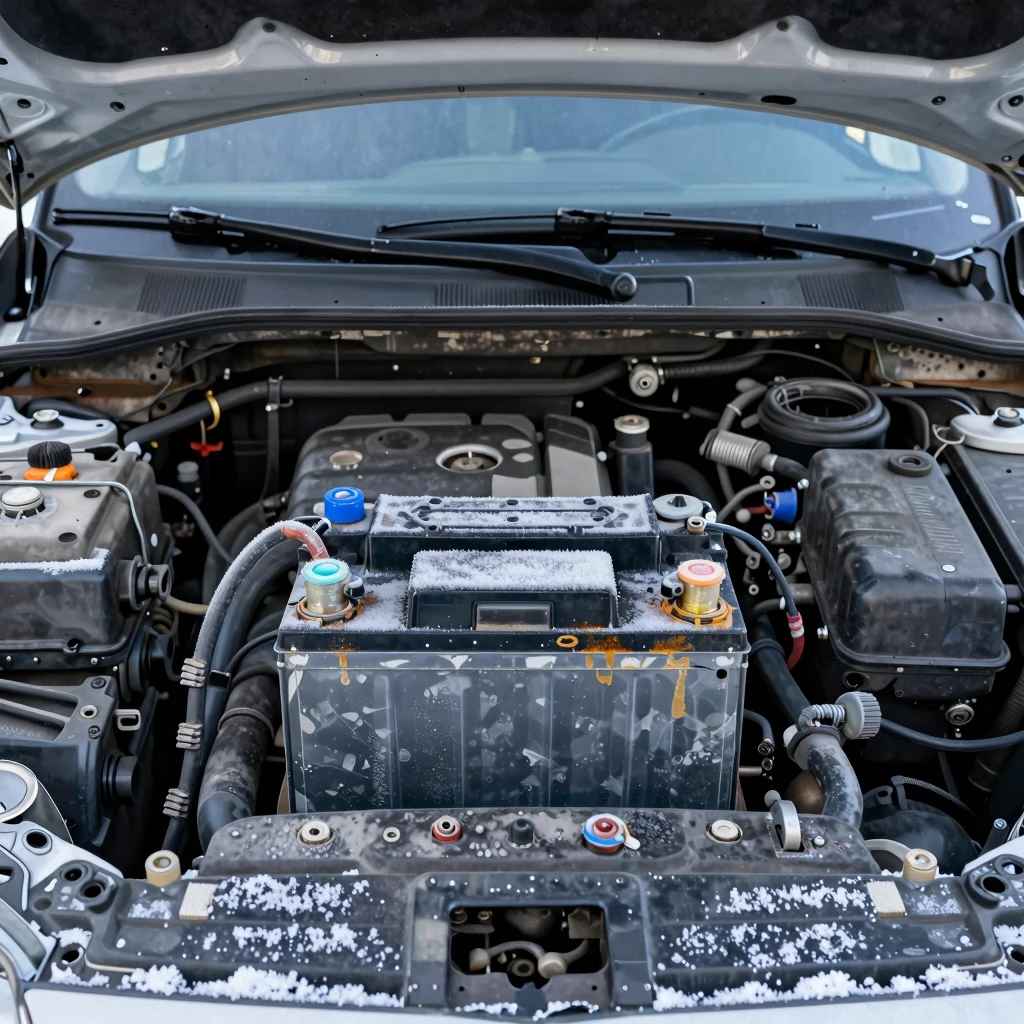
If you suspect your car battery has frozen, it’s a critical sign of a problem. A fully charged battery has a much lower freezing point than a discharged one. If the electrolyte freezes, it can expand and cause physical damage to the battery case, leading to cracks and leaks.
A frozen battery is almost certainly damaged and needs immediate replacement. Do not attempt to start the car or charge a frozen battery, as this can be dangerous.
If you see ice or notice bulging on your battery, it’s best to have it inspected and replaced by a professional.
A fully charged lead-acid battery electrolyte has a freezing point of about -76°F (-60°C). However, a discharged battery, with a higher concentration of water, can freeze at temperatures well above 32°F (0°C). This is why a battery that is left in a discharged state during cold weather is at high risk of freezing.
Signs of a frozen battery include a swollen or cracked casing, or a battery that feels abnormally light. If you suspect freezing, do not attempt to charge it or jump-start the vehicle. The physical damage can lead to acid leaks and potential battery explosion when charging is attempted.
If a battery has frozen and appears damaged, it should be safely removed and disposed of according to local regulations. It is crucial to
Frequently Asked Questions
Question: Why does my car start fine in warm weather but struggle in the cold
Answer: In cold weather, the chemical reactions inside your car battery slow down, reducing its power output. Also, your car’s engine oil thickens, making the engine harder to turn over, which requires more power from the battery. This combination means a battery that works well in warm weather can struggle when it’s freezing.
Question: How can I check my car battery’s health before winter
Answer: You can check your battery’s terminals for corrosion and clean them if needed. It’s also a good idea to have your battery tested at an auto parts store; they can check its charge and Cold Cranking Amps (CCA) rating to see if it’s ready for winter.
Question: Is it safe to jump-start a car in freezing temperatures
Answer: Yes, it is generally safe to jump-start a car in freezing temperatures, but you must follow the correct procedure carefully. Ensure the vehicles are not touching and connect the jumper cables in the correct order (positive to positive, negative to a ground point on the dead car). A weak or frozen battery can present additional risks, so caution is always advised.
Question: How long do car batteries usually last in cold climates
Answer: Car batteries typically last 3-5 years. However, in very cold climates, the increased stress and demand can shorten their lifespan. Batteries in harsh winter environments might only last 2-4 years on average, especially if they are not properly maintained or are subjected to frequent deep discharges.
Question: What is the best way to store a car that won’t be driven in winter
Answer: If you’re storing a car for winter, it’s best to disconnect the battery or use a battery tender. A battery tender will keep the battery charged without overcharging it. If you cannot disconnect it, ensure it is fully charged before storage, and consider using a battery warmer if it will be exposed to extreme cold.
Summary
Cold weather challenges car batteries by slowing chemical reactions, reducing power output, and increasing engine starting demands. Understanding Cold Cranking Amps (CCA), voltage drop, and signs like slow cranks helps identify issues. Regular maintenance, protective measures like battery warmers, and mindful driving habits can prevent cold-weather battery drain, ensuring your car starts reliably all winter long.