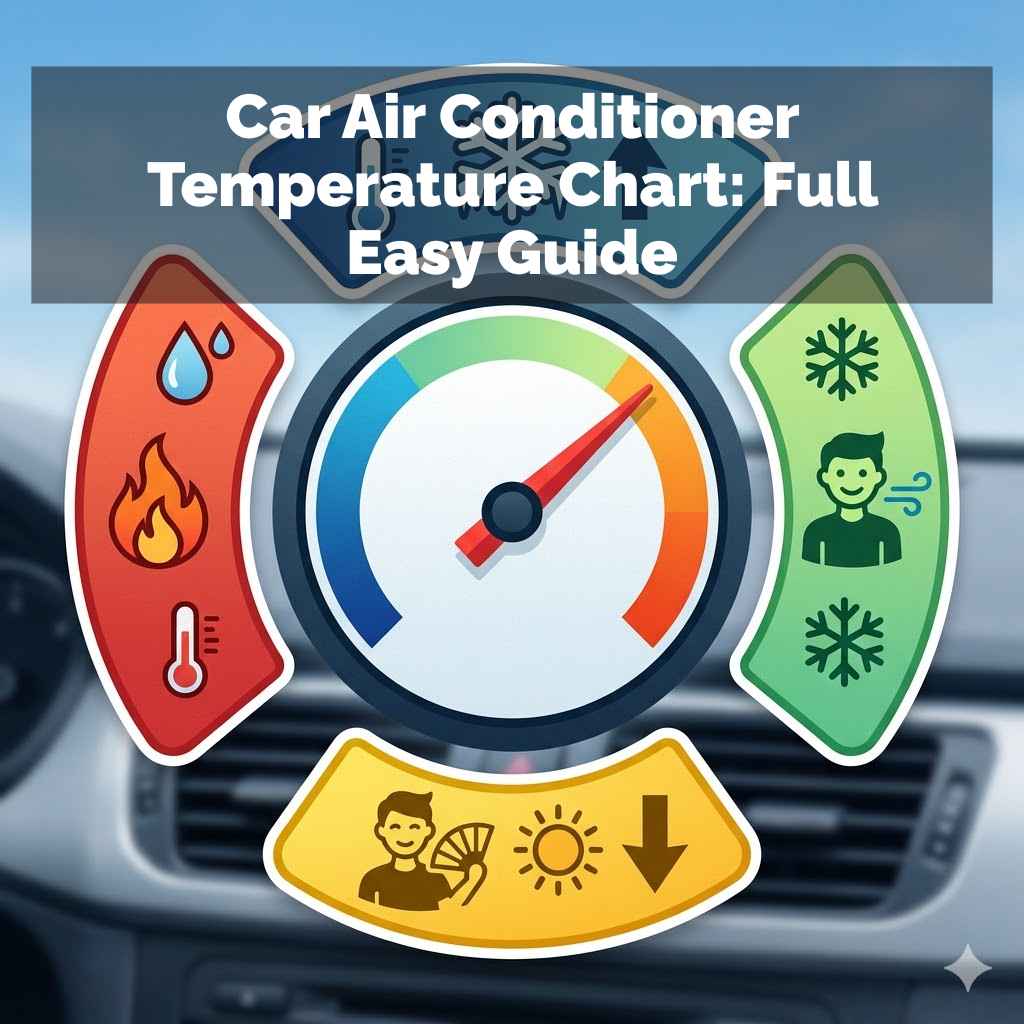
Car Air Conditioner Temperature Chart: Normal Vent Temps at 70, 90 & 100°F
Your car’s AC feels weaker than usual, but is it actually failing, or just responding to the weather outside? Vent temperature isn’t one fixed number — it shifts with the outside air, which is why comparing your reading to a single “should be” figure often gives the wrong answer. This car air conditioner temperature chart breaks down what a healthy vent reading looks like at different outside temperatures, plus the signs — a clogged cabin filter, low refrigerant, a failing compressor — that mean your AC needs attention.
Quick Answer
A healthy car AC should blow air 35–50°F cooler than the outside temperature. If it’s 90°F outside, expect 45–55°F at the center vent. A temperature drop below 20°F suggests low refrigerant or a clogged condenser. Test with a digital thermometer after running MAX COLD with recirculation ON for 5 minutes.
Understanding Your Car’s AC Temperature Basics
When we talk about a car air conditioner temperature chart, it’s not usually a physical paper you find in your glove box. Instead, it refers to the general principles and expected performance of your car’s cooling system. The main goal of your car’s AC is to cool the air inside the cabin.
It does this by removing heat and moisture from the air.
Think of it like this: your car’s AC system works like a refrigerator. It has a refrigerant that circulates. This refrigerant absorbs heat from the inside air, making it cool.
Then, it releases that heat outside your car. The temperature you feel coming from the vents is the result of this process.
The key takeaway is that your car’s AC doesn’t cool the air to a specific absolute temperature, like 70°F. Instead, it cools the air by a certain amount relative to the outside air. This is a crucial point that often causes confusion.
The warmer it is outside, the harder the system has to work to cool the air down.
Most automotive AC systems are designed to reduce the cabin air temperature by about 30 to 50 degrees Fahrenheit compared to the outside temperature. So, if it’s 90°F outside, you might expect the air coming from your vents to be around 45°F to 55°F. This is a normal and efficient operating range.
This temperature difference is often referred to as the “delta T” or temperature drop. Understanding this delta T is the first step to interpreting what your car’s AC is doing. If you’re not getting close to this drop, there might be an issue with your system.
Car Air Conditioner Temperature Chart: Outside Temp vs. Vent Temp
Use this chart as a baseline. Test conditions: AC on MAX COLD, fan on HIGH, recirculation ON, engine idling or driving, after 5–10 minutes of operation.
| Outside Temperature | Expected Vent Temperature | Temperature Drop (Delta T) |
|---|---|---|
| 70°F (21°C) | 35–40°F (2–4°C) | 30–35°F |
| 80°F (27°C) | 40–45°F (4–7°C) | 35–40°F |
| 90°F (32°C) | 45–55°F (7–13°C) | 35–45°F |
| 100°F (38°C) | 50–60°F (10–16°C) | 40–50°F |
| 110°F (43°C) | 55–65°F (13–18°C) | 45–55°F |
Note: High humidity can add 3–5°F to vent readings — this is normal. For a full step-by-step measurement guide with a thermometer, see our car AC temperature chart testing guide.
The settings on your dashboard dial or climate control panel often don’t represent the exact temperature of the air. Instead, they represent a desired level of cooling or a target air temperature that the system tries to achieve. When you turn the dial to “cold,” you’re telling the system to work harder to create a larger temperature drop.
Many modern cars have automatic climate control systems. These systems use sensors to monitor the cabin temperature and the outside temperature. They then adjust the fan speed, air recirculation, and compressor operation to maintain your set temperature.
This is where a “chart” becomes more complex, as the system is constantly making adjustments.
However, even with automatic systems, the underlying principle of a 35–50°F temperature drop remains the target for optimal performance. If your automatic system seems to struggle, or if the air never feels cool enough, it could still indicate a problem with the AC components.
It’s also important to remember that factors like humidity, direct sunlight, and the number of people in the car can affect how quickly and effectively your AC cools. A slightly warmer than expected output might be normal on a very humid day or when the car has been sitting in direct sun for hours.

My Own AC Struggles: A Hot Summer Night Revelation
I remember one particularly sweltering summer night a few years ago. I was driving back from a friend’s place, and the air coming from my car’s vents was barely cool. It was definitely not the refreshing blast I expected.
The outside temperature was probably around 85°F, and I had the AC set to its coldest setting.
I felt a wave of panic mixed with annoyance. My car is usually pretty good at cooling down. I fiddled with the knobs, turned the fan speed up, then down.
Nothing seemed to make a real difference. The air felt more like a slightly cool breeze than air conditioning. I started picturing expensive repair bills and the misery of driving in that heat.
I pulled over at a gas station, my brow slick with sweat. I popped the hood, even though I’m not much of a mechanic. I just stared blankly at the engine, hoping for a sign.
Nothing looked obviously wrong. But then, I remembered reading something about the temperature drop. I got back in the car, held my hand right up to a vent, and tried to feel the actual temperature difference compared to the air around me.
It was only maybe 5-10°F cooler. That’s when I knew something was seriously wrong. A normal car AC should deliver air much colder than that — the chart above shows why: I was getting a 5–10°F delta when I should have been getting 35–45°F.
It turns out I had a slow refrigerant leak. It wasn’t completely empty, but it was low enough that the system couldn’t produce that significant temperature drop anymore. A simple recharge fixed it, and the relief was immense.
That experience really drove home how important that temperature difference is.
Understanding Your Car’s AC Vent Temperature
Normal Vent Temperature: 35–50°F cooler than outside air.
Example: If it’s 90°F outside, expect vent air around 45–55°F.
Signs of Trouble: Vent air is only a few degrees cooler than outside, or feels only slightly cool.
What Affects Your Car’s AC Cooling Performance?
Several things can influence how well your car’s air conditioner cools. Understanding these factors helps you interpret the “temperature chart” for your specific situation. It’s not just about the number on the dial.
First, outside temperature is the biggest player. The hotter it is outside, the harder your AC system has to work. If it’s 100°F outside, achieving that 40–50°F drop means blowing air at 50–60°F.
If it’s 70°F outside, you might get air down to 35–40°F. This is why your AC might feel less effective on extreme heat days, even if it’s working perfectly.
Second, humidity plays a big role. Air conditioning systems also dehumidify the air. On very humid days, the system has to work harder to remove moisture.
This can sometimes make the air feel less “cold” because some of the system’s energy is spent on dehumidification. High humidity also makes the ambient air feel warmer and more uncomfortable, so the perceived difference might be less.
Third, direct sunlight on your car can drastically increase the cabin temperature. If your car has been parked in the sun for hours, the interior surfaces, like the dashboard and seats, get very hot. It takes time for the AC to overcome this stored heat and bring the cabin temperature down.
This is why cooling is often more effective when you’re driving constantly than when you’ve just started your car after it’s been sitting.
Fourth, the condition of your AC system is paramount. This includes things like:
- Refrigerant level: Too low or too high can cause issues.
- Compressor function: This is the heart of the system.
- Condenser cleanliness: This part releases heat outside. If it’s blocked by debris, it can’t work well.
- Evaporator condition: This part cools the air inside.
- Air filters: A clogged cabin air filter restricts airflow.
- Leaks: Refrigerant leaks are a common problem.
Fifth, your car’s ventilation system itself matters. How well are the vents sealed? Is there any fresh air intake that might be letting in warmer outside air?
How efficiently does the air circulate within the cabin?
Finally, your car’s age and design can also be a factor. Older cars might have less efficient AC systems compared to newer models. Some car designs are also better at insulating the cabin and managing heat load than others.
Quick Check: Is Your AC Working Right?
Step 1: Note the outside temperature. (e.g., 95°F)
Step 2: Let your car idle with AC on MAX COLD for 5-10 minutes.
Step 3: Place your hand directly in front of a main vent.
Step 4: Feel the air. It should feel noticeably colder than the outside air. If it feels only slightly cool or close to outside temp, you might have an issue.
Best Car AC Thermometer Pick
UEi Test Instruments PDT650 Folding Pocket Digital Thermometer
The go-to tool for measuring car AC vent temperature. The folding probe fits perfectly into a center dash vent for an accurate 5-minute baseline reading.
- Best for: Checking vent temp against the temperature chart above
- Why we picked it: Compact folding probe fits any vent; instant digital readout
- Main drawback: No data logging — you read the display manually
Compare more car AC testing options
 Option 1 BlueSeal A/C Stop Leak, Non-Polymer, Seals Metal & Rubber, R-134a
|
 Option 2 R134A AC Refrigerant Recharge Hose Kit
|
 Option 3 Jikkolum R134a AC Diagnostic Manifold Gauge
|
As an Amazon Associate we earn from qualifying purchases.
How to Read Your Car’s “Temperature Chart” (System Performance)
Since there isn’t a literal chart, we interpret your car’s AC performance based on its output. The “chart” is essentially a performance evaluation of your AC system. Here’s how to “read” it.
Ideal Performance: The air coming from your vents should feel significantly colder than the air outside. If it’s 90°F outside, you should feel air around 45–55°F. This means your system is working efficiently and achieving that 35–50°F temperature drop.
Slightly Warm Output: If the air feels only a few degrees cooler than outside, this is a major red flag. This suggests a problem like low refrigerant, a faulty compressor, or a blocked condenser. The system is struggling to transfer heat effectively.
Inconsistent Cooling: Sometimes the AC works great, and other times it’s weak. This can be caused by a malfunctioning clutch on the AC compressor, an electrical issue, or a problem with the expansion valve. The system isn’t consistently engaging or performing.
Weak Airflow, but Air is Cold: If the air is cold but doesn’t blow strongly, the issue is likely with the blower motor, a clogged cabin air filter, or a blockage in the ductwork. The cooling components might be fine, but the air isn’t reaching you properly.
AC Turns On and Off Frequently: This can indicate an overcharged system, a faulty pressure switch, or a problem with the compressor clutch. The system might be cycling on and off rapidly to prevent damage.
When you adjust the temperature settings on your climate control, you’re essentially telling the system to try and achieve a colder vent temperature. On a “MAX” or “Coldest” setting, it will run the compressor at full capacity and try to maximize that temperature drop. On a warmer setting, it will reduce the compressor’s workload or blend in some warm air.
Modern cars with automatic climate control have sophisticated ways of managing this. They might cycle the compressor on and off, adjust fan speeds, or even use an electronic expansion valve to precisely control refrigerant flow. This is to maintain your set temperature within a small margin of error, rather than just blowing the coldest possible air.
The “temperature chart” in your mind should always revolve around that 35–50°F delta T as a benchmark for a healthy system. If you’re consistently not hitting that, it’s time to investigate.
Car AC Performance Indicators
Indicator: Strong, cold air from vents
Meaning: System likely functioning well. Achieving expected temp drop.
Indicator: Weak or slightly cool air
Meaning: Potential issue: low refrigerant, compressor problem, condenser block.
Indicator: Air is cold but airflow is weak
Meaning: Potential issue: clogged cabin filter, blower motor problem.
My Experience with a Clogged Condenser
One summer, my car’s AC started acting up. It wasn’t completely broken, but it just wasn’t as cold as it used to be, especially on really hot days. I’d set it to 70°F, and it would eventually get there, but it took forever.
The air from the vents felt lukewarm.
I took it to my usual mechanic. He hooked up his gauges, checked the refrigerant levels, and said everything looked okay on the pressure side. He thought maybe the compressor was starting to go bad.
I was really bummed about that possibility.
He suggested we try cleaning the condenser first. I didn’t even know what that was, exactly. He explained that the condenser sits in front of the radiator and its job is to release the heat from the refrigerant into the outside air.
Over time, it can get clogged with bugs, leaves, dirt, and road grime. If it’s blocked, it can’t release heat properly.
He took a hose and sprayed down the front of my car, really getting into the condenser fins. Then he sprayed a special cleaner. After rinsing it off, he started the car and ran the AC.
We put a thermometer in the vent.
The difference was almost immediate. The air coming out was significantly colder. He said that by cleaning the condenser, he allowed the refrigerant to cool down more efficiently, which in turn made the whole system work much better.
The temperature drop at the vents went from maybe 15°F to a solid 38°F. It cost me next to nothing, just a bit of cleaning fluid and labor, and my AC was back to its old self. It was a great lesson in how simple maintenance can make a huge difference.
Car AC Maintenance Myth vs. Reality
Myth: My AC is broken, it must be a major part like the compressor.
Reality: Often, issues are due to simple maintenance. Low refrigerant, clogged filters, or dirty condensers are common and easily fixed.
Myth: Just recharging the AC is always the answer.
Reality: If your refrigerant is low, there’s usually a leak. Simply recharging without fixing the leak means the problem will return, and it’s bad for the environment.
Understanding Your Climate Control Settings
Your climate control panel is your interface with the car’s cooling system. While not a “temperature chart,” the settings provide important clues.
Manual AC Controls:
- Temperature Dial: This usually controls a blend door. When set to cold, it allows maximum cold air from the evaporator. When set to hot, it blends in hot air from the heater core.
- Fan Speed: Controls how fast the blower motor pushes air through the vents. Higher speed means more air, but can sometimes reduce the perceived coolness if the air isn’t cold enough.
- Recirculation Button: When on, the system recirculates air from inside the cabin. This is more efficient as it’s cooling already cooled air. When off (fresh air), it pulls in warmer outside air.
- AC Button: This engages or disengages the AC compressor. If the AC light is on, the compressor should be running.
Automatic Climate Control:
- Set Temperature: You enter a desired cabin temperature (e.g., 72°F). The system then automatically adjusts fan speed, compressor engagement, and blend doors to maintain it.
- Auto Button: Activates the automatic mode.
- Dual Zone: Allows different temperatures for the driver and passenger.
The automatic system is smart. If you set it to 70°F on a 100°F day, it will run the compressor constantly at full blast and the fan on high until it reaches 70°F. Once it’s there, it might cycle the compressor or reduce its output, and adjust the fan speed to maintain that temperature.
This constant adjustment is why you don’t see a single “vent temperature” on the dash.
If your automatic system seems to be blowing warm air even when set to cold, it could be a sensor issue, a problem with the blend doors, or a lack of refrigerant, similar to manual systems. The complexity of automatic systems means there are more potential points of failure, but they also offer more precise control when working correctly.
Always remember that the number you set is a target for the cabin, not the air coming out of the vents. The vent air temperature is the tool the system uses to reach that cabin target. A good AC system will achieve a significant temperature drop at the vents to quickly cool the cabin.
Climate Control Quick Guide
Manual AC: You control the fan, temp blend, and AC on/off.
Automatic AC: You set a target temp; car adjusts everything.
Recirculate: Best for fast cooling, keeps outside air out.
Fresh Air: Good for air quality, but slower to cool.
When to Worry: Signs Your AC Needs Professional Attention
While you can do some basic checks, certain signs mean it’s time to call a professional. Ignoring these can lead to more extensive and expensive damage.
Persistent Lack of Cold Air: If you’ve tried the basic checks and the air is still not getting cold enough (not achieving that 35–50°F drop), it’s likely a refrigerant issue or a component failure. This could be a leak, a failing compressor, or a blocked expansion valve.
Strange Noises: Grinding, squealing, or rattling noises coming from the AC system when it’s running are bad signs. These often indicate a worn-out bearing in the compressor or a problem with the clutch. Stop using the AC immediately if you hear these noises.
AC Not Engaging at All: If you press the AC button, the light comes on, but you don’t hear the compressor clutch engage (a distinct “click” sound), and no cold air comes out, it could be an electrical issue, a blown fuse, a faulty pressure switch, or a completely failed compressor.
Musty or Moldy Smells: While not directly related to temperature, a persistent bad smell from the vents often means mold or mildew has built up in the evaporator or ductwork, which can be a health concern. Sometimes a professional can clean this, other times parts might need replacement.
AC Works Intermittently: If the AC blows cold for a while and then suddenly stops, or cycles on and off too rapidly, it suggests a problem with pressure regulation, an electrical fault, or an overheating component.
Visible Leaks: If you see oily residue around AC lines or components, it’s a strong indicator of a refrigerant leak. Refrigerant often contains oil to lubricate the system, so an oil stain means refrigerant is escaping.
When you take your car to a mechanic, they have specialized tools like manifold gauges to measure the high and low-side pressures of the AC system. You can see how to read AC gauges on a car to understand what those readings mean. These diagnostics are essential for accurately pinpointing the “temperature chart” problem.
For example, low pressure on the low side and high pressure on the high side might indicate a restriction. Low pressure on both sides often means low refrigerant charge. High pressure on both sides could mean an overcharge or a blockage in the condenser.
Professional AC Checkpoints
Pressure Readings: Technicians use gauges to check refrigerant pressures.
Leak Detection: Electronic sniffers or UV dye are used to find leaks.
Component Testing: Diagnosing the compressor, clutch, fans, and sensors.
Airflow Analysis: Ensuring proper air circulation through the system.
Tips for Maximizing Your Car’s AC Performance
You can do a few things to help your car’s AC work better and last longer. These are simple habits and maintenance steps.
1. Run Your AC Regularly: Even in winter, run your AC for a few minutes once a month. This keeps the seals lubricated and prevents refrigerant from escaping.
It also helps keep the evaporator dry, reducing mold growth.
2. Park in the Shade: Whenever possible, park your car in a shaded area. This prevents the interior from overheating, meaning your AC won’t have to work as hard to cool it down.
3. Use the Recirculation Mode: Once the cabin is cool, switch to recirculate mode. This cools the air already inside the car, which is more efficient than constantly cooling hot outside air.
4. Clean the Cabin Air Filter: This is a big one! A dirty cabin air filter restricts airflow, making your AC work harder and blow less air.
Check your owner’s manual for its location and replacement interval. It’s often an easy DIY job.
5. Keep Condenser Clear: Periodically check the front of your car (where the radiator is) and gently clear away any debris like leaves or bugs from the condenser fins. You can use a soft brush or compressed air.
6. Don’t Blast It Immediately: On a very hot day, open your windows for a minute or two first to let the super-heated air escape. Then, start the AC.
This reduces the initial load on the system.
7. Monitor for Leaks: If you notice your AC cooling performance decreasing over time, it might be a sign of a slow refrigerant leak. Get it checked before it becomes a major issue.
8. Understand Your Settings: Use the automatic climate control as intended. If you have manual controls, try to find a balance between fan speed and temperature setting that provides comfort without overworking the system.
By following these tips, you can help ensure your car’s AC system stays in good shape and provides that comfortable temperature drop you expect. It’s all about proactive care and understanding how the system is designed to work. Also see our guide on why car AC blows cold then warm for intermittent cooling problems.
Top AC Care Tips
Regular Use: Run AC monthly, even in winter.
Shade Parking: Reduces interior heat load.
Recirculate: For faster, efficient cooling once cool.
Filter Change: Crucial for airflow and efficiency.
Condenser Care: Keep front fins clear of debris.

Frequently Asked Questions about Car AC Temperature
What is the ideal temperature for car AC?
The ideal temperature isn’t a single number. Your car’s AC system should aim to cool the air coming from the vents by 35–50°F below the outside temperature. So, if it’s 90°F outside, expect vent air around 45–55°F. If it’s 70°F outside, expect 35–40°F at the vent.
Why is my car AC blowing warm air?
This can happen for many reasons, including low refrigerant, a leak in the system, a faulty compressor, a clogged condenser, a blocked cabin air filter, or electrical issues preventing the AC from engaging. The most common cause is low refrigerant from a slow leak.
How often should I recharge my car’s AC?
You shouldn’t need to “recharge” your AC regularly. If your AC is losing its cooling ability, it likely has a refrigerant leak. Simply recharging without fixing the leak is a temporary fix and harmful to the environment. A mechanic should find and repair the leak first.
Can I measure the AC vent temperature myself?
Yes. Use a digital probe thermometer placed directly into a center vent after the AC has been running on MAX COLD with recirculation for at least 5–10 minutes. Compare your reading to the temperature chart above to see the delta T and assess your system’s health.
What does the “MAX AC” button do?
The “MAX AC” button usually tells the system to run at its coldest setting and often engages the recirculation mode. This maximizes the cooling output and helps cool the cabin down as quickly as possible by re-cooling already-cooled cabin air.
Does humidity affect car AC performance?
Yes, high humidity makes the AC system work harder. It has to remove moisture from the air before it can effectively cool it. On very humid days, your vent temperature may read 3–5°F higher than the chart shows — this is normal, not a system failure.
Final Thoughts on Your Car’s Cooling Comfort
Understanding your car’s AC performance is key to staying comfortable. Remember that the “temperature chart” is really about the difference between the outside air and the air coming from your vents — that 35–50°F drop is your benchmark. Keep up with simple maintenance, pay attention to any unusual sounds or smells, and don’t hesitate to seek professional help when needed.
A well-functioning AC system makes a huge difference on a hot drive!
Products related to this article
Sponsored / affiliate links. As an Amazon Associate I earn from qualifying purchases. I may earn additional commission from eligible campaigns.