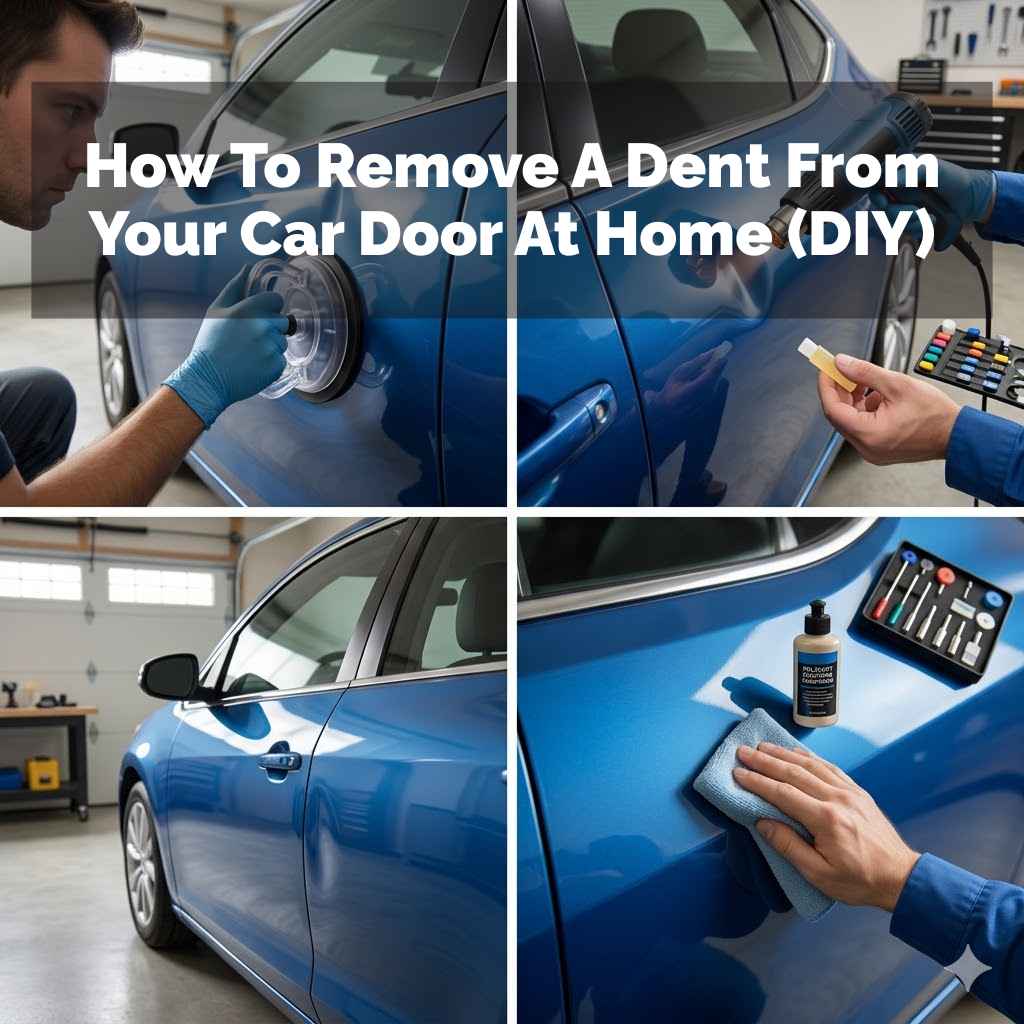
How to Remove a Dent From Your Car Door at Home (DIY Guide)
The good news is, many car door dents are actually fixable at home. You don’t always need a professional to make them disappear. This guide will walk you through different ways to tackle those annoying dents. We’ll cover simple tricks, tools, and what to expect. Our goal is to help you get your car looking great again without breaking the bank.
You can often remove a car door dent at home using simple tools and methods. Techniques like Paintless Dent Repair (PDR), using heat and cold, or even household items can be effective. The success depends on the dent’s size, location, and how sharp the metal is. Always start with the least invasive method.
Quick Answer
Yes, most shallow door dents can be fixed at home for $20-$80 in tools using paintless dent repair (PDR) kits, the hot-glue-and-block method, or a plunger. Small credit-card-sized dents with intact paint have the best success rate. Deep creases, stretched metal, or cracked paint are best left to a professional PDR shop ($75-$200) rather than risking a $400+ mistake.
Understanding Car Door Dents
Car door dents happen. A rogue shopping cart might bump it. A stray baseball could hit it.
Even a sudden hailstorm can leave its mark. These impacts push the metal of your car door inward. This changes the door’s shape.
Some dents are soft and round. The metal stretches a little. Other dents are sharp.
This means the metal might have creased. These sharp dents can be harder to fix. They often need more precise work.
It’s good to look closely at the dent before you try to fix it. This helps you pick the best method.
The paint is also important. If the paint is cracked or chipped, the dent might be deeper than it looks. If the paint is okay, you have a better chance of a clean fix.
Many DIY methods aim to push or pull the metal back into its original shape. They do this without damaging the paint.
Think of the metal like a trampoline. When you push on it, it goes down. When you let go, it springs back up.
Car doors are similar. But sometimes, the metal gets stuck in the dented position. Our job is to gently encourage it to pop back out.
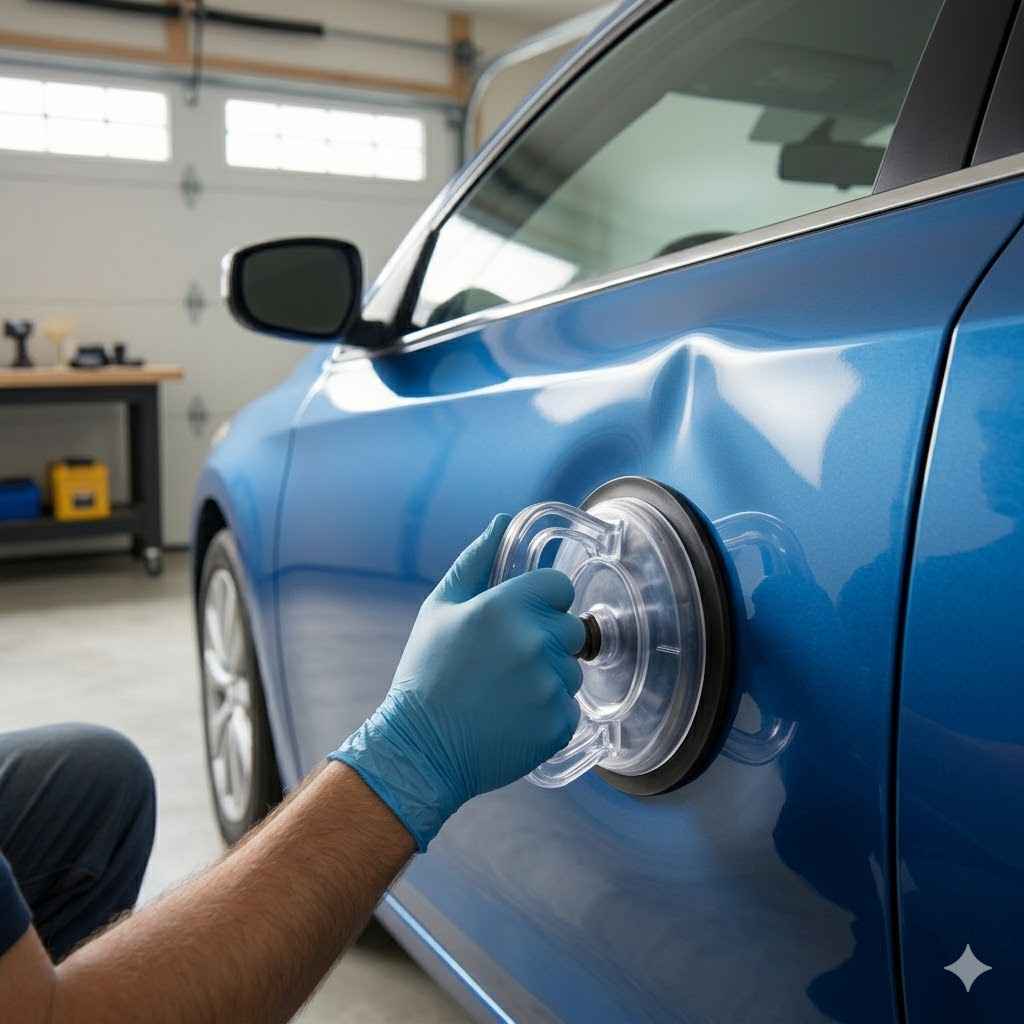
My Own Dent Nightmare
I remember one time, I was at the mall. I had a lot of bags. As I was unloading my car, I heard a loud thud.
My heart sank. Someone had opened their car door too hard, right into mine. I looked, and there it was: a nasty crease on my rear passenger door.
It wasn’t huge, but it was sharp and very obvious.
My first thought was dread. I imagined a body shop bill that would make my eyes water. I felt so annoyed and frustrated.
“I started with a basic PDR kit I ordered online. The dent was right on a body line, which made it trickier — but after a slow first pass with the bridge puller, I could already see it lifting.” — Md Meraj, from the repair in this article
I had tried to park far away to avoid this. It felt unfair. I sat in my car for a few minutes, just staring at the dent.
I felt helpless for a moment.
That night, I started researching. Could I fix this myself? I found a lot of information online.
Some people talked about special tools. Others mentioned things like hair dryers and compressed air. It seemed a little crazy, but I was determined to try something before calling a professional.
The dent was right on a body line. This made it a bit trickier. I started with a basic PDR kit I ordered online.
It had a few rods. I tried to gently push from behind. It helped a little, but the sharp crease was stubborn.
I felt a flicker of hope mixed with doubt.
Next, I tried the heat method. I used a hairdryer. Then I sprayed compressed air.
The quick temperature change is supposed to make the metal contract. I watched closely. For a second, I thought it worked!
The dent seemed shallower. But then it settled back. It was a learning experience, for sure.
I realized that some dents need more patience and a mix of methods.
I eventually got it much better with a combination of gentle pushing and careful tapping. It wasn’t perfect, but it was worlds better than before. It saved me hundreds of dollars.
That experience taught me a lot about car dents and how they can be managed.
Types of Dents and How They Affect Repair
Soft Dents: These are rounded and smooth. The metal hasn’t creased. They are usually the easiest to fix.
They often pop back out with gentle pressure.
Sharp Dents: These have a clear crease or kink in the metal. They are harder to repair because the metal is more deformed. They might require more skill or specialized tools.
Stretched Metal Dents: These are larger dents where the metal has been pulled outward. They can be difficult to repair completely. Sometimes, the metal can’t be perfectly returned to its original shape.
Dents on Body Lines: These dents are on the raised or creased lines of your car’s body. These lines are structural. Fixing them requires precision to maintain the car’s original look.
Paint Damage: If the paint is cracked or chipped, the dent is likely more severe. This can complicate repairs. You might need to get the paint touched up after fixing the dent.
Our Pick: Best At-Home Dent Repair Kit
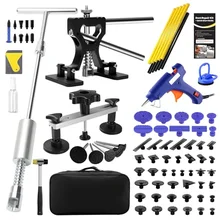
QwikFix 139-Piece Paintless Dent Repair Kit
- Best for: Shallow-to-medium door dings with intact paint, including body-line creases
- Why we picked it: Includes the bridge puller and T-slide hammer this article’s own “Method 4” section describes, plus glue tabs and a lifter for smaller dents in one kit
- Main drawback: Sharp creases on curved body lines still take patience and may need several attempts
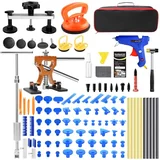 VEXTRO PDR Kit Best for: Beginners wanting a simpler bridge-puller-only kit Why we picked it: Fewer parts than the 139pc kit, easier to learn on first dent Main drawback: Fewer glue tab sizes for smaller dings |
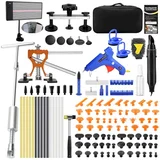 FLY5D Kit with Heat Gun Best for: The heat-and-cold method described in this guide’s Method 2 Why we picked it: Bundles a heat gun so you don’t need a hair dryer plus compressed air separately Main drawback: Heat gun adds bulk vs. simpler kits |
 HORFUTY Car Dent Puller 3 Pack Dent Puller Powerful Car Dent Removal Kit Suction Cup Dent Puller for Best for: Trying the plunger method (Method 3) with a purpose-built tool instead Why we picked it: A dedicated suction puller seals better than a household plunger on curved panels Main drawback: Still limited to shallow, gently-curved dents |
Method 1: Paintless Dent Repair (PDR) at Home
Paintless Dent Repair, or PDR, is a popular method. It’s used by professionals. The goal is to repair the dent without touching the paint.
This means no sanding, filling, or repainting. It’s a great DIY option if the paint is intact.
You can buy PDR kits online. They usually come with metal rods. These rods have different tips.
You use them to access the back of the dent. Then, you gently massage the metal. You push from the inside out.
It’s like giving the dent a gentle massage back into place.
First, you need to find a way to see the dent clearly. Some kits come with special lights. These lights help you see the dent’s high and low spots.
You work slowly. You apply light, steady pressure. You don’t want to push too hard too fast.
This could create a new high spot.
You might also use a PDR kit that has glue tabs. You glue a tab to the dent. Then you use a special pulling tool to pull the dent out.
This is another way to work from the outside. Again, steady, controlled pulls are key. You often use this method when you can’t get to the back of the dent easily.
It takes patience. You might need to work on the dent from different angles. You push a little, then check.
You push a bit more. You’re aiming for a smooth transition. You want the metal to look like it was never dented.
It’s very rewarding when it works.
Key PDR Steps:
- Clean the area around the dent.
- Access the back of the dent with a PDR rod.
- Gently push the metal outward.
- Use a PDR light to see the dent’s contours.
- Work slowly and patiently.
- Alternatively, use glue tabs and a pulling tool from the outside.
PDR Kit Essentials
Metal Rods: Various shapes and sizes to reach behind the dent. They have different tips for pushing.
Glue Tabs: Plastic tabs that stick to the dent’s surface.
Glue Gun and Glue Sticks: Used with glue tabs. Special PDR glue is needed.
Pulling Tool: A device that attaches to the glue tab to pull the dent out.
Knockdown Tool: Used to gently tap down high spots that might appear after pushing.
PDR Light: A special light that shows the dent’s reflection, highlighting low and high spots.
Method 2: Heat and Cold Therapy
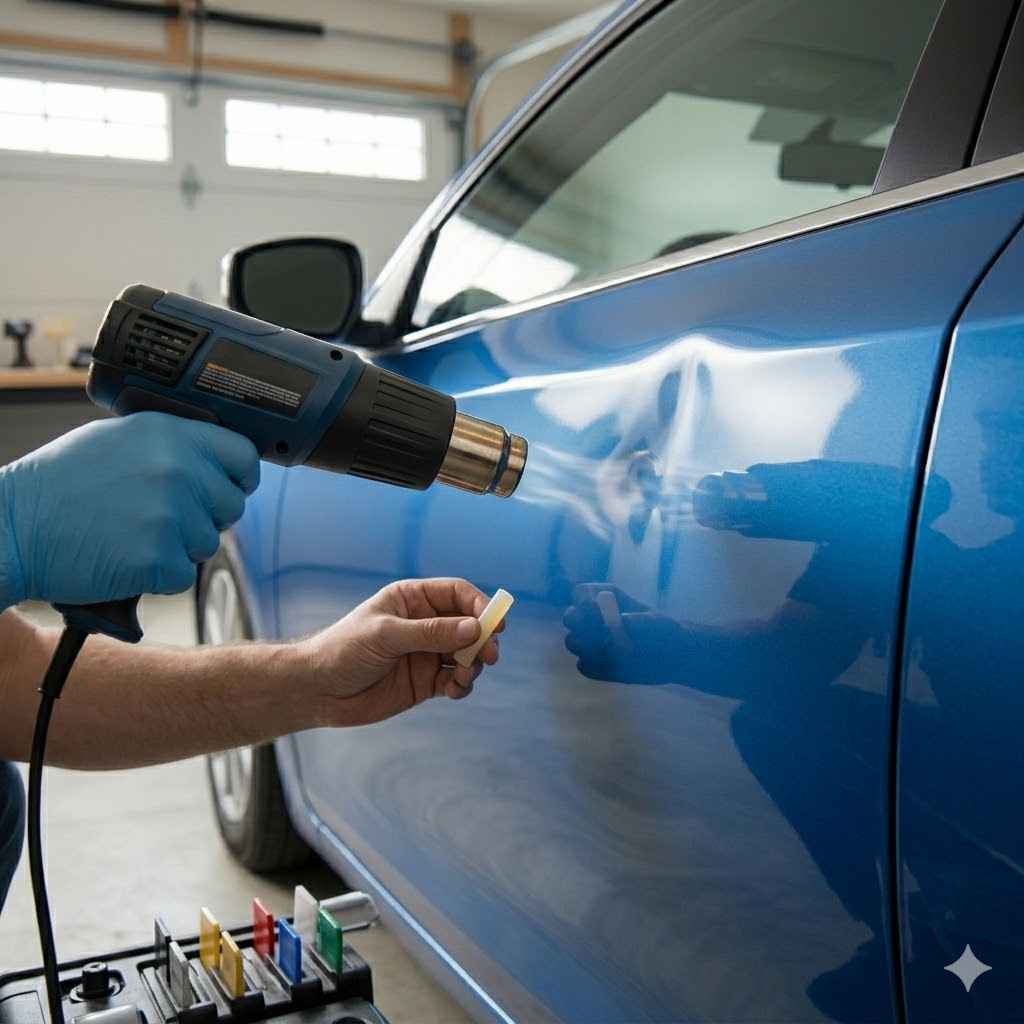
This method sounds a bit like magic, but it has a scientific basis. Metal expands when heated and contracts when cooled. By rapidly changing the temperature of the dented area, you can sometimes shock the metal back into its original shape.
It works best on larger, shallow dents.
You can use a hairdryer or a heat gun (on a low setting) to warm up the dent. You want the metal to be warm, not hot. If you use a heat gun, keep it moving.
Don’t let it stay in one spot for too long. You don’t want to damage the paint. About 60 seconds of heating is often enough.
After heating, you need to cool it down quickly. The common method is using compressed air. Turn the can upside down and spray the cold liquid onto the heated area.
The sudden cold causes the metal to contract rapidly. This contraction can pull the dent out.
Another way to cool it is with dry ice. Be very careful if you use dry ice. Wear thick gloves.
Never touch it with bare skin. It can cause frostbite very quickly. You can hold a piece of dry ice on the dent for a minute or two.
Sometimes, you might hear a popping sound. That’s a good sign! It means the metal is moving.
This method is less about precision and more about causing a reaction in the metal. It’s a good first try for certain types of dents.
Tips for Heat/Cold:
- Clean the dented area first.
- Use a hairdryer or low heat gun. Heat for about 60 seconds.
- Keep heat moving to avoid paint damage.
- Spray compressed air (upside down) or use dry ice for rapid cooling.
- Wear gloves with dry ice.
- Listen for a pop.
- Repeat if necessary, but give the metal time to rest.
Is Heat/Cold Right for Your Dent?
Best For: Larger, shallow dents where the metal isn’t creased.
Not Ideal For: Sharp creases, small dents, or dents on body lines. Dents where the paint is damaged.
Potential Risk: Paint damage if heat is too high or applied for too long. Frostbite with dry ice.
Method 3: Plunger Power
This is a classic, simple trick that can sometimes work for larger, smoother dents. You’ve probably seen it done on TV or in videos. It’s easy to try and uses a common household item.
You’ll need a flange plunger. The kind you use for your toilet. Make sure it’s clean!
You don’t want to spread any grime onto your car’s paint. Some people prefer a brand-new plunger for this. Or, a separate, clean one.
First, wet the rim of the plunger. This helps it create a strong seal against the car door. You might also want to wet the surface of the dent slightly.
Now, press the plunger firmly onto the center of the dent.
You want to create a good suction. Then, pull the plunger back sharply. You’re trying to yank the dented metal outward.
You might need to try this several times. Pull with a steady, strong motion. If the plunger slips, reapply it and try again.
This method works because the plunger creates a vacuum. When you pull, it exerts force on the metal. For shallow, rounded dents, this force can be enough to pop the metal back into place.
It’s a bit like how suction cups work.
Be careful not to pull too hard or at an angle that could damage the paint. It’s less about brute force and more about creating effective suction and a good, quick pull. It’s a low-risk method to start with.
Plunger Steps:
- Get a clean flange plunger.
- Wet the rim of the plunger and the dent area.
- Press the plunger firmly onto the dent’s center.
- Create a strong seal.
- Pull the plunger straight back with a sharp, steady motion.
- Repeat if needed, ensuring a good seal each time.
When the Plunger Might Not Work
Sharp Creases: The plunger can’t create enough targeted force.
Small Dents: Not enough surface area for the plunger to seal properly.
Stretched Metal: The metal might not have enough “spring” to return.
Body Lines: Dents on these lines are too irregular for a plunger’s flat surface.
Method 4: Using Household Items (Hot Glue and Blocks)
This is a clever DIY approach that mimics some professional PDR techniques. It uses hot glue to adhere a pulling tool to the dent. You then use the tool to pull the dent out.
It’s surprisingly effective for many dents.
You’ll need a hot glue gun, special PDR glue sticks (these are formulated to be strong but removable), and a pulling tool. The pulling tool can be a simple tab with a handle, or something more sophisticated like a PDR bridge puller. You can also use a wooden block or a similar object to gently tap down high spots.
First, clean the dented area thoroughly. Apply hot glue to the pulling tab. Quickly place the tab onto the center of the dent.
Hold it in place for about 30 seconds to a minute until the glue cools and hardens. You want a strong bond.
Once the glue is set, attach your pulling tool. If you have a bridge puller, you’ll position it over the tab. Then you’ll slowly tighten a knob to pull the tab upwards.
If you have a simpler tab with a handle, you’ll just pull straight up with steady force.
Work slowly. Pull a little, then check the dent. You might need to repeat the gluing and pulling process a few times.
You’re trying to gradually lift the dented metal. If you create a high spot, you can use a knockdown tool or a gentle tapping tool to tap it down slightly.
After you’ve pulled the dent as much as you can, you need to remove the glue. Use rubbing alcohol. It dissolves the PDR glue without harming the paint.
Gently work the tab off. You can also use a plastic scraper if needed, but be very careful not to scratch the paint.
This method gives you a lot of control. It’s less about sudden force and more about gradual, controlled pulling. It’s a great way to tackle dents when you can’t access the back of the panel.
Hot Glue Pulling Steps:
- Clean the dented area.
- Apply hot PDR glue to a pulling tab.
- Press the tab onto the center of the dent.
- Let the glue cool and harden (about 30-60 seconds).
- Attach your pulling tool (bridge puller or handle).
- Slowly and steadily pull the tab upwards.
- Repeat the process if needed, working gradually.
- Use a knockdown tool for high spots.
- Remove glue with rubbing alcohol.
DIY Dent Pulling Tools
Hot Glue Gun: Standard craft glue gun is okay, but PDR-specific glue is better for adhesion and removal.
PDR Glue Sticks: Special formulation for dent repair. Different colors may indicate different strengths or temperatures.
Pulling Tabs: Various shapes and sizes designed to adhere to metal and provide a pulling point.
Bridge Puller: A tool that uses a lever or screw mechanism to lift the tab evenly.
Knockdown Tool: A handle with various tips used to gently tap down raised areas.
Rubbing Alcohol: Essential for safe and clean glue removal.
Should You DIY, Pay a Pro, or File an Insurance Claim?
Before you commit to a method, it helps to know what each option actually costs — and when filing an insurance claim makes the problem worse instead of better.
| Option | Typical Cost | Best For |
|---|---|---|
| DIY kit (PDR tools, glue tabs, plunger) | $20–$80 | Shallow, coin-sized dents with intact paint |
| Professional PDR shop | $75–$200 | Larger dents or ones you’d rather not risk yourself |
| Traditional body shop (bodywork + repaint) | $200–$2,500+ | Deep creases, stretched metal, cracked paint |
Data point: Most collision deductibles run $500–$1,000, while paintless dent repair for a single ding runs $75–$150 — meaning a $500-deductible policy covers the entire repair cost out of pocket anyway. Filing a claim for a cosmetic dent can also raise your premium at renewal, often costing more over time than just paying for the repair. (Source: Progressive, MoneyGeek)
Comprehensive coverage typically applies to dents from hail, fallen branches, or vandalism; collision coverage applies if another car (or door) caused the dent. Before filing anything, do the math: if the repair costs less than your deductible, you’re paying for it either way — so skip the claim and go straight to a PDR shop or a DIY attempt.
Real-World Context: Where Dents Appear and Why
Car door dents aren’t picky. They can show up anywhere on the door. But some spots are more common.
Dents often appear on the lower parts of the door. This is because cars are often parked close together in parking lots. The edge of another car door or a shopping cart can easily hit the lower half.
Dents can also occur on the edges of the doors. This happens if someone opens their door too quickly and it hits a pole, a wall, or another car. These are often sharp impacts.
The type of car door can also matter. Lighter weight doors on smaller cars might dent more easily. Heavier doors on larger SUVs or trucks might be more resistant, but the dents can be deeper if they do occur.
The environment plays a role too. Hailstorms are a major cause of widespread, small dents. Parking garages with tight spaces can also lead to more accidental bumps.
Even strong winds can cause car doors to bang against things.
Your habits matter too. If you tend to park in crowded areas, you increase your risk. If you’re careful to leave plenty of space, you reduce it.
Understanding where and why dents happen can help you avoid them in the future.
What This Means for You: When Dents Are Normal and When to Worry
Most minor car door dents are normal occurrences. Life happens! A small ding from a parking lot is common.
A light scrape from a bicycle could also happen. These are usually not signs of a major problem with your car.
You should start to worry if the dent is very large. Or if it’s on a structural part of the car. If you see signs of metal tearing, that’s a concern.
Dents that affect the car’s door frame or the area around the hinges might be more serious.
Also, if the paint is severely cracked or the metal is deeply creased, it might be beyond a simple DIY fix. These could compromise the car’s structure or lead to rust if not properly repaired. Dents that affect the way the door opens or closes are also a red flag.
Simple Checks to Make:
- Is the paint cracked or chipped?
- Is the dent very deep or sharp?
- Does the door still open and close properly?
- Is the dent on a major structural line or edge?
- Does the metal look torn or severely deformed?
If you answer yes to any of these, you might need to consult a professional. But for most typical dings and dents, you have good options at home.
Quick Fixes & Tips for Dent Removal Success
Here are some extra tips to help you achieve the best results when trying to remove a car door dent yourself.
Cleanliness is Key: Always start with a clean car. Wash and dry the area around the dent. Any dirt or grit can scratch the paint during the repair process.
It can also interfere with suction or glue adhesion.
Patience, Patience, Patience: Don’t rush. Dents take time to form, and they take time to fix. Work slowly and deliberately.
It’s better to make small, controlled movements than to try and force the dent out quickly.
Work in Good Light: Natural daylight is best. It helps you see the contours of the dent and how the metal is reacting. If you can’t get daylight, use a bright artificial light.
Start Small: If you’re unsure, begin with the least invasive method. A plunger or the heat/cold method might be good first steps. If they don’t work, you can move to PDR kits or glue pulling.
Know When to Stop: If you’re not seeing progress, or if you feel you might be causing damage, it’s okay to stop. Sometimes, a dent is just too complex for a DIY fix. It’s better to save money and get it done professionally than to make it worse.
Protect Your Paint: Always be mindful of your paint. Use soft cloths. Be careful with tools.
If using heat, keep the source moving. For glue pulling, use the correct alcohol for removal.
Watch Videos: Seeing the techniques in action can be incredibly helpful. Look up videos of PDR, glue pulling, or even plunger fixes for your specific type of dent.
Frequent Questions About DIY Dent Removal
Can I really remove a car door dent with a hairdryer and compressed air?
Yes, sometimes! This method works best for larger, shallow dents where the metal isn’t sharply creased. The rapid temperature change can cause the metal to contract and pop the dent out.
It’s a good first attempt for suitable dents, but it doesn’t work for all types of damage.
How deep can a dent be and still be DIY fixable?
Generally, shallow dents that are about the size of a quarter or a dollar coin are good candidates for DIY repair. Dents with sharp creases or those that have stretched the metal significantly are much harder. If the paint is not damaged, your chances of success are much higher.
Will using a plunger damage my car’s paint?
Generally, no, if done correctly. Make sure the plunger is clean and the area around the dent is clean. Wetting the plunger and the surface helps create a good seal.
Pull straight back with a firm but not excessive force. Avoid pulling at an angle or using excessive force that could stress the paint.
What is PDR and is it suitable for home use?
Paintless Dent Repair (PDR) is a technique that removes dents without affecting the paint. Professionals use specialized tools to massage the metal from behind. You can buy PDR kits for home use.
They are effective for many types of dents, but require patience and a gentle touch. It’s best for dents where the paint is intact.
I tried pulling a dent with hot glue, but it didn’t come out. What now?
Don’t get discouraged! Sometimes dents require multiple attempts or a different method. You might need to reapply the glue and tab, pulling with slightly more controlled force.
If that doesn’t work, consider if the dent is too sharp or creased for this method. You might then try PDR rods from behind if accessible, or consider professional help.
When should I absolutely take my car to a professional for dent repair?
You should seek professional help if the dent is very large, deep, or has caused significant creasing or stretching of the metal. If the paint is severely cracked, chipped, or if the dent is on a structural part of the car (like the door frame), it’s best left to experts. Also, if the door’s functionality is affected, or if you’ve tried DIY methods without success and risk making it worse.
Should I file an insurance claim for a small door dent?
Usually no. Most collision deductibles are $500–$1,000, while paintless dent repair for a single ding costs $75–$200 — so you’d pay the full cost out of pocket either way, and filing a claim for cosmetic damage can raise your premium at renewal. Save the claim for larger damage that clearly exceeds your deductible.
Conclusion
Seeing a dent on your car door can be a bummer. But remember, you have options beyond expensive body shop visits. Many dents are fixable right in your driveway.
With patience and the right approach, you can smooth out those imperfections.
Try the methods we’ve discussed. Start with the easiest. See what works for your specific dent.
You might be surprised at how much you can improve your car’s appearance yourself. Happy fixing!
Products related to this article
Sponsored / affiliate links. As an Amazon Associate I earn from qualifying purchases. I may earn additional commission from eligible campaigns.